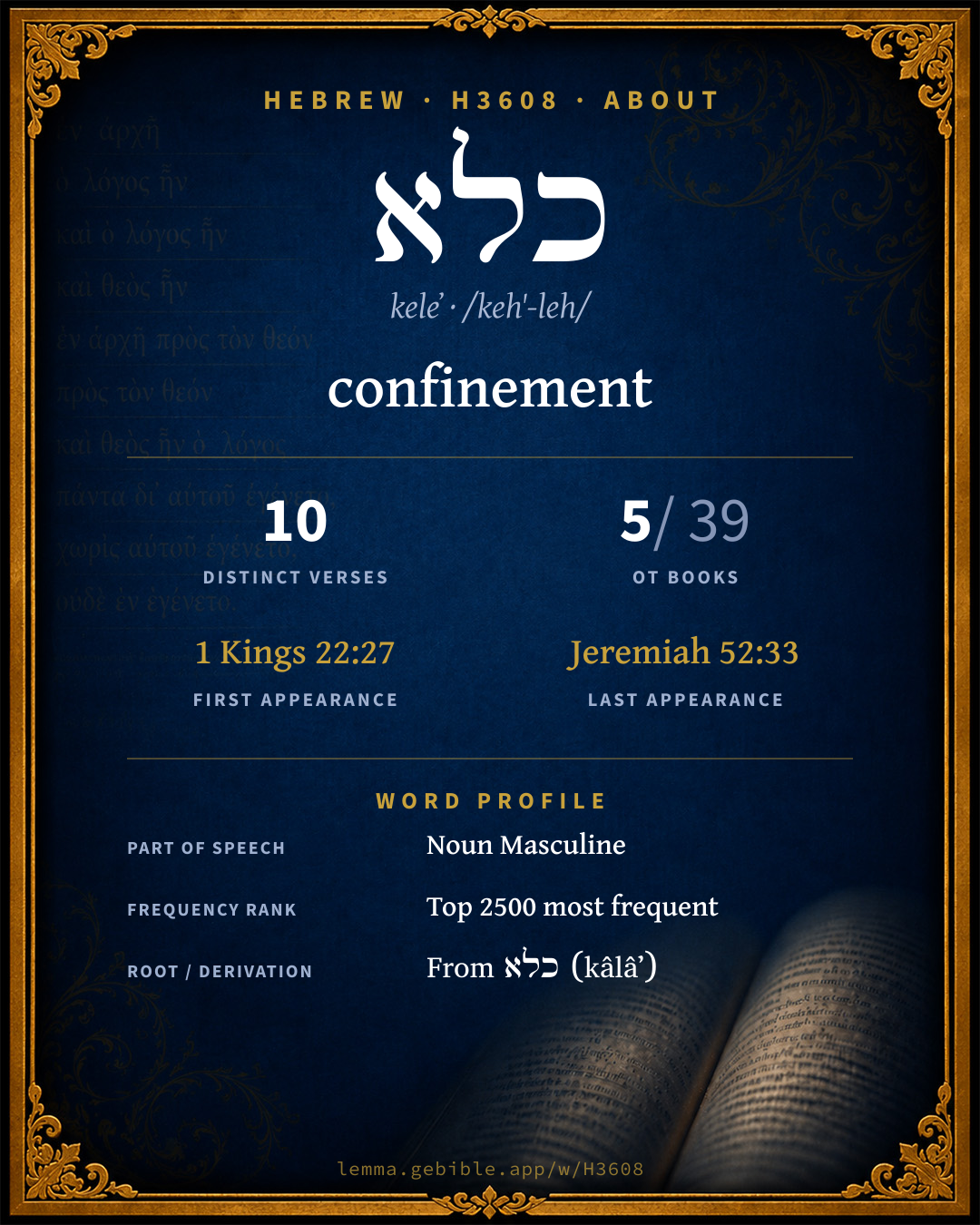
כֶּ֫לֶא
confinement
Full lexicon entry — Brown-Driver-Briggs (BDB)
From Brown-Driver-Briggs (BDB)
Where this word appears
See every Absolute-state word in the Hebrew Bible →
Grammar key — what these labels mean
Part of speech
- Noun
- A naming word — a person, place, thing, or idea.
Noun type
- Common
- A common noun — a general class of person, place, or thing (“king,” “city,” “water”), not a specific name.
State
- Absolute
- The independent form of a noun, not bound to a following word.
- Construct
- A noun bound to a following noun in a possessive / “of” relationship (the construct chain).
Gender
- Masculine
- Grammatically masculine.
Number
- Singular
- One.
- Plural
- More than one (in Hebrew, generally three or more).
8 distinct verses where H3608 appears in the Absolute state, across 5 books. Filtered view — show all forms. Click any verse to open its interlinear word-by-word view. Verse text shown in the World English Bible for context — . Each verse’s Hebrew form is shown with its reference; the English is not keyword-highlighted, since the data carries no word-level English alignment. Use “Compare translations” on any verse to read it across multiple English versions. This concordance covers the Hebrew Bible; Septuagint (Greek Old Testament) occurrences are not indexed here.
1 Kings 1 verse
2 Kings 2 verses
- 2 Kings 17:4 כֶּֽלֶא n c ms The king of Assyria found conspiracy in Hoshea; for he had sent messengers to So king of Egypt, and offered no tribute to the king of Assyria, as he had done year by year: therefore the king of Assyria shut him up, and bound him in prison.
- 2 Kings 25:27 כֶּֽלֶא n c ms It happened in the seven and thirtieth year of the captivity of Jehoiachin king of Judah, in the twelfth month, on the seven and twentieth day of the month, that Evilmerodach king of Babylon, in the year that he began to reign, did lift up the head of Jehoiachin king of Judah out of prison;
2 Chronicles 1 verse
Isaiah 2 verses
- Isaiah 42:7 כֶּ֖לֶא n c ms to open the blind eyes, to bring out the prisoners from the dungeon, and those who sit in darkness out of the prison-house.
- Isaiah 42:22 כְלָאִ֖ים n c mp But this is a people robbed and plundered; they are all of them snared in holes, and they are hid in prison-houses: they are for a prey, and none delivers; for a spoil, and none says, Restore.
Jeremiah 2 verses
- Jeremiah 37:15 הַ/כֶּֽלֶא ptcl def.art + n c ms The princes were angry with Jeremiah, and struck him, and put him in prison in the house of Jonathan the scribe; for they had made that the prison.
- Jeremiah 37:18 הַ/כֶּֽלֶא ptcl def.art + n c ms Moreover Jeremiah said to king Zedekiah, Wherein have I sinned against you, or against your servants, or against this people, that you have put me in prison?
About this entry
At a glance — auto-summarized from this page’s data, not written by a person. Every figure links to its source below. This summary describes the numbers; it doesn’t interpret them.
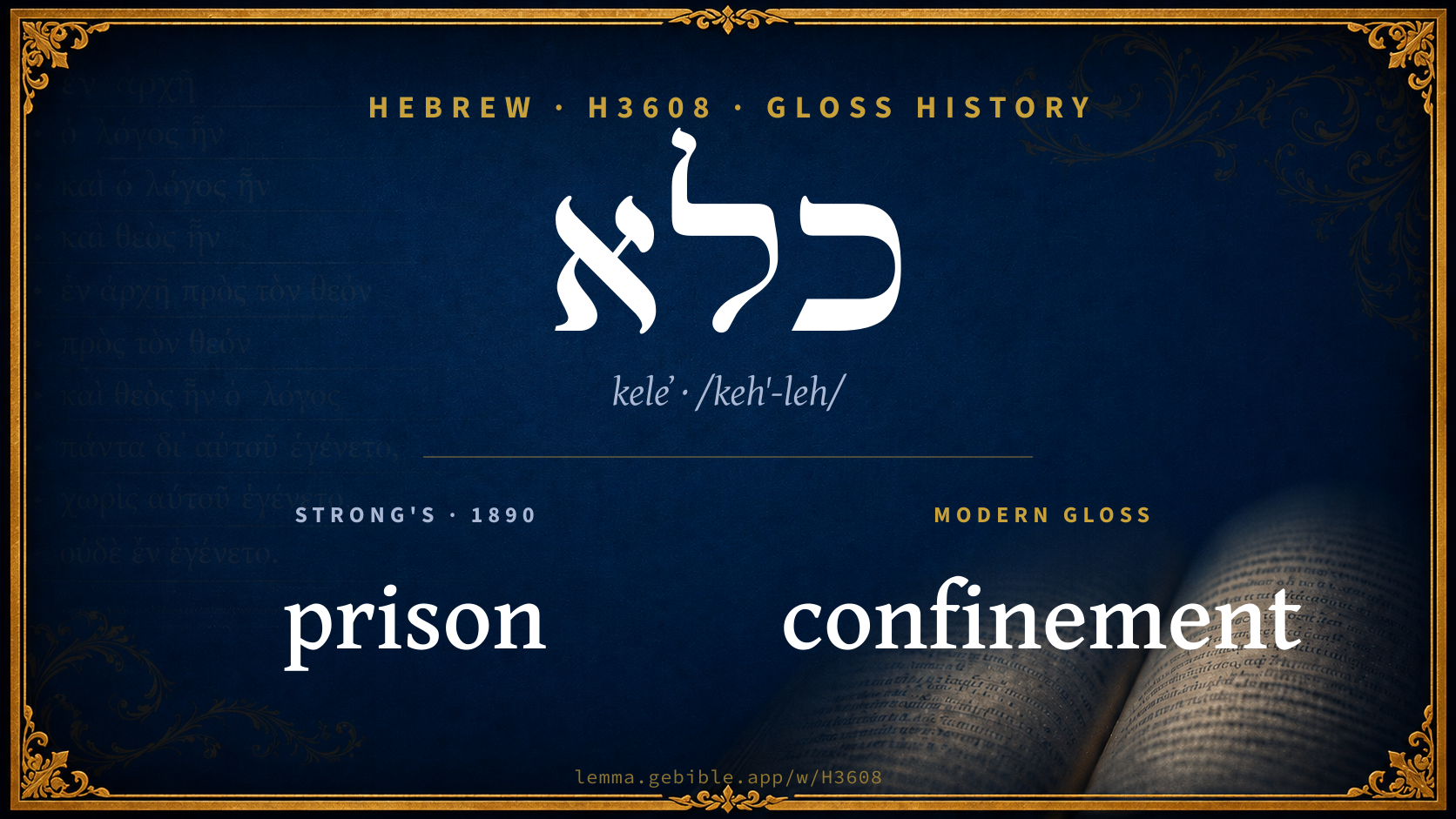
At its core, כלא (keleʼ) means “confinement.” The King James Version usually renders it “prison,” while modern versions prefer “imprisonment” (unfoldingWord Literal Text) — see the renderings breakdown. With 10 verses in 5 books, it is an uncommon word in the Hebrew Bible. Its uses concentrate in 2 Kings (30% of all occurrences). Scripture first uses it in 1 Kings 22:27. Dig into 10-verse concordance and the renderings breakdown below.
Gloss history
Strong's 1890 vs modern scholarship
About this word
Strong's H3608 catalogs a Hebrew word from the Hebrew Old Testament.
These counts are not copied from any lexicon or concordance. They are computed here, from the morphology-tagged Hebrew Old Testament. What Lemma adds →
- 10
- distinct verses
- The word appears in 10 distinct verses.
- 5 / 39
- OT books
- The word appears in 5 of 39 Old Testament books.
- #2,342
- by frequency
- Top 2500 most frequent Hebrew words (rank 2,342 of 8,640 Hebrew words by occurrence).
View all 10 occurrences in the concordance →
By section of the Old Testament
By traditional corpus
Conventional, traditional groupings — biblical authorship is debated, so this is a traditional corpus grouping, not an authorship claim. Each share is this word’s portion of its verses in that division of the Hebrew canon. Each figure is a share of the word’s 10 distinct verses.
- Prophets (Nevi'im) 9 verses · 90%
- Writings (Ketuvim) 1 verse · 10%
How translations render this word
Counts come from each version’s own published word-to-Strong’s tagging or interlinear alignment — an approximate guide to how each version renders this word, not a word-level alignment the data otherwise carries. Because each total is that version’s own tagged count, the per-version totals vary from one another and need not match the appearance or distinct-verse counts above. These counts may also differ from a printed concordance because Lemma counts each distinctly tagged rendering and does not collapse phrase taggings into a single head-word total. This is a fixed set of word-tagged versions (KJV, ASV, BSB, ULT) and does not change with the reading translation you choose elsewhere. Each version’s license is shown beside its name below (and on Sources).
- King James Version: Prison 5×
- American Standard Version: Prison 4×
- Berean Standard Bible: Prison 5×
- unfoldingWord Literal Text: Imprisonment 5×, Confinement 2×
King James Version Public Domain
Renders H3608 across 5 tagged occurrences — most commonly:
Not rendered by a distinct English word in 5 further occurrences.
American Standard Version Public Domain
Renders H3608 across 5 tagged occurrences — most commonly:
Plus 1 rendering that appears only once — usually multi-word phrases or single function words the recovered tagging swept in, not distinct renderings.
Berean Standard Bible Public Domain
Renders H3608 across 5 tagged occurrences — most commonly:
Not rendered by a distinct English word in 5 further occurrences.
unfoldingWord Literal Text CC BY-SA 4.0
Renders H3608 across 7 tagged occurrences — most commonly:
Senses in BDB
The 1 sense BDB distinguishes for this word, in lexicon order (not ranked by frequency or importance). The full entry — with sub-senses — is in the Lexicon Entry tab.
- imprisonment, confinement, restraint
Word origin
n.[m.] confinement, restraint, imprisonment;—abs. כ׳ 1 K 22:27 + 6 times; sf. כִּלְאוֹ 2 K 25:29; Je 52:33; pl. כְּלָאִים Is 42:22;—confinement, in combin. בֵּית (ה)כ׳ (cf. Assyrian bît kīli, prison, Dl HWB 328) 1 K 22:27 = 2 Ch 18:26, 2 K 17:4; Je 37:15, 18; Is 42:7; בָּֽתֵּי כְלָאִים v 22 (cf. בַּיִת 1 (ε) (2) p. 109 supr.; v. also כלוא infr.); בִּנְדֵי כִלְאוֹ 2 K 25:29 = Je 52:33 garments of imprisonment = prison-garb.
— Brown-Driver-Briggs (Oxford 1906, public domain), digitized via Sefaria, supplemented by the OpenScriptures HebrewLexicon (CC BY 4.0). See Sources.
Derived from כלא (kâlâʼ) (H3607) — to restrain.
Jastrow Dictionary
A second Hebrew/Aramaic lexicon for comparison, covering Aramaic and post-biblical (Talmudic, Targumic, Midrashic) usage that the biblical-Hebrew BDB does not. Matched by lemma rather than by Strong’s number, so a lemma may carry more than one Jastrow headword (shown separately below), and the entries cover usage well beyond the Bible.
כָּל
- ch., v. כּוֹל
כָּלָא
- , v. כלי
כַּלָּה
- 1. [crown, ornament, v. Is. XLIX, 18,] (sub. בעלת or בת, cmp. אִיתּוּ, חוֹרִים a. בֶּן חוֹרִים) bride; daughter-in-law. Yeb. I, 1 וכַלָּתוֹ and his (deceased) son’s wife. Sot. IX, 14 שתצא הב׳ וכ׳ that the bride on her wedding day may be taken around in procession, v. אַפִּרְיוֹן. Keth. 71ᵇ; Pes. 87ᵃ ככ׳ שנמצאת וכ׳ like a bride (daughter-in-law) found perfect in the house of her father-in-law. Ib. כ׳ בבית אביה a bride in her father’s house (not yet taken to her husband’s paternal house). Ex. R. s. 41 (play on ככלתו, Ex. XXXI, 18, cmp. כְּלַל Pa.) מה כ׳ זו מקושטת וכ׳ as the bride is adorned &c.; a. fr. [Tanḥ. Ki Thissa 18 כ׳ נופי, read with ed. Bub. ib. 9 קלי נינפי.]—Pl. כַּלּוֹת. Sot. l. c. עטרות כ׳ (Talm. ed. sing.) the bridal wreaths. Ib. 49ᵇ; a. fr e.g. Isaiah 49:18
- 2. general assembly, esp. Kallah, the assembly of Babylonian students in the months of Elul and Adar. Ber. 8ᵇ פרשייתא דכ׳ Ar. (Ms. Paris דכַלָּא, v. Rabb. D. S., Vol. I, p. 384; ed. דכולא שתא) the weekly Scripture lessons of the Kallah weeks (during which R. Bibi could not find time to peruse the section of each week). Ib. 6ᵃ, v. דּוּחֲקָא. Ib. 57ᵃ ראש לבני כ׳; B. Bath. 22ᵃ ריש כ׳ the president of the Kallah.—Pl. (of כַּלָּא) כַּלֵּי. Ḥull. 49ᵃ רישי כ׳.—מסכת כלה, מסכתא דכ׳ a (small) treatise of the Talmud named Kallah (from its first word). Sabb. 114ᵃ; Kidd. 49ᵇ; Taan. 10ᵇ; [oth. opin.: a subject which has been discussed in the general assembly].
כְּלֵי
- 1. to keep enclosed, to withhold, restrain. Targ. I Sam. VI, 10. Targ. Ps. XXI, 3. Targ. Is. XXXIII, 15 כָּלֵי (ed. Wil. כָּל) restrains his eyes. Targ. Prov. XI, 26 כָּאלֵא ed. Lag.; ib. XVII, 28 כָּאלֵי ed. Lag.—Part. pass. כְּלֵי. Targ. Jer. XXXII, 2; (Targ. Ps. LXXXVIII, 9 כָּלוּא, h. form).—Sabb. 57ᵇ כַּלְיָא פרוחי, v. בִּזְיוּנָא I; [Var. Ar. דידבי, reminiscence fr. Nidd. 17ᵃ, v. בָּאלֵי.]—כַּלְיָא עורב, v. preced.
- 2. to be finished, gone. Ber. 39ᵃ כַּלְיָא ברכה the benediction is finished &c., v. preced. B. Mets. 79ᵃ וקא כליא קרנא and the capital itself is used up (v. infra). Yoma 69ᵇ כ׳ עלמא the world would come to an end; a. fr.
- 3. (cmp. שלם) [to be entirely with,] to trust. Targ. Ps. XXXI, 7. Ib. 25 כַּלְיָין (ed. Lag. a. oth. כיילין, corr. acc.). Ib. XXXII, 10; a. e.; v. תְּכַל. [Differ. fr. b. h. כָּלָה to be consumed by anxiety, to long, die for.]
- to lock up, restrain. Targ. II Chr. VII, 13.—Kidd. 81ᵇ מַכְלֵי להו מִכּוּלָּהּ וכ׳ Ar. a. Tosaf. (ed. מכלליה, read: מכלי ליה) kept the cattle off from the entire field (in which he walked); (ed.: kept himself aloof from the entire pasture ground). B. Bath. 5ᵃ, v. next w.
- to destroy, use up, diminish. B. Mets. l. c. מְכַלִּינָן קרנא (when hiring the usufruct of an object,) we are permitted to use up the stock itself, e.g. if you hired an ass for travelling, and it died on the road, you may sell its carcass, and hire another ass for the money; ib. לא מכ׳ קרנא we must not use up the stock, i.e. you may buy another ass for the carcass, but not hire one. Ib. Ms. M. לכַלּוּיֵי קרנא לא חיישינן (v. Rabb. D. S. a. l. note 8) and as for using up the stock, we need not take that into consideration. B. Kam. 3ᵃ דמְכַלְּיָא קרנא when the obnoxious subject destroys the object itself (not only the fruits).
- to be closed up, withheld; to refrain. Targ. O. Gen. VIII, 2. Targ. Prov. III, 27; a. fr.
כְּלֵי ²
- , Af. אַכְלֵי (v. preced.) [to assemble, call together (cmp. אוֹכְלוֹסָא),]
- 1. to call, give a signal. Targ. Jer. I, 15. Targ. Zeph. II, 15; a. e.
- 2. (of the lion) to roar; to shout, thunder &c. Targ. Ps. CIV, 21, v. אַכְלִי. Ib. XXIX, 3. Ib. LXXIV, 4; a. e.—B. Bath. 5ᵃ עיזא בעלמא אַכְלוּיֵי מַכְלִינָן בה v. Ar. s. v. כל; (incorr. in eds. לאו לאכלויי בעיא) as to a goat, we need only shout at her (to drive her off). Ib. ולאו גברא בעי לאכלויי Rashi (ed. דמיכלי, read דמַכְלֵי) and need you not a man to shout at her?; [oth. opin. we need only keep her off, v. preced.]
לֹא
- v. לַאי) not, no. Ber. I, 1 לא קרינו וכ׳ we have omitted to recite &c. Ib. III, 4 לא … ולא וכ׳ neither before nor after. Nidd. 5ᵃ לא אין להן וכ׳, no; it means &c., v. לַאו; a. v. fr.—וְלֹא indeed not? Ḥull. 4ᵇ ולא והכתיב וכ׳ indeed not (is it so that the verb הֵסִית never refers to persuasion by speech)? Do we not read &c.?; a. v. fr.—(מִצְוַת) לֹא תַעֲשֶׂה a prohibitory law, opp. עֲשֵׂה, a positive command; v. לַאו. Kidd. I, 7. Macc. 14ᵇ bot.; a. v. fr.—בְּלֹא without. Ber. 35ᵃ bot. ב׳ ברכה without pronouncing a benediction; a. v. fr.—והוא שלא, v. הוּא.
לָא I
- Targ. Gen. II, 5; a. v. fr.—Pes. 10ᵇ מקמיה … אין בתר … לא before the time when it is forbidden, yes (he must search after leavened bread); after the time, no (he must not search). Ib. לא שנא there is no difference; a. v. fr.
לָא II
- (preced. wds.) particle, mote. Yoma 20ᵇ, v. חִרְגָּא. Midr. Till. to Ps. LXVIII, 3 כלא חשיבי they are like a mote.
לָא III
- La, abbrev. of אִילָא, הִילָא; v. Fr. M’bo, p. 75ᵇ.
A Dictionary of the Targumim, the Talmud Babli and Yerushalmi, and the Midrashic Literature (Marcus Jastrow; London, Luzac, 1903) — Public Domain. Digitized via Sefaria. Digitized via Sefaria. Full attribution on Sources.
Forms in the corpus
The 6 distinct written forms H3608 takes in the Hebrew Bible, most frequent first — each parse links to that state’s occurrences in the concordance. Hebrew forms include their vowel points and cantillation, so a single lemma takes many written forms.
| Form | Parsing | Example | Uses |
|---|---|---|---|
| הַ/כֶּ֑לֶא | Noun, Common, Masculine, Singular, Absolute | 1 Kings 22:27 | 2 |
| הַ/כֶּֽלֶא | Noun, Common, Masculine, Singular, Absolute | Jeremiah 37:15 | 2 |
| כִלְא֑/וֹ | Noun, Common, Masculine, Singular, Construct | 2 Kings 25:29 | 2 |
| כֶּֽלֶא | Noun, Common, Masculine, Singular, Absolute | 2 Kings 17:4 | 2 |
| כְלָאִ֖ים | Noun, Common, Masculine, Plural, Absolute | Isaiah 42:22 | 1 |
| כֶּ֖לֶא | Noun, Common, Masculine, Singular, Absolute | Isaiah 42:7 | 1 |
Same root — word family
Other BDB entries built from the same root as H3608, grouped by Strong’s listed origin. These share a root / origin per the lexicon — not necessarily a shared meaning. Each links to that word’s own entry.
Derives from
Shares the same root
Derived from this word
Proper names from this root
People and places named from this root — a name, not an additional meaning of the word.
Compare all same-root words → Showing 4 of 6 — not the complete family. 1 of the same-root words is a proper name (a person or place). They share a root, not necessarily a meaning.
Septuagint verse parallels
This word appears in 9 verses that also exist in the Greek Old Testament (Septuagint), out of the 10 Hebrew verses it occurs in. You can read those verses in Greek by switching the Old Testament edition to the Septuagint.
Read these verses in the Septuagint
This is a verse-level parallel only — the same verses exist in both the Hebrew and Greek Old Testaments. No word-level Hebrew↔Greek correspondence is claimed: the data carries no such alignment, so no Greek word is shown as this Hebrew word’s translation. Coverage is not total — the Septuagint omits the deuterocanon and renumbers the Psalms, so some Hebrew verses have no direct Greek parallel.