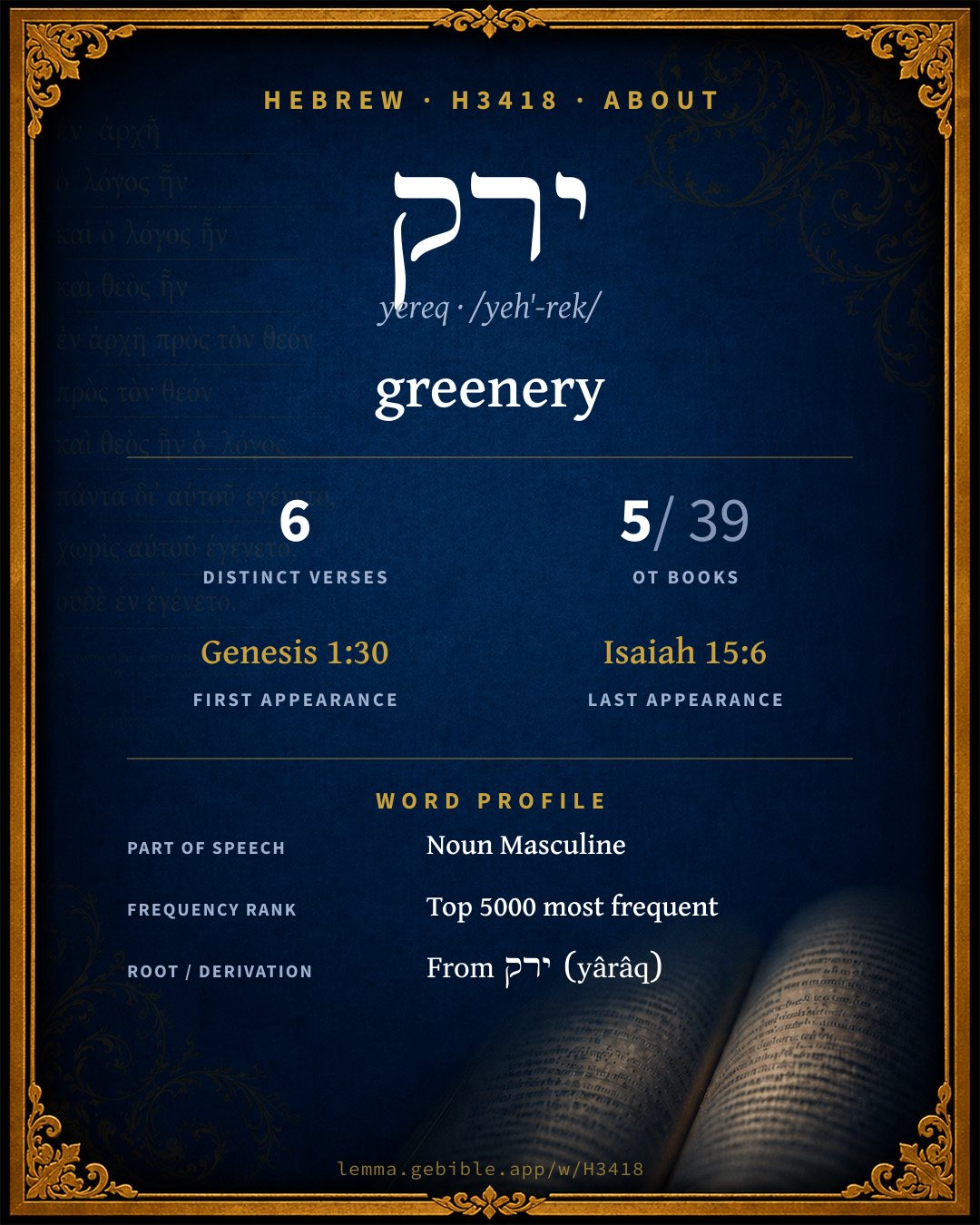
יֶ֫רֶק
greenery
Full lexicon entry — Brown-Driver-Briggs (BDB)
From Brown-Driver-Briggs (BDB)
Where this word appears
Grammar key — what these labels mean
Part of speech
- Noun
- A naming word — a person, place, thing, or idea.
Noun type
- Common
- A common noun — a general class of person, place, or thing (“king,” “city,” “water”), not a specific name.
State
- Absolute
- The independent form of a noun, not bound to a following word.
- Construct
- A noun bound to a following noun in a possessive / “of” relationship (the construct chain).
Gender
- Masculine
- Grammatically masculine.
Number
- Singular
- One.
Every verse where H3418 appears in the Book of Genesis — 2 distinct verses. Click any verse to open its interlinear word-by-word view. Verse text shown in the World English Bible for context — . Each verse’s Hebrew form is shown with its reference; the English is not keyword-highlighted, since the data carries no word-level English alignment. Use “Compare translations” on any verse to read it across multiple English versions. This concordance covers the Hebrew Bible; Septuagint (Greek Old Testament) occurrences are not indexed here.
Genesis
- Genesis 1:30 יֶ֥רֶק n c ms To every animal of the earth, and to every bird of the sky, and to everything that creeps on the earth, in which there is life, I have given every green herb for food." And it was so.
- Genesis 9:3 כְּ/יֶ֣רֶק prep + n c ms Every moving thing that lives will be food for you. As the green herb, I have given everything to you.
About this entry
At a glance — auto-summarized from this page’s data, not written by a person. Every figure links to its source below. This summary describes the numbers; it doesn’t interpret them.
ירק — transliterated yereq — is a Hebrew noun carrying the sense “greenery.” Debuting at Genesis 1:30, it then recurs through the corpus. It appears 6 verses across 5 books of the Hebrew Bible, among its uncommon vocabulary. More than a third of its appearances fall in Genesis. Related forms include ירק, ירוק and ירק. See the sense tree, 6-verse concordance, and the renderings breakdown below.
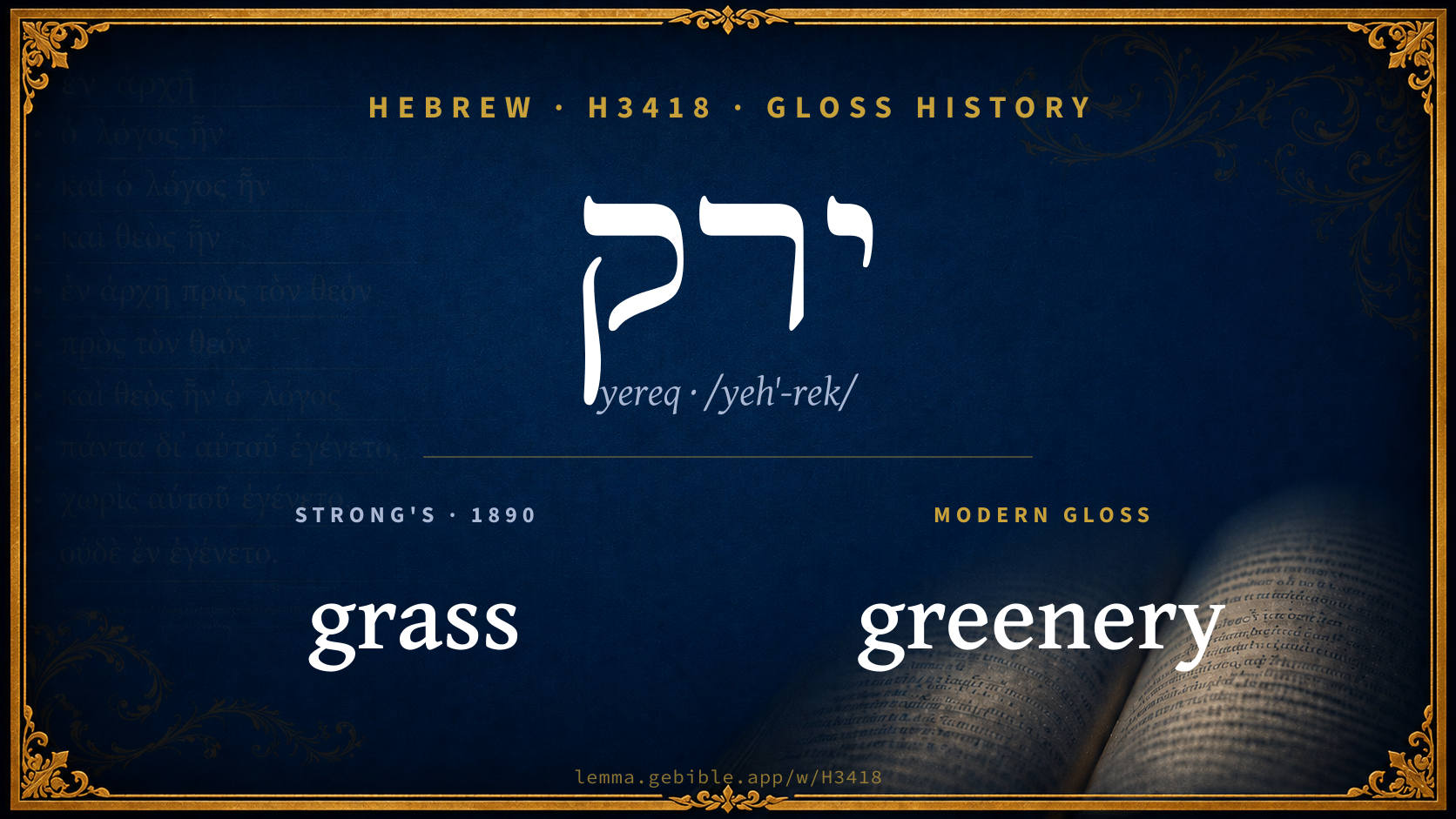
Gloss history
Strong's 1890 vs modern scholarship
About this word
Strong's H3418 catalogs a Hebrew word from the Hebrew Old Testament.
These counts are not copied from any lexicon or concordance. They are computed here, from the morphology-tagged Hebrew Old Testament. What Lemma adds →
- 6
- distinct verses
- The word appears in 6 distinct verses.
- 5 / 39
- OT books
- The word appears in 5 of 39 Old Testament books.
- #3,040
- by frequency
- Top 5000 most frequent Hebrew words (rank 3,040 of 8,640 Hebrew words by occurrence).
View all 6 occurrences in the concordance →
By section of the Old Testament
By traditional corpus
Conventional, traditional groupings — biblical authorship is debated, so this is a traditional corpus grouping, not an authorship claim. Each share is this word’s portion of its verses in that division of the Hebrew canon. Each figure is a share of the word’s 6 distinct verses.
- Torah (Pentateuch) 4 verses · 67%
- Prophets (Nevi'im) 1 verse · 17%
- Writings (Ketuvim) 1 verse · 17%
How translations render this word
Counts come from each version’s own published word-to-Strong’s tagging or interlinear alignment — an approximate guide to how each version renders this word, not a word-level alignment the data otherwise carries. Because each total is that version’s own tagged count, the per-version totals vary from one another and need not match the appearance or distinct-verse counts above. These counts may also differ from a printed concordance because Lemma counts each distinctly tagged rendering and does not collapse phrase taggings into a single head-word total. This is a fixed set of word-tagged versions (KJV, ASV, BSB, ULT) and does not change with the reading translation you choose elsewhere. Each version’s license is shown beside its name below (and on Sources).
- King James Version: Any green thing 1×, Grass 1×, Green 1×
- American Standard Version: Any green thing 1×, Grass 1×, Green 1×
- Berean Standard Bible: Green 2×
- unfoldingWord Literal Text: Green 2×, Greenery 2×
King James Version Public Domain
Renders H3418 across 6 tagged occurrences — most commonly:
American Standard Version Public Domain
Renders H3418 across 6 tagged occurrences — most commonly:
Berean Standard Bible Public Domain
Renders H3418 across 6 tagged occurrences — most commonly:
Plus 4 renderings that appear only once — usually multi-word phrases or single function words the recovered tagging swept in, not distinct renderings.
unfoldingWord Literal Text CC BY-SA 4.0
Renders H3418 across 8 tagged occurrences — most commonly:
Plus 4 renderings that appear only once — usually multi-word phrases or single function words the recovered tagging swept in, not distinct renderings.
Senses in BDB
The 1 sense BDB distinguishes for this word, in lexicon order (not ranked by frequency or importance). The full entry — with sub-senses — is in the Lexicon Entry tab.
- green, greenness, green plants, greenery
Word origin
n.m. Is 15:6 green, greenness (on ܝܰܪܩܳܐ in gardens, v. NöZMG 1876, 777 Löwp. 236 f.)—abs. Ex 10:15 Is 15:6; cstr. Gn 1:30 + 3 times;—יֶרֶק עֵשֶׂב Gn 1:30; 9:3 (both P); יֶרֶק דֶּשֶׁא ψ 37:2; יֶרֶק הַשָּׂדֶה Nu 22:4 (E) = green thing, grass; alone Ex 10:15 (J) green thing, incl. עֵץ and עֵשֶׂב, Is 15:6.
— Brown-Driver-Briggs (Oxford 1906, public domain), digitized via Sefaria, supplemented by the OpenScriptures HebrewLexicon (CC BY 4.0). See Sources.
Derived from ירק (yârâq) (H3417) — to spit.
Jastrow Dictionary
A second Hebrew/Aramaic lexicon for comparison, covering Aramaic and post-biblical (Talmudic, Targumic, Midrashic) usage that the biblical-Hebrew BDB does not. Matched by lemma rather than by Strong’s number, so a lemma may carry more than one Jastrow headword (shown separately below), and the entries cover usage well beyond the Bible.
יָרַק I
- (b. h.) to spit, v. רָקַק, רוּק.
יְרַק
- Targ. Y. Deut. XXV, 9 תִּירוֹק.—Yeb. 39ᵇ ויַרְקַת וכ׳ and she spat before him &c. (Y. ib. XII, 13ᵃ top ורָקַת).—V. רְקַק, רוּק.
יָרַק II
- (b. h.) to be light-colored, pale, green, yellow.
- 1. to become green, pallid, pale. Sot. III, 4 פניה מוֹרִיקוֹת her face grew pale (sickly); Sifré Num. 8; Tosef. Sot. III, 3; a. fr.
- 2. to make pale, cause to fade. Ber. 44ᵇ כל ירק חי מוֹרִיק vegetable eaten raw makes pale. Gen. R. s. 13 (ref. to ארקא, Jer. X, 11) כנגד … שהיא מוֹרֶקֶת וכ׳ the earth is called arka, corresponding to the season of Tebeth which causes her fruits to fade. e.g. Jeremiah 10:11
- 3. to make shine (like gold, bronze &c.; cmp. ירקרק Ps. LXVIII, 14). Ib. s. 43; Yalk. Gen. 73 (ref. to וירק, Gen. XIV, 14) בכלי זיין הוֹרִיקָן he made them glisten with armor; באבנים … ה׳ with jewels; בפרשת שוטרים הוריקן he made them bright (courageous) by reading the section (Deut. XX, 1—9); Ned. 32ᵃ הוריקן בזהב; הוריקן בתורה (Var. הֵרִיקָן מן התורה, v. רִיק).—ה׳ פנים כנגד (cmp. כִּרְכֵּם) to turn a brazen face against, to defy, oppose. Gen. R. l. c.; Yalk. l. c. הן הוֹרִיקוּ פ׳ וכ׳ they opposed Abraham. Ib. אברהם ה׳ פ׳ וכ׳ Abraham defied them. e.g. Psalms 68:14
יְרַק ²
- , Af. אוֹרִיק same, to become pale &c. Targ. Y. Num. XXXI, 18 אפהא מוֹרִיקַן her face grew pale. Targ. Ps. CXIII, 9 מוֹרִיקָא looking pale (with envy; Ms. מוֹדִיקָא, v. דּוּק).
יֶרֶק
- preced. wds.) green, herb. Peah III, 4, v. מַלְבֵּן. Maasr. IV, 5, v. זֵיר. Ib. יַרְקָהּ פטור its herb (foliage) is exempt from tithes. Ber. 36ᵃ מין י׳ הוא it is a species of herb, opp. אילן; a. fr.—Pl. יְרָקוֹת. Ib. VI, 1. Pes. II, 6 ואלו י׳ וכ׳ and these are the (bitter) herbs which may be used as maror. R. Hash. I, 1 ר"ה … לנטיעה ולי׳ a new year as regards … the planting (of trees) and (the tithes from) herbs; a. fr.—יַרְקוֹת חמור (Var. יְרִיקַת, יְרוֹקֶת) ass-herbs, the large-leaved cucumis agrestis (v. Löw Pfl. p. 333). Ohol. VIII, 1 (cmp. Tosef. ib. XIII, 5).—2) name of a species of green-fish. Y. B. Mets. II, beg. 8ᵇ, opp. to לכיס (v. יָרוֹקָא).
קִדָּה
- (b. h.)
- 1. cassia, bark of the tree called cassia (v. Sm. Ant. s. v.) Ker. 5ᵃ; Y. Shek. VI, beg. 49ᶜ.
- 2. ק׳ לבנה white Ḳiddah, a tree. Kil. I, 8; Erub. 34ᵇ
- 3. name of a seasoning plant. Ib. הקנים והק׳ וכ׳ (Var. והקִידִּין pl.) seasoning reeds, Ḳiddah, and Urbanin belong to the vegetable class (ירק). Ib. ק׳ לחוד ק׳ לבנה לחוד Ḳiddah and white Ḳ. are different species.
A Dictionary of the Targumim, the Talmud Babli and Yerushalmi, and the Midrashic Literature (Marcus Jastrow; London, Luzac, 1903) — Public Domain. Digitized via Sefaria. Digitized via Sefaria. Full attribution on Sources.
Forms in the corpus
The 6 distinct written forms H3418 takes in the Hebrew Bible, most frequent first — each parse links to that state’s occurrences in the concordance. Hebrew forms include their vowel points and cantillation, so a single lemma takes many written forms.
| Form | Parsing | Example | Uses |
|---|---|---|---|
| וּ/כְ/יֶ֥רֶק | Noun, Common, Masculine, Singular, Construct | Psalms 37:2 | 1 |
| יֶ֖רֶק | Noun, Common, Masculine, Singular, Absolute | Isaiah 15:6 | 1 |
| יֶ֣רֶק | Noun, Common, Masculine, Singular, Construct | Numbers 22:4 | 1 |
| יֶ֥רֶק | Noun, Common, Masculine, Singular, Absolute | Genesis 1:30 | 1 |
| יֶ֧רֶק | Noun, Common, Masculine, Singular, Absolute | Exodus 10:15 | 1 |
| כְּ/יֶ֣רֶק | Noun, Common, Masculine, Singular, Absolute | Genesis 9:3 | 1 |
Same root — word family
Other BDB entries built from the same root as H3418, grouped by Strong’s listed origin. These share a root / origin per the lexicon — not necessarily a shared meaning. Each links to that word’s own entry.
Derives from
Shares the same root
Derived from this word
Compare all same-root words → Showing 4 of 6 — not the complete family. They share a root, not necessarily a meaning.
Septuagint verse parallels
This word appears in 6 verses that also exist in the Greek Old Testament (Septuagint), out of the 6 Hebrew verses it occurs in. You can read those verses in Greek by switching the Old Testament edition to the Septuagint.
Read these verses in the Septuagint
This is a verse-level parallel only — the same verses exist in both the Hebrew and Greek Old Testaments. No word-level Hebrew↔Greek correspondence is claimed: the data carries no such alignment, so no Greek word is shown as this Hebrew word’s translation. Coverage is not total — the Septuagint omits the deuterocanon and renumbers the Psalms, so some Hebrew verses have no direct Greek parallel.