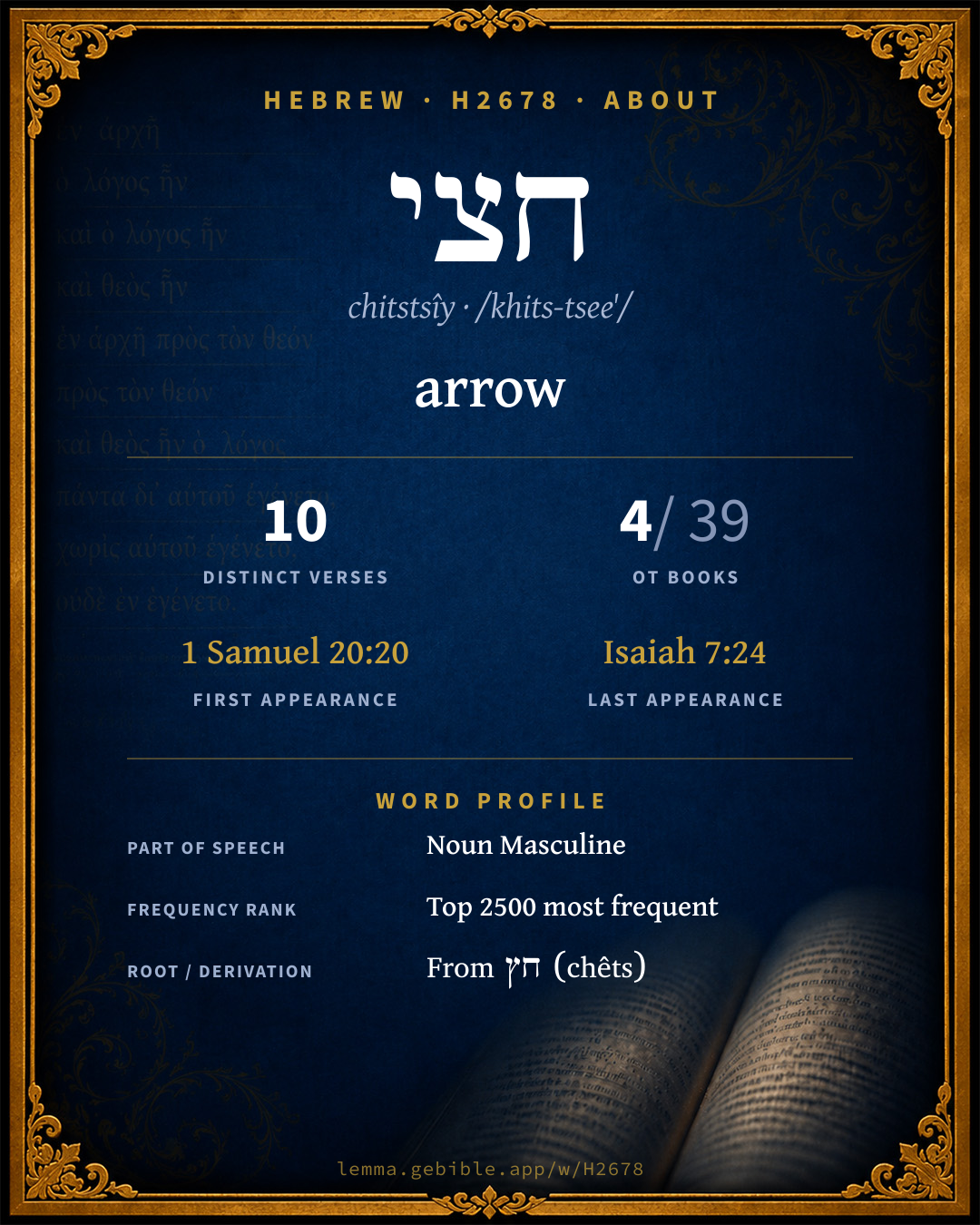
חֵ֫צִי
arrow
Full lexicon entry — Brown-Driver-Briggs (BDB)
From Brown-Driver-Briggs (BDB)
Where this word appears
Grammar key — what these labels mean
Noun type
- Common
- A common noun — a general class of person, place, or thing (“king,” “city,” “water”), not a specific name.
State
- Absolute
- The independent form of a noun, not bound to a following word.
Gender
- Masculine
- Grammatically masculine.
Number
- Plural
- More than one (in Hebrew, generally three or more).
- Singular
- One.
Every verse where H2678 appears in the Book of 2 Kings — 2 distinct verses. Click any verse to open its interlinear word-by-word view. Verse text shown in the World English Bible for context — . Each verse’s Hebrew form is shown with its reference; the English is not keyword-highlighted, since the data carries no word-level English alignment. Use “Compare translations” on any verse to read it across multiple English versions. This concordance covers the Hebrew Bible; Septuagint (Greek Old Testament) occurrences are not indexed here.
2 Kings
- 2 Kings 9:24 הַ/חֵ֖צִי ptcl def.art + n c ms Jehu drew his bow with his full strength, and struck Joram between his arms; and the arrow went out at his heart, and he sunk down in his chariot.
- 2 Kings 13:18 הַ/חִצִּ֖ים ptcl def.art + n c mp He said, Take the arrows; and he took them. He said to the king of Israel, Smite on the ground; and he struck thrice, and stayed.
About this entry
At a glance — auto-summarized from this page’s data, not written by a person. Every figure links to its source below. This summary describes the numbers; it doesn’t interpret them.
At its core, חצי (chitstsîy) means “arrow.” The word gravitates to 1 Samuel (60%), then 2 Kings and 2 Chronicles. It appears 10 verses across 4 books of the Hebrew Bible, among its uncommon vocabulary. First canonically at 1 Samuel 20:20, it enters the text early. Each statement above links to its evidence; the full detail follows below.
Gloss history
Strong's 1890 vs modern scholarship
About this word
Strong's H2678 catalogs a Hebrew word from the Hebrew Old Testament.
These counts are not copied from any lexicon or concordance. They are computed here, from the morphology-tagged Hebrew Old Testament. What Lemma adds →
- 10
- distinct verses
- The word appears in 10 distinct verses.
- 4 / 39
- OT books
- The word appears in 4 of 39 Old Testament books.
- #1,910
- by frequency
- Top 2500 most frequent Hebrew words (rank 1,910 of 8,640 Hebrew words by occurrence).
View all 10 occurrences in the concordance →
Most concentrated in
- 1 Samuel 6 verses 60%
- 2 Kings 2 verses 20%
- 2 Chronicles 1 verse 10%
By section of the Old Testament
By traditional corpus
Conventional, traditional groupings — biblical authorship is debated, so this is a traditional corpus grouping, not an authorship claim. Each share is this word’s portion of its verses in that division of the Hebrew canon. Each figure is a share of the word’s 10 distinct verses.
- Prophets (Nevi'im) 9 verses · 90%
- Writings (Ketuvim) 1 verse · 10%
How translations render this word
Counts come from each version’s own published word-to-Strong’s tagging or interlinear alignment — an approximate guide to how each version renders this word, not a word-level alignment the data otherwise carries. Because each total is that version’s own tagged count, the per-version totals vary from one another and need not match the appearance or distinct-verse counts above. These counts may also differ from a printed concordance because Lemma counts each distinctly tagged rendering and does not collapse phrase taggings into a single head-word total. This is a fixed set of word-tagged versions (KJV, ASV, BSB, ULT) and does not change with the reading translation you choose elsewhere. Each version’s license is shown beside its name below (and on Sources).
BDB lists this Strong’s number as 2 distinct words (homographs). Each count above pools all of them and is not split by sense — see the Senses section below. A low-frequency rendering may belong to a different one of those words, not the primary meaning.
- King James Version†: Arrow 3×
- American Standard Version†: Arrow 3×
- Berean Standard Bible†: Arrow 4×
- unfoldingWord Literal Text†: Arrows 8×, Arrow 4×
King James Version Public Domain
Renders H2678 across 4† tagged occurrences — most commonly:
Plus 1 rendering that appears only once — usually multi-word phrases or single function words the recovered tagging swept in, not distinct renderings. Not rendered by a distinct English word in 1 further occurrence.
American Standard Version Public Domain
Renders H2678 across 4† tagged occurrences — most commonly:
Plus 1 rendering that appears only once — usually multi-word phrases or single function words the recovered tagging swept in, not distinct renderings.
Berean Standard Bible Public Domain
Renders H2678 across 4† tagged occurrences — most commonly:
Not rendered by a distinct English word in 1 further occurrence.
unfoldingWord Literal Text CC BY-SA 4.0
Renders H2678 across 12† tagged occurrences — most commonly:
Senses in the full BDB
What do BDB’s symbols mean?
BDB uses these scholarly abbreviations:
| Symbol | Meaning |
|---|---|
| 𝔊 | the Septuagint (the ancient Greek translation, LXX) |
| 𝔙 | the Vulgate (the Latin translation) |
| 𝔖 | the Syriac version (the Peshitta) |
| 𝔗 | the Targum (the Aramaic translation) |
| ψ | the Psalms |
| √ | root (the underlying root or stem) |
| ‖ | parallel passage (a synonymous or contrasted parallel) |
| † | the dagger: every passage where the word occurs is cited |
The 2 senses and sub-senses the full Brown-Driver-Briggs lexicon distinguishes for this word, in lexicon order (not ranked by frequency), with BDB’s own verbatim wording and sub-sense lettering. Shown in Hebrew script with BDB’s own scholarly abbreviations. The condensed entry is in the Lexicon Entry tab. See also the Forms in the corpus table below.
- 1. lit., shot from bow by hand 1 S 20:20, 21(×2), 22 (𝔊 We sg., i.e. הַחֵצִי, in v 21, 22, see also Dr) v 36, 38 Qr 2 K 19:32 = Is 37:33, Is 5:28; 7:24; Je 50:9, 14; 51:11; Ez 39:3, 9; 1 Ch 12:2; shot from engine of war 2 Ch 26:15; used in divination Ez 21:26 cf. 2 K 13:15(×2), 17(×2), 18; בַּעֲלֵי חִצִּים = archers Gn 49:23. e.g. 1 Samuel 20:20
- 2. fig. of Israel’s weapons Nu 24:8, of the (Messianic) king ψ 45:6, of Yahweh’s judgments Dt 32:23, 42; Jb 6:4 (cf. חִצִּי = my wound 34:6), ψ 7:14; 38:3; 58:3 (but on text cf. Checrit. n.) 64:8; 120:4 (? cf. Che); further Pr 7:23; La 3:12; Ez 5:16; in theoph. ψ 18:15 = 2 S 22:15, cf. Hb 3:11 Zc 9:14 ψ 77:18; 144:6; of wicked men’s violence ψ 11:2 cf. 91:5, under fig. of lion’s teeth ψ 57:5; their words ψ 64:4 cf. Pr 25:18; Je 9:8; simile, of strength and efficiency derived from one’s children, ψ 127:4; of a deceiver’s words Pr 26:18; metaph. of servant of ח׳ בָּרוּר י׳ Is 49:2.—In 1 S 17:7 read עֵץ (for חֵץ) as Qr and ‖ 2 S 21:19 = the shaft; v. עֵץ; so Klo Dr e.g. Numbers 24:8
Senses from the full Brown-Driver-Briggs lexicon (Brown, Driver, Briggs; Oxford 1906 — public domain), digitized via Sefaria, supplemented by the OpenScriptures HebrewLexicon (CC BY 4.0). Full attribution on Sources.
Word origin
n.m. 1 S 20:20 arrow, mostly poet. and proph. (cf. חֵצִי supr. sub חצה)—abs. ח׳ ψ 91:5 + 9 times + 1 S 17:7 Kt (Qr עֵץ q.v.); cstr. id. 2 K 13:17(×2); sf. חִצִּי Jb 34:6, חִצּוֹ ψ 58:8 Zc 9:14, חִצָּם ψ 11:2; 64:4; Pl. חִצִּים Gn 49:23 + 17 times + 1 S 20:38 Qr (Kt חֵ֫צִי q.v.) + 2 S 22:15 (חִצָּיו ‖ ψ 18:15); cstr. חִצֵּי Jb 6:4 ψ 120:4 + Ez 5:16 (Co חִצַּי cf. 𝔊 𝔖 Hi); חִצַּי Dt 32:23, 42 (Ez 5:16 v. supr.), חִצֶּיךָ ψ 38:3 + 4 times חֲצָצֶיךָ 77:18; חִצָּיו Is 5:28 + 5 times;—
— Brown-Driver-Briggs (Oxford 1906, public domain), digitized via Sefaria, supplemented by the OpenScriptures HebrewLexicon (CC BY 4.0). See Sources.
Derived from חץ (chêts) (H2671) — arrow.
Jastrow Dictionary
A second Hebrew/Aramaic lexicon for comparison, covering Aramaic and post-biblical (Talmudic, Targumic, Midrashic) usage that the biblical-Hebrew BDB does not. Matched by lemma rather than by Strong’s number, so a lemma may carry more than one Jastrow headword (shown separately below), and the entries cover usage well beyond the Bible.
חצי
- v. חָצַץ)
- 1. to split, divide. B. Bath. 3ᵃ שרצו לַחֲצוֹת, v. מְחִיצָה.
- 2. to pick one’s teeth. Tosef. Bets. III, 18, v. חָצַץ I.
- to order a division, to assign half, divide. B. Kam. 34ᵃ פחת שפחתתו מיתה מַחֲצִין בחי Ms. M. a. Rashi (ed. שפחתו) half of the loss of value which death has caused, is collected from the living animal; Y. ib. I, end, 2ᶜ מחצין את הנזק the loss is divided.
חֲצֵי
- , to pick out (of birds, v. P. Sm. 1349); to pick one’s teeth. Targ. Prov. XXX, 17.—Y. Ḥall. IV, end, 60ᵇ מִיחֲצִי שיניי (not ניח׳) to pick my teeth with; Y. Dem. III, 23ᵇ bot. מיחצד, מחצדן (corr. acc.).
חֵצִי
- preced. wds.) half. B. Kam. IV, 9 חֲ׳ נזק half the damage. Gitt. IV, 5 מי שחֶצְיוֹ עבד וכ׳ he who is half a slave and half a freedman (having been emancipated by one of the partners); a. v. fr.—Pl. חֲצָיִים, חֲצָיִין, חֲצָאִים, חֲצָאִין. Sifra Vayikra, N’dab., ch. X, Par. 9 לא יביאנה ח׳ he must not offer it in parts. Ned. 83ᵃ אין נזירות לח׳ there is no nazaritism by halves, i.e. one cannot vow to be a nazarite by partial abstinence; ואין קרבן לח׳ nor is there a sacrifice for partial nazaritism. Y. Hor. I, 46ᵇ top אין הפסח לה׳ the Passover offering does not take place in divisions (of clean and unclean parties). Kerith. 5ᵃ מפטם לח׳ taking only a part of each ingredient; Y. Yoma IV, 41ᵈ bot. פיטמה ח׳; a. fr.
A Dictionary of the Targumim, the Talmud Babli and Yerushalmi, and the Midrashic Literature (Marcus Jastrow; London, Luzac, 1903) — Public Domain. Digitized via Sefaria. Digitized via Sefaria. Full attribution on Sources.
Forms in the corpus
The 9 distinct written forms H2678 takes in the Hebrew Bible, most frequent first — each parse links to that state’s occurrences in the concordance. Hebrew forms include their vowel points and cantillation, so a single lemma takes many written forms.
| Form | Parsing | Example | Uses |
|---|---|---|---|
| הַ/חִצִּ֖ים | Noun, Common, Masculine, Plural, Absolute | 1 Samuel 20:20 | 3 |
| הַ/חֵ֖צִי | Noun, Common, Masculine, Singular, Absolute | 1 Samuel 20:36 | 3 |
| הַ֣/חִצִּ֔ים | Noun, Common, Masculine, Plural, Absolute | 1 Samuel 20:36 | 2 |
| בַּ/חִצִּ֥ים | Noun, Common, Masculine, Plural, Absolute | Isaiah 7:24 | 1 |
| בַּֽ/חִצִּ֔ים | Noun, Common, Masculine, Plural, Absolute | 2 Chronicles 26:15 | 1 |
| ה/חצי | Noun, Common, Masculine, Singular, Absolute | 1 Samuel 20:38 | 1 |
| הַ/חִצִּ֑ים | Noun, Common, Masculine, Plural, Absolute | 1 Samuel 20:21 | 1 |
| הַ/חִצִּ֣ים | Noun, Common, Masculine, Plural, Absolute | 1 Samuel 20:21 | 1 |
| הַ/חֵ֔צִי | Noun, Common, Masculine, Singular, Absolute | 1 Samuel 20:37 | 1 |
Septuagint verse parallels
This word appears in 10 verses that also exist in the Greek Old Testament (Septuagint), out of the 10 Hebrew verses it occurs in. You can read those verses in Greek by switching the Old Testament edition to the Septuagint.
Read these verses in the Septuagint
This is a verse-level parallel only — the same verses exist in both the Hebrew and Greek Old Testaments. No word-level Hebrew↔Greek correspondence is claimed: the data carries no such alignment, so no Greek word is shown as this Hebrew word’s translation. Coverage is not total — the Septuagint omits the deuterocanon and renumbers the Psalms, so some Hebrew verses have no direct Greek parallel.