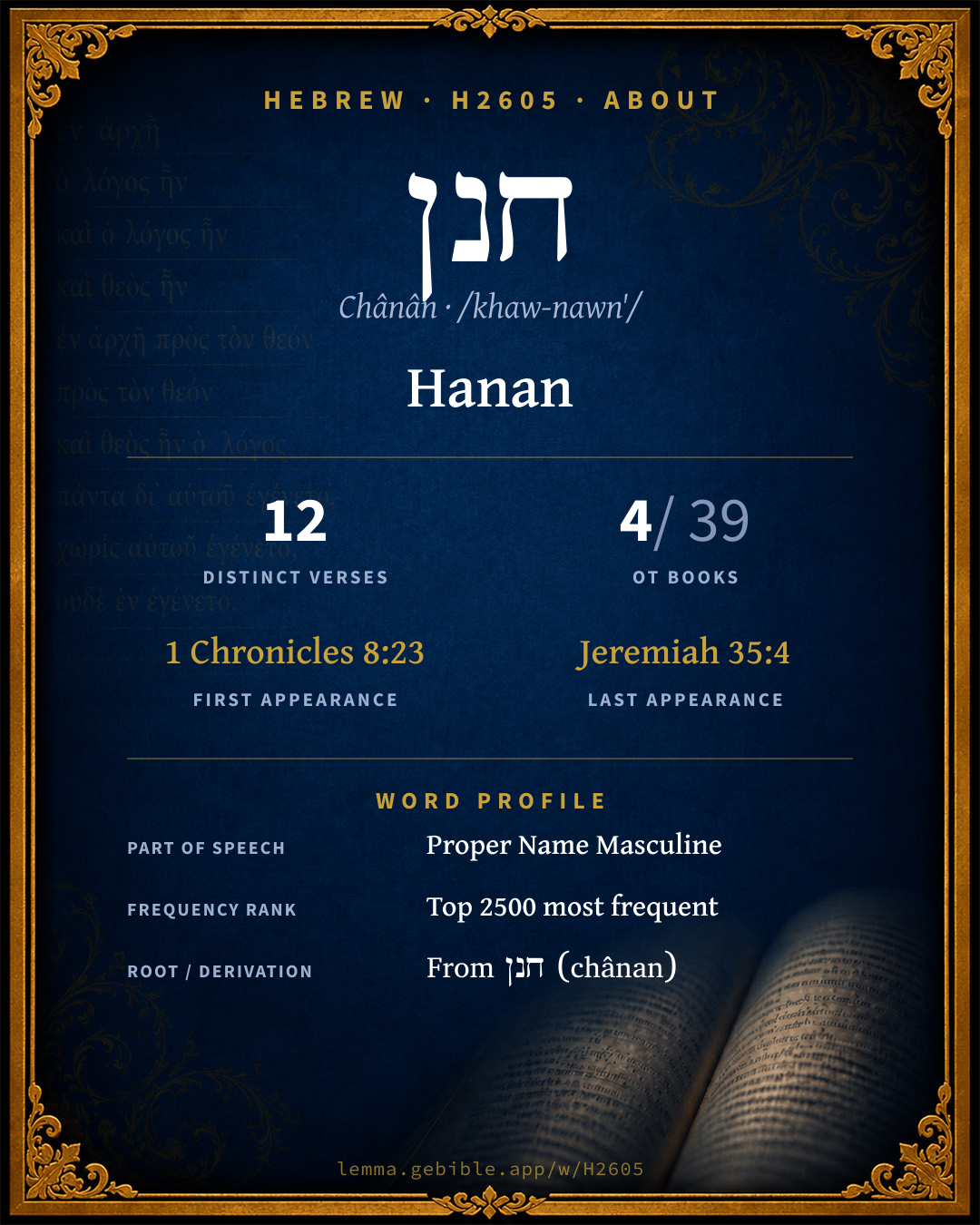
חָנָן
Hanan
BDB lists 10 entries for ‘Hanan’ fuller range ↓
Full lexicon entry — Brown-Driver-Briggs (BDB)
From Brown-Driver-Briggs (BDB)
Where this word appears
Grammar key — what these labels mean
Part of speech
- Noun
- A naming word — a person, place, thing, or idea.
Noun type
- Proper
- A name of a specific person, place, or people (e.g. Abraham, Zion, Israel).
Every verse where H2605 appears in the Book of Nehemiah — 6 distinct verses. Click any verse to open its interlinear word-by-word view. Verse text shown in the World English Bible for context — . Each verse’s Hebrew form is shown with its reference; the English is not keyword-highlighted, since the data carries no word-level English alignment. Use “Compare translations” on any verse to read it across multiple English versions. This concordance covers the Hebrew Bible; Septuagint (Greek Old Testament) occurrences are not indexed here.
Nehemiah
- Nehemiah 7:49 חָנָ֥ן n Proper the children of Hanan, the children of Giddel, the children of Gahar,
- Nehemiah 8:7 חָנָ֤ן n Proper Also Jeshua, and Bani, and Sherebiah, Jamin, Akkub, Shabbethai, Hodiah, Maaseiah, Kelita, Azariah, Jozabad, Hanan, Pelaiah, and the Levites, caused the people to understand the law: and the people [stood] in their place.
- Nehemiah 10:10 חָנָֽן n Proper and their brothers, Shebaniah, Hodiah, Kelita, Pelaiah, Hanan,
- Nehemiah 10:22 חָנָ֖ן n Proper Pelatiah, Hanan, Anaiah,
- Nehemiah 10:26 חָנָ֖ן n Proper and Ahiah, Hanan, Anan,
- Nehemiah 13:13 חָנָ֥ן n Proper I made treasurers over the treasuries, Shelemiah the priest, and Zadok the scribe, and of the Levites, Pedaiah: and next to them was Hanan the son of Zaccur, the son of Mattaniah; for they were counted faithful, and their business was to distribute to their brothers.
About this entry
At a glance — auto-summarized from this page’s data, not written by a person. Every figure links to its source below. This summary describes the numbers; it doesn’t interpret them.
“Hanan” is the headline sense of the Hebrew name חנן (Chânân). More than half of its appearances fall in Nehemiah. The Hebrew Bible uses it across 12 verses — uncommon. Its earliest occurrence is 1 Chronicles 8:23. See 12-verse concordance and the renderings breakdown below.
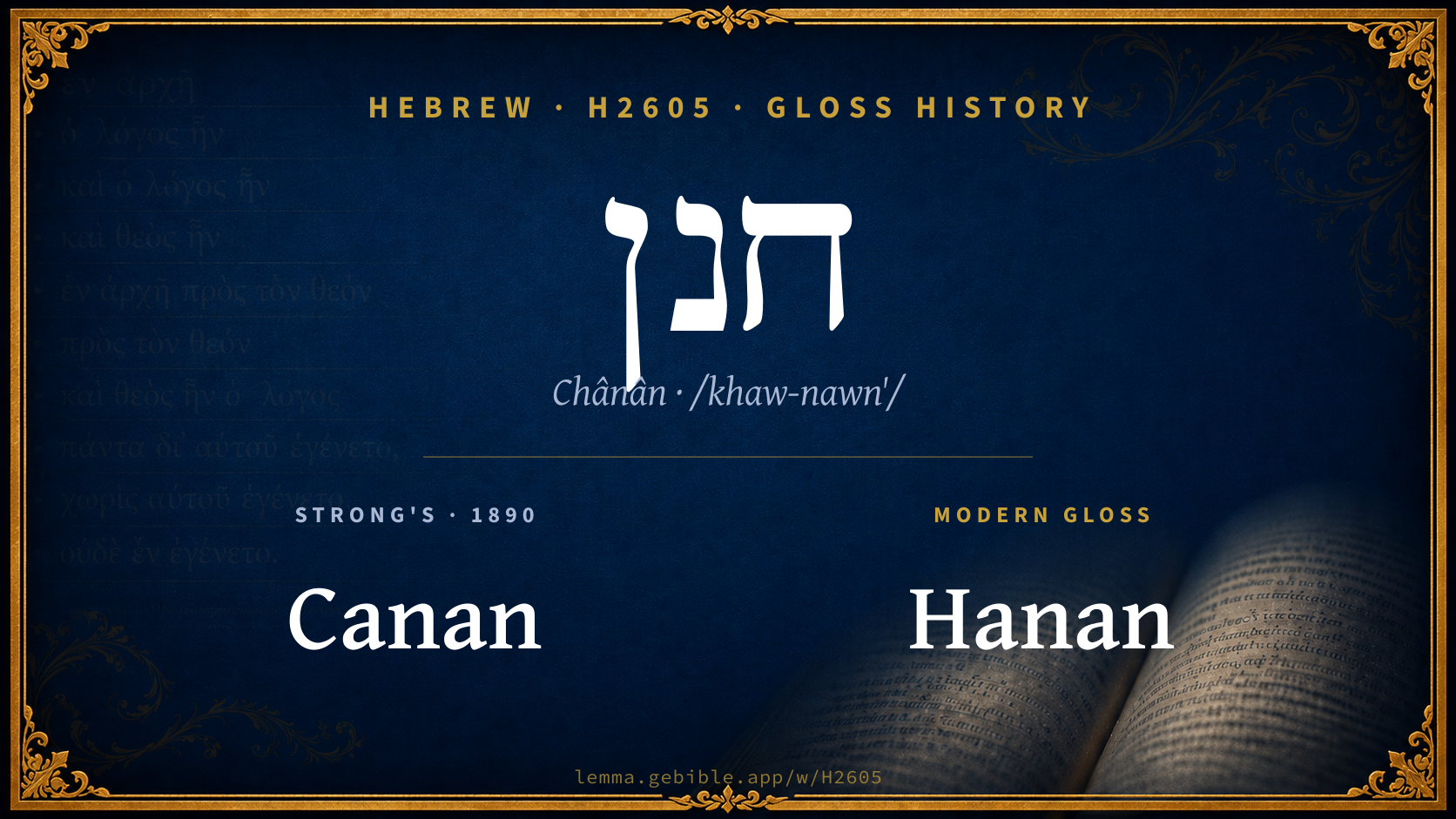
Gloss history
Strong's 1890 vs modern scholarship
About this word
Strong's H2605 catalogs a Hebrew word from the Hebrew Old Testament.
These counts are not copied from any lexicon or concordance. They are computed here, from the morphology-tagged Hebrew Old Testament. What Lemma adds →
- 12
- distinct verses
- The word appears in 12 distinct verses.
- 4 / 39
- OT books
- The word appears in 4 of 39 Old Testament books.
- #2,101
- by frequency
- Top 2500 most frequent Hebrew words (rank 2,101 of 8,640 Hebrew words by occurrence).
View all 12 occurrences in the concordance →
Most concentrated in
- Nehemiah 6 verses 50%
- 1 Chronicles 4 verses 33%
- Ezra 1 verse 8%
By section of the Old Testament
By traditional corpus
Conventional, traditional groupings — biblical authorship is debated, so this is a traditional corpus grouping, not an authorship claim. Each share is this word’s portion of its verses in that division of the Hebrew canon. Each figure is a share of the word’s 12 distinct verses.
- Writings (Ketuvim) 11 verses · 92%
- Prophets (Nevi'im) 1 verse · 8%
How translations render this word
Counts come from each version’s own published word-to-Strong’s tagging or interlinear alignment — an approximate guide to how each version renders this word, not a word-level alignment the data otherwise carries. Because each total is that version’s own tagged count, the per-version totals vary from one another and need not match the appearance or distinct-verse counts above. These counts may also differ from a printed concordance because Lemma counts each distinctly tagged rendering and does not collapse phrase taggings into a single head-word total. This is a fixed set of word-tagged versions (KJV, ASV, BSB, ULT) and does not change with the reading translation you choose elsewhere. Each version’s license is shown beside its name below (and on Sources).
- King James Version: Hanan 11×
- American Standard Version: Hanan 11×
- Berean Standard Bible: Hanan 12×
- unfoldingWord Literal Text: Hanan 11×
King James Version Public Domain
Renders H2605 across 12 tagged occurrences — most commonly:
Plus 1 rendering that appears only once — usually multi-word phrases or single function words the recovered tagging swept in, not distinct renderings.
American Standard Version Public Domain
Renders H2605 across 12 tagged occurrences — most commonly:
Plus 1 rendering that appears only once — usually multi-word phrases or single function words the recovered tagging swept in, not distinct renderings.
Berean Standard Bible Public Domain
Renders H2605 across 12 tagged occurrences — most commonly:
unfoldingWord Literal Text CC BY-SA 4.0
Renders H2605 across 11 tagged occurrences — most commonly:
8 senses and sub-senses in the full BDB
What do BDB’s symbols mean?
BDB uses these scholarly abbreviations:
| Symbol | Meaning |
|---|---|
| 𝔊 | the Septuagint (the ancient Greek translation, LXX) |
| 𝔙 | the Vulgate (the Latin translation) |
| 𝔖 | the Syriac version (the Peshitta) |
| 𝔗 | the Targum (the Aramaic translation) |
| ψ | the Psalms |
| √ | root (the underlying root or stem) |
| ‖ | parallel passage (a synonymous or contrasted parallel) |
| † | the dagger: every passage where the word occurs is cited |
The 8 senses and sub-senses the full Brown-Driver-Briggs lexicon distinguishes for this word, in lexicon order (not ranked by frequency), with BDB’s own verbatim wording and sub-sense lettering. Shown in Hebrew script with BDB’s own scholarly abbreviations. The condensed entry is in the Lexicon Entry tab. See also the Forms in the corpus table below.
- 1. one of the warriors of David 1 Ch 11:43. e.g. 1 Chronicles 11:43
- 2. one of the heads of families of Nethinim Ezr 2:46 = Ne 7:49. e.g. Ezra 2:46
- 3. names of Levites Ne 8:7; 10:11; 13:3. e.g. Nehemiah 8:7
- 4. chiefs of the people:
- a. Ne 10:23. e.g. Nehemiah 10:23
- b. Ne 10:27. e.g. Nehemiah 10:27
- 5. Benjamite name 1 Ch 8:23, 38; 9:44 (cf. n.pr.loc. בֵּית חָנָן, Mish. כְּפַר חָנָן). e.g. 1 Chronicles 8:23
- 6. אִישׁ הָאֱלֹהִים head of a prophetic guild, בְּנֵי הָנָן Je 35:4. e.g. Jeremiah 35:4
Senses from the full Brown-Driver-Briggs lexicon (Brown, Driver, Briggs; Oxford 1906 — public domain), digitized via Sefaria, supplemented by the OpenScriptures HebrewLexicon (CC BY 4.0). Full attribution on Sources.
Word origin
n.pr.m. (gracious; cf. Sab. חנן, Ph. חנא)—
— Brown-Driver-Briggs (Oxford 1906, public domain), digitized via Sefaria, supplemented by the OpenScriptures HebrewLexicon (CC BY 4.0). See Sources.
Derived from חנן (chânan) (H2603) — to be gracious.
Jastrow Dictionary
A second Hebrew/Aramaic lexicon for comparison, covering Aramaic and post-biblical (Talmudic, Targumic, Midrashic) usage that the biblical-Hebrew BDB does not. Matched by lemma rather than by Strong’s number, so a lemma may carry more than one Jastrow headword (shown separately below), and the entries cover usage well beyond the Bible.
חנן
- , Y. Peah I, 16ᵇ מה ח׳ קיימין, read, as Y. Snh. X, beg. 27ᶜ, מה נן. [חנן Syr., rare form, v. P. Sm. 250 s. v. אנא.]
חָנַן
- [to cover, surround,] to caress, grace, favor. Sabb. 104ᵃ (in children’s acrostics) זֹן אותך וחָ֗ן אותך sustains and graces thee. Num. R. s. 11 (ref. to Num. VI, 25) יָחוֹן איתך בבנים may He favor thee with (good) children. Ib. (quot. from daily prayers) אתה חוֹנֵן לאדם דעת thou graciously endowest man with knowledge. Ib. עתיד הקב"ה לָחוֹן עליהם the Lord will in due time protect them. Sifré Num. 41 יָחְנְךָ בתלמוד תורה may He grace thee by enabling thee to study the Law. Pesik. Asser, p. 97ᵃ (ref. to מהונך, Prov. III, 9) ממה שחֲנָנְךָ out of what He has endowed thee with; a. fr.—[Midr. Till. to Ps. LXXVIII חָן, v. חָנָה.]—Part. pass. חָניּן, pl. חֲנוּנִים e.g. Numbers 6:25
- 1. graced, endowed. Num. R. l. c. חֲנוּנֵי (ב)דעת endowed with knowledge. Pes. 87ᵃ בני חֲנוּנֶיךָ children of thy favored ones, Abraham &c. (Ms., v. בָּחַן).
- 2. bandaged. Pl. fem. חֲנוּנוֹת. Sabb. V, 4, v. חָנוּן I, 2.
- to be shown favor. Deut. R. s. 7 (ref. to Is. XXVI, 10) אבל אם למד … אינו נ׳ but if he has learned …, he will be shown no favor (will not be forgiven). e.g. Isaiah 26:10
- to bend one’s self, to supplicate (v. תְּחִנָּה). Deut. R. s. 2, beg. מִתְחַנֵּן, v. חָבַט. Ib. התחיל להִתְחַנֵּן (התחיל מתחנן) he began to pray; a. fr.
- = חָנָה) to come to rest, to be collected. Ber. 30ᵇ (adopting the expression in conformity with ואתחנן, Deut. III, 23) until his mind be collected again (for prayer), v. חוּל. e.g. Deuteronomy 3:23
חֲנַן
- ch., pret. חַן same. Targ. O. Gen. XXXIII, 5.—Targ. O. Ex. XXXIII, 19 אֵיחוֹן. Targ. Jud. XXI, 22 חֲנוּנוּן להון ed. Lag. (oth. ed. חנינינון) be gracious to them.—Pes. 110ᵇ (in an incantation) אדחֲנַנִי וחֲנַנְכִי וכ׳ while He graced me and yourselves, I had not come to that (v. Ar. s. v. הר 8, a. Rabb. D. S. a. l. note for var. lect.).
חָנָן
- (b. h.) pr. n. m. Hanan, name of several Tannaim and of several Amoraim, esp. H., one of the Justices of Peace in Jerusalem, v. אַדְמוֹן. Keth. XIII, 1. Y. ib. 35ᶜ a. fr.—Ḥ. the Egyptian: Snh. 17ᵇ; a. e.—H. (interch. with הנין). M. Kat. 25ᵇ אסיקו ליה ח׳ וכ׳ (Ms. M. חנין) they gave him the name of H. from his father (Hanin).—Y. Yeb. XI, 12ᵃ top (ed. Krot. חָנוּן). Y. Sot. VII, 21ᵈ bot. חנינן.—Y. Ber. IV, beg. 7ᵃ (ח׳ בר ווא) ח׳ בר אבא; Y. Pes. IV, 31ᵃ חנין; a. oth.—V. Frank. M’bo p. 86ᵃ
A Dictionary of the Targumim, the Talmud Babli and Yerushalmi, and the Midrashic Literature (Marcus Jastrow; London, Luzac, 1903) — Public Domain. Digitized via Sefaria. Digitized via Sefaria. Full attribution on Sources.
Forms in the corpus
The 7 distinct written forms H2605 takes in the Hebrew Bible, most frequent first — each parse links to that state’s occurrences in the concordance. Hebrew forms include their vowel points and cantillation, so a single lemma takes many written forms.
| Form | Parsing | Example | Uses |
|---|---|---|---|
| חָנָ֥ן | Noun, Proper | Jeremiah 35:4 | 3 |
| וְ/חָנָ֑ן | Noun, Proper | 1 Chronicles 8:38 | 2 |
| חָנָ֖ן | Noun, Proper | Nehemiah 10:22 | 2 |
| חָנָֽן | Noun, Proper | Ezra 2:46 | 2 |
| וְ/חָנָֽן | Noun, Proper | 1 Chronicles 8:23 | 1 |
| חָנָ֤ן | Noun, Proper | Nehemiah 8:7 | 1 |
| חָנָן֙ | Noun, Proper | 1 Chronicles 11:43 | 1 |
Same root — word family
Other BDB entries built from the same root as H2605, grouped by Strong’s listed origin. These share a root / origin per the lexicon — not necessarily a shared meaning. Each links to that word’s own entry.
Derives from
Shares the same root
- חן chên H2580 grace
- חנה chânâh H2583 to encamp
- חנון channûwn H2587 gracious
- חנות channôwth H2589 to be gracious
- חנינה chănîynâh H2594 compassion
- חנן chănan H2604 to show favour
- תחנה tᵉchinnâh H8467 supplication
- תחנון tachănûwn H8469 supplication
Proper names from this root
People and places named from this root — a name, not an additional meaning of the word.
- חנה Channâh H2584 Hannah
- חנון Chânûwn H2586 Hanun
- חניאל Channîyʼêl H2592 Hanniel
- חננאל Chănanʼêl H2606 Hananeel
- חנני Chănânîy H2607 Hanani
- חנניה Chănanyâh H2608 Hananiah
- חנתן Channâthôn H2615 Hannathon
Compare all same-root words → Showing 4 of 17 — not the complete family. 7 of the same-root words are proper names (people or places). They share a root, not necessarily a meaning.
Bible dictionary
Public-domain dictionary articles matched to this entry by name (Hanan). A biblical name can be shared by more than one person or place, so an article may treat several.
Easton's Bible Dictionary · M. G. Easton, 1897
Merciful. (1.) A Benjamite (1 Chr. 8:23). (2.) One of David's heroes (1 Chr. 11:43). (3.) Jer. 35:4. (4.) A descendant of Saul (1 Chr. 8:38). (5.) One of the Nethinim (Ezra 2:46). (6.) One of the Levites who assisted Ezra (Neh. 8:7). (7.) One of the chiefs who subscribed the covenant (Neh. 10:22).
Smith's Bible Dictionary · William Smith, 1863
(merciful).
+ One of the chief people of the tribe of Benjamin. (1 Chronicles 8:23) + The last of the six sons of Azel, a descendant of Saul. (1 Chronicles 8:38; 9:44) (B.C. 588.) + "Son of Maachah," i.e. possibly a Syrian of Aram-maachah, one of the heroes of David's guard. (1 Chronicles 11:43) (B.C. 1046). + The sons of Hanan were among the Nethinim who returned from Babylon with Zerubbabel. (Ezra 2:46; Nehemiah 7:49) (B.C. 536). + One of the Levites who assisted Ezra in his public exposition of the law. (Nehemiah 8:7) (B.C. 446.) The same person is probably mentioned in ch. (Nehemiah 10:10) + One of the "heads" of "the people," who also sealed the covenant. (Nehemiah 10:22) (B.C. 410.) + Another of the chief laymen on the same occasion. (Nehemiah 10:26) + Son of Zaccur, son of Mattaniah, whom Nehemiah made one of the store. keepers of the provisions collected as tithes. (Nehemiah 13:13) + Son of Igdaliah. (Jeremiah 35:4) (B.C. 410.)
Hitchcock's Bible Names Dictionary · Roswell D. Hitchcock, 1869
full of grace
Classic public-domain reference works; full attribution on Sources.
Septuagint verse parallels
This word appears in 6 verses that also exist in the Greek Old Testament (Septuagint), out of the 12 Hebrew verses it occurs in. You can read those verses in Greek by switching the Old Testament edition to the Septuagint.
Read these verses in the Septuagint
This is a verse-level parallel only — the same verses exist in both the Hebrew and Greek Old Testaments. No word-level Hebrew↔Greek correspondence is claimed: the data carries no such alignment, so no Greek word is shown as this Hebrew word’s translation. Coverage is not total — the Septuagint omits the deuterocanon and renumbers the Psalms, so some Hebrew verses have no direct Greek parallel.