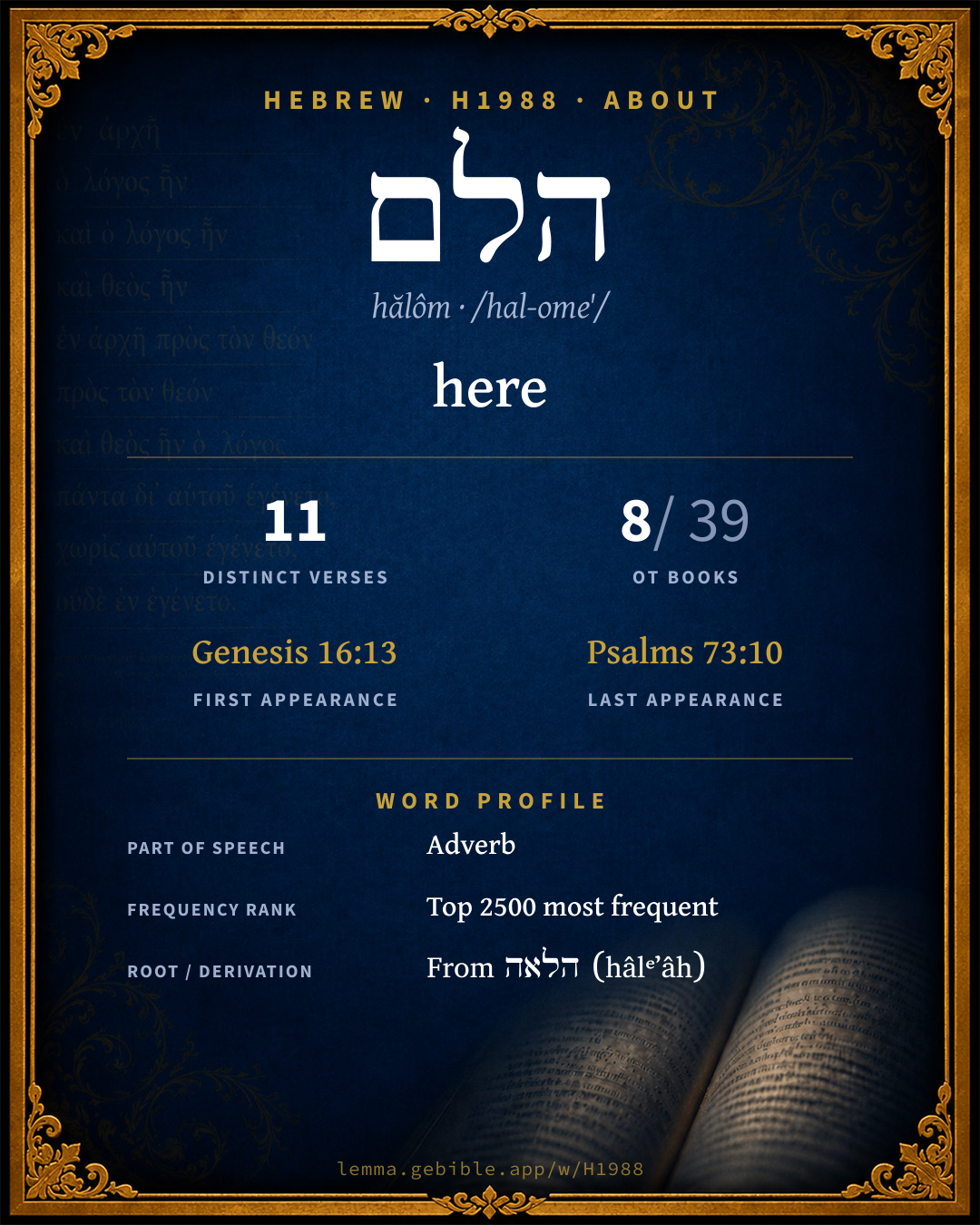
הֲלֹם
here
Full lexicon entry — Brown-Driver-Briggs (BDB)
From Brown-Driver-Briggs (BDB)
Where this word appears
Grammar key — what these labels mean
Part of speech
- Adverb
- A word that modifies a verb, adjective, or other adverb.
Every verse where H1988 appears in the Book of 2 Samuel — 1 distinct verse. Click any verse to open its interlinear word-by-word view. Verse text shown in the World English Bible for context — . Each verse’s Hebrew form is shown with its reference; the English is not keyword-highlighted, since the data carries no word-level English alignment. Use “Compare translations” on any verse to read it across multiple English versions. This concordance covers the Hebrew Bible; Septuagint (Greek Old Testament) occurrences are not indexed here.
2 Samuel
About this entry
At a glance — auto-summarized from this page’s data, not written by a person. Every figure links to its source below. This summary describes the numbers; it doesn’t interpret them.
הלם — transliterated hălôm — is a Hebrew verb carrying the sense “here.” Debuting at Genesis 16:13, it then recurs through the corpus. It appears 11 verses across 8 books of the Hebrew Bible, among its uncommon vocabulary. More than a quarter of its appearances fall in 1 Samuel. Related forms include הלאה, הלא and הלזה. See the sense tree, 11-verse concordance, and the renderings breakdown below.
Gloss history
Strong's 1890 vs modern scholarship
About this word
Strong's H1988 catalogs a Hebrew word from the Hebrew Old Testament.
These counts are not copied from any lexicon or concordance. They are computed here, from the morphology-tagged Hebrew Old Testament. What Lemma adds →
- 11
- distinct verses
- The word appears in 11 distinct verses.
- 8 / 39
- OT books
- The word appears in 8 of 39 Old Testament books.
- #2,210
- by frequency
- Top 2500 most frequent Hebrew words (rank 2,210 of 8,640 Hebrew words by occurrence).
View all 11 occurrences in the concordance →
By section of the Old Testament
By traditional corpus
Conventional, traditional groupings — biblical authorship is debated, so this is a traditional corpus grouping, not an authorship claim. Each share is this word’s portion of its verses in that division of the Hebrew canon. Each figure is a share of the word’s 11 distinct verses.
- Prophets (Nevi'im) 6 verses · 55%
- Writings (Ketuvim) 3 verses · 27%
- Torah (Pentateuch) 2 verses · 18%
How translations render this word
Counts come from each version’s own published word-to-Strong’s tagging or interlinear alignment — an approximate guide to how each version renders this word, not a word-level alignment the data otherwise carries. Because each total is that version’s own tagged count, the per-version totals vary from one another and need not match the appearance or distinct-verse counts above. These counts may also differ from a printed concordance because Lemma counts each distinctly tagged rendering and does not collapse phrase taggings into a single head-word total. This is a fixed set of word-tagged versions (KJV, ASV, BSB, ULT) and does not change with the reading translation you choose elsewhere. Each version’s license is shown beside its name below (and on Sources).
- King James Version: Hither 4×, Hitherto 2×
- American Standard Version: Hither 5×, Far 2×
- Berean Standard Bible: Here 5×, Far 2×
- unfoldingWord Literal Text: Here 11×
King James Version Public Domain
Renders H1988 across 11 tagged occurrences — most commonly:
Plus 5 renderings that appear only once — usually multi-word phrases or single function words the recovered tagging swept in, not distinct renderings.
American Standard Version Public Domain
Renders H1988 across 11 tagged occurrences — most commonly:
Plus 4 renderings that appear only once — usually multi-word phrases or single function words the recovered tagging swept in, not distinct renderings.
Berean Standard Bible Public Domain
Renders H1988 across 12 tagged occurrences — most commonly:
Plus 5 renderings that appear only once — usually multi-word phrases or single function words the recovered tagging swept in, not distinct renderings.
unfoldingWord Literal Text CC BY-SA 4.0
Renders H1988 across 11 tagged occurrences — most commonly:
Senses in BDB
The 1 sense BDB distinguishes for this word, in lexicon order (not ranked by frequency or importance). The full entry — with sub-senses — is in the Lexicon Entry tab.
- here, hither
Word origin
adv. of place, hither (Arabic هَلُمَّ hither!)—Ex 3:5 אַל־תִּקְרַב הֲלֹם approach not hither, Ju 18:3; 20:7 1 S 10:22; 14:16 and lo, the camp melted away וַיֵּלֶךְ וַהֲלֹם read with 𝔊 (ἔνθεν καὶ ἔνθεν) Th We Dr הֲלֹם וַהֲלֹם hither and thither i.e. in different directions (cf. הֵנָּה וָהֵנָּה Jos 8:20), v 36, 38 Ru 2:14; עַד הֲלֹם fig. hitherto, thus far (i.e. to this point of dignity and greatness) 2 S 7:18 (= 1 Ch 17:16). ψ 73:10, if text be sound, הֲלֹם must mean thither (sc. after the persons described v 3–9); but such sense questionable; read prob. with Houb La for ישיב עמו הלם, יַשְׂבִּעֵמוֹ לָ֑חֶם satisfies them with bread: cf. Che Hup-Now. Gn 16:13 = here; but here also text is dub.: v Di. Ju 14:15 read הֲלֹם for הֲלֹא: v. הֲ 1 end.
— Brown-Driver-Briggs (Oxford 1906, public domain), digitized via Sefaria, supplemented by the OpenScriptures HebrewLexicon (CC BY 4.0). See Sources.
Derived from הלאה (hâlᵉʼâh) (H1973) — yonder.
Jastrow Dictionary
A second Hebrew/Aramaic lexicon for comparison, covering Aramaic and post-biblical (Talmudic, Targumic, Midrashic) usage that the biblical-Hebrew BDB does not. Matched by lemma rather than by Strong’s number, so a lemma may carry more than one Jastrow headword (shown separately below), and the entries cover usage well beyond the Bible.
הָלַם
- a. Arab. ḫilm friend; v. Fl. to Levy Talm. Dict. I, p. 558ᵃ)
- 1. to join, weld. Gen. R. s. 44 (ref. to הוֹלֶם פעם Is. XLI, 7) וה׳ את כל וכ׳ and welded all mankind to follow one road to the Lord; Yalk. ib. 76; Yalk. Is. 313. e.g. Isaiah 41:7
- 2. to be attached, fit closely. Ab. Zar. 44ᵃ מתנשא שביקש להוֹלְמוֹ ולא הוֹלַמְתּוֹ Ms. M. (ed. שמתנשא לה׳, corr. acc.) ‘he exalted himself’ (I Kings I, 5) means that he attempted to fasten (the crown to his head), but it would not fit him; Yalk. Kings 166; Snh. 21ᵇ.—[Tosef. Bekh. IV, 13 מוהלמות, read: מְבוּלָּמוֹת, v. בָּלַם.] e.g. 1 Kings 1:5
- to attach closely, paste on. Y. Ter. X, 47ᵃ bot. מַהֲלִימִין היו they made the pastry adhere to the mouth of the vessel.
A Dictionary of the Targumim, the Talmud Babli and Yerushalmi, and the Midrashic Literature (Marcus Jastrow; London, Luzac, 1903) — Public Domain. Digitized via Sefaria. Digitized via Sefaria. Full attribution on Sources.
Forms in the corpus
The 7 distinct written forms H1988 takes in the Hebrew Bible, most frequent first — each parse links to that state’s occurrences in the concordance. Hebrew forms include their vowel points and cantillation, so a single lemma takes many written forms.
| Form | Parsing | Example | Uses |
|---|---|---|---|
| הֲלֹֽם | Adverb | 1 Chronicles 17:16 | 3 |
| הֲלֹ֑ם | Adverb | Exodus 3:5 | 2 |
| הֲלֹ֔ם | Adverb | 1 Samuel 14:38 | 2 |
| הֲלֹ֖ם | Adverb | 1 Samuel 14:36 | 1 |
| הֲלֹ֛ם | Adverb | Genesis 16:13 | 1 |
| הֲלֹ֣ם | Adverb | 1 Samuel 10:22 | 1 |
| הֲלֹם֙ | Adverb | Ruth 2:14 | 1 |
Same root — word family
Other BDB entries built from the same root as H1988, grouped by Strong’s listed origin. These share a root / origin per the lexicon — not necessarily a shared meaning. Each links to that word’s own entry.
Derives from
Shares the same root
Compare all same-root words → They share a root, not necessarily a meaning.
Septuagint verse parallels
This word appears in 11 verses that also exist in the Greek Old Testament (Septuagint), out of the 11 Hebrew verses it occurs in. You can read those verses in Greek by switching the Old Testament edition to the Septuagint.
Read these verses in the Septuagint
- Genesis 16:13
- Exodus 3:5
- Judges 18:3
- Ruth 2:14
- 1 Samuel 10:22
- 2 Samuel 7:18
- 1 Chronicles 17:16
- Psalms 73:10
This is a verse-level parallel only — the same verses exist in both the Hebrew and Greek Old Testaments. No word-level Hebrew↔Greek correspondence is claimed: the data carries no such alignment, so no Greek word is shown as this Hebrew word’s translation. Coverage is not total — the Septuagint omits the deuterocanon and renumbers the Psalms, so some Hebrew verses have no direct Greek parallel.