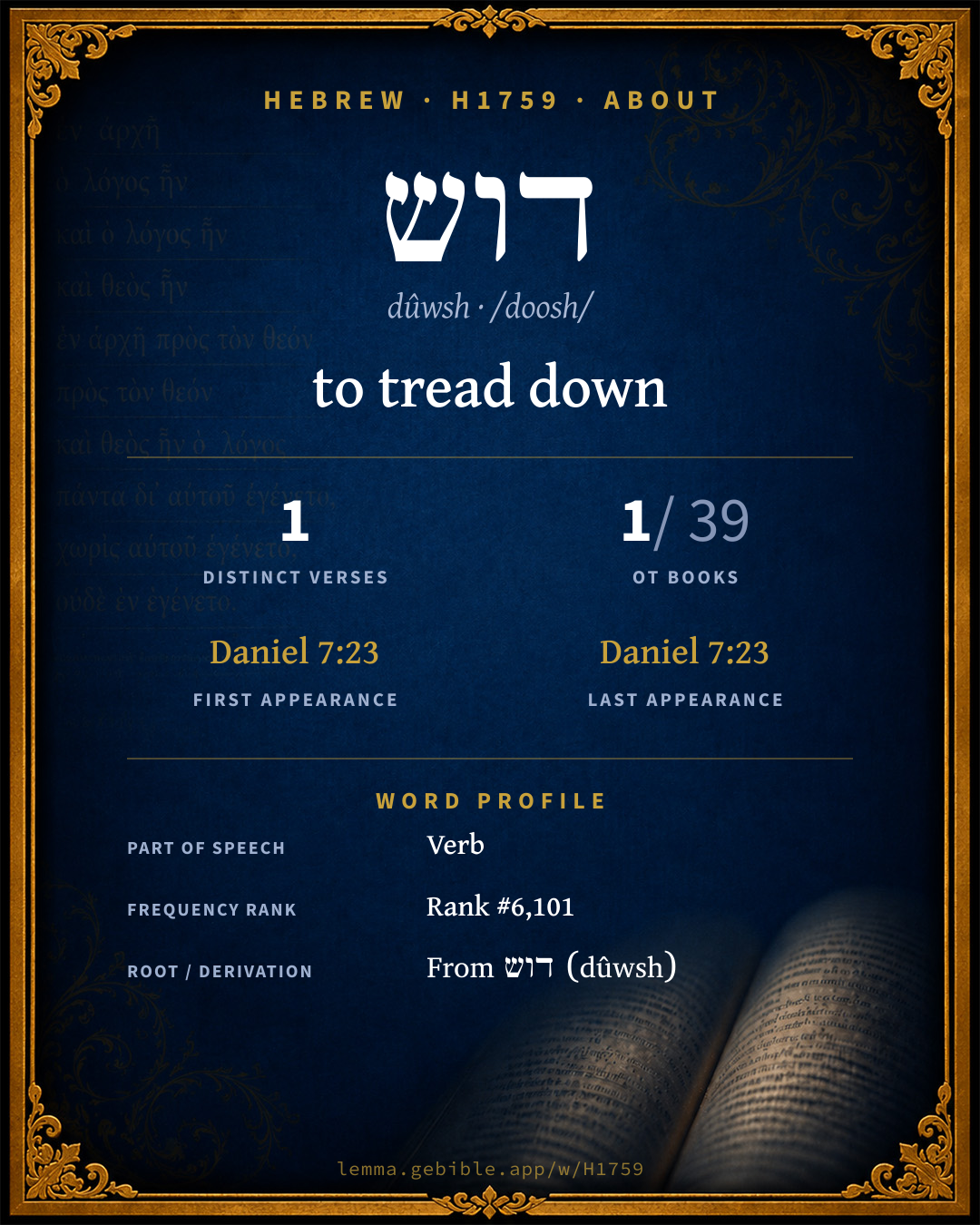
דּוּשׁ
to tread down
Full lexicon entry — Brown-Driver-Briggs (BDB)
From Brown-Driver-Briggs (BDB)
Where this word appears
Grammar key — what these labels mean
Stem
- Qal
- The basic, simple active stem — the plain form of the verb (“he wrote”).
Form
- Imperfect
- An incomplete, ongoing, or future action (“he will / would write”).
Person
- 3rd Person
- The one spoken about (“he / she / it / they”).
Gender
- Feminine
- Grammatically feminine.
Number
- Singular
- One.
Every verse where H1759 appears — 1 distinct verse across 1 book. Click any verse to open its interlinear word-by-word view. Verse text shown in the World English Bible for context — . Each verse’s Hebrew form is shown with its reference; the English is not keyword-highlighted, since the data carries no word-level English alignment. Use “Compare translations” on any verse to read it across multiple English versions. This concordance covers the Hebrew Bible; Septuagint (Greek Old Testament) occurrences are not indexed here.
Daniel 1 verse
About this entry
At a glance — auto-summarized from this page’s data, not written by a person. Every figure links to its source below. This summary describes the numbers; it doesn’t interpret them.
At its core, דוש (dûwsh) means “to tread down.” It occurs a mere 1 verse across Scripture. Its uses cluster heavily in Daniel (100% of all occurrences). A true hapax — its single appearance is Daniel 7:23. Sharing its root, it stands alongside דוש, דיש and דישן. Each statement above links to its evidence; the full detail follows below.
Gloss history
Strong's 1890 vs modern scholarship
About this word
Strong's H1759 catalogs a Hebrew word from the Hebrew Old Testament.
These counts are not copied from any lexicon or concordance. They are computed here, from the morphology-tagged Hebrew Old Testament. What Lemma adds →
- 1
- distinct verses
- The word appears in 1 distinct verse.
- 1 / 39
- OT books
- The word appears in 1 of 39 Old Testament books.
- #6,101
- by frequency
- Rank #6,101 (rank 6,101 of 8,640 Hebrew words by occurrence).
View all 1 occurrence in the concordance →
Most concentrated in
- Daniel 1 verse 100%
By section of the Old Testament
By traditional corpus
Conventional, traditional groupings — biblical authorship is debated, so this is a traditional corpus grouping, not an authorship claim. Each share is this word’s portion of its verses in that division of the Hebrew canon. Each figure is a share of the word’s 1 distinct verse.
- Writings (Ketuvim) 1 verse · 100%
How translations render this word
Counts come from each version’s own published word-to-Strong’s tagging or interlinear alignment — an approximate guide to how each version renders this word, not a word-level alignment the data otherwise carries. Because each total is that version’s own tagged count, the per-version totals vary from one another and need not match the appearance or distinct-verse counts above. These counts may also differ from a printed concordance because Lemma counts each distinctly tagged rendering and does not collapse phrase taggings into a single head-word total. This is a fixed set of word-tagged versions (KJV, ASV, BSB, ULT) and does not change with the reading translation you choose elsewhere. Each version’s license is shown beside its name below (and on Sources).
- King James Version: Shall tread it down 1×
- American Standard Version: Shall tread it down 1×
- Berean Standard Bible: Trample it down 1×
- unfoldingWord Literal Text: Trample it down 1×
King James Version Public Domain
Renders H1759 across 1 tagged occurrence — most commonly:
American Standard Version Public Domain
Renders H1759 across 1 tagged occurrence — most commonly:
Berean Standard Bible Public Domain
Renders H1759 across 1 tagged occurrence — most commonly:
unfoldingWord Literal Text CC BY-SA 4.0
Renders H1759 across 1 tagged occurrence — most commonly:
Senses in BDB
The 1 sense BDB distinguishes for this word, in lexicon order (not ranked by frequency or importance). The full entry — with sub-senses — is in the Lexicon Entry tab.
- (Peal) to tread down
Word origin
[ דּוּשׁ ] vb. tread down (BH);— Pe. Dn 7:23
— Brown-Driver-Briggs (Oxford 1906, public domain), digitized via Sefaria, supplemented by the OpenScriptures HebrewLexicon (CC BY 4.0). See Sources.
Derived from דוש (dûwsh) (H1758) — to thresh.
Jastrow Dictionary
A second Hebrew/Aramaic lexicon for comparison, covering Aramaic and post-biblical (Talmudic, Targumic, Midrashic) usage that the biblical-Hebrew BDB does not. Matched by lemma rather than by Strong’s number, so a lemma may carry more than one Jastrow headword (shown separately below), and the entries cover usage well beyond the Bible.
דּוּשׁ
- (b. h.), part. a. perf. דָּשׁ
- 1. to tread, trample, thresh. Sabb. VII, 2 הדָּשׁ he who threshes (on the Sabbath); a. fr.—Euphem. for sexual contact. Nidd. 41ᵇ. Gen. R. s. 85. Pes. 87ᵇ; a. e.—דוש בעקב to trample with one’s heel, to treat lightly, not to heed. Ab. Zar. 18ᵃ. Lev. R. s. 27.
- 2. to walk about, be familiar, well-known. Meg. 24ᵇ אם היה דש בעירו if he has been a familiar figure in his town (so that people do not mind his bodily disfigurement); Y. Taan. IV, beg. 67ᵇ; a. fr.
- to trample. Ex. R. s. 15 הייתם מְדַיְּישִׁין את העץ וכ׳ you used to tread upon this piece of wood. Midr. Till. to Ps. VIII, 3 מְדַיֵּישׁ עליך כעפר even one who treads upon thee as upon dust. Gen. R. s. 44 דַּיְּישֵׁם tread upon them.
- , v. דָּשַׁשׁ
דּוּשׁ ²
- 1. to thresh. Targ. Ruth II, 17.—Zeb. 116ᵇ; Men. 22ᵃ, v. דַּשְׁתָּאָה.
- 2. to tread upon, trample (to death). Targ. II Kings VII, 17; a. fr.—B. Kam. 9ᵃ דָּיֵישׁ אמצרי he sets his foot upon the landmark (symbol of possession).
- 3. to be used to, not to mind. Sabb. 129ᵇ כיון דדָשוּ ביה רבים since the people are in the habit of doing it. Gitt. 56ᵇ כיון דדש דש being used (to the hammering) the gnat did not heed it. Keth. 62ᵃ דַּשְׁנָן בה we are used to it.—Targ. Prov. VIII, 33 תְדִישׁוּן, v. Af.
- to pass over, to leave unheeded, to be listless. Targ. Prov. IV, 15; XIII, 18; XV, 32 Ar. a. Mss. (ed. Lag. אר׳, מר׳ with ר, h. text פרע); ib. VIII, 33 (v. supra, ed. Lag. תירשון).—Snh. 7ᵃ (prov.) טוביה לדשמע ואדיש (Ms. M. ואריש) happy he who hears (himself abused) and minds it not; he will escape a hundred evils.—Y. Peah I, 15ᶜ bot.; Y. Kidd. I, 61ᵇ אכול ואֲדֵישׁ … ומַדְשִׁין eat and care not (do not share in our conversation), for so do dogs eat and mind not. [Targ. Y. II, Num. XI, 8 אדשין, v. דְּשַׁשׁ.]
- to be trampled upon, threshed. Targ. Is. XXIV, 3. Ib. XXV, 10.—[Targ. Jer. XLVIII, 26, v. דְּשַׁשׁ.]
- Palp. דַּשְׁדֵּשׁ, v. דְּשַׁשׁ.
A Dictionary of the Targumim, the Talmud Babli and Yerushalmi, and the Midrashic Literature (Marcus Jastrow; London, Luzac, 1903) — Public Domain. Digitized via Sefaria. Digitized via Sefaria. Full attribution on Sources.
Same root — word family
Other BDB entries built from the same root as H1759, grouped by Strong’s listed origin. These share a root / origin per the lexicon — not necessarily a shared meaning. Each links to that word’s own entry.
Derives from
Shares the same root
Compare all same-root words → Showing 4 of 5 — not the complete family. They share a root, not necessarily a meaning.
Septuagint verse parallels
This word appears in 1 verse that also exists in the Greek Old Testament (Septuagint), out of the 1 Hebrew verse it occurs in. You can read those verses in Greek by switching the Old Testament edition to the Septuagint.
Read these verses in the Septuagint
This is a verse-level parallel only — the same verses exist in both the Hebrew and Greek Old Testaments. No word-level Hebrew↔Greek correspondence is claimed: the data carries no such alignment, so no Greek word is shown as this Hebrew word’s translation. Coverage is not total — the Septuagint omits the deuterocanon and renumbers the Psalms, so some Hebrew verses have no direct Greek parallel.