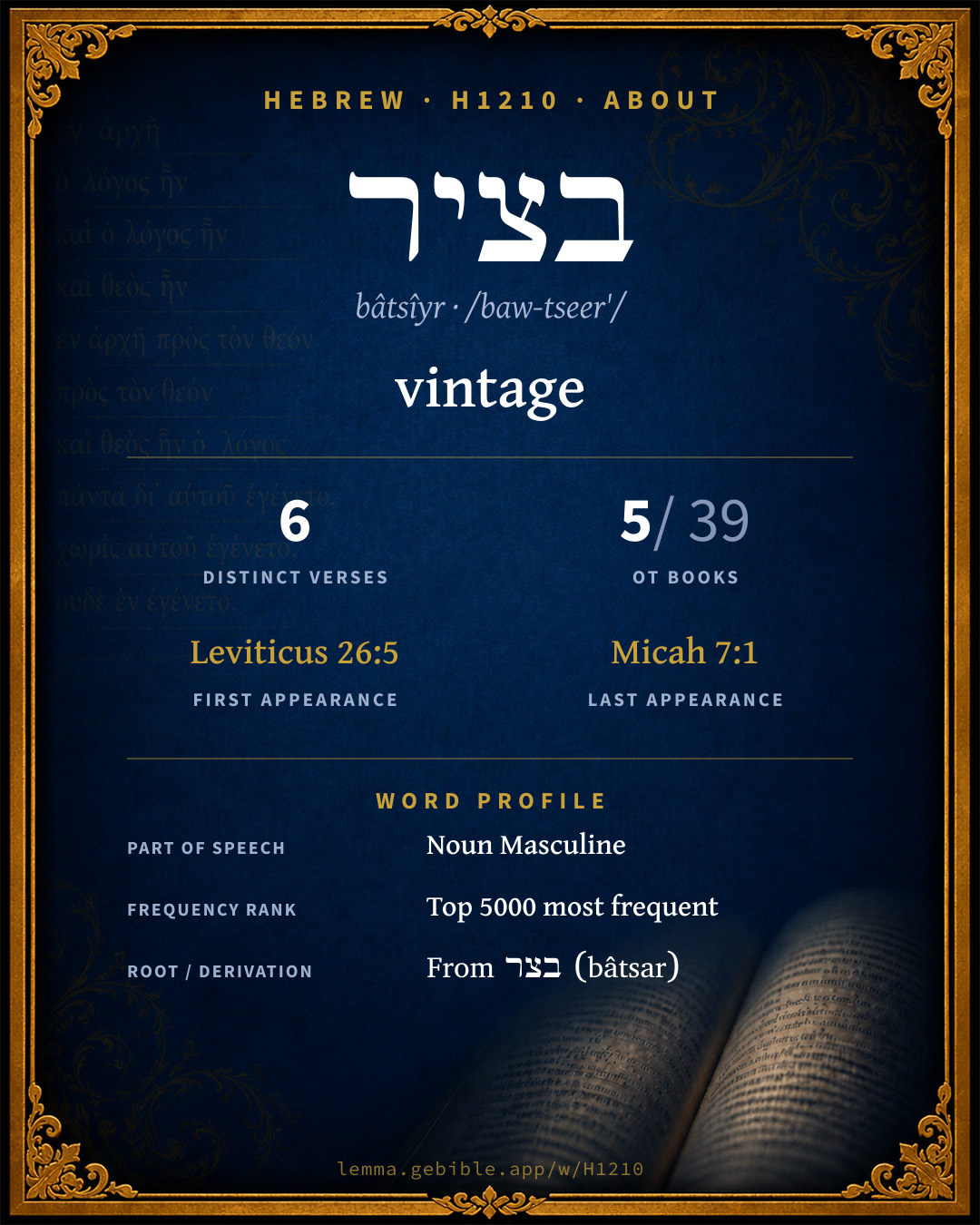
בָּצִיר
vintage
Full lexicon entry — Brown-Driver-Briggs (BDB)
From Brown-Driver-Briggs (BDB)
Where this word appears
Grammar key — what these labels mean
Part of speech
- Noun
- A naming word — a person, place, thing, or idea.
Noun type
- Common
- A common noun — a general class of person, place, or thing (“king,” “city,” “water”), not a specific name.
State
- Absolute
- The independent form of a noun, not bound to a following word.
- Construct
- A noun bound to a following noun in a possessive / “of” relationship (the construct chain).
Gender
- Masculine
- Grammatically masculine.
Number
- Singular
- One.
Every verse where H1210 appears in the Book of Jeremiah — 1 distinct verse. Click any verse to open its interlinear word-by-word view. Verse text shown in the World English Bible for context — . Each verse’s Hebrew form is shown with its reference; the English is not keyword-highlighted, since the data carries no word-level English alignment. Use “Compare translations” on any verse to read it across multiple English versions. This concordance covers the Hebrew Bible; Septuagint (Greek Old Testament) occurrences are not indexed here.
Jeremiah
About this entry
At a glance — auto-summarized from this page’s data, not written by a person. Every figure links to its source below. This summary describes the numbers; it doesn’t interpret them.
The Hebrew noun בציר centers on the idea of “vintage.” Its earliest occurrence is Leviticus 26:5. It turns up in 6 verses across 5 books, an uncommon footprint. The word gravitates to Isaiah (33%), then Leviticus and Judges. It shares a root with בצר, בצור and בצר. Dig into 6-verse concordance and the renderings breakdown below.
Gloss history
Strong's 1890 vs modern scholarship
About this word
Strong's H1210 catalogs a Hebrew word from the Hebrew Old Testament.
These counts are not copied from any lexicon or concordance. They are computed here, from the morphology-tagged Hebrew Old Testament. What Lemma adds →
- 6
- distinct verses
- The word appears in 6 distinct verses.
- 5 / 39
- OT books
- The word appears in 5 of 39 Old Testament books.
- #2,835
- by frequency
- Top 5000 most frequent Hebrew words (rank 2,835 of 8,640 Hebrew words by occurrence).
View all 6 occurrences in the concordance →
By section of the Old Testament
By traditional corpus
Conventional, traditional groupings — biblical authorship is debated, so this is a traditional corpus grouping, not an authorship claim. Each share is this word’s portion of its verses in that division of the Hebrew canon. Each figure is a share of the word’s 6 distinct verses.
- Prophets (Nevi'im) 5 verses · 83%
- Torah (Pentateuch) 1 verse · 17%
How translations render this word
Counts come from each version’s own published word-to-Strong’s tagging or interlinear alignment — an approximate guide to how each version renders this word, not a word-level alignment the data otherwise carries. Because each total is that version’s own tagged count, the per-version totals vary from one another and need not match the appearance or distinct-verse counts above. These counts may also differ from a printed concordance because Lemma counts each distinctly tagged rendering and does not collapse phrase taggings into a single head-word total. This is a fixed set of word-tagged versions (KJV, ASV, BSB, ULT) and does not change with the reading translation you choose elsewhere. Each version’s license is shown beside its name below (and on Sources).
- King James Version: Vintage 6×
- American Standard Version: Vintage 6×
- Berean Standard Bible: Grape harvest 4×
- unfoldingWord Literal Text: Grape harvest 3×
King James Version Public Domain
Renders H1210 across 7 tagged occurrences — most commonly:
Plus 1 rendering that appears only once — usually multi-word phrases or single function words the recovered tagging swept in, not distinct renderings.
American Standard Version Public Domain
Renders H1210 across 7 tagged occurrences — most commonly:
Plus 1 rendering that appears only once — usually multi-word phrases or single function words the recovered tagging swept in, not distinct renderings.
Berean Standard Bible Public Domain
Renders H1210 across 7 tagged occurrences — most commonly:
Plus 3 renderings that appear only once — usually multi-word phrases or single function words the recovered tagging swept in, not distinct renderings.
unfoldingWord Literal Text CC BY-SA 4.0
Renders H1210 across 5 tagged occurrences — most commonly:
Plus 2 renderings that appear only once — usually multi-word phrases or single function words the recovered tagging swept in, not distinct renderings.
Senses in BDB
The 1 sense BDB distinguishes for this word, in lexicon order (not ranked by frequency or importance). The full entry — with sub-senses — is in the Lexicon Entry tab.
- vintage
Word origin
n.m. Lv 26:5 vintage (cf. בָּצַר)—בָּצִיר Lv 26:5 + 4 times + Zc 11:2 Qr (but read בצור Kt); cstr. בְּצִיר Ju 8:2; sf. בְּצִירֵךְ Je 48:32;—vintage, lit. Lv 26:5(×2) Ju 8:2 Is 32:10 Je 48:32; in simile Is 24:13 Mi 7:1; Zc 11:2 read בצור (Kt) and cf. sub בָּצַר.
— Brown-Driver-Briggs (Oxford 1906, public domain), digitized via Sefaria, supplemented by the OpenScriptures HebrewLexicon (CC BY 4.0). See Sources.
Derived from בצר (bâtsar) (H1219) — to fortify.
Jastrow Dictionary
A second Hebrew/Aramaic lexicon for comparison, covering Aramaic and post-biblical (Talmudic, Targumic, Midrashic) usage that the biblical-Hebrew BDB does not. Matched by lemma rather than by Strong’s number, so a lemma may carry more than one Jastrow headword (shown separately below), and the entries cover usage well beyond the Bible.
בָּצִיר I
- vintage, harvesting. Peah VII, 7; a. fr.—Y. B. Bath. III, 14ᵃ top ג׳ שנים … ב׳ וכ׳ three undisturbed grain crops, three grape harvests &c.; v. Bab. B. Bath. 36ᵇ. v. בְּצִירָה.
בָּצִיר II
- ch. m. (בצר) diminished, small; (adv.) less, least. Targ. Y. Gen. I, 16; a. e.—Snh. 108ᵇ. B. Mets. 21ᵇ ב׳ מהכי less than this; a. fr.—V. בִּיצִירְתָּא.
בְּצִיר
- to be less, v. בְּצַר.
בְּצַר
- 1. (neut. v.) to be cut, lessened; to be small; to want. Ab. Zar. 9ᵃ כמה בצרן (Rashi בצירן) how much is wanting yet? Targ. Prov. XIV, 28 בציר עמא the population is diminishing.—Ḥull. 42ᵇ בצר להו חדא there is, according to him, one less (than the number stated); a. fr.
- 2. (act. v.) to diminish, lessen. Targ. Y. Deut. XIII, 1; IV, 2 (Var. תבַצְּרוּן Pa.). Targ. Job XV, 4.—Nidd. 65ᵃ למִבְצַר לה חדא to allow her one night less; a. fr.
- to cut off; to diminish, deduct. Men. 37ᵇ האי מאן דבַצְּרֵיה לגלימיה he who cuts one corner of his cloak off.—Targ. Koh. III, 5. Targ. Deut. IV, 2, a. e., v. supra.—Ab. Zar. 9ᵇ ונְבַצַּר וכ׳ we let him deduct therefrom forty eight. B. Mets. 103ᵇ בַּצְּרִי לך I let thee have it for less.—Denom. בַּצִּירָא one who uses the vowel letters sparingly. Ab. Zar. 9ᵃ; 9ᵇ and as a mnemonical sign (for remembering when to add and when to deduct) ספרא ב׳ וכ׳ the writer of Bible copies writes many words without the vowel letters (defective) which the Mishnah teacher writes plene
צַיָּר
- , v. צַיָּיר
צִיר I
- (צוּר; cmp. זוּרְיוֹן, זַיָּירָא) juice, brine. Sifra Sh’mini, ch. IV, Par. 3 (ref. to Lev. XI, 12) שקץ לאסור את צִירָן ורוטבן וכ׳ ‘abomination’ is used to imply the prohibition of their brine or soup &c. Ib. לאסור צִירָם ורוטבם. Ab. Zar. II, 6 (35ᵇ) צ׳ שאין בה דגה (read בו) brine in which no fish is distinguishable. Ib. 40ᵃ בצירן in their brine (without the fish), opp. בגופן. Ḥull. 99ᵇ; a. fr. e.g. Leviticus 11:12
צִיר
- Targ. Y. Lev. XI, 11 צידיהון ורועדיהון, read: צִירֵיהוֹן ורוטביהון (v. Sifra quot. in preced.).—Ab. Zar. 40ᵃ הוה מטבילנא בצִירָן I used to dip (bread &c.) in their brine. Y. Ter. VIII, 45ᵇ bot. הדין צ׳ דמורייסא (not מור׳) the brine of muries
צִיר II
- hinge, pivot. Men. 33ᵃ; Erub. 11ᵇ היכר צ׳, v. אַבְקָתָא. Kel. XI, 2; Num. R. s. 12, v. פּוֹתָה. Erub. X, 12 מחזירין צ׳ התחתון you may bring back to its socket the lower pivot (of a door of a chest &c.). Yoma 39ᵇ וצ׳ דלתות וכ׳ the turning hinges of the Temple door were heard &c.; a. fr.—Pl. צִירִים, צִירִין. Y. Naz. VIII, 57ᵃ bot איסטרטיוטות שומרי צ׳ וכ׳ (not ושומרי) Roman soldiers were stationed in Jerusalem as guards of the hinges (of the Temple gates); Tosef. Pes. VII, 13 צורים ed. Zuck. (corr. acc.). Bekh. 45ᵃ כשם שצ׳ לבית כך צ׳ לאשה as a house has hinges (doors moving in sockets), so a woman’s body has hinges (in her sexual organs; ref. to I Sam. IV, 19 צִרֶיהָ). Ib. צִירֵי בשר (the sockets and pivots in the male body are merely) hinges of flesh (muscles, not separate organs); a. e. e.g. 1 Samuel 4:19
צִיר III
- writhing, agony, throes of birth.—Pl. צִירִים. Pesik. R. s. 36 ויאחוז אותם צ׳ כצִירֵי יולדה and pangs like those of a travailing woman shall seize them (v. Is. XXI, 3). e.g. Isaiah 21:3
צִיר IV
- [one going around,] messenger, agent. Pirké d’R. El. ch. XXIII כשולח ביד צ׳ נאמן לשולחיו like one sending through a messenger faithful to those who send him (Prov. XXV, 13); Yalk. Gen. 58. Ab. d’R. N. ch. XXXIV. e.g. Proverbs 25:13
צְיָר
- (צוּר) siege; straitness. Targ. O. Deut. XXVIII, 53 (ed. Berl. צְיָארָא); ib. 55; 57. Targ. Ez. IV, 2 (ed. Lag. בצייר; oth. ed. מצייר, corr. acc.). Ib. 3 (ed. Wil. צַיְרָא). Targ. Deut. XX, 19; a. fr.
A Dictionary of the Targumim, the Talmud Babli and Yerushalmi, and the Midrashic Literature (Marcus Jastrow; London, Luzac, 1903) — Public Domain. Digitized via Sefaria. Digitized via Sefaria. Full attribution on Sources.
Forms in the corpus
The 7 distinct written forms H1210 takes in the Hebrew Bible, most frequent first — each parse links to that state’s occurrences in the concordance. Hebrew forms include their vowel points and cantillation, so a single lemma takes many written forms.
| Form | Parsing | Example | Uses |
|---|---|---|---|
| בָצִ֔יר | Noun, Common, Masculine, Singular, Absolute | Isaiah 32:10 | 1 |
| בָצִֽיר | Noun, Common, Masculine, Singular, Absolute | Isaiah 24:13 | 1 |
| בְּצִירֵ֖/ךְ | Noun, Common, Masculine, Singular, Construct | Jeremiah 48:32 | 1 |
| בָּצִ֑יר | Noun, Common, Masculine, Singular, Absolute | Micah 7:1 | 1 |
| בָּצִ֔יר | Noun, Common, Masculine, Singular, Absolute | Leviticus 26:5 | 1 |
| וּ/בָצִ֖יר | Noun, Common, Masculine, Singular, Absolute | Leviticus 26:5 | 1 |
| מִ/בְצִ֥יר | Noun, Common, Masculine, Singular, Construct | Judges 8:2 | 1 |
Same root — word family
Other BDB entries built from the same root as H1210, grouped by Strong’s listed origin. These share a root / origin per the lexicon — not necessarily a shared meaning. Each links to that word’s own entry.
Derives from
Shares the same root
- בצור bâtsôwr H1208 vintage
- בצר betser H1220 gold
- בצרה botsrâh H1223 sheepfold
- בצרון bitstsârôwn H1225 stronghold
- בצרת batstsôreth H1226 drought
- מבצר mibtsâr H4013 fortress
Compare all same-root words → Showing 4 of 8 — not the complete family. They share a root, not necessarily a meaning.
Septuagint verse parallels
This word appears in 5 verses that also exist in the Greek Old Testament (Septuagint), out of the 6 Hebrew verses it occurs in. You can read those verses in Greek by switching the Old Testament edition to the Septuagint.
Read these verses in the Septuagint
This is a verse-level parallel only — the same verses exist in both the Hebrew and Greek Old Testaments. No word-level Hebrew↔Greek correspondence is claimed: the data carries no such alignment, so no Greek word is shown as this Hebrew word’s translation. Coverage is not total — the Septuagint omits the deuterocanon and renumbers the Psalms, so some Hebrew verses have no direct Greek parallel.