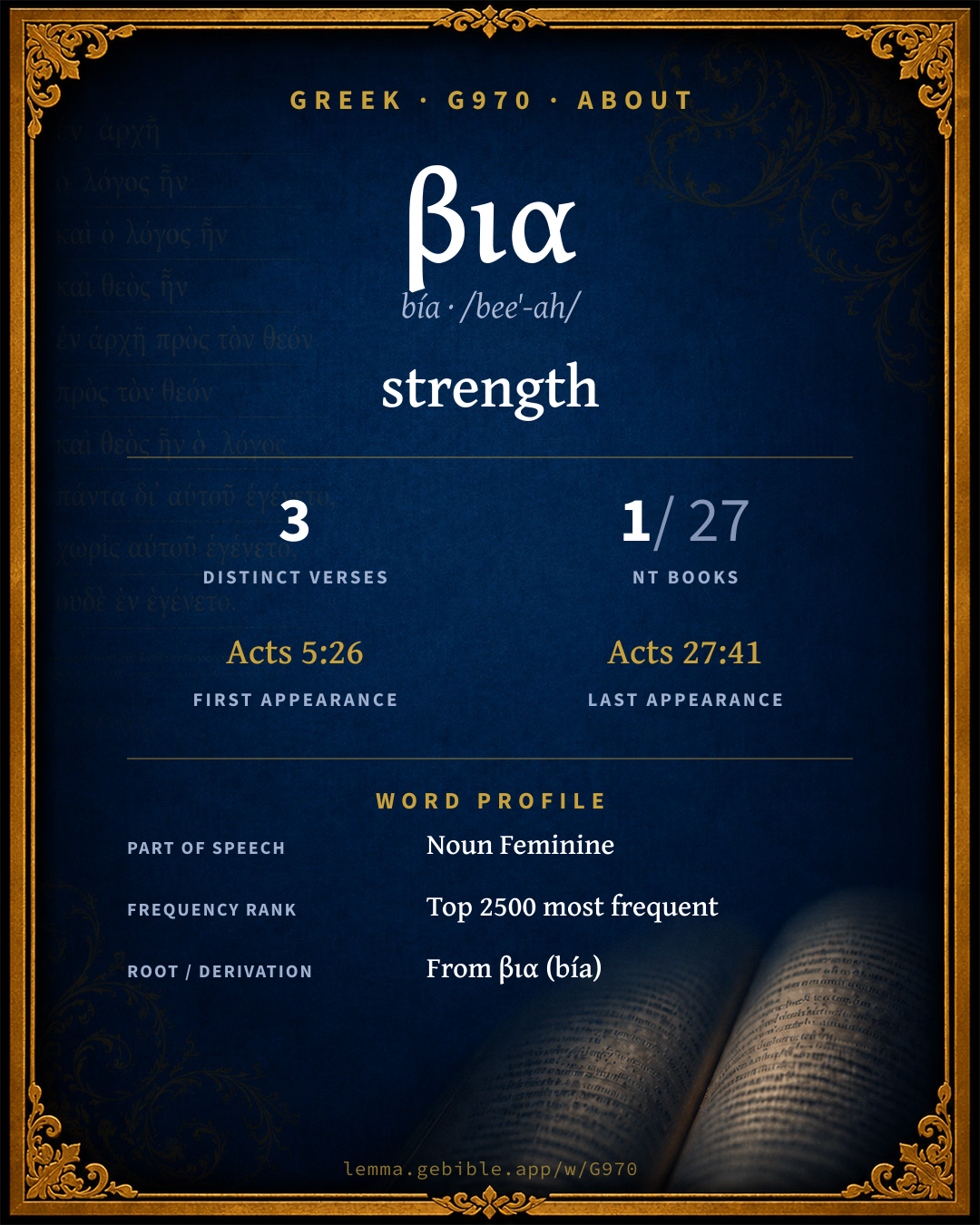
βία
strength
‘strength’ is one of 2 main senses fuller range ↓
Full lexicon entry — Thayer's Greek Lexicon
From Thayer's Greek Lexicon
Where this word appears
See every Genitive-case word in the Greek New Testament →
Grammar key — what these labels mean
Part of speech
- Noun
- A naming word — a person, place, thing, or idea.
Case
- Genitive
- The case of source, possession, or “of” — answers “whose / from what.”
- Accusative
- The case of the direct object and of extent.
Gender
- Feminine
- Grammatically feminine.
Number
- Singular
- One.
1 distinct verse where G970 appears in the Accusative case, across 1 book. Filtered view — show all forms. Click any verse to open its interlinear word-by-word view. Verse text shown in the World English Bible for context — . Each verse’s Greek form is shown with its reference; the English is not keyword-highlighted, since the data carries no word-level English alignment. Use “Compare translations” on any verse to read it across multiple English versions. This concordance covers the Greek New Testament; Septuagint (Greek Old Testament) occurrences of this word are not indexed here.
Acts 1 verse
About this entry
At a glance — auto-summarized from this page’s data, not written by a person. Every figure links to its source below. This summary describes the numbers; it doesn’t interpret them.
βια (bía) is a Greek noun most often rendered “strength.” A scarce word — 3 verses in all of the Greek New Testament. Acts dominates its distribution — 3 of 3 verses. Scripture first uses it in Acts 5:26. Ranging over 2 senses, it is not a single-sense word. The sections below give every sense, occurrence, and version rendering.
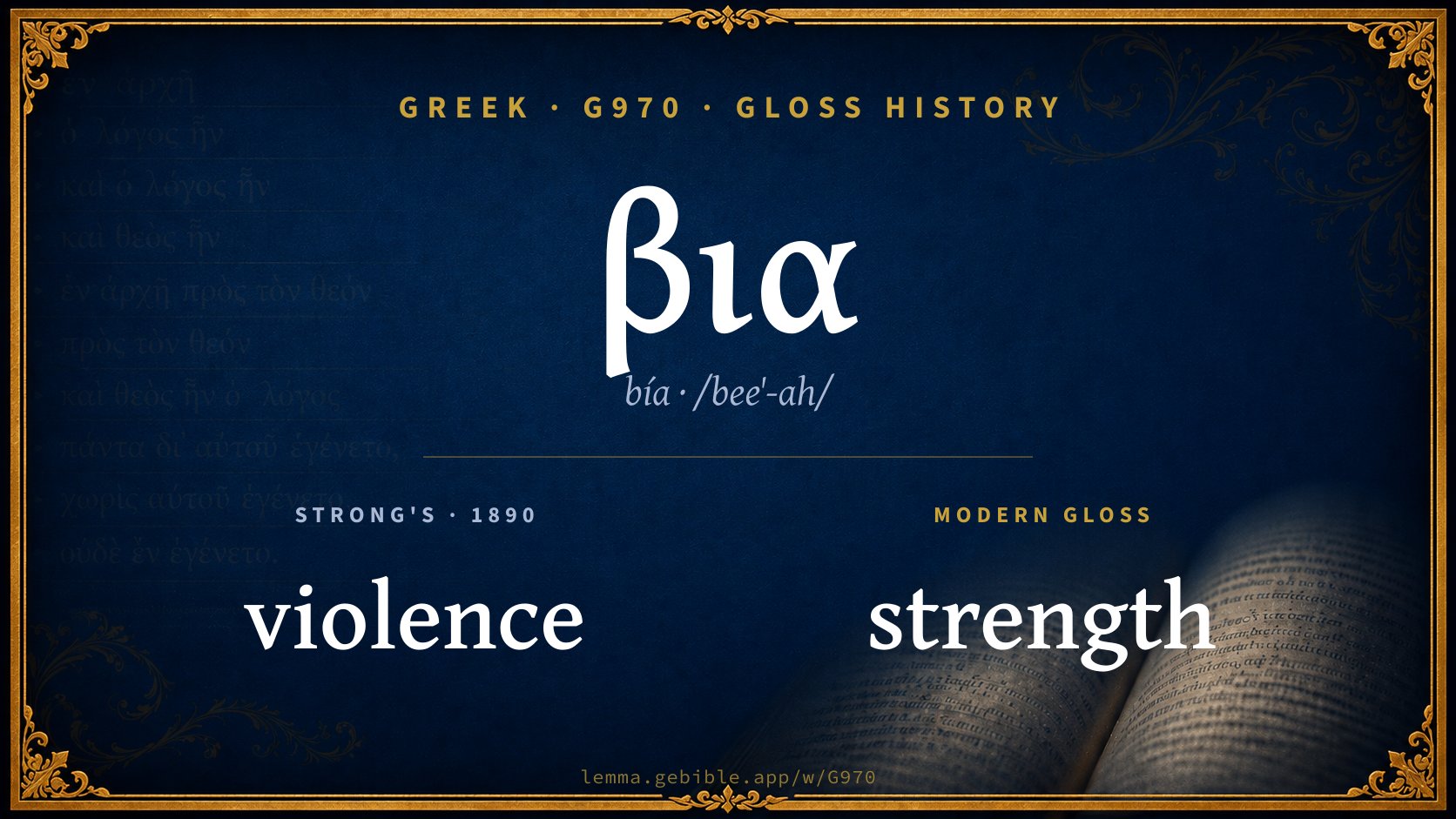
Gloss history
Strong's 1890 vs modern scholarship
About this word
Strong's G970 catalogs a Greek word from the Greek New Testament.
These counts are not copied from any lexicon or concordance. They are computed here, from the morphology-tagged Greek New Testament. What Lemma adds →
- 3
- distinct verses
- The word appears in 3 distinct verses.
- 1 / 27
- NT books
- The word appears in 1 of 27 New Testament books.
- #2,203
- by frequency
- Top 2500 most frequent Greek words (rank 2,203 of 5,347 Greek words by occurrence).
View all 3 occurrences in the concordance →
Most concentrated in
- Acts 3 verses 100%
By section of the New Testament
By traditional corpus
Conventional, traditional groupings — biblical authorship is debated, so this is a traditional corpus grouping, not an authorship claim. Some books belong to more than one corpus (Luke is in both the Gospels and the Lukan corpus, and so on), so these shares overlap and need not total 100%. Each figure is a share of the word’s 3 distinct verses.
- Lukan (Luke–Acts) 3 verses · 100%
How translations render this word
Counts come from each version’s own published word-to-Strong’s tagging or interlinear alignment — an approximate guide to how each version renders this word, not a word-level alignment the data otherwise carries. Because each total is that version’s own tagged count, the per-version totals vary from one another and need not match the appearance or distinct-verse counts above. These counts may also differ from a printed concordance because Lemma counts each distinctly tagged rendering and does not collapse phrase taggings into a single head-word total. This is a fixed set of word-tagged versions (KJV, ASV, BSB, ULT) and does not change with the reading translation you choose elsewhere. Each version’s license is shown beside its name below (and on Sources).
- King James Version: Violence 4×
- American Standard Version: Violence 2×
- Berean Standard Bible: Force 1×, Pounding 1×, Violence 1×
- unfoldingWord Literal Text: Violence 3×
King James Version Public Domain
Renders G970 across 4 tagged occurrences — most commonly:
American Standard Version Public Domain
Renders G970 across 3 tagged occurrences — most commonly:
Plus 1 rendering that appears only once — usually multi-word phrases or single function words the recovered tagging swept in, not distinct renderings.
Berean Standard Bible Public Domain
Renders G970 across 3 tagged occurrences — most commonly:
unfoldingWord Literal Text CC BY-SA 4.0
Renders G970 across 4 tagged occurrences — most commonly:
Plus 1 rendering that appears only once — usually multi-word phrases or single function words the recovered tagging swept in, not distinct renderings.
Senses in Thayer's
The 2 senses Thayer's distinguishes for this word, in lexicon order (not ranked by frequency or importance). The full entry — with sub-senses — is in the Lexicon Entry tab.
- strength, whether of body or mind
- strength in violent action, force
Word origin
Derived from βια (bía) (G970) — strength.
Probably akin to G979 (through the idea of vital activity); force : - violence.
— Strong’s Exhaustive Concordance (1890), public domain.
Forms in the corpus
The 2 distinct written forms G970 takes in the Greek New Testament, most frequent first — each parse links to that case’s occurrences in the concordance.
| Form | Parsing | Example | Uses |
|---|---|---|---|
| βίας bías | Noun, Genitive, Singular, Feminine | Acts 5:26 | 2 |
| βίαν bían | Noun, Accusative, Singular, Feminine | Acts 21:35 | 1 |
Same root — word family
Other Thayer's entries built from the same root as G970, grouped by Strong’s listed origin. These share a root / origin per the lexicon — not necessarily a shared meaning. Each links to that word’s own entry.
Derived from this word
Compare all same-root words → They share a root, not necessarily a meaning.
Septuagint usage
The same Greek word βια appears 14 times in the Greek Old Testament (Septuagint), across 14 verses in 6 books.
- 14
- LXX occurrences
- Tagged occurrences of this Greek word in the Septuagint.
- 14
- verses
- Distinct Septuagint verses containing this word.
- 6 / 39
- OT books
- The word appears in 6 of the 39 Old Testament books.
Sample Septuagint occurrences
- Exodus 1:13 βία
- Ezra 15:14 βία
- Isaiah 17:13 βία
- Ezekiel 44:18 βία
- Daniel 11:17 βία
- Habakkuk 3:6 βία
Septuagint occurrences (same lexeme)
Every verse where the same Strong’s number (G970) appears in the Greek Septuagint. Verse text shown in the World English Bible for context; the Greek form is the matched word — the English is not keyword-highlighted.
- Exodus 1:13 βία The Egyptians ruthlessly made the children of Israel serve,
- Exodus 1:14 βία and they made their lives bitter with hard service, in mortar and in brick, and in all manner of service in the field, all their service, in which they ruthlessly made them serve.
- Exodus 14:25 βία He took off their chariot wheels, and they drove them heavily; so that the Egyptians said, "Let's flee from the face of Israel, for Yahweh fights for them against the Egyptians!"
- Ezra 15:14 βία
- Ezra 15:15 βία
- Ezra 15:18 βία
- Isaiah 17:13 βία The nations shall rush like the rushing of many waters: but he shall rebuke them, and they shall flee far off, and shall be chased as the chaff of the mountains before the wind, and like the whirling dust before the storm.
- Isaiah 28:2 βία Behold, the Lord has a mighty and strong one; as a tempest of hail, a destroying storm, as a tempest of mighty waters overflowing, will he cast down to the earth with the hand.
- Isaiah 30:30 βία Yahweh will cause his glorious voice to be heard, and will show the lighting down of his arm, with the indignation of [his] anger, and the flame of a devouring fire, with a blast, and tempest, and hailstones.
- Isaiah 52:4 βία For thus says the Lord Yahweh, My people went down at the first into Egypt to sojourn there: and the Assyrian has oppressed them without cause.
- Isaiah 63:1 βία Who is this who comes from Edom, with dyed garments from Bozrah? this who is glorious in his clothing, marching in the greatness of his strength? I who speak in righteousness, mighty to save.
- Ezekiel 44:18 βία They shall have linen tires on their heads, and shall have linen breeches on their loins; they shall not gird themselves with [anything that causes] sweat.
- Daniel 11:17 βία He shall set his face to come with the strength of his whole kingdom, and with him equitable conditions; and he shall perform them: and he shall give him the daughter of women, to corrupt her; but she shall not stand, neither be for him.
- Habakkuk 3:6 βία He stood, and shook the earth. He looked, and made the nations tremble. The ancient mountains were crumbled. The age-old hills collapsed. His ways are eternal.
These are occurrences of the same Greek lexeme (G970) in the Septuagint — not a translation of any one Hebrew word. The store carries no word-level Hebrew↔Greek alignment, so no Hebrew original is asserted here. Counts come from the recovered LXX Strong's tagging — high-frequency vocabulary is well covered, while rare or late forms may be untagged — so they reflect tagged occurrences and may slightly undercount.