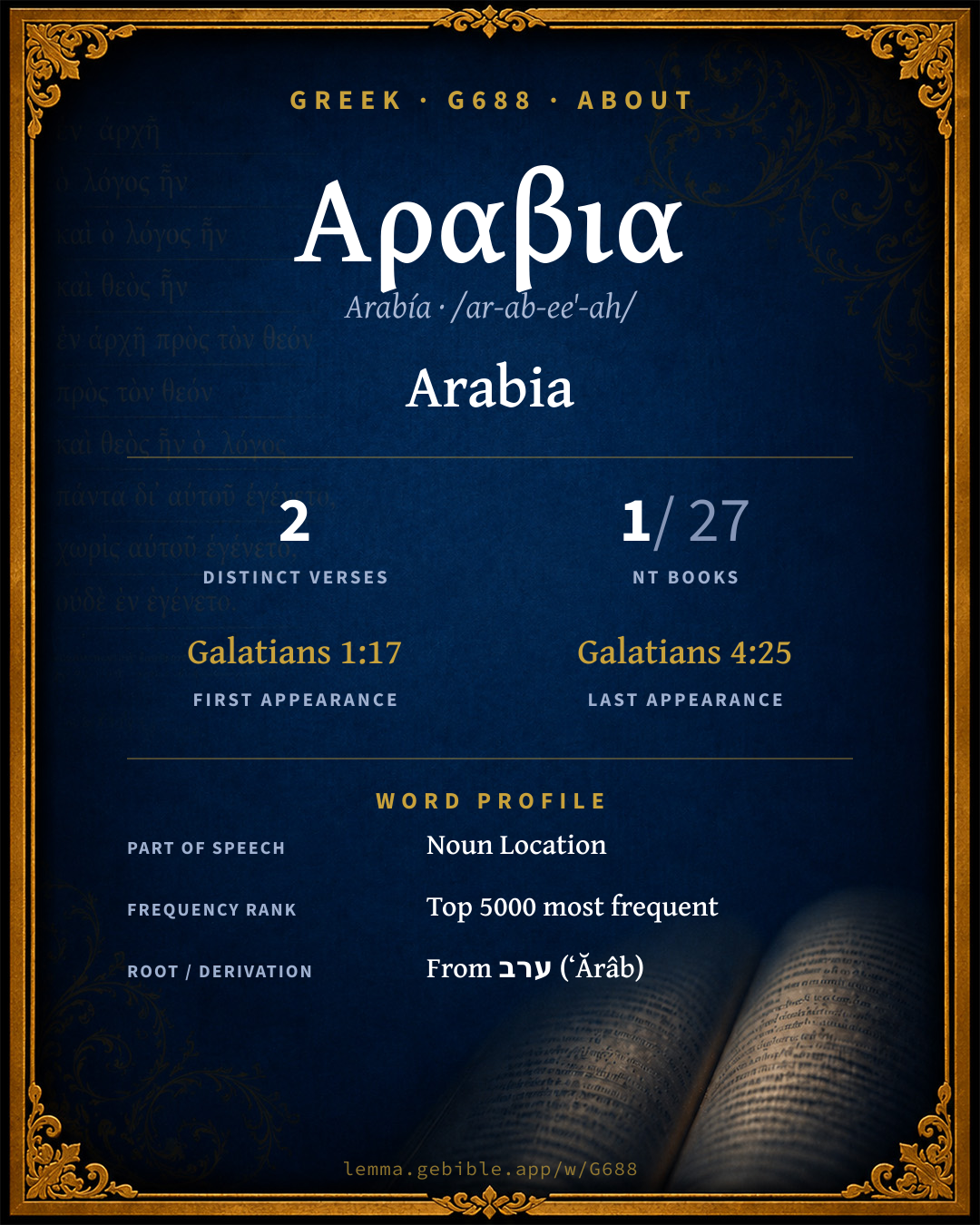
Ἀραβία
Arabia
Thayer's lists 2 entries for ‘Arabia’ fuller range ↓
Full lexicon entry — Thayer's Greek Lexicon
From Thayer's Greek Lexicon
Where this word appears
See every Accusative-case word in the Greek New Testament →
Grammar key — what these labels mean
Part of speech
- Noun
- A naming word — a person, place, thing, or idea.
Case
- Accusative
- The case of the direct object and of extent.
- Dative
- The case of the indirect object, means, or location — “to / for / with / in.”
Gender
- Feminine
- Grammatically feminine.
Number
- Singular
- One.
1 distinct verse where G688 appears in the Dative case, across 1 book. Filtered view — show all forms. Click any verse to open its interlinear word-by-word view. Verse text shown in the World English Bible for context — . Each verse’s Greek form is shown with its reference; the English is not keyword-highlighted, since the data carries no word-level English alignment. Use “Compare translations” on any verse to read it across multiple English versions. This concordance covers the Greek New Testament; Septuagint (Greek Old Testament) occurrences of this word are not indexed here.
Galatians 1 verse
About this entry
At a glance — auto-summarized from this page’s data, not written by a person. Every figure links to its source below. This summary describes the numbers; it doesn’t interpret them.
Αραβια (Arabía) is a Greek name most often rendered “Arabia.” The Greek New Testament uses it only 2 verses. It clusters heavily in Galatians, which alone accounts for 100% of its uses. It first appears in Galatians 1:17. For the data behind this summary, explore 2-verse concordance and the renderings breakdown below.
Gloss history
Strong's 1890 vs modern scholarship
About this word
Strong's G688 catalogs a Greek word from the Greek New Testament.
These counts are not copied from any lexicon or concordance. They are computed here, from the morphology-tagged Greek New Testament. What Lemma adds →
- 2
- distinct verses
- The word appears in 2 distinct verses.
- 1 / 27
- NT books
- The word appears in 1 of 27 New Testament books.
- #2,678
- by frequency
- Top 5000 most frequent Greek words (rank 2,678 of 5,347 Greek words by occurrence).
View all 2 occurrences in the concordance →
Most concentrated in
- Galatians 2 verses 100%
By section of the New Testament
By traditional corpus
Conventional, traditional groupings — biblical authorship is debated, so this is a traditional corpus grouping, not an authorship claim. Some books belong to more than one corpus (Luke is in both the Gospels and the Lukan corpus, and so on), so these shares overlap and need not total 100%. Each figure is a share of the word’s 2 distinct verses.
- Pauline corpus 2 verses · 100%
How translations render this word
Counts come from each version’s own published word-to-Strong’s tagging or interlinear alignment — an approximate guide to how each version renders this word, not a word-level alignment the data otherwise carries. Because each total is that version’s own tagged count, the per-version totals vary from one another and need not match the appearance or distinct-verse counts above. These counts may also differ from a printed concordance because Lemma counts each distinctly tagged rendering and does not collapse phrase taggings into a single head-word total. This is a fixed set of word-tagged versions (KJV, ASV, BSB, ULT) and does not change with the reading translation you choose elsewhere. Each version’s license is shown beside its name below (and on Sources).
- King James Version: Arabia 2×
- American Standard Version: Arabia 2×
- Berean Standard Bible: Arabia 2×
- unfoldingWord Literal Text: Arabia 2×
King James Version Public Domain
Renders G688 across 2 tagged occurrences — most commonly:
American Standard Version Public Domain
Renders G688 across 2 tagged occurrences — most commonly:
Berean Standard Bible Public Domain
Renders G688 across 2 tagged occurrences — most commonly:
unfoldingWord Literal Text CC BY-SA 4.0
Renders G688 across 2 tagged occurrences — most commonly:
Senses in Thayer's
The 2 senses Thayer's distinguishes for this word, in lexicon order (not ranked by frequency or importance). The full entry — with sub-senses — is in the Lexicon Entry tab.
- Arabia = "desert or barren"
- a well known peninsula of Asia lying towards Africa…
Word origin
Derived from ערב (ʻĂrâb) (H6152) — steppe.
Of hebrew origin [ H6152 ]; Arabia a region of Asia : - Arabia.
— Strong’s Exhaustive Concordance (1890), public domain.
Forms in the corpus
The 2 distinct written forms G688 takes in the Greek New Testament, most frequent first — each parse links to that case’s occurrences in the concordance.
| Form | Parsing | Example | Uses |
|---|---|---|---|
| Ἀραβίαν Arabían | Noun, Accusative, Singular, Feminine | Galatians 1:17 | 1 |
| Ἀραβίᾳ Arabía | Noun, Dative, Singular, Feminine | Galatians 4:25 | 1 |
Same root — word family
Other Thayer's entries built from the same root as G688, grouped by Strong’s listed origin. These share a root / origin per the lexicon — not necessarily a shared meaning. Each links to that word’s own entry.
Derives from
Proper names from this root
People and places named from this root — a name, not an additional meaning of the word.
Compare all same-root words → 3 of the same-root words are proper names (people or places). They share a root, not necessarily a meaning.
Bible dictionary
Public-domain dictionary articles matched to this entry by name (Arabia). A biblical name can be shared by more than one person or place, so an article may treat several.
Easton's Bible Dictionary · M. G. Easton, 1897
Arid, an extensive region in the south-west of Asia. It is bounded on the west by the Isthmus of Suez and the Red Sea, on the south by the Indian Ocean, and on the east by the Persian Gulf and the Euphrates. It extends far into the north in barren deserts, meeting those of Syria and Mesopotamia. It is one of the few countries of the world from which the original inhabitants have never been expelled.
It was anciently divided into three parts:, (1.) Arabia Felix (Happy Arabia), so called from its fertility. It embraced a large portion of the country now known by the name of Arabia. The Arabs call it Yemen. It lies between the Red Sea and the Persian Gulf. (2.) Arabia Deserta, the el-Badieh or "Great Wilderness" of the Arabs. From this name is derived that which is usually given to the nomadic tribes which wander over this region, the "Bedaween," or, more generally, "Bedouin," (3.) Arabia Petraea, i.e., the Rocky Arabia, so called from its rocky mountains and stony plains. It comprehended all the north-west portion of the country, and is much better known to travellers than any other portion. This country is, however, divided by modern geographers into (1) Arabia Proper, or the Arabian Peninsula; (2) Northern Arabia, or the Arabian Desert; and (3) Western Arabia, which includes the peninsula of Sinai and the Desert of Petra, originally inhabited by the Horites (Gen. 14:6, etc.), but in later times by the descendants of Esau, and known as the Land of Edom or Idumea, also as the Desert of Seir or Mount Seir.
The whole land appears (Gen. 10) to have been inhabited by a variety of tribes of different lineage, Ishmaelites, Arabians, Idumeans, Horites, and Edomites; but at length becoming amalgamated, they came to be known by the general designation of Arabs. The modern nation of Arabs is predominantly Ishmaelite. Their language is the most developed and the richest of all the Semitic languages, and is of great value to the student of Hebrew.
The Israelites wandered for forty years in Arabia. In the days of Solomon, and subsequently, commercial intercourse was to a considerable extent kept up with this country (1 Kings 10:15; 2 Chr. 9:14; 17:11). Arabians were present in Jerusalem at Pentecost (Acts 2:11). Paul retired for a season into Arabia after his conversion (Gal. 1:17). This country is frequently referred to by the prophets (Isa. 21:11; 42:11; Jer. 25:24, etc.)
Smith's Bible Dictionary · William Smith, 1863
(desert, barren), a country known in the Old Testament under two designations:--
+ The East Country, (Genesis 25:6) or perhaps the East, ((Genesis 10:30; Numbers 23:7; Isaiah 2:6) and Land of the Sons of the East, (Genesis 29:1) Gentile name, Sons of the East, (Judges 6:3; 7:12; 1 Kings 4:30; Job 1:3; Isaiah 11:14; Jeremiah 49:28; Ezekiel 25:4) From these passages it appears that Land of the East and Sons of the East indicate, primarily, the country east of Palestine, and the tribes descended from Ishmael and from Keturah; and that this original signification may have become gradually extended to Arabia and its inhabitants generally, though without any strict limitation. + 'Arab and 'Arab, whence Arabia. (2 Chronicles 9:14; Isaiah 21:13; Jeremiah 26:24; Ezekiel 27:21) (Arabia is a triangular peninsula, included between the Mediterranean and Red seas, the Indian Ocean and the Persian Gulf. Its extreme length, north and south, is about 1300 miles, and its greatest breadth 1500 miles. -Encyc. Brit.) Divisions .--Arabia may be divided into Arabia Proper, containing the whole peninsula as far as the limits of the northern deserts; Northern Arabia (Arabia Deserta), constituting the great desert of Arabia; and Western Arabia, the desert of Petra and the peninsula of Sinai, or the country that has been called Arabia Petraea, I. Arabia Proper, or the Arabian penninsula consists of high tableland, declining towards the north. Most of it is well peopled, watered by wells and streams, and enjoys periodical rains. The moist fertile tracts are those on the southwest and south. II. Northern Arabia, or the Arabian Desert, is a high, undulating, parched plain, of which the Euphrates forms the natural boundary from the Persian Gulf to the frontier of Syria, whence it is bounded by the latter country and the desert of Petra on the northwest and west, the peninsula of Arabia forming its southern limit. It has few oases, the water of the wells is generally either brackish or unpotable and it is visited by the sand-wind called Samoom . The inhabitants principally descended from Ishmael and from Keturah, have always led a wandering and pastoral life. They conducted a considerable trade of merchandise of Arabia and India from the shore of the Persian Gulf. (Ezekiel 27:20-24) III. Western Arabia includes the peninsula of Sinai [Sinai, Or Sinai] and the desert of Petra; corresponding generally with the limits of Arabia Petraea. The latter name is probably derived from that of its chief city, not from its stony character. It was mostly peopled by descendants of Esau, and was generally known as the land of Edom or Idumea [Edom, Idumaea Or Idumea], as well as by its older appellation, the desert of Seir or Mount Seir. [Seir] Inhabitants .-- (Arabia, which once ruled from India to the Atlantic, now has eight or nine millions of inhabitants, about one-fifth of whom are Bedouin or wandering tribes, and the other four-fifths settled Arabs.--Encyc. Brit.) + The descendants of Joktan occupied the principal portions of the south and southwest of the peninsula, with colonies in the interior. The principal Joktanite kingdom, and the chief state of ancient Arabia, was that of the Yemen. + The ISHMAELITES appear to have entered the peninsula from the northwest. That they have spread over the whole of it (with the exception of one or two districts on the south coast), and that the modern nation is predominantly Ishmaelite, is asserted by the Arabs. + Of the descendants of Keturah the Arabs say little. They appear to have settled chiefly north of the peninsula in Desert Arabia, from Palestine to the Persian Gulf. + In northern and western Arabia are other peoples, which, from their geographical position and mode of life are sometimes classed with the Arabs, of these are Amalek, the descendants of Esau, etc. (Productions-- The productions are varied. The most noted animal is the horse. Camels, sheep, cattle, asses, mules and cats are common. Agricultural products are coffee, wheat, barley, millet, beans, pulse, dates and the common garden plants. In pasture lands Arabia is peculiarly fortunate. In mineral products it is singularly poor, lead being most abundant.--Encyc. Brit.) Religion .-- The most ancient idolatry of the Arabs we must conclude to have been fetishism. Magianism, an importation from Chaldaea and Persia, must be reckoned among the religions of the pagan Arabs; but it never had very numerous followers. Christianity was introduced into southern Arabia toward the close of the second century, and about a century later it had made great progress. It flourished chiefly in the Yemen, where many churches were built. Judaism was propagated in Arabia, principally by Karaites, at the captivity. They are now nominally Mohammedans. Language .-- Arabic the language of Arabia, is the most developed and the richest of Shemitic languages, and the only one of which we have an extensive literature; it is, therefore, of great importance to the study of Hebrew. Government .-- Arabia is now under the government of the Ottoman empire.
Hitchcock's Bible Names Dictionary · Roswell D. Hitchcock, 1869
evening; desert; ravens
Classic public-domain reference works; full attribution on Sources.
Septuagint usage
The same Greek word Αραβια appears 11 times in the Greek Old Testament (Septuagint), across 11 verses in 8 books.
- 11
- LXX occurrences
- Tagged occurrences of this Greek word in the Septuagint.
- 11
- verses
- Distinct Septuagint verses containing this word.
- 8 / 39
- OT books
- The word appears in 8 of the 39 Old Testament books.
Sample Septuagint occurrences
- Genesis 45:10 ἀραβία
- 2 Chronicles 9:14 ἀραβία
- Job 42:17 ἀραβία
- Psalms 71:15 ἀραβία
- Isaiah 10:9 ἀραβία
- Ezekiel 27:21 ἀραβία
- Habakkuk 1:8 ἀραβία
- Zephaniah 3:3 ἀράβια
Septuagint occurrences (same lexeme)
Every verse where the same Strong’s number (G688) appears in the Greek Septuagint. Verse text shown in the World English Bible for context; the Greek form is the matched word — the English is not keyword-highlighted.
- Genesis 45:10 ἀραβία You shall dwell in the land of Goshen, and you will be near to me, you, your children, your children's children, your flocks, your herds, and all that you have.
- Genesis 46:34 ἀραβία that you shall say, 'Your servants have been keepers of cattle from our youth even until now, both we, and our fathers:' that you may dwell in the land of Goshen; for every shepherd is an abomination to the Egyptians."
- 2 Chronicles 9:14 ἀραβία besides that which the traders and merchants brought: and all the kings of Arabia and the governors of the country brought gold and silver to Solomon.
- Job 42:17 ἀραβία So Job died, being old and full of days.
- Psalms 71:15 ἀραβία My mouth will tell about your righteousness, And of your salvation all day, Though I don't know its full measure.
- Isaiah 10:9 ἀραβία Isn't Calno as Carchemish? Isn't Hamath as Arpad? Isn't Samaria as Damascus?
- Isaiah 11:11 ἀραβία It shall happen in that day, that the Lord will set his hand again the second time to recover the remnant of his people, who shall remain, from Assyria, and from Egypt, and from Pathros, and from Cush, and from Elam, and from Shinar, and from Hamath, and from the islands of the sea.
- Ezekiel 27:21 ἀραβία Arabia, and all the princes of Kedar, they were the merchants of your hand; in lambs, and rams, and goats, in these were they your merchants.
- Ezekiel 47:8 ἀραβία Then said he to me, These waters issue forth toward the eastern region, and shall go down into the Arabah; and they shall go toward the sea; into the sea [shall the waters go] which were made to issue forth; and the waters shall be healed.
- Habakkuk 1:8 ἀραβία Their horses also are swifter than leopards, and are more fierce than the evening wolves. Their horsemen press proudly on. Yes, their horsemen come from afar. They fly as an eagle that hurries to devour.
- Zephaniah 3:3 ἀράβια Her princes in the midst of her are roaring lions. Her judges are evening wolves. They leave nothing until the next day.
These are occurrences of the same Greek lexeme (G688) in the Septuagint — not a translation of any one Hebrew word. The store carries no word-level Hebrew↔Greek alignment, so no Hebrew original is asserted here. Counts come from the recovered LXX Strong's tagging — high-frequency vocabulary is well covered, while rare or late forms may be untagged — so they reflect tagged occurrences and may slightly undercount.