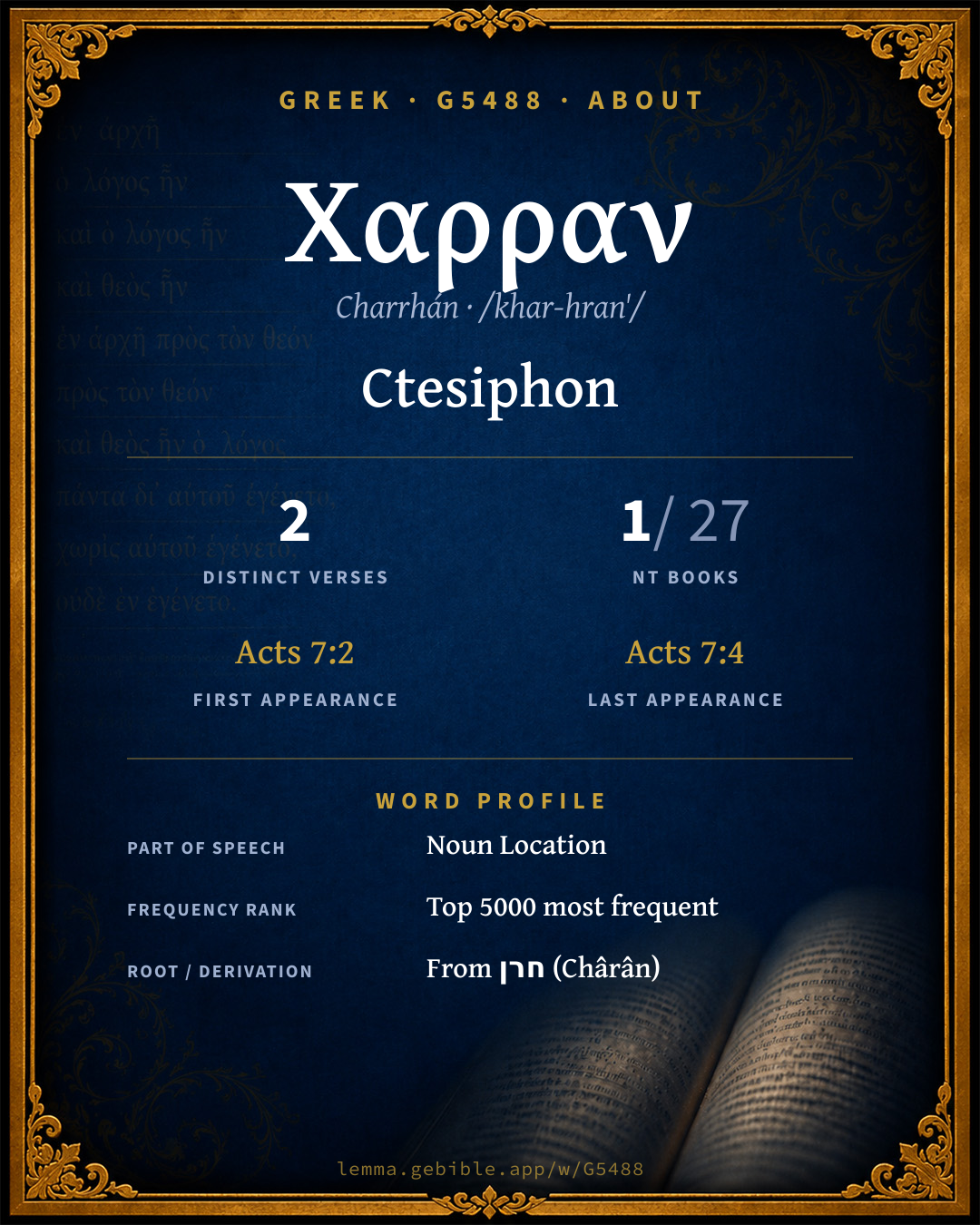
Χαῤῥάν
Ctesiphon
Thayer's lists 2 entries for ‘Ctesiphon’ fuller range ↓
Full lexicon entry — Thayer's Greek Lexicon
From Thayer's Greek Lexicon
Where this word appears
Every verse where G5488 appears — 2 distinct verses across 1 book. Click any verse to open its interlinear word-by-word view. Verse text shown in the World English Bible for context — . Each verse’s Greek form is shown with its reference; the English is not keyword-highlighted, since the data carries no word-level English alignment. Use “Compare translations” on any verse to read it across multiple English versions. This concordance covers the Greek New Testament; Septuagint (Greek Old Testament) occurrences of this word are not indexed here.
Acts 2 verses
- Acts 7:2 Χαρράν n proper indecl He said, "Brothers and fathers, listen. The God of glory appeared to our father Abraham, when he was in Mesopotamia, before he lived in Haran,
- Acts 7:4 Χαρράν n proper indecl Then he came out of the land of the Chaldaeans, and lived in Haran. From there, when his father was dead, God moved him into this land, where you are now living.
About this entry
At a glance — auto-summarized from this page’s data, not written by a person. Every figure links to its source below. This summary describes the numbers; it doesn’t interpret them.
The Greek name Χαρραν centers on the idea of “Ctesiphon.” With only 2 verses it sits in the long tail of Greek New Testament vocabulary. Acts dominates its distribution — 2 of 2 verses. First canonically at Acts 7:2, it enters the text early. Dig into 2-verse concordance and the renderings breakdown below.
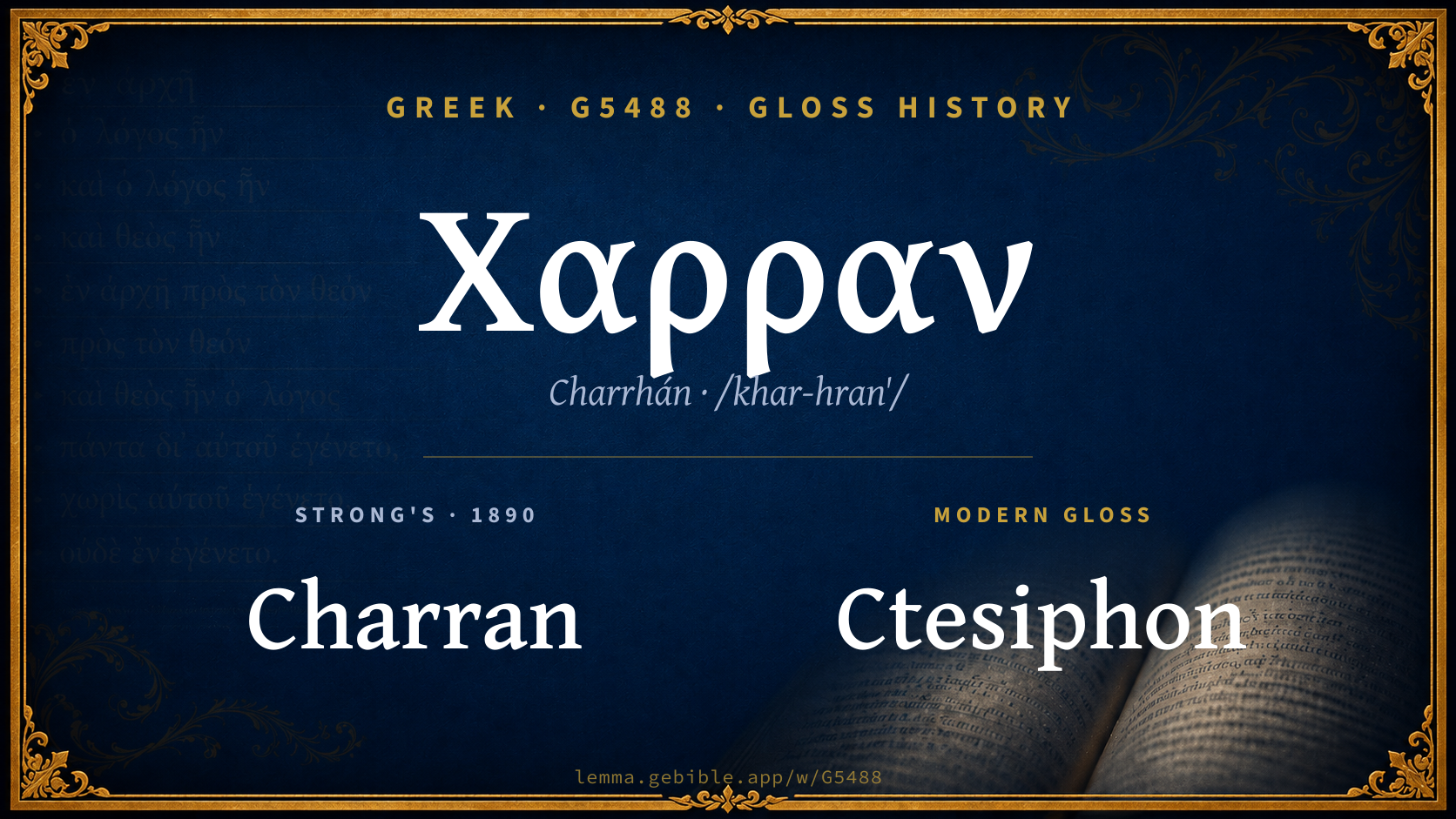
Gloss history
Strong's 1890 vs modern scholarship
About this word
Strong's G5488 catalogs a Greek word from the Greek New Testament.
These counts are not copied from any lexicon or concordance. They are computed here, from the morphology-tagged Greek New Testament. What Lemma adds →
- 2
- distinct verses
- The word appears in 2 distinct verses.
- 1 / 27
- NT books
- The word appears in 1 of 27 New Testament books.
- #2,678
- by frequency
- Top 5000 most frequent Greek words (rank 2,678 of 5,347 Greek words by occurrence).
View all 2 occurrences in the concordance →
Most concentrated in
- Acts 2 verses 100%
By section of the New Testament
By traditional corpus
Conventional, traditional groupings — biblical authorship is debated, so this is a traditional corpus grouping, not an authorship claim. Some books belong to more than one corpus (Luke is in both the Gospels and the Lukan corpus, and so on), so these shares overlap and need not total 100%. Each figure is a share of the word’s 2 distinct verses.
- Lukan (Luke–Acts) 2 verses · 100%
How translations render this word
Counts come from each version’s own published word-to-Strong’s tagging or interlinear alignment — an approximate guide to how each version renders this word, not a word-level alignment the data otherwise carries. Because each total is that version’s own tagged count, the per-version totals vary from one another and need not match the appearance or distinct-verse counts above. These counts may also differ from a printed concordance because Lemma counts each distinctly tagged rendering and does not collapse phrase taggings into a single head-word total. This is a fixed set of word-tagged versions (KJV, ASV, BSB, ULT) and does not change with the reading translation you choose elsewhere. Each version’s license is shown beside its name below (and on Sources).
- King James Version: Charran 2×
- American Standard Version: Haran 2×
- Berean Standard Bible: Haran 2×
- unfoldingWord Literal Text: Haran 2×
King James Version Public Domain
Renders G5488 across 2 tagged occurrences — most commonly:
American Standard Version Public Domain
Renders G5488 across 2 tagged occurrences — most commonly:
Berean Standard Bible Public Domain
Renders G5488 across 2 tagged occurrences — most commonly:
unfoldingWord Literal Text CC BY-SA 4.0
Renders G5488 across 2 tagged occurrences — most commonly:
Senses in Thayer's
The 2 senses Thayer's distinguishes for this word, in lexicon order (not ranked by frequency or importance). The full entry — with sub-senses — is in the Lexicon Entry tab.
- Haran = "a mountaineer"
- a city in Mesopotamia, of great antiquity and made famous by the defeat of Crassus
Word origin
Derived from חרן (Chârân) (H2771) — Haran.
Of hebrew origin [ H2771 ]; Charrhan (that is Charan ) a place in mesopotamia : - Charran.
— Strong’s Exhaustive Concordance (1890), public domain.
Septuagint usage
The same Greek word Χαρραν appears 14 times in the Greek Old Testament (Septuagint), across 13 verses in 6 books.
- 14
- LXX occurrences
- Tagged occurrences of this Greek word in the Septuagint.
- 13
- verses
- Distinct Septuagint verses containing this word.
- 6 / 39
- OT books
- The word appears in 6 of the 39 Old Testament books.
Sample Septuagint occurrences
- Genesis 11:31 χαρραν
- 2 Kings 19:12 χαρραν
- 1 Chronicles 1:29 χαρραν
- Isaiah 37:12 χαρραν
- Ezekiel 27:23 χαρραν
- Amos 1:5 χαρραν
Septuagint occurrences (same lexeme)
Every verse where the same Strong’s number (G5488) appears in the Greek Septuagint. Verse text shown in the World English Bible for context; the Greek form is the matched word — the English is not keyword-highlighted.
- Genesis 11:31 χαρραν Terah took Abram his son, Lot the son of Haran, his son's son, and Sarai his daughter-in-law, his son Abram's wife. They went forth from Ur of the Chaldees, to go into the land of Canaan. They came to Haran, and lived there.
- Genesis 11:32 χαρραν The days of Terah were two hundred five years. Terah died in Haran.
- Genesis 12:4 χαρραν So Abram went, as Yahweh had spoken to him. Lot went with him. Abram was seventy-five years old when he departed out of Haran.
- Genesis 12:5 χαρραν Abram took Sarai his wife, Lot his brother's son, all their substance that they had gathered, and the souls who they had gotten in Haran; and they went forth to go into the land of Canaan. Into the land of Canaan they came.
- Genesis 27:43 χαρραν Now therefore, my son, obey my voice. Arise, flee to Laban, my brother, in Haran.
- Genesis 28:10 χαρραν Jacob went out from Beersheba, and went toward Haran.
- Genesis 29:4 χαρραν Jacob said to them, "My relatives, where are you from?" They said, "We are from Haran."
- Genesis 36:26 χαρραν These are the children of Dishon: Hemdan, Eshban, Ithran, and Cheran.
- 2 Kings 19:12 χαρραν Have the gods of the nations delivered them, which my fathers have destroyed, Gozan, and Haran, and Rezeph, and the children of Eden that were in Telassar?
- 1 Chronicles 1:29 χαρραν These are their generations: the firstborn of Ishmael, Nebaioth; then Kedar, and Adbeel, and Mibsam,
- Isaiah 37:12 χαρραν Have the gods of the nations delivered them, which my fathers have destroyed, Gozan, and Haran, and Rezeph, and the children of Eden who were in Telassar?
- Ezekiel 27:23 χαρραν Haran and Canneh and Eden, the traffickers of Sheba, Asshur [and] Chilmad, were your traffickers.
- Amos 1:5 χαρραν I will break the bar of Damascus, And cut off the inhabitant from the valley of Aven, And him who holds the scepter from the house of Eden; And the people of Syria shall go into captivity to Kir," says Yahweh.
These are occurrences of the same Greek lexeme (G5488) in the Septuagint — not a translation of any one Hebrew word. The store carries no word-level Hebrew↔Greek alignment, so no Hebrew original is asserted here. Counts come from the recovered LXX Strong's tagging — high-frequency vocabulary is well covered, while rare or late forms may be untagged — so they reflect tagged occurrences and may slightly undercount.