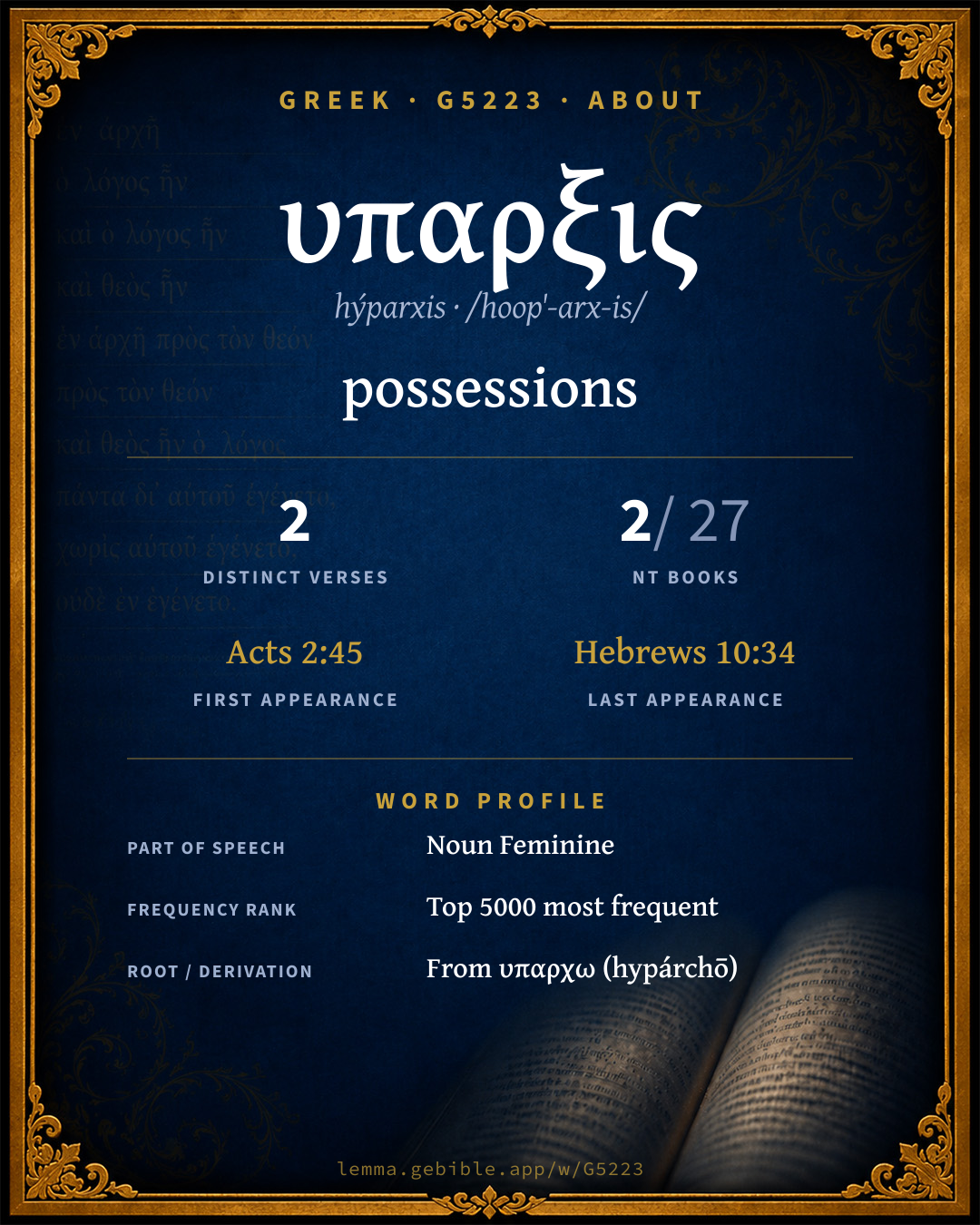
ὕπαρξις
possessions
Full lexicon entry — Thayer's Greek Lexicon
From Thayer's Greek Lexicon
Where this word appears
Grammar key — what these labels mean
Part of speech
- Noun
- A naming word — a person, place, thing, or idea.
Case
- Accusative
- The case of the direct object and of extent.
Gender
- Feminine
- Grammatically feminine.
Number
- Plural
- More than one.
- Singular
- One.
Every verse where G5223 appears in the Book of Hebrews — 1 distinct verse. Click any verse to open its interlinear word-by-word view. Verse text shown in the World English Bible for context — . Each verse’s Greek form is shown with its reference; the English is not keyword-highlighted, since the data carries no word-level English alignment. Use “Compare translations” on any verse to read it across multiple English versions. This concordance covers the Greek New Testament; Septuagint (Greek Old Testament) occurrences of this word are not indexed here.
Hebrews
About this entry
At a glance — auto-summarized from this page’s data, not written by a person. Every figure links to its source below. This summary describes the numbers; it doesn’t interpret them.
“possessions” is the headline sense of the Greek noun υπαρξις (hýparxis). With only 2 verses it sits in the long tail of Greek New Testament vocabulary. It clusters heavily in Acts, which alone accounts for 50% of its uses. First canonically at Acts 2:45, it enters the text early. From the same root come υπαρχω and υπαρχοντα. The sections below give every sense, occurrence, and version rendering.
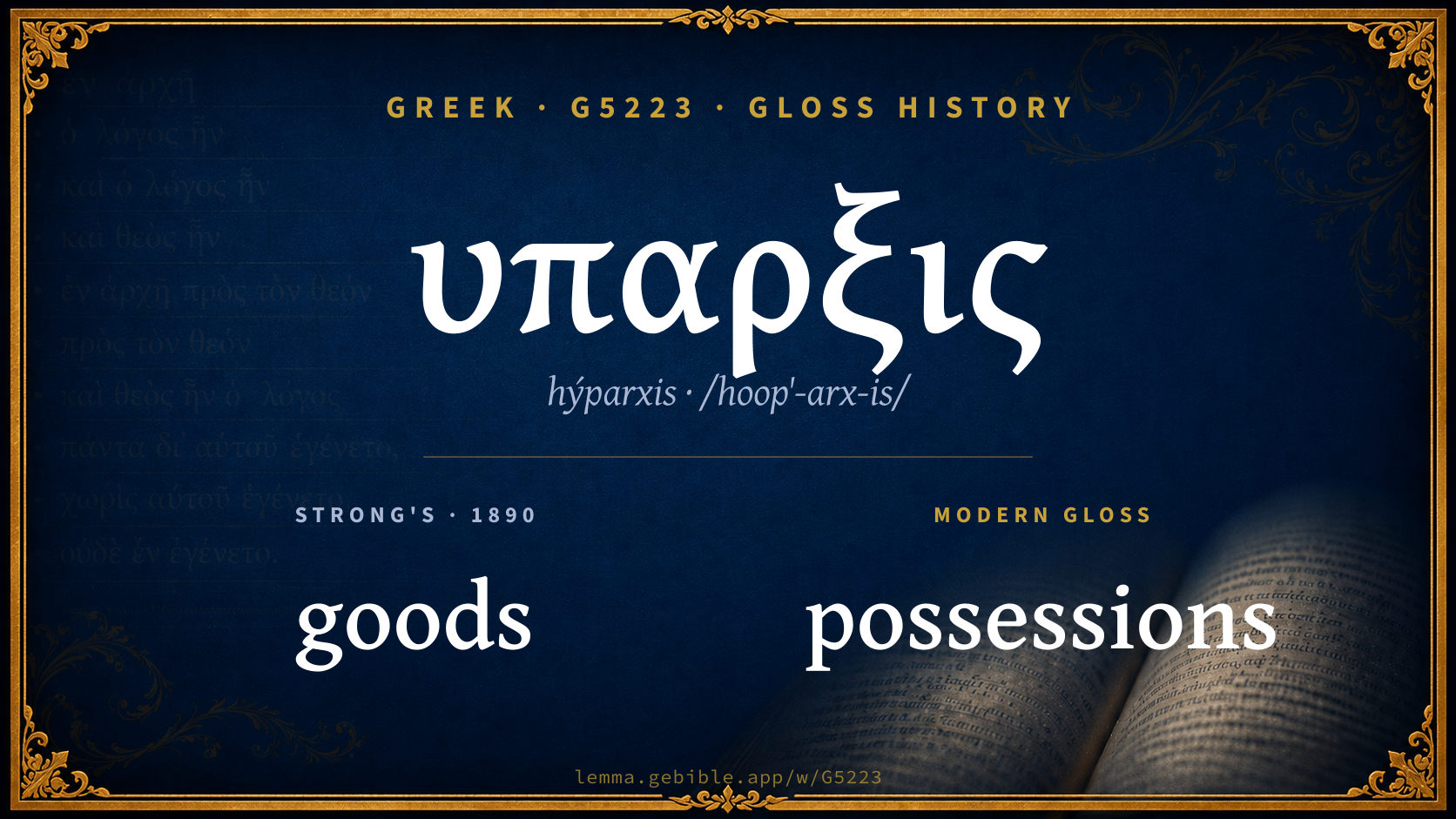
Gloss history
Strong's 1890 vs modern scholarship
About this word
Strong's G5223 catalogs a Greek word from the Greek New Testament.
These counts are not copied from any lexicon or concordance. They are computed here, from the morphology-tagged Greek New Testament. What Lemma adds →
- 2
- distinct verses
- The word appears in 2 distinct verses.
- 2 / 27
- NT books
- The word appears in 2 of 27 New Testament books.
- #2,678
- by frequency
- Top 5000 most frequent Greek words (rank 2,678 of 5,347 Greek words by occurrence).
View all 2 occurrences in the concordance →
By traditional corpus
Conventional, traditional groupings — biblical authorship is debated, so this is a traditional corpus grouping, not an authorship claim. Some books belong to more than one corpus (Luke is in both the Gospels and the Lukan corpus, and so on), so these shares overlap and need not total 100%. Each figure is a share of the word’s 2 distinct verses.
- Lukan (Luke–Acts) 1 verse · 50%
- Hebrews 1 verse · 50%
How translations render this word
Counts come from each version’s own published word-to-Strong’s tagging or interlinear alignment — an approximate guide to how each version renders this word, not a word-level alignment the data otherwise carries. Because each total is that version’s own tagged count, the per-version totals vary from one another and need not match the appearance or distinct-verse counts above. These counts may also differ from a printed concordance because Lemma counts each distinctly tagged rendering and does not collapse phrase taggings into a single head-word total. This is a fixed set of word-tagged versions (KJV, ASV, BSB, ULT) and does not change with the reading translation you choose elsewhere. Each version’s license is shown beside its name below (and on Sources).
- King James Version: Goods 1×, Substance 1×
- American Standard Version: Goods 1×, One 1×
- Berean Standard Bible: Goods 1×, Possession 1×
- unfoldingWord Literal Text: A 1×, Possession 1×, Possessions 1×
King James Version Public Domain
Renders G5223 across 2 tagged occurrences — most commonly:
American Standard Version Public Domain
Renders G5223 across 2 tagged occurrences — most commonly:
Berean Standard Bible Public Domain
Renders G5223 across 2 tagged occurrences — most commonly:
unfoldingWord Literal Text CC BY-SA 4.0
Renders G5223 across 3 tagged occurrences — most commonly:
Senses in Thayer's
The 1 sense Thayer's distinguishes for this word, in lexicon order (not ranked by frequency or importance). The full entry — with sub-senses — is in the Lexicon Entry tab.
- possessions, goods, wealth, property
Word origin
Derived from υπαρχω (hypárchō) (G5225) — to be at hand.
From G5225 ; existency or proprietorship that is (concretely) property wealth : - goods substance.
— Strong’s Exhaustive Concordance (1890), public domain.
Forms in the corpus
The 2 distinct written forms G5223 takes in the Greek New Testament, most frequent first — each parse links to that case’s occurrences in the concordance.
| Form | Parsing | Example | Uses |
|---|---|---|---|
| ὑπάρξεις hypárxeis | Noun, Accusative, Plural, Feminine | Acts 2:45 | 1 |
| ὕπαρξιν hýparxin | Noun, Accusative, Singular, Feminine | Hebrews 10:34 | 1 |
Same root — word family
Other Thayer's entries built from the same root as G5223, grouped by Strong’s listed origin. These share a root / origin per the lexicon — not necessarily a shared meaning. Each links to that word’s own entry.
Derives from
Shares the same root
Compare all same-root words → They share a root, not necessarily a meaning.
Septuagint usage
The same Greek word υπαρξις appears 7 times in the Greek Old Testament (Septuagint), across 7 verses in 5 books.
- 7
- LXX occurrences
- Tagged occurrences of this Greek word in the Septuagint.
- 7
- verses
- Distinct Septuagint verses containing this word.
- 5 / 39
- OT books
- The word appears in 5 of the 39 Old Testament books.
Sample Septuagint occurrences
- 2 Chronicles 35:7 ὑπάρξις
- Ezra 10:8 ὕπαρξις
- Psalms 77:48 ὕπαρξις
- Proverbs 13:11 ὕπαρξις
- Jeremiah 9:9 ὕπαρξις
Septuagint occurrences (same lexeme)
Every verse where the same Strong’s number (G5223) appears in the Greek Septuagint. Verse text shown in the World English Bible for context; the Greek form is the matched word — the English is not keyword-highlighted.
- 2 Chronicles 35:7 ὑπάρξις Josiah gave to the children of the people, of the flock, lambs and kids, all of them for the Passover offerings, to all who were present, to the number of thirty thousand, and three thousand bulls: these were of the king's substance.
- Ezra 10:8 ὕπαρξις and that whoever didn't come within three days, according to the counsel of the princes and the elders, all his substance should be forfeited, and himself separated from the assembly of the captivity.
- Psalms 77:48 ὕπαρξις
- Proverbs 13:11 ὕπαρξις Wealth gained dishonestly dwindles away, But he who gathers by hand makes it grow.
- Proverbs 18:11 ὕπαρξις The rich man's wealth is his strong city, Like an unscalable wall in his own imagination.
- Proverbs 19:14 ὕπαρξις House and riches are an inheritance from fathers, But a prudent wife is from Yahweh.
- Jeremiah 9:9 ὕπαρξις Shall I not visit them for these things? says Yahweh; shall not my soul be avenged on such a nation as this?
These are occurrences of the same Greek lexeme (G5223) in the Septuagint — not a translation of any one Hebrew word. The store carries no word-level Hebrew↔Greek alignment, so no Hebrew original is asserted here. Counts come from the recovered LXX Strong's tagging — high-frequency vocabulary is well covered, while rare or late forms may be untagged — so they reflect tagged occurrences and may slightly undercount.