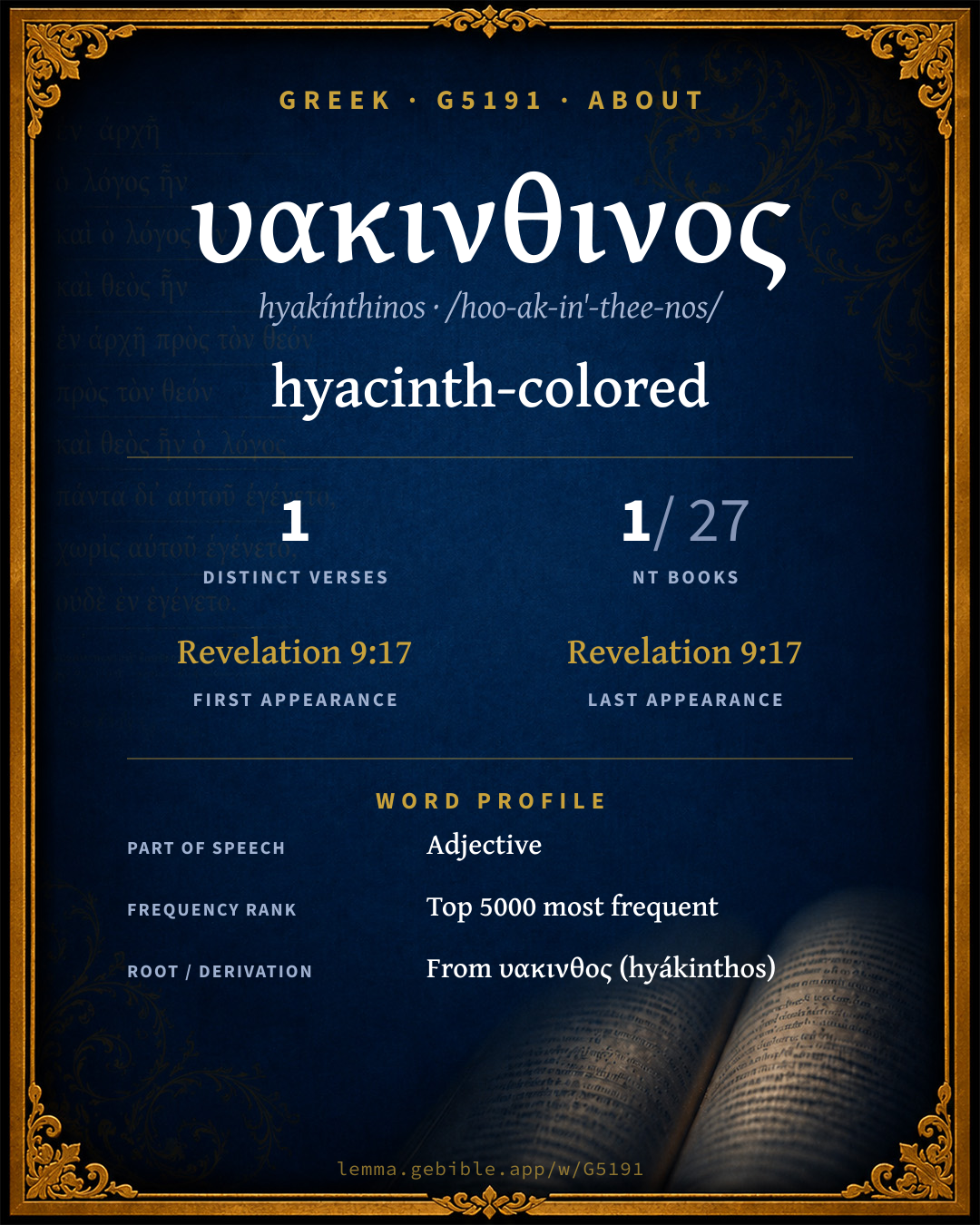
ὑακίνθινος
hyacinth-colored
Full lexicon entry — Thayer's Greek Lexicon
From Thayer's Greek Lexicon
Where this word appears
Grammar key — what these labels mean
Part of speech
- Adjective
- A word that describes or qualifies a noun.
Case
- Accusative
- The case of the direct object and of extent.
Gender
- Masculine
- Grammatically masculine.
Number
- Plural
- More than one.
Every verse where G5191 appears — 1 distinct verse across 1 book. Click any verse to open its interlinear word-by-word view. Verse text shown in the World English Bible for context — . Each verse’s Greek form is shown with its reference; the English is not keyword-highlighted, since the data carries no word-level English alignment. Use “Compare translations” on any verse to read it across multiple English versions. This concordance covers the Greek New Testament; Septuagint (Greek Old Testament) occurrences of this word are not indexed here.
Revelation 1 verse
About this entry
At a glance — auto-summarized from this page’s data, not written by a person. Every figure links to its source below. This summary describes the numbers; it doesn’t interpret them.
υακινθινος — transliterated hyakínthinos — is a Greek adjective carrying the sense “hyacinth-colored.” The Greek New Testament uses it only 1 verse. More than three-quarters of its appearances fall in Revelation. It occurs only once, in Revelation 9:17. Each statement above links to its evidence; the full detail follows below.
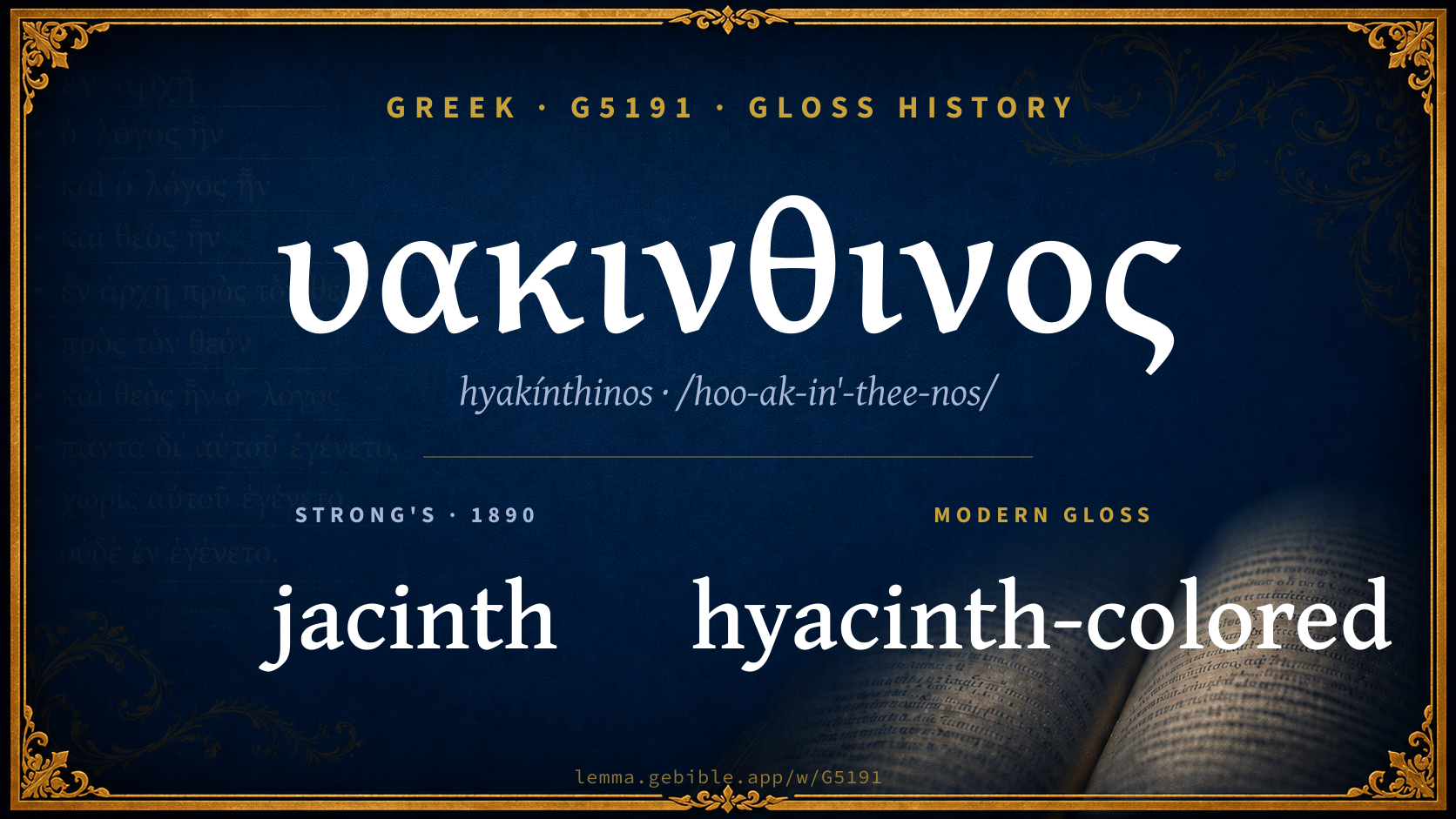
Gloss history
Strong's 1890 vs modern scholarship
About this word
Strong's G5191 catalogs a Greek word from the Greek New Testament.
These counts are not copied from any lexicon or concordance. They are computed here, from the morphology-tagged Greek New Testament. What Lemma adds →
- 1
- distinct verses
- The word appears in 1 distinct verse.
- 1 / 27
- NT books
- The word appears in 1 of 27 New Testament books.
- #3,503
- by frequency
- Top 5000 most frequent Greek words (rank 3,503 of 5,347 Greek words by occurrence).
View all 1 occurrence in the concordance →
Most concentrated in
- Revelation 1 verse 100%
By section of the New Testament
By traditional corpus
Conventional, traditional groupings — biblical authorship is debated, so this is a traditional corpus grouping, not an authorship claim. Some books belong to more than one corpus (Luke is in both the Gospels and the Lukan corpus, and so on), so these shares overlap and need not total 100%. Each figure is a share of the word’s 1 distinct verse.
- Johannine 1 verse · 100%
- Revelation 1 verse · 100%
How translations render this word
Counts come from each version’s own published word-to-Strong’s tagging or interlinear alignment — an approximate guide to how each version renders this word, not a word-level alignment the data otherwise carries. Because each total is that version’s own tagged count, the per-version totals vary from one another and need not match the appearance or distinct-verse counts above. These counts may also differ from a printed concordance because Lemma counts each distinctly tagged rendering and does not collapse phrase taggings into a single head-word total. This is a fixed set of word-tagged versions (KJV, ASV, BSB, ULT) and does not change with the reading translation you choose elsewhere. Each version’s license is shown beside its name below (and on Sources).
- King James Version: Jacinth 1×
- American Standard Version: Hyacinth 1×
- Berean Standard Bible: Sapphire 1×
- unfoldingWord Literal Text: Hyacinth 1×
King James Version Public Domain
Renders G5191 across 1 tagged occurrence — most commonly:
American Standard Version Public Domain
Renders G5191 across 1 tagged occurrence — most commonly:
Berean Standard Bible Public Domain
Renders G5191 across 1 tagged occurrence — most commonly:
unfoldingWord Literal Text CC BY-SA 4.0
Renders G5191 across 1 tagged occurrence — most commonly:
Senses in Thayer's
The 1 sense Thayer's distinguishes for this word, in lexicon order (not ranked by frequency or importance). The full entry — with sub-senses — is in the Lexicon Entry tab.
- hyacinth, of the colour of hyacinth
Word origin
Derived from υακινθος (hyákinthos) (G5192) — hyacinth.
From G5192 ; hyacinthine or jacinthine that is deep blue : - jacinth.
— Strong’s Exhaustive Concordance (1890), public domain.
Septuagint usage
The same Greek word υακινθινος appears 24 times in the Greek Old Testament (Septuagint), across 20 verses in 4 books.
- 24
- LXX occurrences
- Tagged occurrences of this Greek word in the Septuagint.
- 20
- verses
- Distinct Septuagint verses containing this word.
- 4 / 39
- OT books
- The word appears in 4 of the 39 Old Testament books.
Sample Septuagint occurrences
- Exodus 25:5 ὑακίνθινος
- Numbers 4:6 ὑακίνθινος
- Isaiah 3:23 ὑακίνθινος
- Ezekiel 23:6 ὑακίνθινος
Septuagint occurrences (same lexeme)
Every verse where the same Strong’s number (G5191) appears in the Greek Septuagint. Verse text shown in the World English Bible for context; the Greek form is the matched word — the English is not keyword-highlighted.
- Exodus 25:5 ὑακίνθινος rams' skins dyed red, sea cow hides, acacia wood,
- Exodus 26:4 ὑακίνθινος You shall make loops of blue on the edge of the one curtain from the edge in the coupling; and likewise shall you make in the edge of the curtain that is outmost in the second coupling.
- Exodus 26:14 ὑακίνθινος You shall make a covering for the tent of rams' skins dyed red, and a covering of sea cow hides above.
- Exodus 28:31 ὑακίνθινος "You shall make the robe of the ephod all of blue.
- Exodus 35:7 ὑακίνθινος rams' skins dyed red, sea cow hides, acacia wood,
- Exodus 35:23 ὑακίνθινος Everyone, with whom was found blue, purple, scarlet, fine linen, goats' hair, rams' skins dyed red, and sea cow hides, brought them.
- Exodus 36:29 ὑακίνθινος They were double beneath, and in like manner they were all the way to the top of it to one ring. He did thus to both of them in the two corners.
- Exodus 36:38 ὑακίνθινος and the five pillars of it with their hooks. He overlaid their capitals and their fillets with gold, and their five sockets were of brass.
- Exodus 39:20 ὑακίνθινος They made two rings of gold, and put them on the two shoulder-pieces of the ephod underneath, in the front of it, close by its coupling, above the skillfully woven band of the ephod.
- Numbers 4:6 ὑακίνθινος and shall put a covering of sealskin on it, and shall spread over it a cloth all of blue, and shall put in its poles.
- Numbers 4:8 ὑακίνθινος They shall spread on them a scarlet cloth, and cover the same with a covering of sealskin, and shall put in its poles.
- Numbers 4:9 ὑακίνθινος They shall take a blue cloth, and cover the lampstand of the light, and its lamps, and its snuffers, and its snuff dishes, and all its oil vessels, with which they minister to it.
- Numbers 4:10 ὑακίνθινος They shall put it and all its vessels within a covering of sealskin, and shall put it on the frame.
- Numbers 4:11 ὑακίνθινος On the golden altar they shall spread a blue cloth, and cover it with a covering of sealskin, and shall put in its poles.
- Numbers 4:12 ὑακίνθινος They shall take all the vessels of ministry, with which they minister in the sanctuary, and put them in a blue cloth, and cover them with a covering of sealskin, and shall put them on the frame.
- Numbers 4:14 ὑακίνθινος They shall put on it all its vessels, with which they minister about it, the fire pans, the flesh hooks, the shovels, and the basins; all the vessels of the altar; and they shall spread on it a covering of sealskin, and put in its poles.
- Numbers 4:25 ὑακίνθινος they shall carry the curtains of the tabernacle, and the Tent of Meeting, its covering, and the covering of sealskin that is above on it, and the screen for the door of the Tent of Meeting,
- Numbers 15:38 ὑακίνθινος Speak to the children of Israel, and bid those who they make them fringes in the borders of their garments throughout their generations, and that they put on the fringe of each border a cord of blue:
- Isaiah 3:23 ὑακίνθινος the hand-mirrors, the fine linen garments, the tiaras, and the shawls.
- Ezekiel 23:6 ὑακίνθινος who were clothed with blue, governors and rulers, all of them desirable young men, horsemen riding on horses.
These are occurrences of the same Greek lexeme (G5191) in the Septuagint — not a translation of any one Hebrew word. The store carries no word-level Hebrew↔Greek alignment, so no Hebrew original is asserted here. Counts come from the recovered LXX Strong's tagging — high-frequency vocabulary is well covered, while rare or late forms may be untagged — so they reflect tagged occurrences and may slightly undercount.