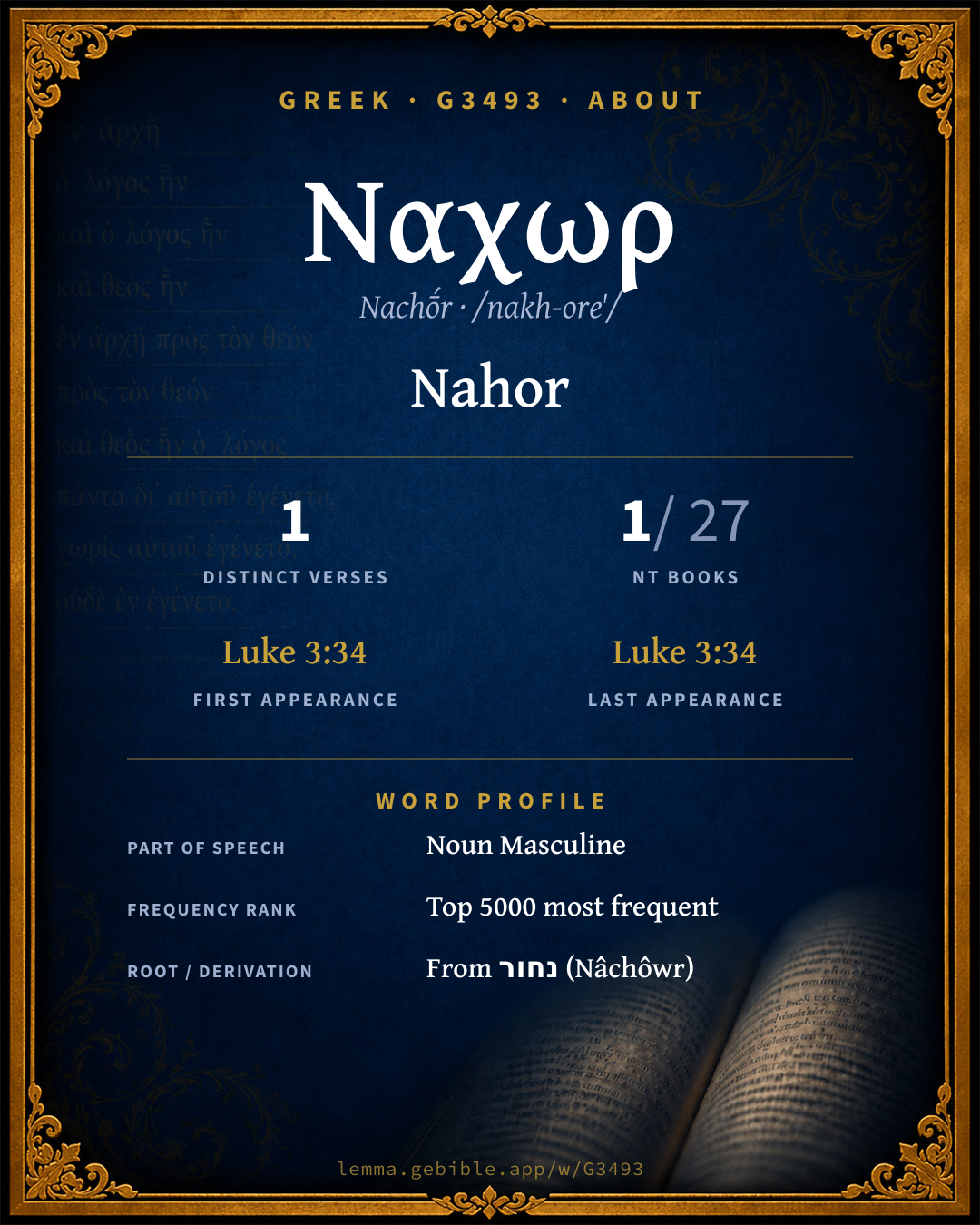
Ναχώρ
Nahor
Thayer's lists 2 entries for ‘Nahor’ fuller range ↓
Full lexicon entry — Thayer's Greek Lexicon
From Thayer's Greek Lexicon
Where this word appears
Every verse where G3493 appears — 1 distinct verse across 1 book. Click any verse to open its interlinear word-by-word view. Verse text shown in the World English Bible for context — . Each verse’s Greek form is shown with its reference; the English is not keyword-highlighted, since the data carries no word-level English alignment. Use “Compare translations” on any verse to read it across multiple English versions. This concordance covers the Greek New Testament; Septuagint (Greek Old Testament) occurrences of this word are not indexed here.
Luke 1 verse
About this entry
At a glance — auto-summarized from this page’s data, not written by a person. Every figure links to its source below. This summary describes the numbers; it doesn’t interpret them.
“Nahor” is the headline sense of the Greek name Ναχωρ (Nachṓr). With only 1 verse it sits in the long tail of Greek New Testament vocabulary. It clusters heavily in Luke, which alone accounts for 100% of its uses. Found nowhere else but Luke 3:34. See 1-verse concordance and the renderings breakdown below.
Gloss history
Strong's 1890 vs modern scholarship

About this word
Strong's G3493 catalogs a Greek word from the Greek New Testament.
These counts are not copied from any lexicon or concordance. They are computed here, from the morphology-tagged Greek New Testament. What Lemma adds →
- 1
- distinct verses
- The word appears in 1 distinct verse.
- 1 / 27
- NT books
- The word appears in 1 of 27 New Testament books.
- #3,503
- by frequency
- Top 5000 most frequent Greek words (rank 3,503 of 5,347 Greek words by occurrence).
View all 1 occurrence in the concordance →
Most concentrated in
- Luke 1 verse 100%
By section of the New Testament
By traditional corpus
Conventional, traditional groupings — biblical authorship is debated, so this is a traditional corpus grouping, not an authorship claim. Some books belong to more than one corpus (Luke is in both the Gospels and the Lukan corpus, and so on), so these shares overlap and need not total 100%. Each figure is a share of the word’s 1 distinct verse.
- Gospels 1 verse · 100%
- Lukan (Luke–Acts) 1 verse · 100%
How translations render this word
Counts come from each version’s own published word-to-Strong’s tagging or interlinear alignment — an approximate guide to how each version renders this word, not a word-level alignment the data otherwise carries. Because each total is that version’s own tagged count, the per-version totals vary from one another and need not match the appearance or distinct-verse counts above. These counts may also differ from a printed concordance because Lemma counts each distinctly tagged rendering and does not collapse phrase taggings into a single head-word total. This is a fixed set of word-tagged versions (KJV, ASV, BSB, ULT) and does not change with the reading translation you choose elsewhere. Each version’s license is shown beside its name below (and on Sources).
- King James Version: Was the son of nachor 1×
- American Standard Version: Son of nahor 1×
- Berean Standard Bible: Nahor 1×
- unfoldingWord Literal Text: Nahor 1×
King James Version Public Domain
Renders G3493 across 1 tagged occurrence — most commonly:
American Standard Version Public Domain
Renders G3493 across 1 tagged occurrence — most commonly:
Berean Standard Bible Public Domain
Renders G3493 across 1 tagged occurrence — most commonly:
unfoldingWord Literal Text CC BY-SA 4.0
Renders G3493 across 1 tagged occurrence — most commonly:
Senses in Thayer's
The 2 senses Thayer's distinguishes for this word, in lexicon order (not ranked by frequency or importance). The full entry — with sub-senses — is in the Lexicon Entry tab.
- Nahor = "snorting"
- was the name of two persons in the family of Abraham, an ancestor of Christ
Word origin
Derived from נחור (Nâchôwr) (H5152) — Nahor.
Of hebrew origin [ H5152 ]; Nachor the grandfather of Abraham : - Nachor.
— Strong’s Exhaustive Concordance (1890), public domain.
Bible dictionary
Public-domain dictionary articles matched to this entry by name (Nahor). A biblical name can be shared by more than one person or place, so an article may treat several.
Easton's Bible Dictionary · M. G. Easton, 1897
Snorting. (1.) The father of Terah, who was the father of Abraham (Gen. 11:22-25; Luke 3:34).
(2.) A son of Terah, and elder brother of Abraham (Gen. 11:26, 27; Josh. 24:2, R.V.). He married Milcah, the daughter of his brother Haran, and remained in the land of his nativity on the east of the river Euphrates at Haran (Gen. 11:27-32). A correspondence was maintained between the family of Abraham in Canaan and the relatives in the old ancestral home at Haran till the time of Jacob. When Jacob fled from Haran all intercourse between the two branches of the family came to an end (Gen. 31:55). His grand-daughter Rebekah became Isaac's wife (24:67).
Smith's Bible Dictionary · William Smith, 1863
(snorting), the name of two persons in the family of Abraham.
+ His grandfather; the son of Serug and father of Terah. (Genesis 11:22-25) (B.C. 2174.) + Grandson of the preceding son of Terah and brother of Abraham and Haran. (Genesis 11:26,27) (B.C. 2000.) The order of the ages of the family of Terah is not improbably inverted in the narrative; in which case Nahor instead of being younger than Abraham, was really older. He married Milcah, the daughter of his brother Haran; and when Abraham and Lot migrated to Canaan, Nahor remained behind in the land of his birth, on the eastern side of the Euphrates.
Hitchcock's Bible Names Dictionary · Roswell D. Hitchcock, 1869
hoarse; dry; hot
Classic public-domain reference works; full attribution on Sources.
Septuagint usage
The same Greek word Ναχωρ appears 19 times in the Greek Old Testament (Septuagint), across 18 verses in 3 books.
- 19
- LXX occurrences
- Tagged occurrences of this Greek word in the Septuagint.
- 18
- verses
- Distinct Septuagint verses containing this word.
- 3 / 39
- OT books
- The word appears in 3 of the 39 Old Testament books.
Sample Septuagint occurrences
- Genesis 11:22 ναχωρ
- Joshua 24:2 ναχωρ
- 1 Chronicles 1:14 ναχωρ
Septuagint occurrences (same lexeme)
Every verse where the same Strong’s number (G3493) appears in the Greek Septuagint. Verse text shown in the World English Bible for context; the Greek form is the matched word — the English is not keyword-highlighted.
- Genesis 11:22 ναχωρ Serug lived thirty years, and became the father of Nahor.
- Genesis 11:23 ναχωρ Serug lived after he became the father of Nahor two hundred years, and became the father of sons and daughters.
- Genesis 11:24 ναχωρ Nahor lived twenty-nine years, and became the father of Terah.
- Genesis 11:25 ναχωρ Nahor lived after he became the father of Terah one hundred nineteen years, and became the father of sons and daughters.
- Genesis 11:26 ναχωρ Terah lived seventy years, and became the father of Abram, Nahor, and Haran.
- Genesis 11:27 ναχωρ Now this is the history of the generations of Terah. Terah became the father of Abram, Nahor, and Haran. Haran became the father of Lot.
- Genesis 11:29 ναχωρ Abram and Nahor took wives. The name of Abram's wife was Sarai, and the name of Nahor's wife, Milcah, the daughter of Haran who was also the father of Iscah.
- Genesis 22:20 ναχωρ It happened after these things, that it was told Abraham, saying, "Behold, Milcah, she also has borne children to your brother Nahor:
- Genesis 22:23 ναχωρ Bethuel became the father of Rebekah. These eight Milcah bore to Nahor, Abraham's brother.
- Genesis 24:10 ναχωρ The servant took ten camels, of his master's camels, and departed, having all goodly things of his master's in his hand. He arose, and went to Mesopotamia, to the city of Nahor.
- Genesis 24:15 ναχωρ It happened, before he had done speaking, that behold, Rebekah came out, who was born to Bethuel the son of Milcah, the wife of Nahor, Abraham's brother, with her pitcher on her shoulder.
- Genesis 24:24 ναχωρ She said to him, "I am the daughter of Bethuel the son of Milcah, whom she bore to Nahor."
- Genesis 24:47 ναχωρ I asked her, and said, 'Whose daughter are you?' She said, 'The daughter of Bethuel, Nahor's son, whom Milcah bare to him.' I put the ring on her nose, and the bracelets on her hands.
- Genesis 29:5 ναχωρ He said to them, "Do you know Laban, the son of Nahor?" They said, "We know him."
- Genesis 31:53 ναχωρ The God of Abraham, and the God of Nahor, the God of their father, judge between us." Then Jacob swore by the fear of his father, Isaac.
- Joshua 24:2 ναχωρ Joshua said to all the people, Thus says Yahweh, the God of Israel, Your fathers lived of old time beyond the River, even Terah, the father of Abraham, and the father of Nahor: and they served other gods.
- 1 Chronicles 1:14 ναχωρ and the Jebusite, and the Amorite, and the Girgashite,
- 1 Chronicles 11:39 ναχωρ Zelek the Ammonite, Naharai the Berothite, the armor bearer of Joab the son of Zeruiah,
These are occurrences of the same Greek lexeme (G3493) in the Septuagint — not a translation of any one Hebrew word. The store carries no word-level Hebrew↔Greek alignment, so no Hebrew original is asserted here. Counts come from the recovered LXX Strong's tagging — high-frequency vocabulary is well covered, while rare or late forms may be untagged — so they reflect tagged occurrences and may slightly undercount.