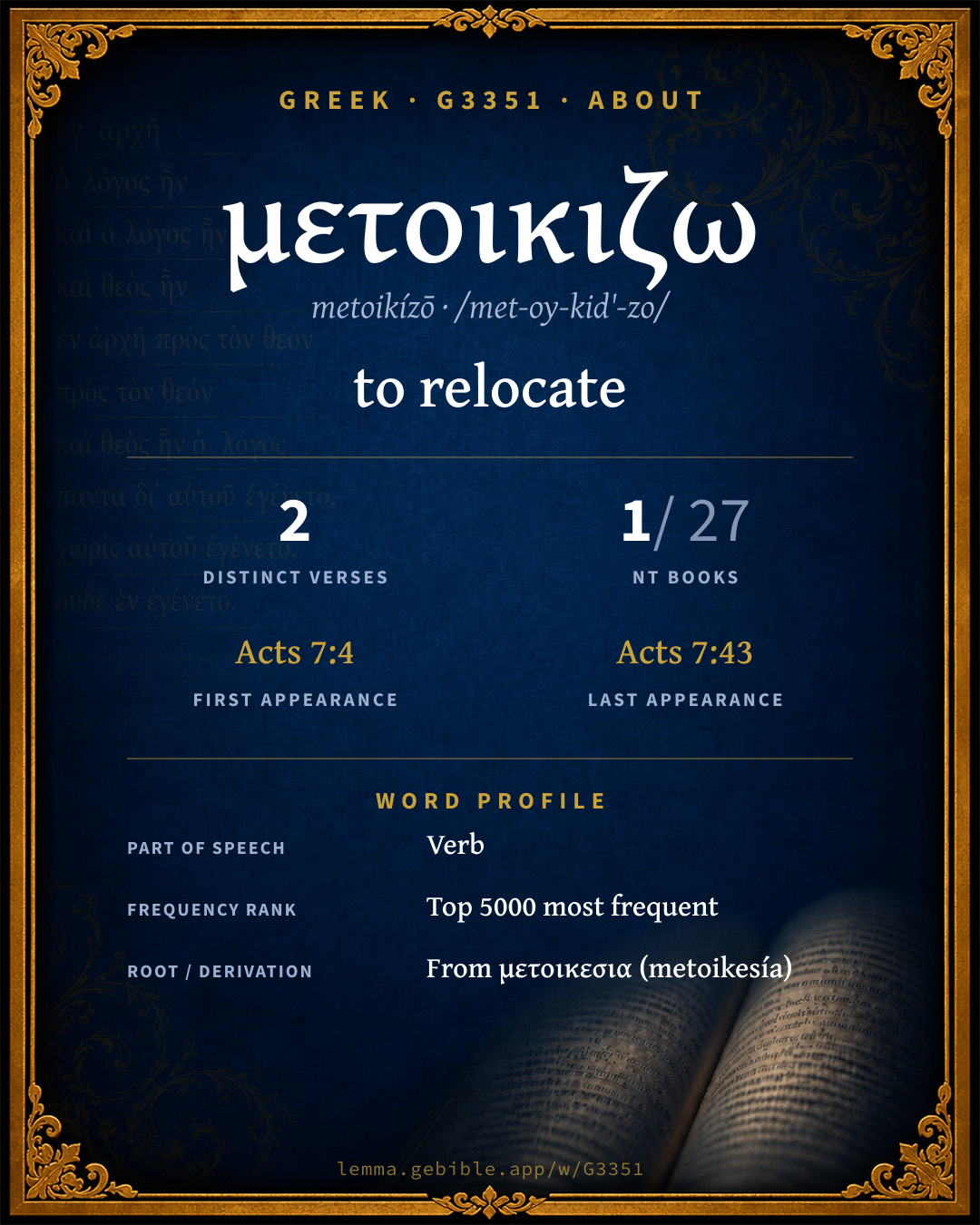
μετοικίζω
to relocate
‘to relocate’ is one of 2 main senses fuller range ↓
Full lexicon entry — Thayer's Greek Lexicon
From Thayer's Greek Lexicon
Where this word appears
See every Aorist-tense verb in the Greek New Testament →
Grammar key — what these labels mean
Part of speech
- Verb
- An action or state-of-being word.
Tense
- Aorist
- Action viewed as a simple whole, without regard to duration — often past (perfective aspect).
- Future
- Action expected in future time.
Voice
- Active
- The subject performs the action.
Mood
- Indicative
- States a fact or asks a factual question (the mood of reality).
Person
- 3rd person
- The one spoken about (“he / she / it / they”).
- 1st person
- The speaker (“I / we”).
Number
- Singular
- One.
1 distinct verse where G3351 appears in the Aorist tense, across 1 book. Filtered view — show all forms. Click any verse to open its interlinear word-by-word view. Verse text shown in the World English Bible for context — . Each verse’s Greek form is shown with its reference; the English is not keyword-highlighted, since the data carries no word-level English alignment. Use “Compare translations” on any verse to read it across multiple English versions. This concordance covers the Greek New Testament; Septuagint (Greek Old Testament) occurrences of this word are not indexed here.
Acts 1 verse
About this entry
At a glance — auto-summarized from this page’s data, not written by a person. Every figure links to its source below. This summary describes the numbers; it doesn’t interpret them.
μετοικιζω (metoikízō) is a Greek verb most often rendered “to relocate.” The Greek New Testament uses it only 2 verses. Acts dominates its distribution — 2 of 2 verses. It first appears in Acts 7:4. Its lexical range runs to 2 senses. The sections below give every sense, occurrence, and version rendering.
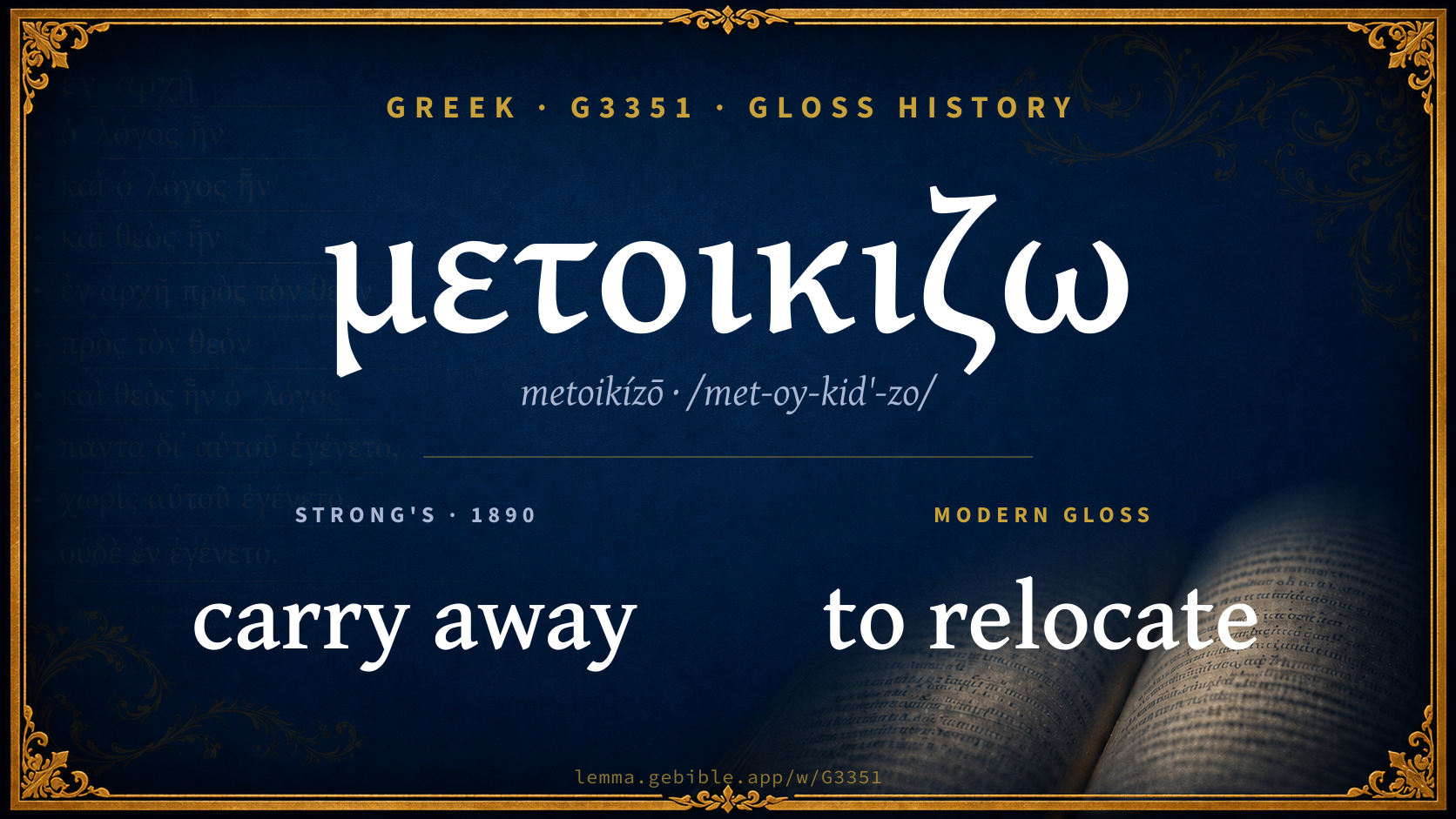
Gloss history
Strong's 1890 vs modern scholarship
About this word
Strong's G3351 catalogs a Greek word from the Greek New Testament.
These counts are not copied from any lexicon or concordance. They are computed here, from the morphology-tagged Greek New Testament. What Lemma adds →
- 2
- distinct verses
- The word appears in 2 distinct verses.
- 1 / 27
- NT books
- The word appears in 1 of 27 New Testament books.
- #2,678
- by frequency
- Top 5000 most frequent Greek words (rank 2,678 of 5,347 Greek words by occurrence).
View all 2 occurrences in the concordance →
Most concentrated in
- Acts 2 verses 100%
By section of the New Testament
By traditional corpus
Conventional, traditional groupings — biblical authorship is debated, so this is a traditional corpus grouping, not an authorship claim. Some books belong to more than one corpus (Luke is in both the Gospels and the Lukan corpus, and so on), so these shares overlap and need not total 100%. Each figure is a share of the word’s 2 distinct verses.
- Lukan (Luke–Acts) 2 verses · 100%
How translations render this word
Counts come from each version’s own published word-to-Strong’s tagging or interlinear alignment — an approximate guide to how each version renders this word, not a word-level alignment the data otherwise carries. Because each total is that version’s own tagged count, the per-version totals vary from one another and need not match the appearance or distinct-verse counts above. These counts may also differ from a printed concordance because Lemma counts each distinctly tagged rendering and does not collapse phrase taggings into a single head-word total. This is a fixed set of word-tagged versions (KJV, ASV, BSB, ULT) and does not change with the reading translation you choose elsewhere. Each version’s license is shown beside its name below (and on Sources).
- King James Version: Away 1×, He removed 1×, I will carry 1×
- American Standard Version: Away 1×, God removed 1×, I will carry 1×
- Berean Standard Bible: Brought 1×, I will send you into exile 1×
- unfoldingWord Literal Text: He brought 1×, I will remove 1×
King James Version Public Domain
Renders G3351 across 3 tagged occurrences — most commonly:
American Standard Version Public Domain
Renders G3351 across 3 tagged occurrences — most commonly:
Berean Standard Bible Public Domain
Renders G3351 across 2 tagged occurrences — most commonly:
unfoldingWord Literal Text CC BY-SA 4.0
Renders G3351 across 2 tagged occurrences — most commonly:
Senses in Thayer's
The 2 senses Thayer's distinguishes for this word, in lexicon order (not ranked by frequency or importance). The full entry — with sub-senses — is in the Lexicon Entry tab.
- to transfer settlers
- to cause to remove into another land
Word origin
Derived from μετοικεσια (metoikesía) (G3350) — removal.
From the same as G3350 ; to transfer as a settler or captive that is colonize or exile : - carry away remove into.
— Strong’s Exhaustive Concordance (1890), public domain.
Forms in the corpus
The 2 distinct written forms G3351 takes in the Greek New Testament, most frequent first — each parse links to that tense’s occurrences in the concordance.
| Form | Parsing | Example | Uses |
|---|---|---|---|
| μετοικιῶ metoikiō̂ | Verb, Future, Active, Indicative, 1st person, Singular, Attic form | Acts 7:43 | 1 |
| μετῴκισεν metṓkisen | Verb, Aorist, Active, Indicative, 3rd person, Singular | Acts 7:4 | 1 |
Septuagint usage
The same Greek word μετοικιζω appears 8 times in the Greek Old Testament (Septuagint), across 8 verses in 5 books.
- 8
- LXX occurrences
- Tagged occurrences of this Greek word in the Septuagint.
- 8
- verses
- Distinct Septuagint verses containing this word.
- 5 / 39
- OT books
- The word appears in 5 of the 39 Old Testament books.
Sample Septuagint occurrences
- 1 Chronicles 5:6 μεταοἰκίζω
- Jeremiah 20:4 μεταοἰκίζω
- Lamentations 1:3 μεταοἰκίζω
- Hosea 10:5 μεταοἰκίζω
- Amos 5:27 μεταοἰκίζω
Septuagint occurrences (same lexeme)
Every verse where the same Strong’s number (G3351) appears in the Greek Septuagint. Verse text shown in the World English Bible for context; the Greek form is the matched word — the English is not keyword-highlighted.
- 1 Chronicles 5:6 μεταοἰκίζω Beerah his son, whom Tilgath Pilneser king of Assyria carried away captive: he was prince of the Reubenites.
- 1 Chronicles 5:26 μεταοἰκίζω The God of Israel stirred up the spirit of Pul king of Assyria, and the spirit of Tilgath Pilneser king of Assyria, and he carried them away, even the Reubenites, and the Gadites, and the half-tribe of Manasseh, and brought them to Halah, and Habor, and Hara, and to the river of Gozan, to this day.
- 1 Chronicles 8:6 μεταοἰκίζω These are the sons of Ehud: these are the heads of fathers' [houses] of the inhabitants of Geba, and they carried them captive to Manahath:
- Jeremiah 20:4 μεταοἰκίζω For thus says Yahweh, Behold, I will make you a terror to yourself, and to all your friends; and they shall fall by the sword of their enemies, and your eyes shall see it; and I will give all Judah into the hand of the king of Babylon, and he shall carry them captive to Babylon, and shall kill them with the sword.
- Jeremiah 22:12 μεταοἰκίζω But in the place where they have led him captive, there shall he die, and he shall see this land no more.
- Lamentations 1:3 μεταοἰκίζω Judah is gone into captivity because of affliction, and because of great servitude; She dwells among the nations, she finds no rest: All her persecutors overtook her within the straits.
- Hosea 10:5 μεταοἰκίζω The inhabitants of Samaria will be in terror for the calves of Beth Aven; For its people will mourn over it, Along with its priests who rejoiced over it, For its glory, because it has departed from it.
- Amos 5:27 μεταοἰκίζω Therefore will I cause you to go into captivity beyond Damascus," says Yahweh, whose name is the God of hosts.
These are occurrences of the same Greek lexeme (G3351) in the Septuagint — not a translation of any one Hebrew word. The store carries no word-level Hebrew↔Greek alignment, so no Hebrew original is asserted here. Counts come from the recovered LXX Strong's tagging — high-frequency vocabulary is well covered, while rare or late forms may be untagged — so they reflect tagged occurrences and may slightly undercount.