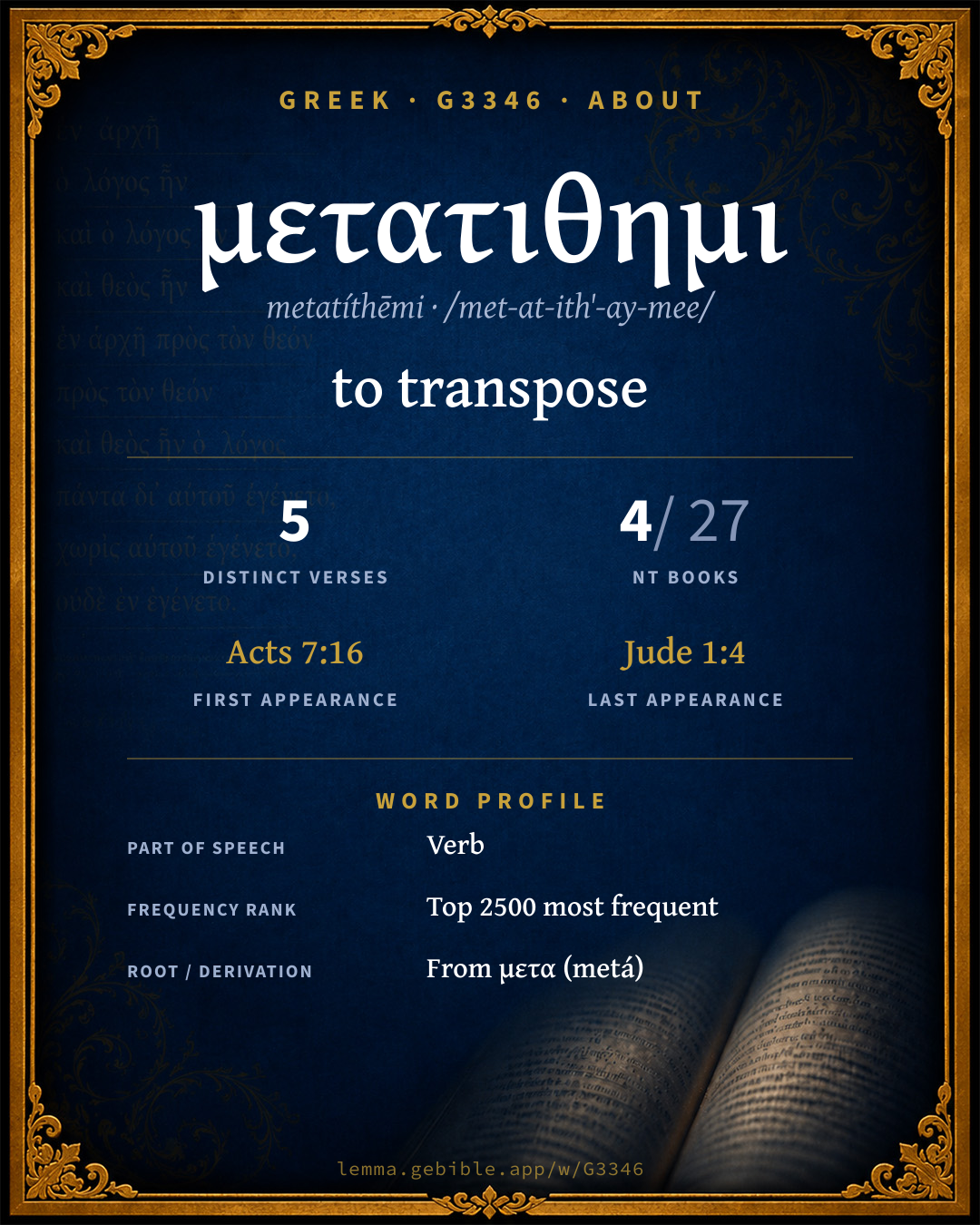
μετατίθημι
to transpose
Full lexicon entry — Thayer's Greek Lexicon
From Thayer's Greek Lexicon
Where this word appears
See every Aorist-tense verb in the Greek New Testament →
Grammar key — what these labels mean
Part of speech
- Verb
- An action or state-of-being word.
Tense
- Aorist
- Action viewed as a simple whole, without regard to duration — often past (perfective aspect).
- Present
- Ongoing or general action in present time (imperfective aspect).
Voice
- Active
- The subject performs the action.
- Passive
- The subject receives the action.
- Middle or Passive
- A form that may be middle or passive — resolved by context.
Mood
- Indicative
- States a fact or asks a factual question (the mood of reality).
- Participle
- A verbal adjective (“writing,” “having written”).
Case
- Nominative
- The case of the subject (and the predicate nominative).
- Genitive
- The case of source, possession, or “of” — answers “whose / from what.”
Person
- 3rd person
- The one spoken about (“he / she / it / they”).
- 2nd person
- The one addressed (“you”).
Gender
- Masculine
- Grammatically masculine.
- Feminine
- Grammatically feminine.
Number
- Singular
- One.
- Plural
- More than one.
1 verse where G3346 appears in the Aorist tense in the Book of Hebrews. Filtered view — show all forms. Click any verse to open its interlinear word-by-word view. Verse text shown in the World English Bible for context — . Each verse’s Greek form is shown with its reference; the English is not keyword-highlighted, since the data carries no word-level English alignment. Use “Compare translations” on any verse to read it across multiple English versions. This concordance covers the Greek New Testament; Septuagint (Greek Old Testament) occurrences of this word are not indexed here.
Hebrews
About this entry
At a glance — auto-summarized from this page’s data, not written by a person. Every figure links to its source below. This summary describes the numbers; it doesn’t interpret them.
μετατιθημι (metatíthēmi) is a Greek verb most often rendered “to transpose.” It is rare — just 5 verses in the entire Greek New Testament. It concentrates in Hebrews, which alone accounts for 40% of its uses. Its earliest occurrence is Acts 7:16. It clusters with μετα, μεθερμηνευω and μεθιστημι under a shared root. For the data behind this summary, explore the sense tree and the renderings breakdown below.
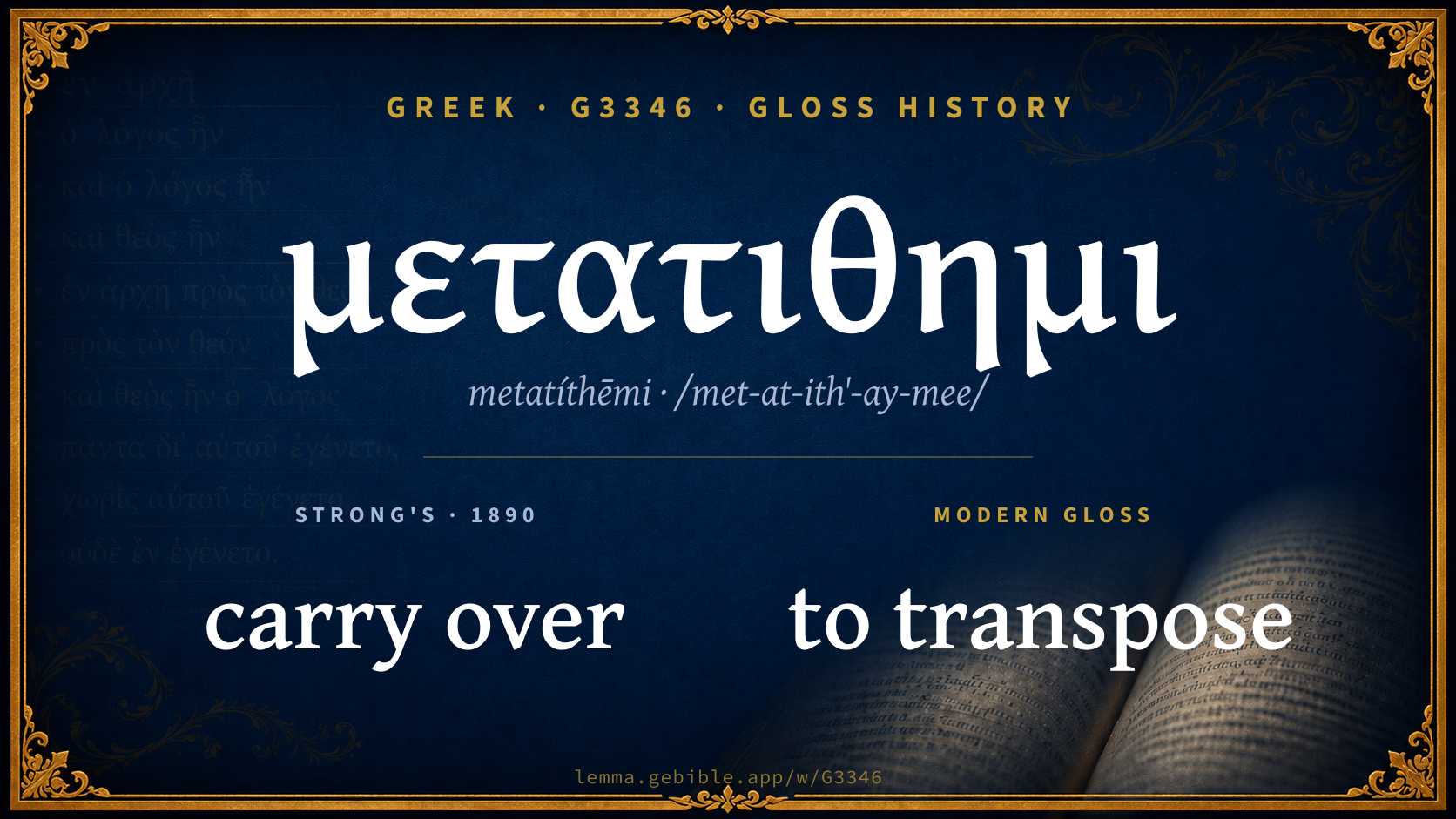
Gloss history
Strong's 1890 vs modern scholarship
About this word
Strong's G3346 catalogs a Greek word from the Greek New Testament.
These counts are not copied from any lexicon or concordance. They are computed here, from the morphology-tagged Greek New Testament. What Lemma adds →
- 5
- distinct verses
- The word appears in 5 distinct verses.
- 4 / 27
- NT books
- The word appears in 4 of 27 New Testament books.
- #1,476
- by frequency
- Top 2500 most frequent Greek words (rank 1,476 of 5,347 Greek words by occurrence).
View all 5 occurrences in the concordance →
By section of the New Testament
By traditional corpus
Conventional, traditional groupings — biblical authorship is debated, so this is a traditional corpus grouping, not an authorship claim. Some books belong to more than one corpus (Luke is in both the Gospels and the Lukan corpus, and so on), so these shares overlap and need not total 100%. Each figure is a share of the word’s 5 distinct verses.
- Hebrews 2 verses · 40%
- Lukan (Luke–Acts) 1 verse · 20%
- Pauline corpus 1 verse · 20%
- General (Catholic) Epistles 1 verse · 20%
How translations render this word
Counts come from each version’s own published word-to-Strong’s tagging or interlinear alignment — an approximate guide to how each version renders this word, not a word-level alignment the data otherwise carries. Because each total is that version’s own tagged count, the per-version totals vary from one another and need not match the appearance or distinct-verse counts above. These counts may also differ from a printed concordance because Lemma counts each distinctly tagged rendering and does not collapse phrase taggings into a single head-word total. This is a fixed set of word-tagged versions (KJV, ASV, BSB, ULT) and does not change with the reading translation you choose elsewhere. Each version’s license is shown beside its name below (and on Sources).
- King James Version: Being changed 1×, Had translated 1×, Removed 1×
- American Standard Version: Being changed 1×, Removing 1×, They were carried over 1×
- Berean Standard Bible: Had taken him away 1×, Is changed 1×, They turn 1×
- unfoldingWord Literal Text: Be changed 1×, Changing 1×, Is changed 1×
King James Version Public Domain
Renders G3346 across 7 tagged occurrences — most commonly:
American Standard Version Public Domain
Renders G3346 across 7 tagged occurrences — most commonly:
Berean Standard Bible Public Domain
Renders G3346 across 6 tagged occurrences — most commonly:
unfoldingWord Literal Text CC BY-SA 4.0
Renders G3346 across 9 tagged occurrences — most commonly:
Senses in Thayer's
The 1 sense Thayer's distinguishes for this word, in lexicon order (not ranked by frequency or importance). The full entry — with sub-senses — is in the Lexicon Entry tab.
- to transpose (two things, one of which is put in place of the other)
Word origin
Derived from μετα (metá) (G3326) — with.
Forms in the corpus
The 6 distinct written forms G3346 takes in the Greek New Testament, most frequent first — each parse links to that tense’s occurrences in the concordance.
| Form | Parsing | Example | Uses |
|---|---|---|---|
| μετέθηκεν metéthēken | Verb, Aorist, Active, Indicative, 3rd person, Singular | Hebrews 11:5 | 1 |
| μετατίθεσθε metatíthesthe | Verb, Present, Middle or Passive, Indicative, 2nd person, Plural | Galatians 1:6 | 1 |
| μετατιθέντες metatithéntes | Verb, Present, Active, Participle, Nominative, Plural, Masculine | Jude 1:4 | 1 |
| μετατιθεμένης metatitheménēs | Verb, Present, Passive, Participle, Genitive, Singular, Feminine | Hebrews 7:12 | 1 |
| μετετέθη metetéthē | Verb, Aorist, Passive, Indicative, 3rd person, Singular | Hebrews 11:5 | 1 |
| μετετέθησαν metetéthēsan | Verb, Aorist, Passive, Indicative, 3rd person, Plural | Acts 7:16 | 1 |
Same root — word family
Other Thayer's entries built from the same root as G3346, grouped by Strong’s listed origin. These share a root / origin per the lexicon — not necessarily a shared meaning. Each links to that word’s own entry.
Derives from
Shares the same root
- μεθερμηνευω methermēneúō G3177 to interpret
- μεθιστημι methístēmi G3179 to transfer
- μεθοδεια methodeía G3180 deceit
- μεθοριος methórios G3181 border
- μεσος mésos G3319 middle
- μεταβαινω metabaínō G3327 to pass over
- μεταβαλλω metabállō G3328 to turn around
- μεταγω metágō G3329 to transfer
- μεταδιδωμι metadídōmi G3330 to impart
- μεταιρω metaírō G3332 to remove
- μετακαλεω metakaléō G3333 to summon
- μετακινεω metakinéō G3334 to move away
- μεταλαμβανω metalambánō G3335 to partake
- μεταλλασσω metallássō G3337 to exchange
- μεταμελλομαι metaméllomai G3338 it is a care
- μεταμορφοω metamorphóō G3339 to transform
- μετανοεω metanoéō G3340 to repent
- μεταξυ metaxý G3342 between
- μεταπεμπω metapémpō G3343 to send for
- μεταστρεφω metastréphō G3344 to turn around
- μετασχηματιζω metaschēmatízō G3345 to transform
- μετεπειτα metépeita G3347 afterwards
- μετεχω metéchō G3348 to partake
- μετεωριζω meteōrízō G3349 to be puffed up
+2 more words share this root (not shown).
Derived from this word
Compare all same-root words → Showing 4 of 29 — not the complete family. They share a root, not necessarily a meaning.
Septuagint usage
The same Greek word μετατιθημι appears 9 times in the Greek Old Testament (Septuagint), across 8 verses in 7 books.
- 9
- LXX occurrences
- Tagged occurrences of this Greek word in the Septuagint.
- 8
- verses
- Distinct Septuagint verses containing this word.
- 7 / 39
- OT books
- The word appears in 7 of the 39 Old Testament books.
Sample Septuagint occurrences
- Genesis 5:24 μετατίθημι
- Deuteronomy 27:17 μετατίθημι
- 1 Kings 20:25 μετατίθημι
- Psalms 45:3 μετατίθημι
- Proverbs 23:10 μετατίθημι
- Isaiah 29:14 μετατίθημι
- Hosea 5:10 μετατίθημι
Septuagint occurrences (same lexeme)
Every verse where the same Strong’s number (G3346) appears in the Greek Septuagint. Verse text shown in the World English Bible for context; the Greek form is the matched word — the English is not keyword-highlighted.
- Genesis 5:24 μετατίθημι Enoch walked with God, and he was not, for God took him.
- Deuteronomy 27:17 μετατίθημι Cursed be he who removes his neighbor's landmark. All the people shall say, Amen.
- 1 Kings 20:25 μετατίθημι and number you an army, like the army that you have lost, horse for horse, and chariot for chariot; and we will fight against them in the plain, and surely we shall be stronger than they. He listened to their voice, and did so.
- Psalms 45:3 μετατίθημι Gird your sword on your thigh, mighty one: Your splendor and your majesty.
- Proverbs 23:10 μετατίθημι Don't move the ancient boundary stone. Don't encroach on the fields of the fatherless:
- Isaiah 29:14 μετατίθημι therefore, behold, I will proceed to do a marvelous work among this people, even a marvelous work and a wonder; and the wisdom of their wise men shall perish, and the understanding of their prudent men shall be hid.
- Isaiah 29:17 μετατίθημι Is it not yet a very little while, and Lebanon shall be turned into a fruitful field, and the fruitful field shall be esteemed as a forest?
- Hosea 5:10 μετατίθημι The princes of Judah are like those who remove a landmark. I will pour out my wrath on them like water.
These are occurrences of the same Greek lexeme (G3346) in the Septuagint — not a translation of any one Hebrew word. The store carries no word-level Hebrew↔Greek alignment, so no Hebrew original is asserted here. Counts come from the recovered LXX Strong's tagging — high-frequency vocabulary is well covered, while rare or late forms may be untagged — so they reflect tagged occurrences and may slightly undercount.