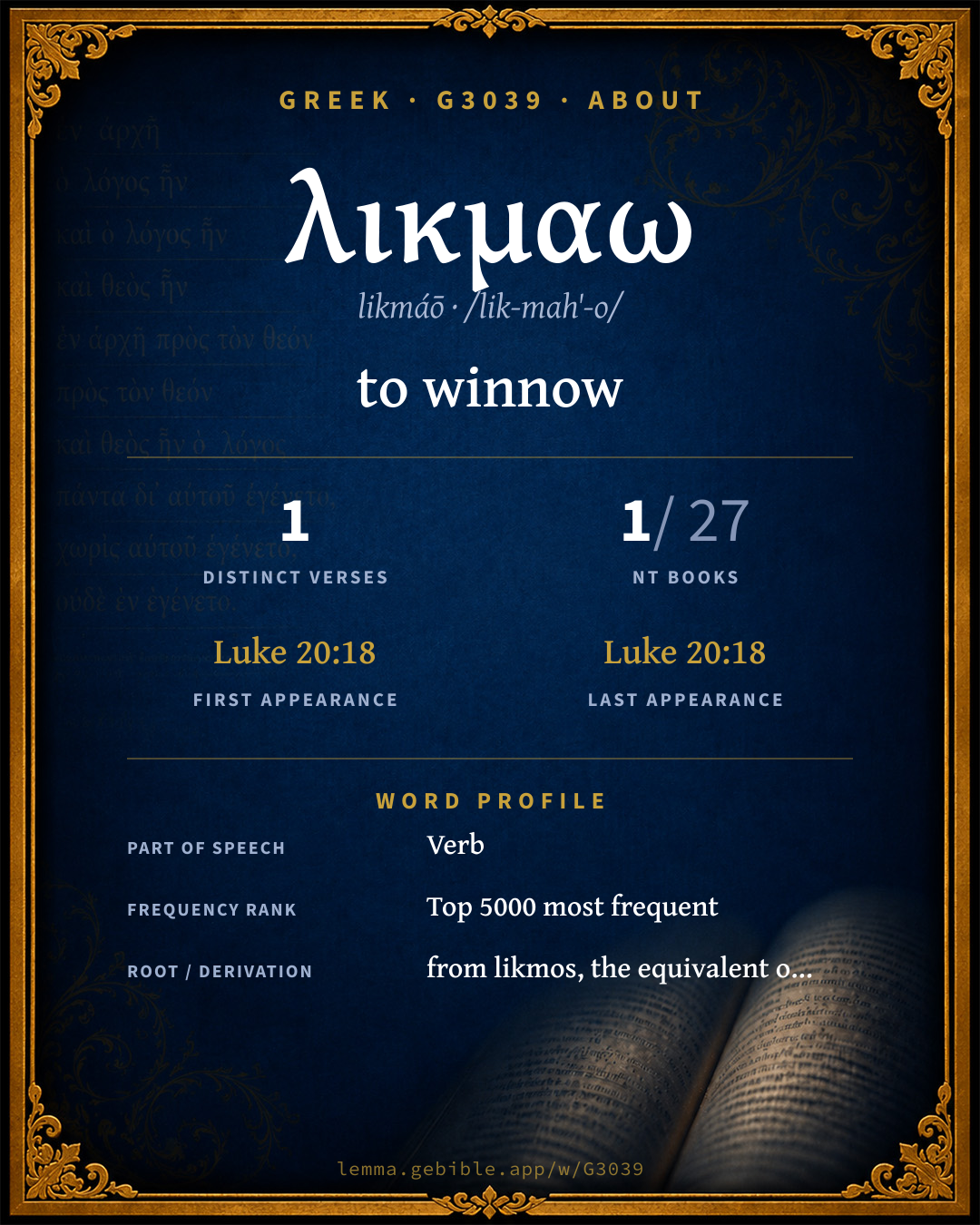
λικμάω
to winnow
‘to winnow’ is one of 3 main senses fuller range ↓
Full lexicon entry — Thayer's Greek Lexicon
From Thayer's Greek Lexicon
Where this word appears
Grammar key — what these labels mean
Part of speech
- Verb
- An action or state-of-being word.
Tense
- Future
- Action expected in future time.
Voice
- Active
- The subject performs the action.
Mood
- Indicative
- States a fact or asks a factual question (the mood of reality).
Person
- 3rd person
- The one spoken about (“he / she / it / they”).
Number
- Singular
- One.
Every verse where G3039 appears — 1 distinct verse across 1 book. Click any verse to open its interlinear word-by-word view. Verse text shown in the World English Bible for context — . Each verse’s Greek form is shown with its reference; the English is not keyword-highlighted, since the data carries no word-level English alignment. Use “Compare translations” on any verse to read it across multiple English versions. This concordance covers the Greek New Testament; Septuagint (Greek Old Testament) occurrences of this word are not indexed here.
Luke 1 verse
About this entry
At a glance — auto-summarized from this page’s data, not written by a person. Every figure links to its source below. This summary describes the numbers; it doesn’t interpret them.
λικμαω (likmáō) is a Greek verb most often rendered “to winnow.” It is rare — just 1 verse in the entire Greek New Testament. Luke dominates its distribution — 1 of 1 verses. Scripture uses it exactly once, at Luke 20:18. Ranging over 3 senses, it is not a single-sense word. For the data behind this summary, explore the sense tree and the renderings breakdown below.
Gloss history
Strong's 1890 vs modern scholarship

About this word
Strong's G3039 catalogs a Greek word from the Greek New Testament.
These counts are not copied from any lexicon or concordance. They are computed here, from the morphology-tagged Greek New Testament. What Lemma adds →
- 1
- distinct verses
- The word appears in 1 distinct verse.
- 1 / 27
- NT books
- The word appears in 1 of 27 New Testament books.
- #3,503
- by frequency
- Top 5000 most frequent Greek words (rank 3,503 of 5,347 Greek words by occurrence).
View all 1 occurrence in the concordance →
Most concentrated in
- Luke 1 verse 100%
By section of the New Testament
By traditional corpus
Conventional, traditional groupings — biblical authorship is debated, so this is a traditional corpus grouping, not an authorship claim. Some books belong to more than one corpus (Luke is in both the Gospels and the Lukan corpus, and so on), so these shares overlap and need not total 100%. Each figure is a share of the word’s 1 distinct verse.
- Gospels 1 verse · 100%
- Lukan (Luke–Acts) 1 verse · 100%
How translations render this word
Counts come from each version’s own published word-to-Strong’s tagging or interlinear alignment — an approximate guide to how each version renders this word, not a word-level alignment the data otherwise carries. Because each total is that version’s own tagged count, the per-version totals vary from one another and need not match the appearance or distinct-verse counts above. These counts may also differ from a printed concordance because Lemma counts each distinctly tagged rendering and does not collapse phrase taggings into a single head-word total. This is a fixed set of word-tagged versions (KJV, ASV, BSB, ULT) and does not change with the reading translation you choose elsewhere. Each version’s license is shown beside its name below (and on Sources).
- King James Version: Powder 2×, Will grind 2×
- American Standard Version: Dust 2×, Will scatter 2×
- Berean Standard Bible: Will be crushed 2×
- unfoldingWord Literal Text: Will crush 2×
King James Version Public Domain
Renders G3039 across 4 tagged occurrences — most commonly:
American Standard Version Public Domain
Renders G3039 across 4 tagged occurrences — most commonly:
Berean Standard Bible Public Domain
Renders G3039 across 2 tagged occurrences — most commonly:
unfoldingWord Literal Text CC BY-SA 4.0
Renders G3039 across 2 tagged occurrences — most commonly:
Senses in Thayer's
The 3 senses Thayer's distinguishes for this word, in lexicon order (not ranked by frequency or importance). The full entry — with sub-senses — is in the Lexicon Entry tab.
- to winnow, cleanse away the chaff from the grain by winnowing
- to scatter
- to crush to pieces, grind to powder
Word origin
Origin: from likmos, the equivalent of liknon (a winnowing fan or basket)
From λικμός likmos the equivalent. of λίκνον liknon (a winnowing fan or basket); to winnow that is (by analogy) to triturate : - grind to powder.
— Strong’s Exhaustive Concordance (1890), public domain.
Septuagint usage
The same Greek word λικμαω appears 14 times in the Greek Old Testament (Septuagint), across 14 verses in 6 books.
- 14
- LXX occurrences
- Tagged occurrences of this Greek word in the Septuagint.
- 14
- verses
- Distinct Septuagint verses containing this word.
- 6 / 39
- OT books
- The word appears in 6 of the 39 Old Testament books.
Sample Septuagint occurrences
- Ruth 3:2 λικμάω
- Job 27:21 λικμάω
- Isaiah 17:13 λικμάω
- Jeremiah 30:27 λικμάω
- Ezekiel 26:4 λικμάω
- Amos 9:9 λικμάω
Septuagint occurrences (same lexeme)
Every verse where the same Strong’s number (G3039) appears in the Greek Septuagint. Verse text shown in the World English Bible for context; the Greek form is the matched word — the English is not keyword-highlighted.
- Ruth 3:2 λικμάω Now isn't Boaz our kinsman, with whose maidens you were? Behold, he winnows barley tonight in the threshing floor.
- Job 27:21 λικμάω The east wind carries him away, and he departs; It sweeps him out of his place.
- Isaiah 17:13 λικμάω The nations shall rush like the rushing of many waters: but he shall rebuke them, and they shall flee far off, and shall be chased as the chaff of the mountains before the wind, and like the whirling dust before the storm.
- Isaiah 30:22 λικμάω You shall defile the overlaying of your engraved images of silver, and the plating of your molten images of gold: you shall cast them away as an unclean thing; you shall tell it, Get you hence.
- Isaiah 30:24 λικμάω the oxen likewise and the young donkeys that till the ground shall eat savory provender, which has been winnowed with the shovel and with the fork.
- Isaiah 41:16 λικμάω You shall winnow them, and the wind shall carry them away, and the whirlwind shall scatter them; and you shall rejoice in Yahweh, you shall glory in the Holy One of Israel.
- Jeremiah 30:27 λικμάω
- Jeremiah 38:10 λικμάω Then the king commanded Ebedmelech the Ethiopian, saying, Take from hence thirty men with you, and take up Jeremiah the prophet out of the dungeon, before he die.
- Ezekiel 26:4 λικμάω They shall destroy the walls of Tyre, and break down her towers: I will also scrape her dust from her, and make her a bare rock.
- Ezekiel 29:12 λικμάω I will make the land of Egypt a desolation in the midst of the countries that are desolate; and her cities among the cities that are laid waste shall be a desolation forty years; and I will scatter the Egyptians among the nations, and will disperse them through the countries.
- Ezekiel 30:23 λικμάω I will scatter the Egyptians among the nations, and will disperse them through the countries.
- Ezekiel 30:26 λικμάω I will scatter the Egyptians among the nations, and disperse them through the countries; and they shall know that I am Yahweh.
- Ezekiel 36:19 λικμάω and I scattered them among the nations, and they were dispersed through the countries: according to their way and according to their doings I judged them.
- Amos 9:9 λικμάω "For, behold, I will command, and I will sift the house of Israel among all the nations, as grain is sifted in a sieve, yet not the least kernel will fall on the earth.
These are occurrences of the same Greek lexeme (G3039) in the Septuagint — not a translation of any one Hebrew word. The store carries no word-level Hebrew↔Greek alignment, so no Hebrew original is asserted here. Counts come from the recovered LXX Strong's tagging — high-frequency vocabulary is well covered, while rare or late forms may be untagged — so they reflect tagged occurrences and may slightly undercount.