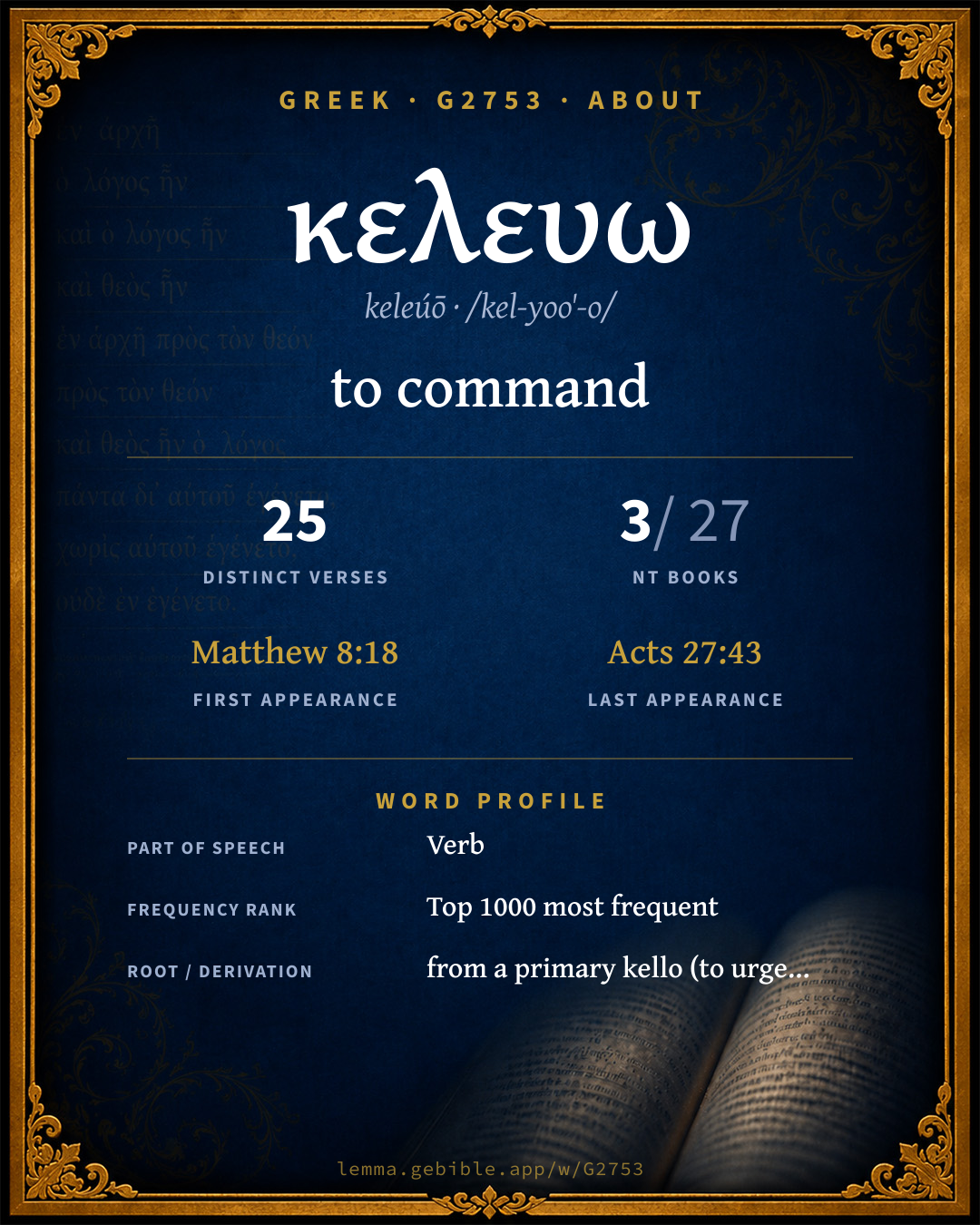
κελεύω
to command
Full lexicon entry — Thayer's Greek Lexicon
From Thayer's Greek Lexicon
Where this word appears
See every Aorist-tense verb in the Greek New Testament →
Grammar key — what these labels mean
Part of speech
- Verb
- An action or state-of-being word.
Tense
- Aorist
- Action viewed as a simple whole, without regard to duration — often past (perfective aspect).
- Imperfect
- Continuous or repeated action in past time (“was writing”).
- Present
- Ongoing or general action in present time (imperfective aspect).
Voice
- Active
- The subject performs the action.
Mood
- Indicative
- States a fact or asks a factual question (the mood of reality).
- Imperative
- Expresses a command or request.
- Participle
- A verbal adjective (“writing,” “having written”).
Case
- Nominative
- The case of the subject (and the predicate nominative).
- Genitive
- The case of source, possession, or “of” — answers “whose / from what.”
Person
- 3rd person
- The one spoken about (“he / she / it / they”).
- 1st person
- The speaker (“I / we”).
- 2nd person
- The one addressed (“you”).
Gender
- Masculine
- Grammatically masculine.
Number
- Singular
- One.
- Plural
- More than one.
Every verse where G2753 appears in the Book of Acts — 17 distinct verses. Click any verse to open its interlinear word-by-word view. Verse text shown in the World English Bible for context — . Each verse’s Greek form is shown with its reference; the English is not keyword-highlighted, since the data carries no word-level English alignment. Use “Compare translations” on any verse to read it across multiple English versions. This concordance covers the Greek New Testament; Septuagint (Greek Old Testament) occurrences of this word are not indexed here.
Acts
- Acts 4:15 κελεύσαντες aor act ptcp nom pl masc But when they had commanded them to go aside out of the council, they conferred among themselves,
- Acts 5:34 ἐκέλευσεν aor act ind 3sg But one stood up in the council, a Pharisee named Gamaliel, a teacher of the law, honored by all the people, and commanded to put the apostles out for a little while.
- Acts 8:38 ἐκέλευσεν aor act ind 3sg He commanded the chariot to stand still, and they both went down into the water, both Philip and the eunuch, and he baptized him.
- Acts 12:19 ἐκέλευσεν aor act ind 3sg When Herod had sought for him, and didn't find him, he examined the guards, and commanded that they should be put to death. He went down from Judea to Caesarea, and stayed there.
- Acts 16:22 ἐκέλευον impf act ind 3pl The multitude rose up together against them, and the magistrates tore their clothes off of them, and commanded them to be beaten with rods.
- Acts 21:33 ἐκέλευσεν aor act ind 3sg Then the commanding officer came near, arrested him, commanded him to be bound with two chains, and inquired who he was and what he had done.
- Acts 21:34 ἐκέλευσεν aor act ind 3sg Some shouted one thing, and some another, among the crowd. When he couldn't find out the truth because of the noise, he commanded him to be brought into the barracks.
- Acts 22:24 ἐκέλευσεν aor act ind 3sg the commanding officer commanded him to be brought into the barracks, ordering him to be examined by scourging, that he might know for what crime they shouted against him like that.
- Acts 22:30 ἐκέλευσεν aor act ind 3sg But on the next day, desiring to know the truth about why he was accused by the Jews, he freed him from the bonds, and commanded the chief priests and all the council to come together, and brought Paul down and set him before them.
- Acts 23:3 κελεύεις pres act ind 2sg Then Paul said to him, "God will strike you, you whitewashed wall! Do you sit to judge me according to the law, and command me to be struck contrary to the law?"
- Acts 23:10 ἐκέλευσεν aor act ind 3sg When a great argument arose, the commanding officer, fearing that Paul would be torn in pieces by them, commanded the soldiers to go down and take him by force from among them, and bring him into the barracks.
- Acts 23:35 κελεύσας aor act ptcp nom sg masc "I will hear you fully when your accusers also arrive." He commanded that he be kept in Herod's palace.
- Acts 25:6 ἐκέλευσεν aor act ind 3sg When he had stayed among them more than ten days, he went down to Caesarea, and on the next day he sat on the judgment seat, and commanded Paul to be brought.
- Acts 25:17 ἐκέλευσα aor act ind 1sg When therefore they had come together here, I didn't delay, but on the next day sat on the judgment seat, and commanded the man to be brought.
- Acts 25:21 ἐκέλευσα aor act ind 1sg But when Paul had appealed to be kept for the decision of the emperor, I commanded him to be kept until I could send him to Caesar."
- Acts 25:23 κελεύσαντος aor act ptcp gen sg masc So on the next day, when Agrippa and Bernice had come with great pomp, and they had entered into the place of hearing with the commanding officers and principal men of the city, at the command of Festus, Paul was brought in.
- Acts 27:43 ἐκέλευσέν aor act ind 3sg But the centurion, desiring to save Paul, stopped them from their purpose, and commanded that those who could swim should throw themselves overboard first to go toward the land;
About this entry
At a glance — auto-summarized from this page’s data, not written by a person. Every figure links to its source below. This summary describes the numbers; it doesn’t interpret them.
At its core, κελευω (keleúō) means “to command.” Its uses cluster heavily in Acts (68% of all occurrences). Spanning 25 verses in 3 books, it ranks among the uncommon words of the Greek New Testament. It first appears in Matthew 8:18. Its English rendering has broadened — “commanded” classically, “ordered that” (Berean Standard Bible) in modern versions; see the renderings breakdown. Dig into 25-verse concordance and the renderings breakdown below.
Gloss history
Strong's 1890 vs modern scholarship

About this word
Strong's G2753 catalogs a Greek word from the Greek New Testament.
These counts are not copied from any lexicon or concordance. They are computed here, from the morphology-tagged Greek New Testament. What Lemma adds →
- 25
- distinct verses
- The word appears in 25 distinct verses.
- 3 / 27
- NT books
- The word appears in 3 of 27 New Testament books.
- #530
- by frequency
- Top 1000 most frequent Greek words (rank 530 of 5,347 Greek words by occurrence).
View all 25 occurrences in the concordance →
By section of the New Testament
By traditional corpus
Conventional, traditional groupings — biblical authorship is debated, so this is a traditional corpus grouping, not an authorship claim. Some books belong to more than one corpus (Luke is in both the Gospels and the Lukan corpus, and so on), so these shares overlap and need not total 100%. Each figure is a share of the word’s 25 distinct verses.
- Lukan (Luke–Acts) 18 verses · 72%
- Gospels 8 verses · 32%
How translations render this word
Counts come from each version’s own published word-to-Strong’s tagging or interlinear alignment — an approximate guide to how each version renders this word, not a word-level alignment the data otherwise carries. Because each total is that version’s own tagged count, the per-version totals vary from one another and need not match the appearance or distinct-verse counts above. These counts may also differ from a printed concordance because Lemma counts each distinctly tagged rendering and does not collapse phrase taggings into a single head-word total. This is a fixed set of word-tagged versions (KJV, ASV, BSB, ULT) and does not change with the reading translation you choose elsewhere. Each version’s license is shown beside its name below (and on Sources).
- King James Version: Commanded 13×, He commanded 6×
- American Standard Version: Commanded 10×, He commanded 5×, Command 2×
- Berean Standard Bible: Ordered that 9×, He ordered that 3×, He gave orders 2×
- unfoldingWord Literal Text: Commanded 6×, He commanded 4×, Ordered 4×
King James Version Public Domain
Renders G2753 across 27 tagged occurrences — most commonly:
Plus 8 renderings that appear only once — usually multi-word phrases or single function words the recovered tagging swept in, not distinct renderings.
American Standard Version Public Domain
Renders G2753 across 26 tagged occurrences — most commonly:
Plus 7 renderings that appear only once — usually multi-word phrases or single function words the recovered tagging swept in, not distinct renderings.
Berean Standard Bible Public Domain
Renders G2753 across 25 tagged occurrences — most commonly:
Plus 11 renderings that appear only once — usually multi-word phrases or single function words the recovered tagging swept in, not distinct renderings.
unfoldingWord Literal Text CC BY-SA 4.0
Renders G2753 across 28 tagged occurrences — most commonly:
Plus 5 renderings that appear only once — usually multi-word phrases or single function words the recovered tagging swept in, not distinct renderings.
Senses in Thayer's
The 1 sense Thayer's distinguishes for this word, in lexicon order (not ranked by frequency or importance). The full entry — with sub-senses — is in the Lexicon Entry tab.
- to command, to order
Word origin
Origin: from a primary kello (to urge on)
From a primary word κέλλω kellō (to urge on); hail; to incite by word that is order : - bid (at give) command (-ment).
— Strong’s Exhaustive Concordance (1890), public domain.
Forms in the corpus
The 10 distinct written forms G2753 takes in the Greek New Testament, most frequent first — each parse links to that tense’s occurrences in the concordance.
| Form | Parsing | Example | Uses |
|---|---|---|---|
| ἐκέλευσεν ekéleusen | Verb, Aorist, Active, Indicative, 3rd person, Singular | Matthew 8:18 | 14 |
| κελεύσας keleúsas | Verb, Aorist, Active, Participle, Nominative, Singular, Masculine | Matthew 14:19 | 2 |
| ἐκέλευσα ekéleusa | Verb, Aorist, Active, Indicative, 1st person, Singular | Acts 25:17 | 2 |
| κέλευσον kéleuson | Verb, Aorist, Active, Imperative, 2nd person, Singular | Matthew 27:64 | 1 |
| κέλευσόν kéleusón | Verb, Aorist, Active, Imperative, 2nd person, Singular | Matthew 14:28 | 1 |
| κελεύεις keleúeis | Verb, Present, Active, Indicative, 2nd person, Singular | Acts 23:3 | 1 |
| κελεύσαντες keleúsantes | Verb, Aorist, Active, Participle, Nominative, Plural, Masculine | Acts 4:15 | 1 |
| κελεύσαντος keleúsantos | Verb, Aorist, Active, Participle, Genitive, Singular, Masculine | Acts 25:23 | 1 |
| ἐκέλευον ekéleuon | Verb, Imperfect, Active, Indicative, 3rd person, Plural | Acts 16:22 | 1 |
| ἐκέλευσέν ekéleusén | Verb, Aorist, Active, Indicative, 3rd person, Singular | Acts 27:43 | 1 |
Same root — word family
Other Thayer's entries built from the same root as G2753, grouped by Strong’s listed origin. These share a root / origin per the lexicon — not necessarily a shared meaning. Each links to that word’s own entry.
Derived from this word
Compare all same-root words → They share a root, not necessarily a meaning.