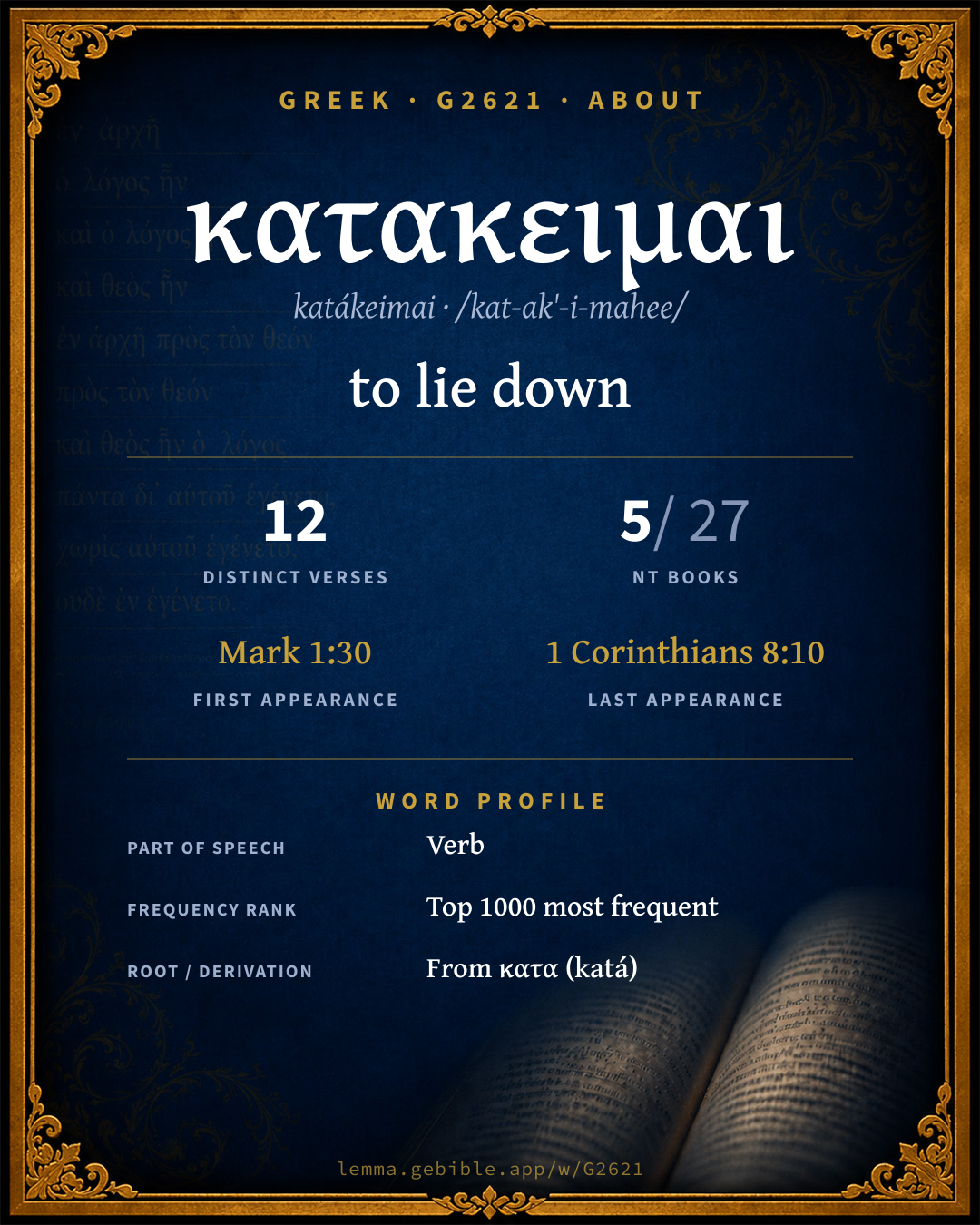
κατάκειμαι
to lie down
Full lexicon entry — Thayer's Greek Lexicon
From Thayer's Greek Lexicon
Where this word appears
See every Present-tense verb in the Greek New Testament →
Grammar key — what these labels mean
Part of speech
- Verb
- An action or state-of-being word.
Tense
- Imperfect
- Continuous or repeated action in past time (“was writing”).
- Present
- Ongoing or general action in present time (imperfective aspect).
Voice
- Middle or Passive deponent
- Middle/passive in form but active in meaning.
Mood
- Indicative
- States a fact or asks a factual question (the mood of reality).
- Participle
- A verbal adjective (“writing,” “having written”).
- Infinitive
- A verbal noun (“to write”), unmarked for person or number.
Case
- Accusative
- The case of the direct object and of extent.
- Genitive
- The case of source, possession, or “of” — answers “whose / from what.”
- Nominative
- The case of the subject (and the predicate nominative).
Person
- 3rd person
- The one spoken about (“he / she / it / they”).
Gender
- Masculine
- Grammatically masculine.
Number
- Singular
- One.
- Plural
- More than one.
Grammatical forms
- Verb, Imperfect, Middle or Passive deponent, Indicative, 3rd person, Singular 4 times (33%)
- Verb, Present, Middle or Passive deponent, Participle, Accusative, Singular, Masculine 3 times (25%)
- Verb, Present, Middle or Passive deponent, Infinitive 2 times (17%)
- Verb, Present, Middle or Passive deponent, Indicative, 3rd person, Singular 1 time (8%)
- Verb, Present, Middle or Passive deponent, Participle, Genitive, Singular, Masculine 1 time (8%)
- Verb, Present, Middle or Passive deponent, Participle, Nominative, Plural, Masculine 1 time (8%)
Parsed forms decoded from the imported morphology (Robinson–Tischendorf, public domain), counted across 12 parsed occurrences — not distinct verses.
Every verse where G2621 appears — 12 distinct verses across 5 books. Click any verse to open its interlinear word-by-word view. Verse text shown in the World English Bible for context — . Each verse’s Greek form is shown with its reference; the English is not keyword-highlighted, since the data carries no word-level English alignment. Use “Compare translations” on any verse to read it across multiple English versions. This concordance covers the Greek New Testament; Septuagint (Greek Old Testament) occurrences of this word are not indexed here.
Mark 4 verses
- Mark 1:30 κατέκειτο impf mid/pass.dep ind 3sg Now Simon's wife's mother lay sick with a fever, and immediately they told him about her.
- Mark 2:4 κατέκειτο impf mid/pass.dep ind 3sg When they could not come near to him for the crowd, they removed the roof where he was. When they had broken it up, they let down the mat that the paralytic was lying on.
- Mark 2:15 κατακεῖσθαι pres mid/pass.dep inf It happened, that he was reclining at the table in his house, and many tax collectors and sinners sat down with Jesus and his disciples, for there were many, and they followed him.
- Mark 14:3 κατακειμένου pres mid/pass.dep ptcp gen sg masc While he was at Bethany, in the house of Simon the leper, as he sat at the table, a woman came having an alabaster jar of ointment of pure nard-- very costly. She broke the jar, and poured it over his head.
Luke 3 verses
- Luke 5:25 κατέκειτο impf mid/pass.dep ind 3sg Immediately he rose up before them, and took up that which he was laying on, and departed to his house, glorifying God.
- Luke 5:29 κατακείμενοι pres mid/pass.dep ptcp nom pl masc Levi made a great feast for him in his house. There was a great crowd of tax collectors and others who were reclining with them.
- Luke 7:37 κατάκειται pres mid/pass.dep ind 3sg Behold, a woman in the city who was a sinner, when she knew that he was reclining in the Pharisee's house, she brought an alabaster jar of ointment.
John 2 verses
- John 5:3 κατέκειτο impf mid/pass.dep ind 3sg In these lay a great multitude of those who were sick, blind, lame, or paralyzed, waiting for the moving of the water;
- John 5:6 κατακείμενον pres mid/pass.dep ptcp acc sg masc When Jesus saw him lying there, and knew that he had been sick for a long time, he asked him, "Do you want to be made well?"
Acts 2 verses
- Acts 9:33 κατακείμενον pres mid/pass.dep ptcp acc sg masc There he found a certain man named Aeneas, who had been bedridden for eight years, because he was paralyzed.
- Acts 28:8 κατακεῖσθαι pres mid/pass.dep inf It happened that the father of Publius lay sick of fever and dysentery. Paul entered in to him, prayed, and laying his hands on him, healed him.
1 Corinthians 1 verse
About this entry
At a glance — auto-summarized from this page’s data, not written by a person. Every figure links to its source below. This summary describes the numbers; it doesn’t interpret them.
The Greek verb κατακειμαι centers on the idea of “to lie down.” First canonically at Mark 1:30, it enters the text early. The Greek New Testament uses it across 12 verses — uncommon. Mark dominates its distribution — 4 of 12 verses. Related forms include κατα, καθα and καθαιρεω. Dig into 12-verse concordance and the renderings breakdown below.
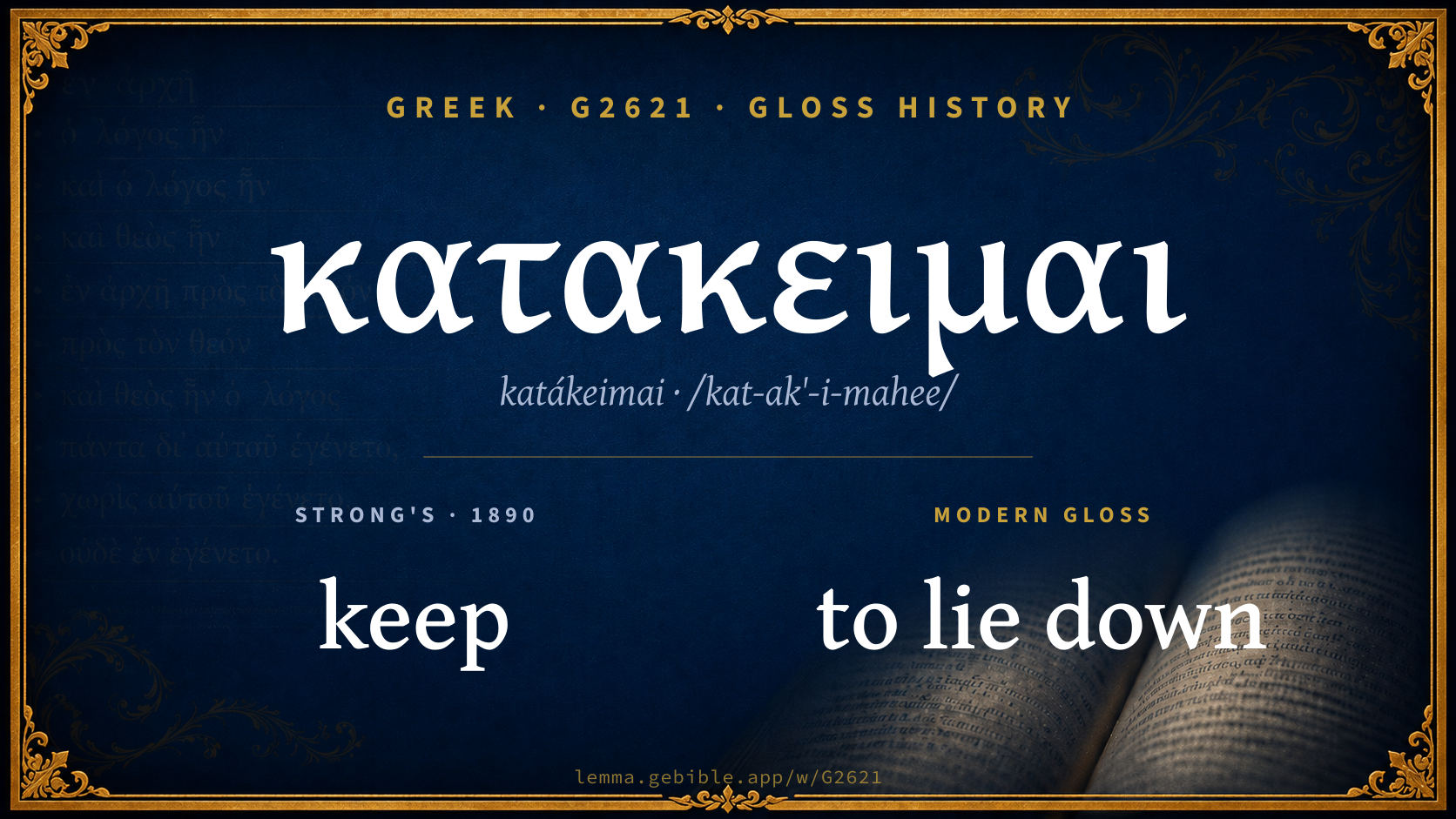
Gloss history
Strong's 1890 vs modern scholarship
About this word
Strong's G2621 catalogs a Greek word from the Greek New Testament.
These counts are not copied from any lexicon or concordance. They are computed here, from the morphology-tagged Greek New Testament. What Lemma adds →
- 12
- distinct verses
- The word appears in 12 distinct verses.
- 5 / 27
- NT books
- The word appears in 5 of 27 New Testament books.
- #904
- by frequency
- Top 1000 most frequent Greek words (rank 904 of 5,347 Greek words by occurrence).
View all 12 occurrences in the concordance →
By section of the New Testament
By traditional corpus
Conventional, traditional groupings — biblical authorship is debated, so this is a traditional corpus grouping, not an authorship claim. Some books belong to more than one corpus (Luke is in both the Gospels and the Lukan corpus, and so on), so these shares overlap and need not total 100%. Each figure is a share of the word’s 12 distinct verses.
- Gospels 9 verses · 75%
- Lukan (Luke–Acts) 5 verses · 42%
- Johannine 2 verses · 17%
- Pauline corpus 1 verse · 8%
How translations render this word
Counts come from each version’s own published word-to-Strong’s tagging or interlinear alignment — an approximate guide to how each version renders this word, not a word-level alignment the data otherwise carries. Because each total is that version’s own tagged count, the per-version totals vary from one another and need not match the appearance or distinct-verse counts above. These counts may also differ from a printed concordance because Lemma counts each distinctly tagged rendering and does not collapse phrase taggings into a single head-word total. This is a fixed set of word-tagged versions (KJV, ASV, BSB, ULT) and does not change with the reading translation you choose elsewhere. Each version’s license is shown beside its name below (and on Sources).
- King James Version: Lay 4×, Sat at meat 2×
- American Standard Version: Lay 3×, Sitting at meat 3×
- Berean Standard Bible: Eating 2×, Was dining 2×
- unfoldingWord Literal Text: Reclining to eat 3×
King James Version Public Domain
Renders G2621 across 10 tagged occurrences — most commonly:
Plus 4 renderings that appear only once — usually multi-word phrases or single function words the recovered tagging swept in, not distinct renderings. Not rendered by a distinct English word in 1 further occurrence.
American Standard Version Public Domain
Renders G2621 across 11 tagged occurrences — most commonly:
Plus 5 renderings that appear only once — usually multi-word phrases or single function words the recovered tagging swept in, not distinct renderings.
Berean Standard Bible Public Domain
Renders G2621 across 11 tagged occurrences — most commonly:
Plus 7 renderings that appear only once — usually multi-word phrases or single function words the recovered tagging swept in, not distinct renderings. Not rendered by a distinct English word in 1 further occurrence.
unfoldingWord Literal Text CC BY-SA 4.0
Renders G2621 across 12 tagged occurrences — most commonly:
Plus 9 renderings that appear only once — usually multi-word phrases or single function words the recovered tagging swept in, not distinct renderings.
Senses in Thayer's
The 1 sense Thayer's distinguishes for this word, in lexicon order (not ranked by frequency or importance). The full entry — with sub-senses — is in the Lexicon Entry tab.
- to have lain down, i.e. to lie prostrate
Word origin
Derived from κατα (katá) (G2596) — down.
Forms in the corpus
The 6 distinct written forms G2621 takes in the Greek New Testament, most frequent first — each parse links to that tense’s occurrences in the concordance.
| Form | Parsing | Example | Uses |
|---|---|---|---|
| κατέκειτο katékeito | Verb, Imperfect, Middle or Passive deponent, Indicative, 3rd person, Singular | Mark 1:30 | 4 |
| κατακείμενον katakeímenon | Verb, Present, Middle or Passive deponent, Participle, Accusative, Singular, Masculine | John 5:6 | 3 |
| κατακεῖσθαι katakeîsthai | Verb, Present, Middle or Passive deponent, Infinitive | Mark 2:15 | 2 |
| κατάκειται katákeitai | Verb, Present, Middle or Passive deponent, Indicative, 3rd person, Singular | Luke 7:37 | 1 |
| κατακείμενοι katakeímenoi | Verb, Present, Middle or Passive deponent, Participle, Nominative, Plural, Masculine | Luke 5:29 | 1 |
| κατακειμένου katakeiménou | Verb, Present, Middle or Passive deponent, Participle, Genitive, Singular, Masculine | Mark 14:3 | 1 |
Same root — word family
Other Thayer's entries built from the same root as G2621, grouped by Strong’s listed origin. These share a root / origin per the lexicon — not necessarily a shared meaning. Each links to that word’s own entry.
Derives from
Shares the same root
- καθα kathá G2505 according as
- καθαιρεω kathairéō G2507 to tear down
- καθαπτω katháptō G2510 to fasten down
- καθεδρα kathédra G2515 seat
- καθεζομαι kathézomai G2516 to sit down
- καθεξης kathexēs G2517 in order
- καθευδω katheúdō G2518 to fall asleep
- καθηγητης kathēgētḗs G2519 guide
- καθηκω kathḗkō G2520 to come down
- καθημαι káthēmai G2521 to sit down
- καθημερινος kathēmerinós G2522 daily
- καθιημι kathíēmi G2524 to send down
- καθιστημι kathístēmi G2525 to place
- καθο kathó G2526 according to what
- καθολου kathólou G2527 wholly
- καθοπλιζω kathoplízō G2528 to arm
- καθοραω kathoráō G2529 to see clearly
- καθοτι kathóti G2530 according to what
- καθως kathṓs G2531 according as
- καμμυω kammýō G2576 to close eyes
- καταβαινω katabaínō G2597 to descend
- καταβαλλω katabállō G2598 to cast down
- καταβαρεω katabaréō G2599 to weigh down
- καταβιβαζω katabibázō G2601 to bring down
+103 more words share this root (not shown).
Compare all same-root words → Showing 4 of 129 — not the complete family. They share a root, not necessarily a meaning.
Septuagint usage
The same Greek word κατακειμαι appears 2 times in the Greek Old Testament (Septuagint), across 2 verses in 1 book.
- 2
- LXX occurrences
- Tagged occurrences of this Greek word in the Septuagint.
- 2
- verses
- Distinct Septuagint verses containing this word.
- 1 / 39
- OT books
- The word appears in 1 of the 39 Old Testament books.
Sample Septuagint occurrences
- Proverbs 6:9 κατακεῖμαι
Septuagint occurrences (same lexeme)
Every verse where the same Strong’s number (G2621) appears in the Greek Septuagint. Verse text shown in the World English Bible for context; the Greek form is the matched word — the English is not keyword-highlighted.
- Proverbs 6:9 κατακεῖμαι How long will you sleep, sluggard? When will you arise out of your sleep?
- Proverbs 23:34 κατακεῖμαι Yes, you will be as he who lies down in the midst of the sea, Or as he who lies on top of the rigging:
These are occurrences of the same Greek lexeme (G2621) in the Septuagint — not a translation of any one Hebrew word. The store carries no word-level Hebrew↔Greek alignment, so no Hebrew original is asserted here. Counts come from the recovered LXX Strong's tagging — high-frequency vocabulary is well covered, while rare or late forms may be untagged — so they reflect tagged occurrences and may slightly undercount.