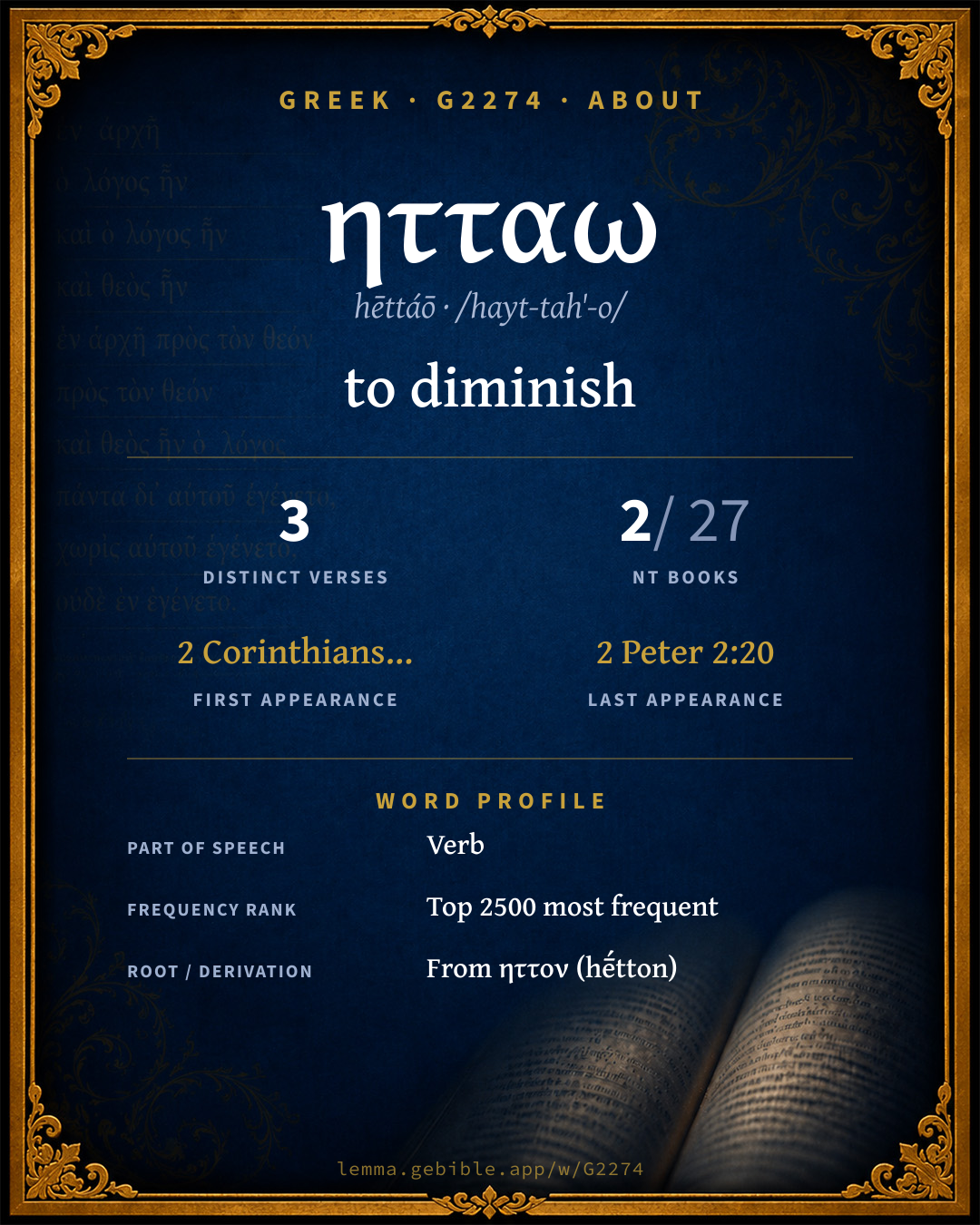
ἡττάω
to diminish
Full lexicon entry — Thayer's Greek Lexicon
From Thayer's Greek Lexicon
Where this word appears
See every Aorist-tense verb in the Greek New Testament →
Grammar key — what these labels mean
Part of speech
- Verb
- An action or state-of-being word.
Tense
- Aorist
- Action viewed as a simple whole, without regard to duration — often past (perfective aspect).
- Present
- Ongoing or general action in present time (imperfective aspect).
- Perfect
- A completed past action with continuing present results.
Voice
- Passive
- The subject receives the action.
- Middle or Passive deponent
- Middle/passive in form but active in meaning.
Mood
- Indicative
- States a fact or asks a factual question (the mood of reality).
Person
- 2nd person
- The one addressed (“you”).
- 3rd person
- The one spoken about (“he / she / it / they”).
Number
- Plural
- More than one.
- Singular
- One.
1 distinct verse where G2274 appears in the Perfect tense, across 1 book. Filtered view — show all forms. Click any verse to open its interlinear word-by-word view. Verse text shown in the World English Bible for context — . Each verse’s Greek form is shown with its reference; the English is not keyword-highlighted, since the data carries no word-level English alignment. Use “Compare translations” on any verse to read it across multiple English versions. This concordance covers the Greek New Testament; Septuagint (Greek Old Testament) occurrences of this word are not indexed here.
2 Peter 1 verse
About this entry
At a glance — auto-summarized from this page’s data, not written by a person. Every figure links to its source below. This summary describes the numbers; it doesn’t interpret them.
At its core, ητταω (hēttáō) means “to diminish.” It occurs a mere 3 verses across Scripture. Its uses cluster heavily in 2 Peter (67% of all occurrences). Scripture first uses it in 2 Corinthians 12:13. From the same root come ηττον and ηττημα. Each statement above links to its evidence; the full detail follows below.
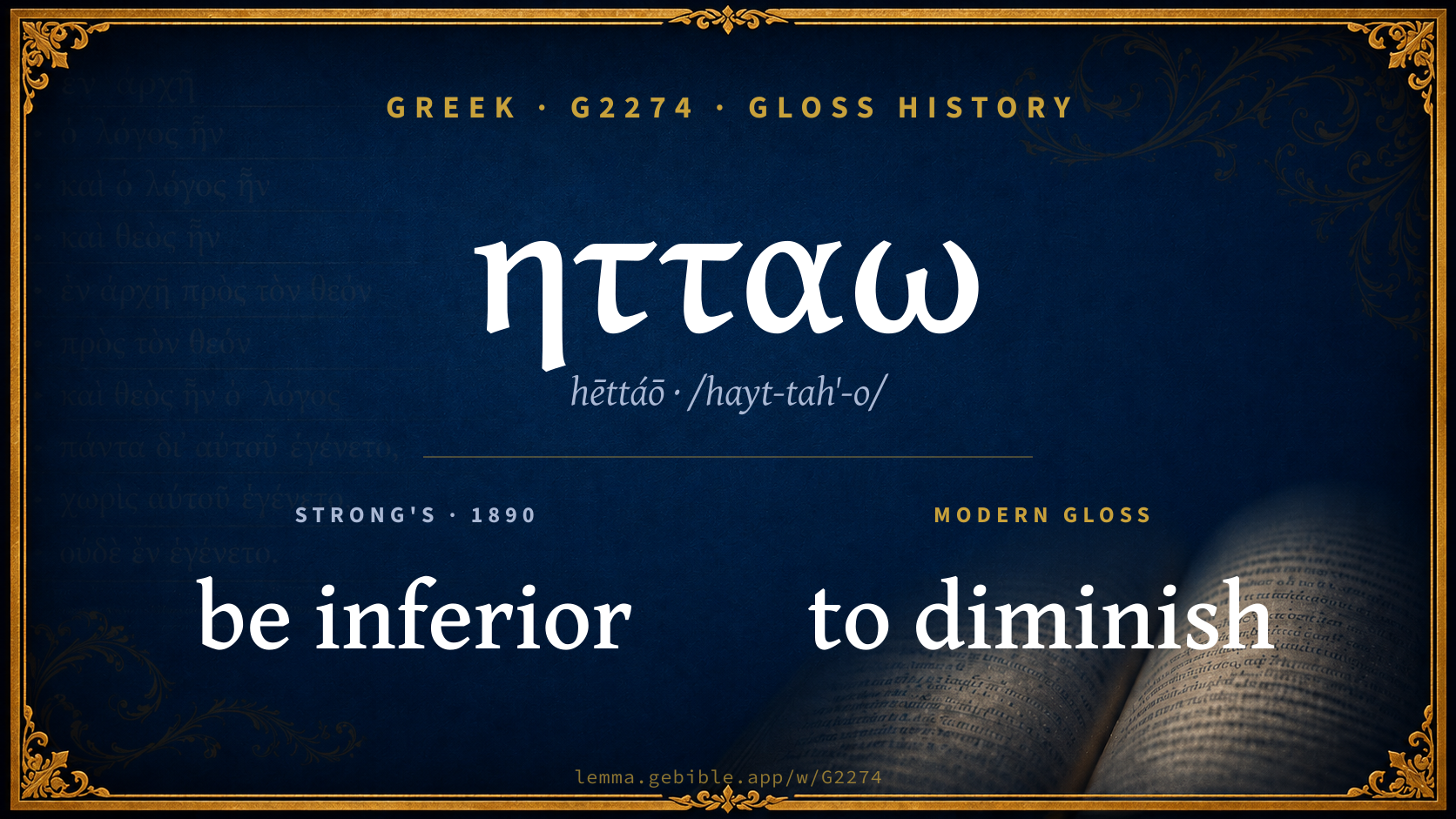
Gloss history
Strong's 1890 vs modern scholarship
About this word
Strong's G2274 catalogs a Greek word from the Greek New Testament.
These counts are not copied from any lexicon or concordance. They are computed here, from the morphology-tagged Greek New Testament. What Lemma adds →
- 3
- distinct verses
- The word appears in 3 distinct verses.
- 2 / 27
- NT books
- The word appears in 2 of 27 New Testament books.
- #2,203
- by frequency
- Top 2500 most frequent Greek words (rank 2,203 of 5,347 Greek words by occurrence).
View all 3 occurrences in the concordance →
Most concentrated in
- 2 Peter 2 verses 67%
- 2 Corinthians 1 verse 33%
By section of the New Testament
By traditional corpus
Conventional, traditional groupings — biblical authorship is debated, so this is a traditional corpus grouping, not an authorship claim. Some books belong to more than one corpus (Luke is in both the Gospels and the Lukan corpus, and so on), so these shares overlap and need not total 100%. Each figure is a share of the word’s 3 distinct verses.
- General (Catholic) Epistles 2 verses · 67%
- Pauline corpus 1 verse · 33%
How translations render this word
Counts come from each version’s own published word-to-Strong’s tagging or interlinear alignment — an approximate guide to how each version renders this word, not a word-level alignment the data otherwise carries. Because each total is that version’s own tagged count, the per-version totals vary from one another and need not match the appearance or distinct-verse counts above. These counts may also differ from a printed concordance because Lemma counts each distinctly tagged rendering and does not collapse phrase taggings into a single head-word total. This is a fixed set of word-tagged versions (KJV, ASV, BSB, ULT) and does not change with the reading translation you choose elsewhere. Each version’s license is shown beside its name below (and on Sources).
- King James Version: Is overcome 1×, Ye were inferior 1×
- American Standard Version: Is overcome 1×, Overcome 1×, Ye were made inferior 1×
- Berean Standard Bible: Has mastered him 1×, Overcome 1×, Were you inferior 1×
- unfoldingWord Literal Text: Has been overcome 1×, They have been overcome 1×, Treated worse 1×
King James Version Public Domain
Renders G2274 across 2 tagged occurrences — most commonly:
Not rendered by a distinct English word in 1 further occurrence.
American Standard Version Public Domain
Renders G2274 across 3 tagged occurrences — most commonly:
Berean Standard Bible Public Domain
Renders G2274 across 3 tagged occurrences — most commonly:
unfoldingWord Literal Text CC BY-SA 4.0
Renders G2274 across 4 tagged occurrences — most commonly:
Senses in Thayer's
The 1 sense Thayer's distinguishes for this word, in lexicon order (not ranked by frequency or importance). The full entry — with sub-senses — is in the Lexicon Entry tab.
- to make less, inferior, to overcome
Word origin
Derived from ηττον (hḗtton) (G2276) — less.
From the same as G2276 ; to make worse that is vanquish (literally or figuratively); by implication to rate lower : - be inferior overcome.
— Strong’s Exhaustive Concordance (1890), public domain.
Forms in the corpus
The 3 distinct written forms G2274 takes in the Greek New Testament, most frequent first — each parse links to that tense’s occurrences in the concordance.
| Form | Parsing | Example | Uses |
|---|---|---|---|
| ἡσσώθητε hēssṓthēte | Verb, Aorist, Passive, Indicative, 2nd person, Plural | 2 Corinthians 12:13 | 1 |
| ἡττῶνται hēttō̂ntai | Verb, Present, Middle or Passive deponent, Indicative, 3rd person, Plural | 2 Peter 2:20 | 1 |
| ἥττηται hḗttētai | Verb, Perfect, Middle or Passive deponent, Indicative, 3rd person, Singular | 2 Peter 2:19 | 1 |
Same root — word family
Other Thayer's entries built from the same root as G2274, grouped by Strong’s listed origin. These share a root / origin per the lexicon — not necessarily a shared meaning. Each links to that word’s own entry.
Derives from
Derived from this word
Compare all same-root words → They share a root, not necessarily a meaning.
Septuagint usage
The same Greek word ητταω appears 15 times in the Greek Old Testament (Septuagint), across 13 verses in 3 books.
- 15
- LXX occurrences
- Tagged occurrences of this Greek word in the Septuagint.
- 13
- verses
- Distinct Septuagint verses containing this word.
- 3 / 39
- OT books
- The word appears in 3 of the 39 Old Testament books.
Sample Septuagint occurrences
- Isaiah 8:9 ἡττάω
- Jeremiah 31:1 ἡττάω
- Daniel 6:6 ἡττάω
Septuagint occurrences (same lexeme)
Every verse where the same Strong’s number (G2274) appears in the Greek Septuagint. Verse text shown in the World English Bible for context; the Greek form is the matched word — the English is not keyword-highlighted.
- Isaiah 8:9 ἡττάω Make an uproar, O you peoples, and be broken in pieces! And give ear, all you of far countries: gird yourselves, and be broken in pieces! Gird yourselves, and be broken in pieces!
- Isaiah 13:15 ἡττάω Everyone who is found shall be thrust through; and everyone who is taken shall fall by the sword.
- Isaiah 19:1 ἡττάω The burden of Egypt. Behold, Yahweh rides on a swift cloud, and comes to Egypt: and the idols of Egypt shall tremble at his presence; and the heart of Egypt shall melt in the midst of it.
- Isaiah 20:5 ἡττάω They shall be dismayed and confounded, because of Ethiopia their expectation, and of Egypt their glory.
- Isaiah 30:31 ἡττάω For through the voice of Yahweh shall the Assyrian be dismayed; with his rod will he strike [him].
- Isaiah 31:4 ἡττάω For thus says Yahweh to me, As the lion and the young lion growling over his prey, if a multitude of shepherds are called forth against him, will not be dismayed at their voice, nor abase himself for the noise of them: so will Yahweh of Hosts come down to fight on Mount Zion, and on the hill of it.
- Isaiah 31:9 ἡττάω His rock shall pass away by reason of terror, and his princes shall be dismayed at the ensign, says Yahweh, whose fire is in Zion, and his furnace in Jerusalem.
- Isaiah 33:1 ἡττάω Woe to you who destroy, and you weren't destroyed; and deal treacherously, and they didn't deal treacherously with you! When you have ceased to destroy, you shall be destroyed; and when you have made an end of dealing treacherously, they shall deal treacherously with you.
- Isaiah 51:7 ἡττάω Listen to me, you who know righteousness, the people in whose heart is my law; don't you fear the reproach of men, neither be you dismayed at their insults.
- Isaiah 54:17 ἡττάω No weapon that is formed against you shall prosper; and every tongue that shall rise against you in judgment you shall condemn. This is the heritage of the servants of Yahweh, and their righteousness which is of me, says Yahweh.
- Jeremiah 31:1 ἡττάω At that time, says Yahweh, will I be the God of all the families of Israel, and they shall be my people.
- Daniel 6:6 ἡττάω Then these presidents and satraps assembled together to the king, and said thus to him, King Darius, live forever.
- Daniel 6:9 ἡττάω Therefore king Darius signed the writing and the interdict.
These are occurrences of the same Greek lexeme (G2274) in the Septuagint — not a translation of any one Hebrew word. The store carries no word-level Hebrew↔Greek alignment, so no Hebrew original is asserted here. Counts come from the recovered LXX Strong's tagging — high-frequency vocabulary is well covered, while rare or late forms may be untagged — so they reflect tagged occurrences and may slightly undercount.