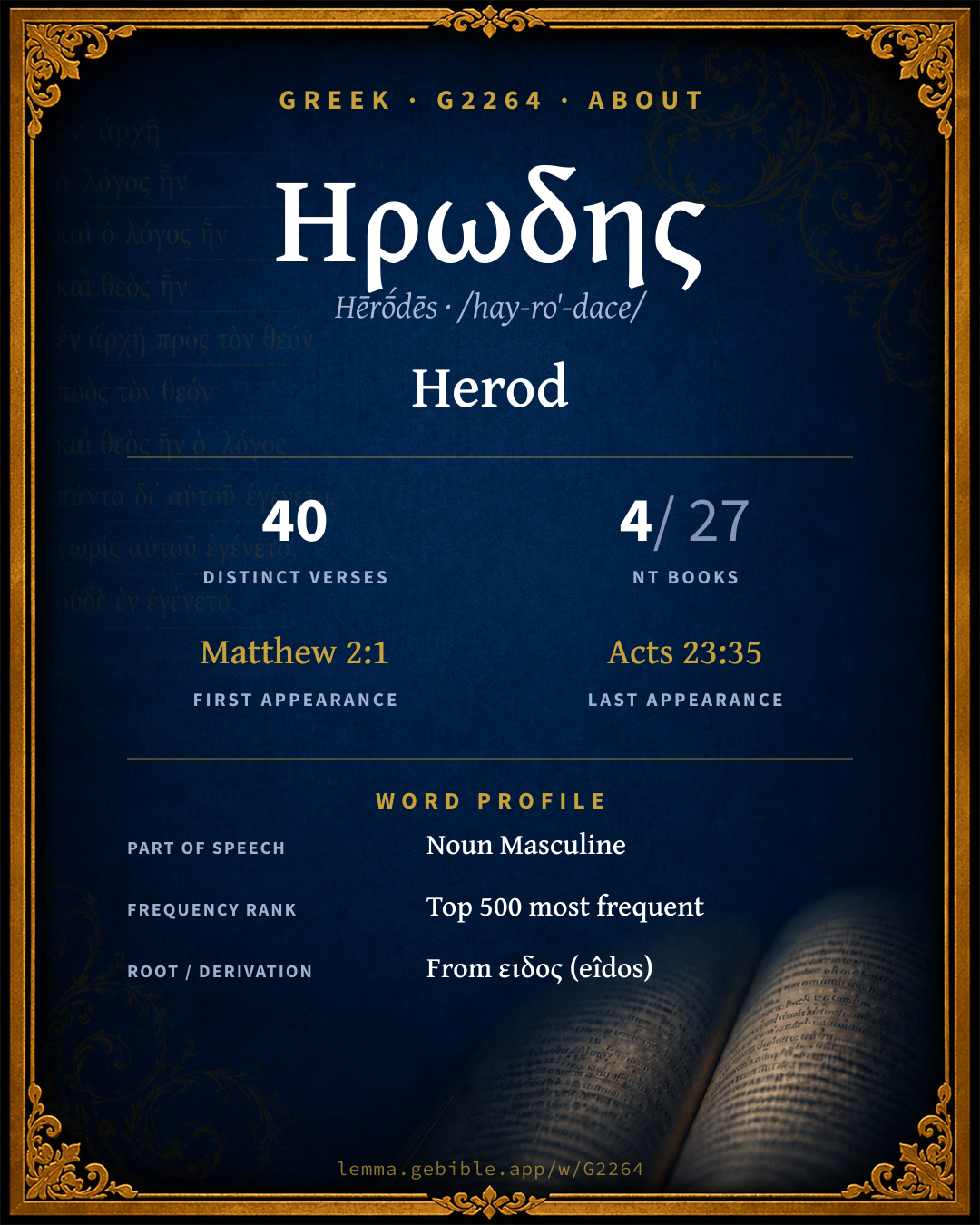
Ἡρώδης
Herod
Thayer's lists 6 entries for ‘Herod’ fuller range ↓
Full lexicon entry — Thayer's Greek Lexicon
From Thayer's Greek Lexicon
Where this word appears
See every Nominative-case word in the Greek New Testament →
Grammar key — what these labels mean
Part of speech
- Noun
- A naming word — a person, place, thing, or idea.
Case
- Nominative
- The case of the subject (and the predicate nominative).
- Genitive
- The case of source, possession, or “of” — answers “whose / from what.”
- Dative
- The case of the indirect object, means, or location — “to / for / with / in.”
- Accusative
- The case of the direct object and of extent.
Gender
- Masculine
- Grammatically masculine.
Number
- Singular
- One.
5 verses where G2264 appears in the Nominative case in the Book of Acts. Filtered view — show all forms. Click any verse to open its interlinear word-by-word view. Verse text shown in the World English Bible for context — . Each verse’s Greek form is shown with its reference; the English is not keyword-highlighted, since the data carries no word-level English alignment. Use “Compare translations” on any verse to read it across multiple English versions. This concordance covers the Greek New Testament; Septuagint (Greek Old Testament) occurrences of this word are not indexed here.
Acts
- Acts 4:27 Ἡρῴδης n nom sg masc For truly, in this city against your holy servant, Jesus, whom you anointed, both Herod and Pontius Pilate, with the Gentiles and the people of Israel, were gathered together
- Acts 12:1 Ἡρῴδης n nom sg masc Now about that time, Herod the king stretched out his hands to oppress some of the assembly.
- Acts 12:6 Ἡρῴδης n nom sg masc The same night when Herod was about to bring him out, Peter was sleeping between two soldiers, bound with two chains. Guards in front of the door kept the prison.
- Acts 12:19 Ἡρώδης n nom sg masc When Herod had sought for him, and didn't find him, he examined the guards, and commanded that they should be put to death. He went down from Judea to Caesarea, and stayed there.
- Acts 12:21 Ἡρῴδης n nom sg masc On an appointed day, Herod dressed himself in royal clothing, sat on the throne, and gave a speech to them.
About this entry
At a glance — auto-summarized from this page’s data, not written by a person. Every figure links to its source below. This summary describes the numbers; it doesn’t interpret them.
Ηρωδης — transliterated Hērṓdēs — is a Greek name carrying the sense “Herod.” Debuting at Matthew 2:1, it then recurs through the corpus. With 40 verses in 4 books, it is a moderately common word in the Greek New Testament. Its uses concentrate in Matthew (30% of all occurrences). See 40-verse concordance and the renderings breakdown below.
Gloss history
Strong's 1890 vs modern scholarship
About this word
Strong's G2264 catalogs a Greek word from the Greek New Testament.
These counts are not copied from any lexicon or concordance. They are computed here, from the morphology-tagged Greek New Testament. What Lemma adds →
- 40
- distinct verses
- The word appears in 40 distinct verses.
- 4 / 27
- NT books
- The word appears in 4 of 27 New Testament books.
- #347
- by frequency
- Top 500 most frequent Greek words (rank 347 of 5,347 Greek words by occurrence).
View all 40 occurrences in the concordance →
By section of the New Testament
By traditional corpus
Conventional, traditional groupings — biblical authorship is debated, so this is a traditional corpus grouping, not an authorship claim. Some books belong to more than one corpus (Luke is in both the Gospels and the Lukan corpus, and so on), so these shares overlap and need not total 100%. Each figure is a share of the word’s 40 distinct verses.
- Gospels 32 verses · 80%
- Lukan (Luke–Acts) 20 verses · 50%
How translations render this word
Counts come from each version’s own published word-to-Strong’s tagging or interlinear alignment — an approximate guide to how each version renders this word, not a word-level alignment the data otherwise carries. Because each total is that version’s own tagged count, the per-version totals vary from one another and need not match the appearance or distinct-verse counts above. These counts may also differ from a printed concordance because Lemma counts each distinctly tagged rendering and does not collapse phrase taggings into a single head-word total. This is a fixed set of word-tagged versions (KJV, ASV, BSB, ULT) and does not change with the reading translation you choose elsewhere. Each version’s license is shown beside its name below (and on Sources).
- King James Version: Herod 40×, Herod's 4×
- American Standard Version: Herod 42×
- Berean Standard Bible: Herod 37×, Herod’s 5×
- unfoldingWord Literal Text: Herod 42×
King James Version Public Domain
Renders G2264 across 44 tagged occurrences — most commonly:
American Standard Version Public Domain
Renders G2264 across 43 tagged occurrences — most commonly:
Plus 1 rendering that appears only once — usually multi-word phrases or single function words the recovered tagging swept in, not distinct renderings.
Berean Standard Bible Public Domain
Renders G2264 across 42 tagged occurrences — most commonly:
Not rendered by a distinct English word in 1 further occurrence.
unfoldingWord Literal Text CC BY-SA 4.0
Renders G2264 across 43 tagged occurrences — most commonly:
Plus 1 rendering that appears only once — usually multi-word phrases or single function words the recovered tagging swept in, not distinct renderings.
Senses in Thayer's
The 6 senses Thayer's distinguishes for this word, in lexicon order (not ranked by frequency or importance). The full entry — with sub-senses — is in the Lexicon Entry tab.
- Herod = "heroic"
- the name of a royal family that flourished among the Jews in the times of Christ and the Apostles. Herod the Great was…
- Herod surnamed "Antipas"…
- to Lugdunum in Gaul, where he seems to have died. He was light minded, sensual and vicious.
- Herod Agrippa I was the son of Aristobulus and Berenice…
- (Herod) Agrippa II…
Word origin
Derived from ειδος (eîdos) (G1491) — appearance.
Compound of ἥρως hē rō s (a hero ) and G1491 ; heroic ; Herodes the name of four Jewish kings : - Herod.
— Strong’s Exhaustive Concordance (1890), public domain.
Forms in the corpus
The 7 distinct written forms G2264 takes in the Greek New Testament, most frequent first — each parse links to that case’s occurrences in the concordance.
| Form | Parsing | Example | Uses |
|---|---|---|---|
| Ἡρώδης Hērṓdēs | Noun, Nominative, Singular, Masculine | Matthew 2:13 | 19 |
| Ἡρῴδου Hērṓdou | Noun, Genitive, Singular, Masculine | Matthew 2:1 | 11 |
| Ἡρῴδης Hērṓdēs | Noun, Nominative, Singular, Masculine | Matthew 2:3 | 6 |
| Ἡρώδου Hērṓdou | Noun, Genitive, Singular, Masculine | Matthew 2:15 | 2 |
| Ἡρῴδην Hērṓdēn | Noun, Accusative, Singular, Masculine | Matthew 2:12 | 2 |
| Ἡρῴδῃ Hērṓdē | Noun, Dative, Singular, Masculine | Mark 6:18 | 2 |
| Ἡρώδῃ Hērṓdē | Noun, Dative, Singular, Masculine | Matthew 14:6 | 1 |
Same root — word family
Other Thayer's entries built from the same root as G2264, grouped by Strong’s listed origin. These share a root / origin per the lexicon — not necessarily a shared meaning. Each links to that word’s own entry.
Derives from
Shares the same root
Proper names from this root
People and places named from this root — a name, not an additional meaning of the word.
- Ηρωδιανοι Hērōdianoí G2265 Herodians
- Ηρωδιας Hērōdiás G2266 Herodias
- Ηρωδιων Hērōdíōn G2267 Herodion
Compare all same-root words → Showing 4 of 7 — not the complete family. 3 of the same-root words are proper names (people or places). They share a root, not necessarily a meaning.
Bible dictionary
Public-domain dictionary articles matched to this entry by name (Herod). A biblical name can be shared by more than one person or place, so an article may treat several.
Smith's Bible Dictionary · William Smith, 1863
(hero-like). This family though of Idumean origin and thus alien by race, was Jewish in faith. I. HEROD THE GREAT was the second son of Antipater, an Idumean, who was appointed procurator of Judea by Julius Caesar, B.C. 47. Immediately after his father's elevation when only fifteen years old, he received the government of Galilee and shortly afterward that of Coele-Syria. Though Josephus says he was 15 years old at this time, it is generally conceded that there must be some mistake, as he lived to be 69 or 70 years old, and died B.C. 4; hence he must have been 25 years old at this time.--ED.) In B.C. 41 he was appointed by Antony tetrarch of Judea. Forced to abandon Judea the following year, he fled to Rome, and received the appointment of king of Judea. In the course of a few years, by the help of the Romans he took Jerusalem (B.C. 37), and completely established his authority throughout his dominions. The terrible acts of bloodshed which Herod perpetrated in his own family were accompanied by others among his subjects equally terrible, from the number who fell victims to them. According to the well-known story) he ordered the nobles whom he had called to him in his last moment to be executed immediately after his decease, that so at least his death might be attended by universal mourning. It was at the time of his fatal illness that he must have caused the slaughter of the infants at Bethlehem. (Matthew 2:16-18) He adorned Jerusalem with many splendid monuments of his taste and magnificence. The temple, which he built with scrupulous care, was the greatest of these works. The restoration was begun B.C. 20, and the temple itself was completed in a year and a half. But fresh additions were constantly made in succeeding years, so that it was said that the temple was "built in forty and six years," (John 2:20) the work continued long after Herod's death. (Herod died of a terrible disease at Jericho, in April, B.C. 4, at the age of 69, after a long reign of 37 years.--ED.) II. HEROD Antipas, Antipas was the son of Herod the Great by Malthake, a Samaritan. He first married a daughter of Aretas, "king of Arabia Petraea," but afterward Herodias, the wife of his half-brother, Herod Philip. Aretas, indignant at the insult offered to his daughter, found a pretext for invading the territory of Herod, and defeated him with great loss. This defeat, according to the famous passage in Josephus, was attributed by many to the murder of John the Baptist, which had been committed by Antipas shortly before, under the influence of Herodias. (Matthew 14:4) ff.; Mark 6:17 ff.; Luke 3:19 At a later time the ambition of Herodias proved the cause of her husband's ruin. She urged him to go to Rome to gain the title of king, cf. (Mark 6:14) but he was opposed at the court of Caligula by the emissaries of Agrippa, and condemned to perpetual banishment at Lugdunum, A.D. 39. Herodias voluntarily shared his punishment, and he died in exile. Pilate took occasion from our Lord's residence in Galilee to bend him for examination, (Luke 23:6) ff., to Herod Antipas, who came up to Jerusalem to celebrate the Passover. The city of Tiberias, which Antipas founded and named in honor of the emperor, was the most conspicuous monument of his long reign. III. HEROD PHILIP I. (Philip,) (Mark 6:17) was the son of Herod the Great and Mariamne. He married Herodias the sister of Agrippa I by whom he had a daughter, Salome. He was excluded from all share in his father's possessions in consequence of his mother's treachery, and lived afterward in a private station. IV. HEROD PHILIP II. was the son of Herod the Great and Cleopatra. He received as his own government Batanea Trachonitis, Auramtis (Gaulanitis), and some parts about Jamnia, with the title of tetrarch. Luke 3:1. He built a new city on the site of Paneas, near the sources of the Jordan, which be called Caesarea Philippi, (Matthew 16:13; Mark 8:27) and raised Bethsaida to the rank of a city under the title of Julias and died there A.D. 34. He married Salome, the daughter of Herod Philip I. and Herodias. V. HEROD AGRIPPA I. was the son of Aristobulus and Berenice, and grandson of Herod the Great. He was brought up at Rome, and was thrown into prison by Tiberius, where he remained till the accession of Caligula, who made him king, first of the tetrarchy of Philip and Lysanias; afterward the dominions of Antipas were added, and finally Judea and Samaria. Unlike his predessors, Agrippa was a strict observer of the law, and he sought with success the favor of the Jews. It is probable that it was with this view he put to death James the son of Zebedee, and further imprisoned Peter. (Acts 12:1) ff. But his sudden death interrupted his ambitious projects. (Acts 12:21,23) VI. HEROD AGRIPPA II--was the son of Herod Agrippa I. In A.D. 62 the emperor gave him the tetrarches formerly held by Philip and Lysanias, with the title of king. (Acts 25:13) The relation in which he stood to his sister Berenice, (Acts 25:13) was the cause of grave suspicion. It was before him that Paul was tried. (Acts 26:28)
Hitchcock's Bible Names Dictionary · Roswell D. Hitchcock, 1869
son of a hero
Classic public-domain reference works; full attribution on Sources.