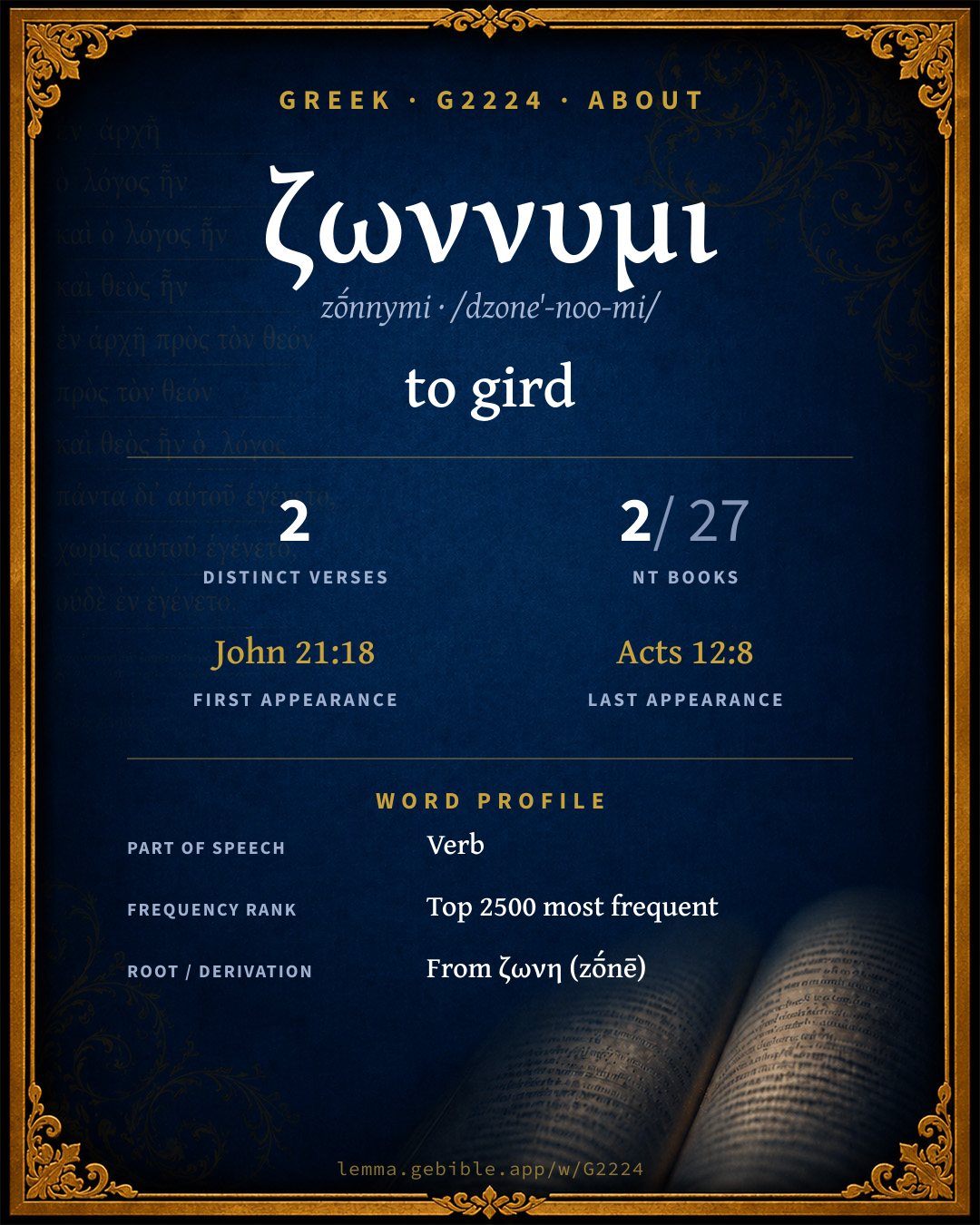
ζώννυμι
to gird
‘to gird’ is one of 2 main senses fuller range ↓
Full lexicon entry — Thayer's Greek Lexicon
From Thayer's Greek Lexicon
Where this word appears
See every Aorist-tense verb in the Greek New Testament →
Grammar key — what these labels mean
Part of speech
- Verb
- An action or state-of-being word.
Tense
- Aorist
- Action viewed as a simple whole, without regard to duration — often past (perfective aspect).
- Future
- Action expected in future time.
- Imperfect
- Continuous or repeated action in past time (“was writing”).
Voice
- Middle
- The subject acts on or for itself, or with special interest in the action.
- Active
- The subject performs the action.
Mood
- Imperative
- Expresses a command or request.
- Indicative
- States a fact or asks a factual question (the mood of reality).
Person
- 2nd person
- The one addressed (“you”).
- 3rd person
- The one spoken about (“he / she / it / they”).
Number
- Singular
- One.
1 distinct verse where G2224 appears in the Imperfect tense, across 1 book. Filtered view — show all forms. Click any verse to open its interlinear word-by-word view. Verse text shown in the World English Bible for context — . Each verse’s Greek form is shown with its reference; the English is not keyword-highlighted, since the data carries no word-level English alignment. Use “Compare translations” on any verse to read it across multiple English versions. This concordance covers the Greek New Testament; Septuagint (Greek Old Testament) occurrences of this word are not indexed here.
John 1 verse
About this entry
At a glance — auto-summarized from this page’s data, not written by a person. Every figure links to its source below. This summary describes the numbers; it doesn’t interpret them.
The Greek verb ζωννυμι centers on the idea of “to gird.” It occurs a mere 2 verses across Scripture. John dominates its distribution — 1 of 2 verses. Debuting at John 21:18, it then recurs through the corpus. Thayer's distinguishes 2 senses for it. Dig into 2-verse concordance and the renderings breakdown below.
Gloss history
Strong's 1890 vs modern scholarship
About this word
Strong's G2224 catalogs a Greek word from the Greek New Testament.
These counts are not copied from any lexicon or concordance. They are computed here, from the morphology-tagged Greek New Testament. What Lemma adds →
- 2
- distinct verses
- The word appears in 2 distinct verses.
- 2 / 27
- NT books
- The word appears in 2 of 27 New Testament books.
- #2,203
- by frequency
- Top 2500 most frequent Greek words (rank 2,203 of 5,347 Greek words by occurrence).
View all 2 occurrences in the concordance →
By traditional corpus
Conventional, traditional groupings — biblical authorship is debated, so this is a traditional corpus grouping, not an authorship claim. Some books belong to more than one corpus (Luke is in both the Gospels and the Lukan corpus, and so on), so these shares overlap and need not total 100%. Each figure is a share of the word’s 2 distinct verses.
- Gospels 1 verse · 50%
- Lukan (Luke–Acts) 1 verse · 50%
- Johannine 1 verse · 50%
How translations render this word
Counts come from each version’s own published word-to-Strong’s tagging or interlinear alignment — an approximate guide to how each version renders this word, not a word-level alignment the data otherwise carries. Because each total is that version’s own tagged count, the per-version totals vary from one another and need not match the appearance or distinct-verse counts above. These counts may also differ from a printed concordance because Lemma counts each distinctly tagged rendering and does not collapse phrase taggings into a single head-word total. This is a fixed set of word-tagged versions (KJV, ASV, BSB, ULT) and does not change with the reading translation you choose elsewhere. Each version’s license is shown beside its name below (and on Sources).
- King James Version: Shall gird 1×, Thou girdedst 1×
- American Standard Version: Shall gird 1×, Thou girdedst 1×
- Berean Standard Bible: Get dressed 1×, Will dress 1×, You dressed 1×
- unfoldingWord Literal Text: Gird yourself 1×, Will gird 1×, You used to gird 1×
King James Version Public Domain
Renders G2224 across 2 tagged occurrences — most commonly:
American Standard Version Public Domain
Renders G2224 across 2 tagged occurrences — most commonly:
Berean Standard Bible Public Domain
Renders G2224 across 3 tagged occurrences — most commonly:
unfoldingWord Literal Text CC BY-SA 4.0
Renders G2224 across 3 tagged occurrences — most commonly:
Senses in Thayer's
The 2 senses Thayer's distinguishes for this word, in lexicon order (not ranked by frequency or importance). The full entry — with sub-senses — is in the Lexicon Entry tab.
- to gird
- to gird one's self
Word origin
Derived from ζωνη (zṓnē) (G2223) — belt.
From G2223 ; to bind about (especially with a belt): - gird.
— Strong’s Exhaustive Concordance (1890), public domain.
Forms in the corpus
The 3 distinct written forms G2224 takes in the Greek New Testament, most frequent first — each parse links to that tense’s occurrences in the concordance.
| Form | Parsing | Example | Uses |
|---|---|---|---|
| ζώσει zṓsei | Verb, Future, Active, Indicative, 3rd person, Singular | John 21:18 | 1 |
| ζῶσαι zō̂sai | Verb, Aorist, Middle, Imperative, 2nd person, Singular | Acts 12:8 | 1 |
| ἐζώννυες ezṓnnyes | Verb, Imperfect, Active, Indicative, 2nd person, Singular | John 21:18 | 1 |
Septuagint usage
The same Greek word ζωννυμι appears 10 times in the Greek Old Testament (Septuagint), across 10 verses in 7 books.
- 10
- LXX occurrences
- Tagged occurrences of this Greek word in the Septuagint.
- 10
- verses
- Distinct Septuagint verses containing this word.
- 7 / 39
- OT books
- The word appears in 7 of the 39 Old Testament books.
Sample Septuagint occurrences
- Exodus 29:9 ζώννυμι
- Judges 18:11 ζώννυμι
- 1 Samuel 17:19 ζώννυμι
- 1 Kings 20:27 ζώννυμι
- 2 Kings 4:29 ζώννυμι
- Job 38:3 ζώννυμι
- Isaiah 11:5 ζώννυμι
Septuagint occurrences (same lexeme)
Every verse where the same Strong’s number (G2224) appears in the Greek Septuagint. Verse text shown in the World English Bible for context; the Greek form is the matched word — the English is not keyword-highlighted.
- Exodus 29:9 ζώννυμι You shall dress them with belts, Aaron and his sons, and bind headbands on them: and they shall have the priesthood by a perpetual statute: and you shall consecrate Aaron and his sons.
- Judges 18:11 ζώννυμι There set forth from there of the family of the Danites, out of Zorah and out of Eshtaol, six hundred men girt with weapons of war.
- 1 Samuel 17:19 ζώννυμι Now Saul, and they, and all the men of Israel, were in the valley of Elah, fighting with the Philistines.
- 1 Samuel 25:13 ζώννυμι David said to his men, Gird you on every man his sword. They girded on every man his sword; and David also girded on his sword: and there went up after David about four hundred men; and two hundred abode by the baggage.
- 1 Kings 20:27 ζώννυμι The children of Israel were mustered, and were provisioned, and went against them: and the children of Israel encamped before them like two little flocks of kids; but the Syrians filled the country.
- 2 Kings 4:29 ζώννυμι Then he said to Gehazi, Gird up your loins, and take my staff in your hand, and go your way: if you meet any man, Don't greet him; and if anyone greets you, don't answer him again: and lay my staff on the face of the child.
- 2 Kings 9:1 ζώννυμι Elisha the prophet called one of the sons of the prophets, and said to him, Gird up your loins, and take this vial of oil in your hand, and go to Ramoth-gilead.
- Job 38:3 ζώννυμι Brace yourself like a man, For I will question you, then you answer me!
- Job 40:7 ζώννυμι "Now brace yourself like a man. I will question you, and you will answer me.
- Isaiah 11:5 ζώννυμι Righteousness shall be the belt of his waist, and faithfulness the belt of his loins.
These are occurrences of the same Greek lexeme (G2224) in the Septuagint — not a translation of any one Hebrew word. The store carries no word-level Hebrew↔Greek alignment, so no Hebrew original is asserted here. Counts come from the recovered LXX Strong's tagging — high-frequency vocabulary is well covered, while rare or late forms may be untagged — so they reflect tagged occurrences and may slightly undercount.