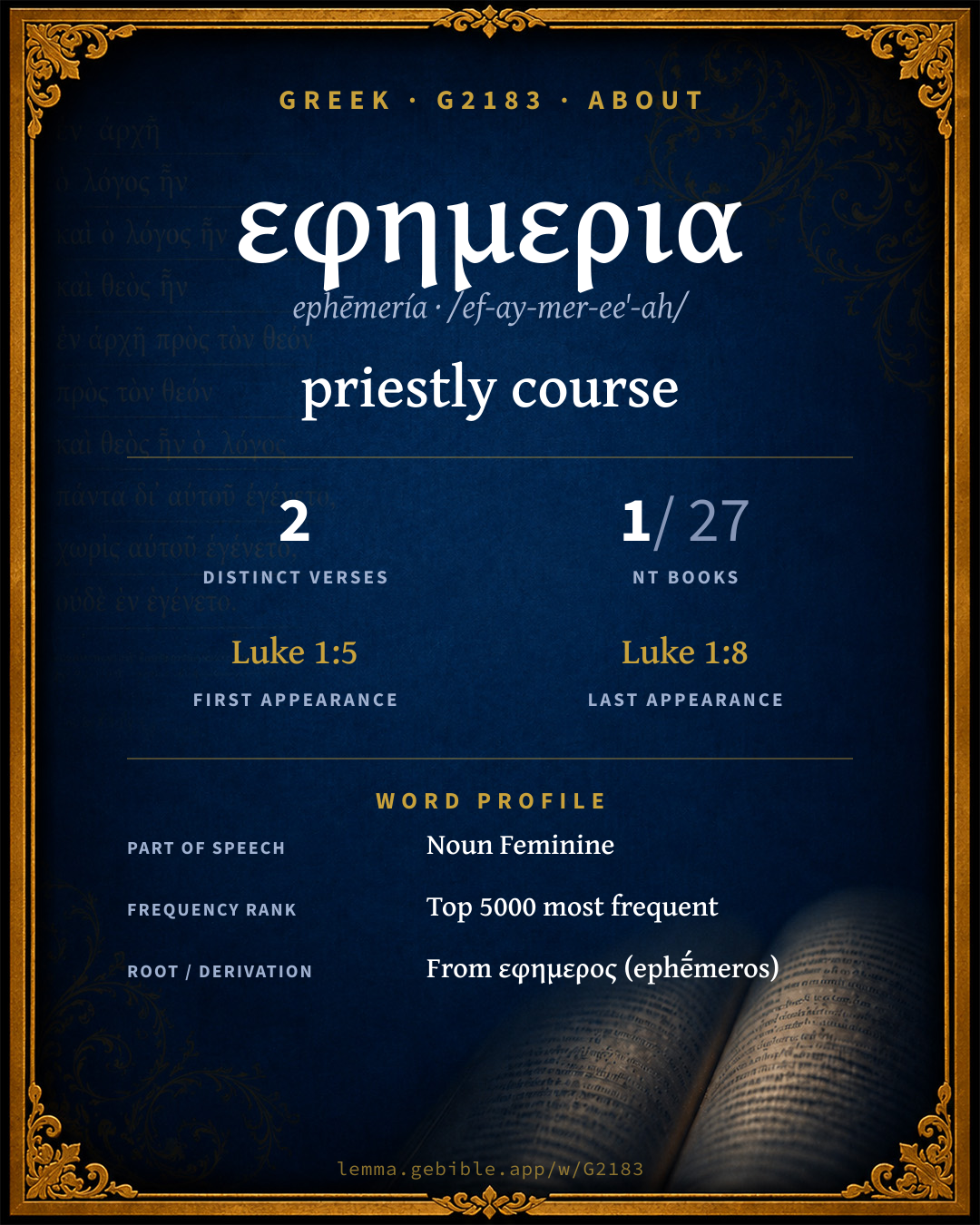
ἐφημερία
priestly course
‘priestly course’ is one of 2 main senses fuller range ↓
Full lexicon entry — Thayer's Greek Lexicon
From Thayer's Greek Lexicon
Where this word appears
Grammar key — what these labels mean
Part of speech
- Noun
- A naming word — a person, place, thing, or idea.
Case
- Genitive
- The case of source, possession, or “of” — answers “whose / from what.”
Gender
- Feminine
- Grammatically feminine.
Number
- Singular
- One.
Every verse where G2183 appears — 2 distinct verses across 1 book. Click any verse to open its interlinear word-by-word view. Verse text shown in the World English Bible for context — . Each verse’s Greek form is shown with its reference; the English is not keyword-highlighted, since the data carries no word-level English alignment. Use “Compare translations” on any verse to read it across multiple English versions. This concordance covers the Greek New Testament; Septuagint (Greek Old Testament) occurrences of this word are not indexed here.
Luke 2 verses
- Luke 1:5 ἐφημερίας n gen sg fem There was in the days of Herod, the king of Judea, a certain priest named Zacharias, of the priestly division of Abijah. He had a wife of the daughters of Aaron, and her name was Elizabeth.
- Luke 1:8 ἐφημερίας n gen sg fem Now it happened, while he executed the priest's office before God in the order of his division,
About this entry
At a glance — auto-summarized from this page’s data, not written by a person. Every figure links to its source below. This summary describes the numbers; it doesn’t interpret them.
εφημερια (ephēmería) is a Greek noun most often rendered “priestly course.” The Greek New Testament uses it only 2 verses. Luke dominates its distribution — 2 of 2 verses. Scripture first uses it in Luke 1:5. Ranging over 2 senses, it is not a single-sense word. The sections below give every sense, occurrence, and version rendering.
Gloss history
Strong's 1890 vs modern scholarship

About this word
Strong's G2183 catalogs a Greek word from the Greek New Testament.
These counts are not copied from any lexicon or concordance. They are computed here, from the morphology-tagged Greek New Testament. What Lemma adds →
- 2
- distinct verses
- The word appears in 2 distinct verses.
- 1 / 27
- NT books
- The word appears in 1 of 27 New Testament books.
- #2,678
- by frequency
- Top 5000 most frequent Greek words (rank 2,678 of 5,347 Greek words by occurrence).
View all 2 occurrences in the concordance →
Most concentrated in
- Luke 2 verses 100%
By section of the New Testament
By traditional corpus
Conventional, traditional groupings — biblical authorship is debated, so this is a traditional corpus grouping, not an authorship claim. Some books belong to more than one corpus (Luke is in both the Gospels and the Lukan corpus, and so on), so these shares overlap and need not total 100%. Each figure is a share of the word’s 2 distinct verses.
- Gospels 2 verses · 100%
- Lukan (Luke–Acts) 2 verses · 100%
How translations render this word
Counts come from each version’s own published word-to-Strong’s tagging or interlinear alignment — an approximate guide to how each version renders this word, not a word-level alignment the data otherwise carries. Because each total is that version’s own tagged count, the per-version totals vary from one another and need not match the appearance or distinct-verse counts above. These counts may also differ from a printed concordance because Lemma counts each distinctly tagged rendering and does not collapse phrase taggings into a single head-word total. This is a fixed set of word-tagged versions (KJV, ASV, BSB, ULT) and does not change with the reading translation you choose elsewhere. Each version’s license is shown beside its name below (and on Sources).
- King James Version: Course 2×
- American Standard Version: Course 2×
- Berean Standard Bible: Division 1×, Priestly division 1×
- unfoldingWord Literal Text: Division 2×
King James Version Public Domain
Renders G2183 across 2 tagged occurrences — most commonly:
American Standard Version Public Domain
Renders G2183 across 2 tagged occurrences — most commonly:
Berean Standard Bible Public Domain
Renders G2183 across 2 tagged occurrences — most commonly:
unfoldingWord Literal Text CC BY-SA 4.0
Renders G2183 across 3 tagged occurrences — most commonly:
Plus 1 rendering that appears only once — usually multi-word phrases or single function words the recovered tagging swept in, not distinct renderings.
Senses in Thayer's
The 2 senses Thayer's distinguishes for this word, in lexicon order (not ranked by frequency or importance). The full entry — with sub-senses — is in the Lexicon Entry tab.
- a service limited to a stated series of days
- the class or course itself of priests who for a week at a time performed the duties of the priestly office. David…
Word origin
Derived from εφημερος (ephḗmeros) (G2184) — daily.
From G2184 ; diurnality that is (specifically) the quotidian rotation or class of the Jewish priests´ service at the Temple as distributed by families : - course.
— Strong’s Exhaustive Concordance (1890), public domain.
Septuagint usage
The same Greek word εφημερια appears 20 times in the Greek Old Testament (Septuagint), across 18 verses in 3 books.
- 20
- LXX occurrences
- Tagged occurrences of this Greek word in the Septuagint.
- 18
- verses
- Distinct Septuagint verses containing this word.
- 3 / 39
- OT books
- The word appears in 3 of the 39 Old Testament books.
Sample Septuagint occurrences
- 1 Chronicles 9:33 ἐφημερία
- 2 Chronicles 5:11 ἐφημερία
- Ezra 22:9 ἐφημερία
Septuagint occurrences (same lexeme)
Every verse where the same Strong’s number (G2183) appears in the Greek Septuagint. Verse text shown in the World English Bible for context; the Greek form is the matched word — the English is not keyword-highlighted.
- 1 Chronicles 9:33 ἐφημερία These are the singers, heads of fathers' [houses] of the Levites, [who lived] in the chambers [and were] free [from other service]; for they were employed in their work day and night.
- 1 Chronicles 23:6 ἐφημερία David divided them into divisions according to the sons of Levi: Gershon, Kohath, and Merari.
- 1 Chronicles 25:8 ἐφημερία They cast lots for their offices, all alike, as well the small as the great, the teacher as the scholar.
- 1 Chronicles 26:12 ἐφημερία Of these were the divisions of the doorkeepers, even of the chief men, having offices like their brothers, to minister in the house of Yahweh.
- 1 Chronicles 28:1 ἐφημερία David assembled all the princes of Israel, the princes of the tribes, and the captains of the companies who served the king by division, and the captains of thousands, and the captains of hundreds, and the rulers over all the substance and possessions of the king and of his sons, with the officers, and the mighty men, even all the mighty men of valor, to Jerusalem.
- 1 Chronicles 28:13 ἐφημερία also for the divisions of the priests and the Levites, and for all the work of the service of the house of Yahweh, and for all the vessels of service in the house of Yahweh;
- 1 Chronicles 28:21 ἐφημερία Behold, there are the divisions of the priests and the Levites, for all the service of the house of God: and there shall be with you in all manner of work every willing man who has skill, for any manner of service: also the captains and all the people will be entirely at your command.
- 2 Chronicles 5:11 ἐφημερία It happened, when the priests were come out of the holy place, (for all the priests who were present had sanctified themselves, and did not keep their divisions;
- 2 Chronicles 13:10 ἐφημερία But as for us, Yahweh is our God, and we have not forsaken him; and [we have] priests ministering to Yahweh, the sons of Aaron, and the Levites in their work:
- 2 Chronicles 23:18 ἐφημερία Jehoiada appointed the officers of the house of Yahweh under the hand of the priests the Levites, whom David had distributed in the house of Yahweh, to offer the burnt offerings of Yahweh, as it is written in the law of Moses, with rejoicing and with singing, according to the order of David.
- 2 Chronicles 31:2 ἐφημερία Hezekiah appointed the divisions of the priests and the Levites after their divisions, every man according to his service, both the priests and the Levites, for burnt offerings and for peace-offerings, to minister, and to give thanks, and to praise in the gates of the camp of Yahweh.
- 2 Chronicles 31:15 ἐφημερία Under him were Eden, and Miniamin, and Jeshua, and Shemaiah, Amariah, and Shecaniah, in the cities of the priests, in their office of trust, to give to their brothers by divisions, as well to the great as to the small:
- 2 Chronicles 31:16 ἐφημερία besides those who were reckoned by genealogy of males, from three years old and upward, even everyone who entered into the house of Yahweh, as the duty of every day required, for their service in their offices according to their divisions;
- 2 Chronicles 31:17 ἐφημερία and those who were reckoned by genealogy of the priests by their fathers' houses, and the Levites from twenty years old and upward, in their offices by their divisions;
- 2 Chronicles 35:4 ἐφημερία Prepare yourselves after your fathers' houses by your divisions, according to the writing of David king of Israel, and according to the writing of Solomon his son.
- Ezra 22:9 ἐφημερία
- Ezra 22:24 ἐφημερία
- Ezra 23:30 ἐφημερία
These are occurrences of the same Greek lexeme (G2183) in the Septuagint — not a translation of any one Hebrew word. The store carries no word-level Hebrew↔Greek alignment, so no Hebrew original is asserted here. Counts come from the recovered LXX Strong's tagging — high-frequency vocabulary is well covered, while rare or late forms may be untagged — so they reflect tagged occurrences and may slightly undercount.