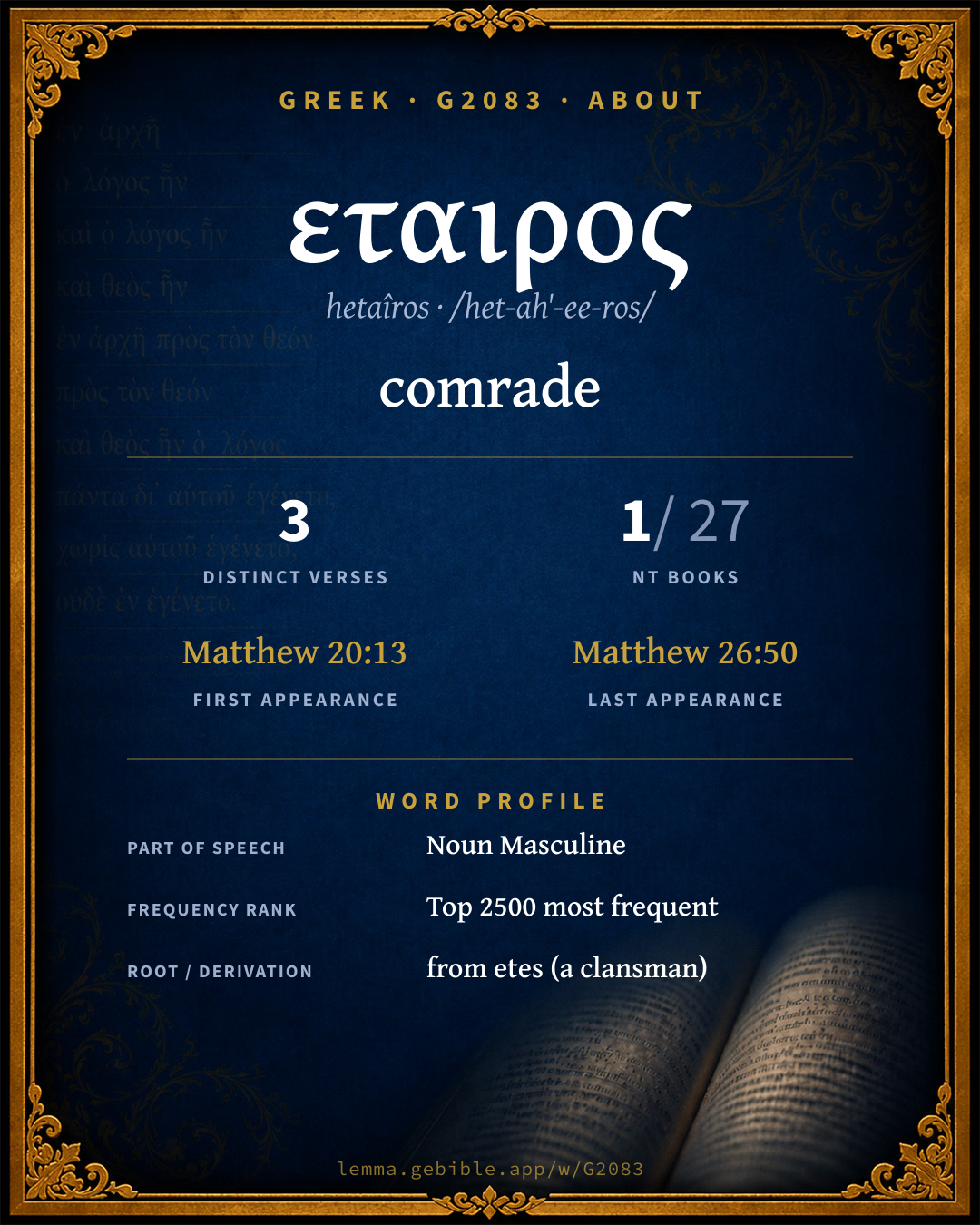
ἑταῖρος
comrade
also: mate, partner fuller range ↓
Full lexicon entry — Thayer's Greek Lexicon
From Thayer's Greek Lexicon
Where this word appears
Grammar key — what these labels mean
Part of speech
- Noun
- A naming word — a person, place, thing, or idea.
Case
- Vocative
- The case of direct address (“O Lord”).
Gender
- Masculine
- Grammatically masculine.
Number
- Singular
- One.
Every verse where G2083 appears — 3 distinct verses across 1 book. Click any verse to open its interlinear word-by-word view. Verse text shown in the World English Bible for context — . Each verse’s Greek form is shown with its reference; the English is not keyword-highlighted, since the data carries no word-level English alignment. Use “Compare translations” on any verse to read it across multiple English versions. This concordance covers the Greek New Testament; Septuagint (Greek Old Testament) occurrences of this word are not indexed here.
Matthew 3 verses
- Matthew 20:13 ἑταῖρε n voc sg masc "But he answered one of them, 'Friend, I am doing you no wrong. Didn't you agree with me for a denarius?
- Matthew 22:12 ἑταῖρε n voc sg masc and he said to him, 'Friend, how did you come in here not wearing wedding clothing?' He was speechless.
- Matthew 26:50 ἑταῖρε n voc sg masc Jesus said to him, "Friend, why are you here?" Then they came and laid hands on Jesus, and took him.
About this entry
At a glance — auto-summarized from this page’s data, not written by a person. Every figure links to its source below. This summary describes the numbers; it doesn’t interpret them.
At its core, εταιρος (hetaîros) means “comrade.” It occurs a mere 3 verses across Scripture. Its uses cluster heavily in Matthew (100% of all occurrences). It first appears in Matthew 20:13. Ranging over 2 senses, its meaning includes “mate” and “partner”. Each statement above links to its evidence; the full detail follows below.
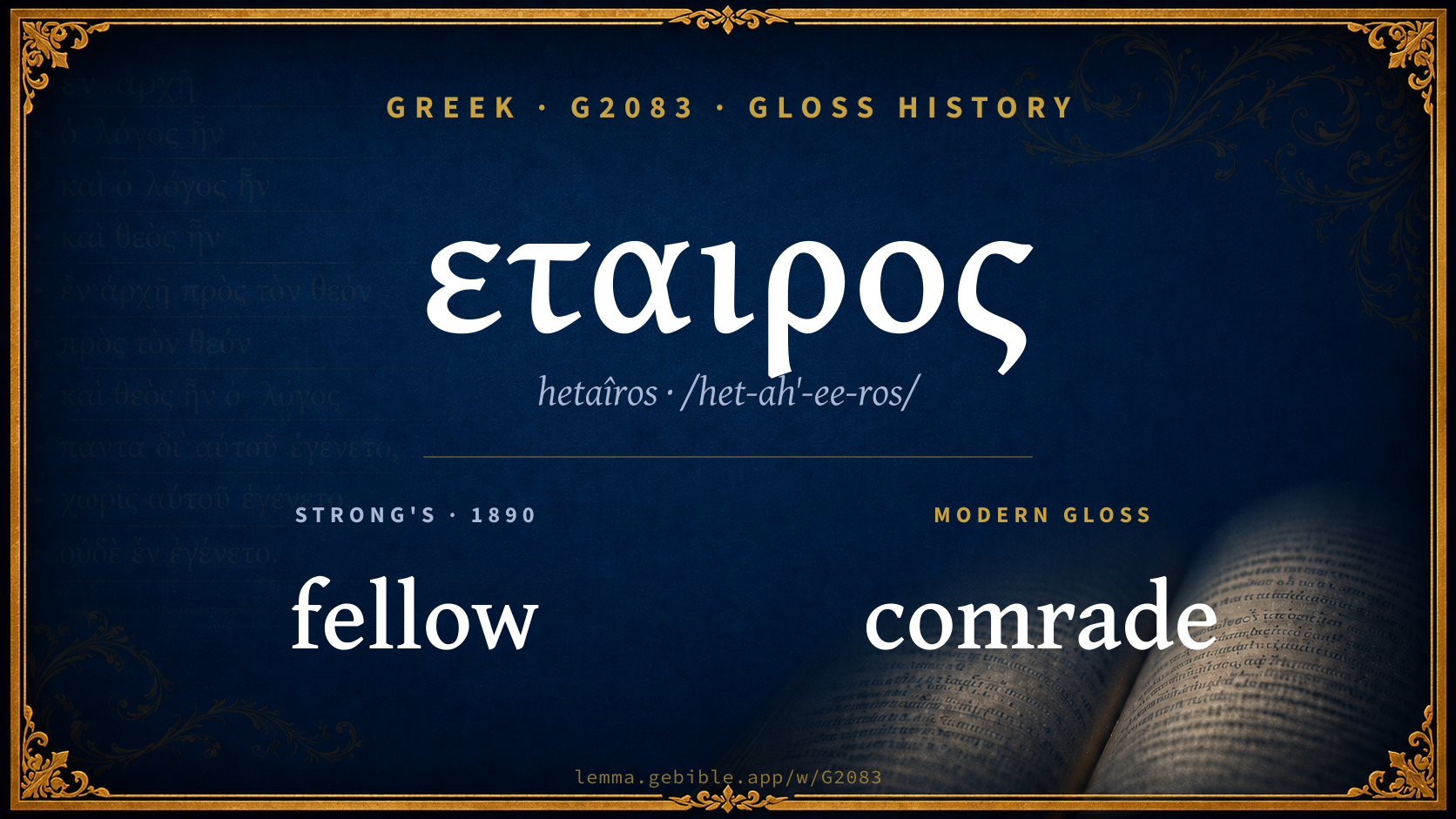
Gloss history
Strong's 1890 vs modern scholarship
About this word
Strong's G2083 catalogs a Greek word from the Greek New Testament.
These counts are not copied from any lexicon or concordance. They are computed here, from the morphology-tagged Greek New Testament. What Lemma adds →
- 3
- distinct verses
- The word appears in 3 distinct verses.
- 1 / 27
- NT books
- The word appears in 1 of 27 New Testament books.
- #2,203
- by frequency
- Top 2500 most frequent Greek words (rank 2,203 of 5,347 Greek words by occurrence).
View all 3 occurrences in the concordance →
Most concentrated in
- Matthew 3 verses 100%
By section of the New Testament
By traditional corpus
Conventional, traditional groupings — biblical authorship is debated, so this is a traditional corpus grouping, not an authorship claim. Some books belong to more than one corpus (Luke is in both the Gospels and the Lukan corpus, and so on), so these shares overlap and need not total 100%. Each figure is a share of the word’s 3 distinct verses.
- Gospels 3 verses · 100%
How translations render this word
Counts come from each version’s own published word-to-Strong’s tagging or interlinear alignment — an approximate guide to how each version renders this word, not a word-level alignment the data otherwise carries. Because each total is that version’s own tagged count, the per-version totals vary from one another and need not match the appearance or distinct-verse counts above. These counts may also differ from a printed concordance because Lemma counts each distinctly tagged rendering and does not collapse phrase taggings into a single head-word total. This is a fixed set of word-tagged versions (KJV, ASV, BSB, ULT) and does not change with the reading translation you choose elsewhere. Each version’s license is shown beside its name below (and on Sources).
- King James Version: Friend 3×
- American Standard Version: Friend 2×
- Berean Standard Bible: Friend 3×
- unfoldingWord Literal Text: Friend 3×
King James Version Public Domain
Renders G2083 across 4 tagged occurrences — most commonly:
Plus 1 rendering that appears only once — usually multi-word phrases or single function words the recovered tagging swept in, not distinct renderings.
American Standard Version Public Domain
Renders G2083 across 2 tagged occurrences — most commonly:
Berean Standard Bible Public Domain
Renders G2083 across 3 tagged occurrences — most commonly:
unfoldingWord Literal Text CC BY-SA 4.0
Renders G2083 across 3 tagged occurrences — most commonly:
Senses in Thayer's
The 2 senses Thayer's distinguishes for this word, in lexicon order (not ranked by frequency or importance). The full entry — with sub-senses — is in the Lexicon Entry tab.
- a comrade, mate, partner
- friend, (my good friend)
Word origin
Origin: from etes (a clansman)
From ἔτης etē s (a clansman ); a comrade : - fellow friend.
— Strong’s Exhaustive Concordance (1890), public domain.
Septuagint usage
The same Greek word εταιρος appears 17 times in the Greek Old Testament (Septuagint), across 16 verses in 8 books.
- 17
- LXX occurrences
- Tagged occurrences of this Greek word in the Septuagint.
- 16
- verses
- Distinct Septuagint verses containing this word.
- 8 / 39
- OT books
- The word appears in 8 of the 39 Old Testament books.
Sample Septuagint occurrences
- Judges 4:17 ἑταῖρος
- 2 Samuel 13:3 ἑταῖρος
- 1 Kings 2:22 ἑταῖρος
- Job 30:29 ἑταῖρος
- Proverbs 22:24 ἑταῖρος
- Ecclesiastes 4:4 ἑταῖρος
- Song of Solomon 1:7 ἑταῖρος
- Daniel 5:1 ἑταῖρος
Septuagint occurrences (same lexeme)
Every verse where the same Strong’s number (G2083) appears in the Greek Septuagint. Verse text shown in the World English Bible for context; the Greek form is the matched word — the English is not keyword-highlighted.
- Judges 4:17 ἑταῖρος However Sisera fled away on his feet to the tent of Jael the wife of Heber the Kenite; for there was peace between Jabin the king of Hazor and the house of Heber the Kenite.
- 2 Samuel 13:3 ἑταῖρος But Amnon had a friend, whose name was Jonadab, the son of Shimeah, David's brother; and Jonadab was a very subtle man.
- 2 Samuel 15:32 ἑταῖρος It happened that when David had come to the top [of the ascent], where God was worshiped, behold, Hushai the Archite came to meet him with his coat torn, and earth on his head.
- 2 Samuel 15:37 ἑταῖρος So Hushai, David's friend, came into the city; and Absalom came into Jerusalem.
- 2 Samuel 16:16 ἑταῖρος It happened, when Hushai the Archite, David's friend, was come to Absalom, that Hushai said to Absalom, [Long] live the king, [Long] live the king.
- 2 Samuel 16:17 ἑταῖρος Absalom said to Hushai, Is this your kindness to your friend? Why didn't you go with your friend?
- 1 Kings 2:22 ἑταῖρος King Solomon answered his mother, Why do you ask Abishag the Shunammite for Adonijah? ask for him the kingdom also; for he is my elder brother; even for him, and for Abiathar the priest, and for Joab the son of Zeruiah.
- 1 Kings 4:5 ἑταῖρος and Azariah the son of Nathan was over the officers; and Zabud the son of Nathan was chief minister, [and] the king's friend;
- Job 30:29 ἑταῖρος I am a brother to jackals, And a companion to ostriches.
- Proverbs 22:24 ἑταῖρος Don't befriend a hot-tempered man, And don't associate with one who harbors anger:
- Proverbs 27:17 ἑταῖρος Iron sharpens iron; So a man sharpens his friend's countenance.
- Ecclesiastes 4:4 ἑταῖρος Then I saw all the labor and achievement that is the envy of a man's neighbor. This also is vanity and a striving after wind.
- Song of Solomon 1:7 ἑταῖρος Tell me, you whom my soul loves, Where you graze your flock, Where you rest them at noon; For why should I be as one who is veiled Beside the flocks of your companions? Lover
- Song of Solomon 8:13 ἑταῖρος You who dwell in the gardens, with friends in attendance, Let me hear your voice! Beloved
- Daniel 5:1 ἑταῖρος Belshazzar the king made a great feast to a thousand of his lords, and drank wine before the thousand.
- Daniel 5:2 ἑταῖρος Belshazzar, while he tasted the wine, commanded to bring the golden and silver vessels which Nebuchadnezzar his father had taken out of the temple which was in Jerusalem; that the king and his lords, his wives and his concubines, might drink from it.
These are occurrences of the same Greek lexeme (G2083) in the Septuagint — not a translation of any one Hebrew word. The store carries no word-level Hebrew↔Greek alignment, so no Hebrew original is asserted here. Counts come from the recovered LXX Strong's tagging — high-frequency vocabulary is well covered, while rare or late forms may be untagged — so they reflect tagged occurrences and may slightly undercount.