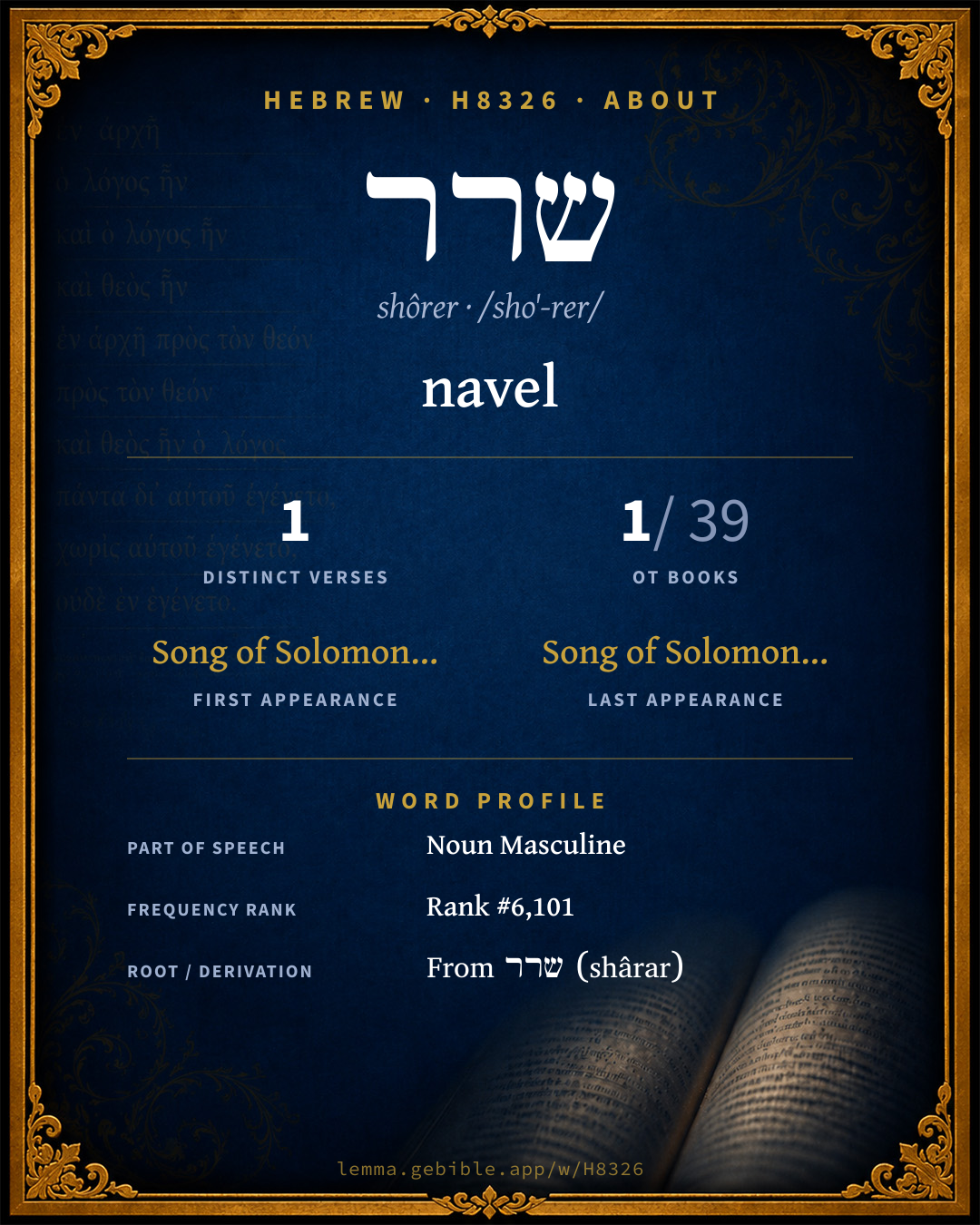
שֹׁרֶר
navel
Full lexicon entry — Brown-Driver-Briggs (BDB)
From Brown-Driver-Briggs (BDB)
Where this word appears
Grammar key — what these labels mean
Part of speech
- Noun
- A naming word — a person, place, thing, or idea.
Noun type
- Common
- A common noun — a general class of person, place, or thing (“king,” “city,” “water”), not a specific name.
State
- Construct
- A noun bound to a following noun in a possessive / “of” relationship (the construct chain).
Gender
- Masculine
- Grammatically masculine.
Number
- Singular
- One.
Every verse where H8326 appears — 1 distinct verse across 1 book. Click any verse to open its interlinear word-by-word view. Verse text shown in the World English Bible for context — . Each verse’s Hebrew form is shown with its reference; the English is not keyword-highlighted, since the data carries no word-level English alignment. Use “Compare translations” on any verse to read it across multiple English versions. This concordance covers the Hebrew Bible; Septuagint (Greek Old Testament) occurrences are not indexed here.
Song of Solomon 1 verse
About this entry
At a glance — auto-summarized from this page’s data, not written by a person. Every figure links to its source below. This summary describes the numbers; it doesn’t interpret them.
שרר — transliterated shôrer — is a Hebrew noun carrying the sense “navel.” It occurs a mere 1 verse across Scripture. More than three-quarters of its appearances fall in Song of Solomon. A true hapax — its single appearance is Song of Solomon 7:2. Related forms include שרר, שר and שרה. Each statement above links to its evidence; the full detail follows below.
Gloss history
Strong's 1890 vs modern scholarship
About this word
Strong's H8326 catalogs a Hebrew word from the Hebrew Old Testament.
These counts are not copied from any lexicon or concordance. They are computed here, from the morphology-tagged Hebrew Old Testament. What Lemma adds →
- 1
- distinct verses
- The word appears in 1 distinct verse.
- 1 / 39
- OT books
- The word appears in 1 of 39 Old Testament books.
- #6,101
- by frequency
- Rank #6,101 (rank 6,101 of 8,640 Hebrew words by occurrence).
View all 1 occurrence in the concordance →
Most concentrated in
- Song of Solomon 1 verse 100%
By section of the Old Testament
By traditional corpus
Conventional, traditional groupings — biblical authorship is debated, so this is a traditional corpus grouping, not an authorship claim. Each share is this word’s portion of its verses in that division of the Hebrew canon. Each figure is a share of the word’s 1 distinct verse.
- Writings (Ketuvim) 1 verse · 100%
How translations render this word
Counts come from each version’s own published word-to-Strong’s tagging or interlinear alignment — an approximate guide to how each version renders this word, not a word-level alignment the data otherwise carries. Because each total is that version’s own tagged count, the per-version totals vary from one another and need not match the appearance or distinct-verse counts above. These counts may also differ from a printed concordance because Lemma counts each distinctly tagged rendering and does not collapse phrase taggings into a single head-word total. This is a fixed set of word-tagged versions (KJV, ASV, BSB, ULT) and does not change with the reading translation you choose elsewhere. Each version’s license is shown beside its name below (and on Sources).
BDB lists this Strong’s number as 3 distinct words (homographs). Each count above pools all of them and is not split by sense — see the Senses section below. A low-frequency rendering may belong to a different one of those words, not the primary meaning.
- King James Version†: Navel 1×
- American Standard Version†: Body 1×
- Berean Standard Bible†: Navel 1×
- unfoldingWord Literal Text†: Is 1×, Navel 1×
King James Version Public Domain
Renders H8326 across 1† tagged occurrence — most commonly:
American Standard Version Public Domain
Renders H8326 across 1† tagged occurrence — most commonly:
Berean Standard Bible Public Domain
Renders H8326 across 1† tagged occurrence — most commonly:
unfoldingWord Literal Text CC BY-SA 4.0
Renders H8326 across 2† tagged occurrences — most commonly:
Senses in the full BDB
What do BDB’s symbols mean?
BDB uses these scholarly abbreviations:
| Symbol | Meaning |
|---|---|
| 𝔊 | the Septuagint (the ancient Greek translation, LXX) |
| 𝔙 | the Vulgate (the Latin translation) |
| 𝔖 | the Syriac version (the Peshitta) |
| 𝔗 | the Targum (the Aramaic translation) |
| ψ | the Psalms |
| √ | root (the underlying root or stem) |
| ‖ | parallel passage (a synonymous or contrasted parallel) |
| † | the dagger: every passage where the word occurs is cited |
The 5 senses and sub-senses the full Brown-Driver-Briggs lexicon distinguishes for this word, in lexicon order (not ranked by frequency), with BDB’s own verbatim wording and sub-sense lettering. Shown in Hebrew script with BDB’s own scholarly abbreviations. The condensed entry is in the Lexicon Entry tab.
שרר I (v. infr.) n.m. violence, havoc, devastation, ruin
- 1. violence, havoc, as social sin: חָמָס וָשֹׁד Am 3:10; Je 6:7; 20:8; Ez 45:9, שׁ׳ וְח׳ Hb 1:3, כָּזָב וָשׁ׳ Ho 12:2 (l. וָשָׁוְא, 𝔊 We Marti al.), שׁ׳ יָשֶׁבֶר Is 59:7; 60:18; Pr 24:2 (‖ עָמָל; שׁ׳ רְשָׁעִים Pr 21:7; c. genit. obj. שׁ׳ עֲנִיִּים ψ 12:6. e.g. Amos 3:10
- 2. devastation, ruin, for nation Ho 7:13, כְּשֹׁד מִשַּׁדַּי יָבוֹא Is 13:6 (sim. of יוֹם י׳) = Jo 1:15; Is 16:4; (Lo Gr CheHpt Marti שֹׁדֵד; ‖ רֹמֵס), 22:4, שׁ׳ וְשֶׁבֶר 51:19; Je 48:3; more gen. Am 5:9(×2); for individ. Jb 5:21 (van d. H. שׁוֹד), v 22; for beasts Hb 2:17 (+ חֲמַס לְבָנוֹן).—Ho 10:14 v. שׁדד Inf.—מִשֹּׁר (הָֽלְכוּ) Ho 9:6 read אַשּׁוּר We Now Marti.—ii. שֹׁד, v. שׁדה. e.g. Hosea 7:13
שרר II [m.] navel-string (cf. Aramaic שׁוּרָא Ez 16
שרר III
- 1. root of people under fig. of tree, involving firmness, permanence, Am 2:9; Ho 9:16; 14:6; Is 14:30; 2 K 19:30 = Is 37:31;—שָׁרְשָׁם Ju 5:14 is prob. corrupt, v. GFM;—so of pers. (cf. Ph., Eshmunazar 11 GACooke pp. 30, 36) Is 5:24; Mal 3:19; Jb 8:17; 18:16; 29:19; Pr 12:3, 12; = stock, family Is 11:1, 10; Dn 11:7, cf. (of serpent) Is 14:29; = source or cause Dt 29:17, שׁ׳ דָּבָר Jb 19:28. e.g. Amos 2:9
- 2. lit root of tree or shrub Je 17:8 (sim.), Ez 31:7 (metaph. of people), Is 53:2 (sim.), Jb 14:8; 30:4; of vine (metaph. of people) Ez 17:6, 7, 9(×2) ψ 80:10 (acc. cogn. c. שׁרשׁ Hiph.). e.g. Jeremiah 17:8
- 3. root, fig. = lowest stratum, of mt. Jb 28:9, of sea 36:30 = bottom (text strange and dub.: Du רָאשֵׁי הָרִים, with אֵדוֹ in v a); of feet, שָׁרְשֵׁי רַגְלַי 13:27, i.e. soles Ew Di De Da al. (elsewhere כַּף), Bu place of treading, footholds; Du (arbitrarily) שָׁרְשִׁי, del. רגלי. e.g. Job 28:9
Senses from the full Brown-Driver-Briggs lexicon (Brown, Driver, Briggs; Oxford 1906 — public domain), digitized via Sefaria, supplemented by the OpenScriptures HebrewLexicon (CC BY 4.0). Full attribution on Sources.
Word origin
II. (v. infr.) n.m. violence, havoc, devastation, ruin;—שׁ׳ abs. Ho 7:13 +; cstr. Is 22:4 +;—
II. n.[m.] navel-string (cf. Aramaic שׁוּרָא Ez 16:4 𝔗, ܫܶܪܳܐ, Arabic سُرٌّ, all id.);—sf. לֹא כָרַּת שָׁרֵּךְ Ez 16:4 (Ges§ 22 s Kö ii. 1. 45) thy navel-string was not cut; questioned are: שָׁרֶּ֑ךָ Pr 3:8 (De al. navel, synechd. for body, ‖ עַצְמוֹתֶיךָ; 𝔊 τῷ σώματί σου, cf. 𝔖, Clericus Bi Frankenberg בְּשָֽׂרְךָ, Ew Hi Kmp al. שְׁאֵרְךָ, Toy either); שָׁרְרֵךְ Ct 7:3 (𝔊 ὀμφαλός σου; ‖ בִּטְנֵךְ), = שָׁרֵּךְ Thes al.; now often interpreted as = vulυa, cf. Arabic سِرٌّ secret part, Hi Stickel Buhl Öttli, noticed also by Thes, but Arabism dub., v. Bu.
I. n.m. Dt 29:17 root;—שׁ׳ abs. Dt 29:17 +, cstr. Is 11:10 +; sf. שָׁרְשִׁי Jb 29:19, etc.; pl. cstr. שָׁרְשֵׁי 13:27 (v. infr.) 36:30, sf. שָֽׁרָשָׁיו Am 2:9 +, שָֽׁרָשֶׁיהָ Ez 17:7 +;—
— Brown-Driver-Briggs (Oxford 1906, public domain), digitized via Sefaria, supplemented by the OpenScriptures HebrewLexicon (CC BY 4.0). See Sources.
Derived from שרר (shârar) (H8324) — enemy.
Jastrow Dictionary
A second Hebrew/Aramaic lexicon for comparison, covering Aramaic and post-biblical (Talmudic, Targumic, Midrashic) usage that the biblical-Hebrew BDB does not. Matched by lemma rather than by Strong’s number, so a lemma may carry more than one Jastrow headword (shown separately below), and the entries cover usage well beyond the Bible.
שָֹרַר
- (b. h.) to be great, to rule.
- to make one’s self lord; (homilet.; cmp. שִׁרְבֵּב) to stretch one’s self. Yoma 9ᵇ (play on מהשֹתֹרֹעֹ, Is. XXVIII, 20) קצר מצע זה מֵהִשְׂ֗תָּ֗רֵר עליו שני ר̇ע̇ים כאחד this couch is too narrow for two lovers to stretch themselves on it (Ms. O. a. Yalk. Is. 302 מהשתרע, v. שָׂרַע); Snh. 103ᵇ מִלְּהִשְׂתָּרֵר. e.g. Isaiah 28:20
שָׁרָר
- , with suffix שָׁרְר׳; שרר to knot, chain) navel, umbilical cord. Num. R. s. 14 (ref. to Cant. VII, 3) והיא משולה בש׳ and it (the Sanhedrin) is compared to the navel; מה הש׳ הזה וכ׳ as the navel is placed in the centre of the body, so are the Sanhedrin &c.; Tanḥ. Ki Thissa 2 (in parallels טיבור). Ib. מה הש׳ הזה … ומן הש׳ הוא אוכל וכ׳ as with regard to the umbilical cord, so long as the child is in its mother’s womb, its mouth is closed, and it is fed from the umbilical cord, so &c. Tanḥ. Thazr. 5 שׁוֹרְרוֹ יוצא עמו וכ׳ its navel comes out with it (the infant) …, and the mother has to cut it off. e.g. Song of Solomon 7:3
שְׁרַר
- (preced.) to chain, knot.—Part. pass. שָׁרִיר, q. v.
- to make strong, hard. Sabb. 74ᵇ מהו דתימא לשָׁרוּרֵי מנא וכ׳ you may have thought that (by putting a green plug into a stove) he intends to make of it a hard coulter (v. מָאנָא); Ab. Zar. 38ᵃ
- to become hard. Nidd. 48ᵇ top אִשְׁתָּרוּר דדיך Var. Ar. ed. Koh. s. v. כרף thy breasts have become hard, v. שְׁדַר II, a. כְּרף.
A Dictionary of the Targumim, the Talmud Babli and Yerushalmi, and the Midrashic Literature (Marcus Jastrow; London, Luzac, 1903) — Public Domain. Digitized via Sefaria. Digitized via Sefaria. Full attribution on Sources.
Same root — word family
Other BDB entries built from the same root as H8326, grouped by Strong’s listed origin. These share a root / origin per the lexicon — not necessarily a shared meaning. Each links to that word’s own entry.
Derives from
Shares the same root
- שר shôr H8270 navel
- שרה shêrâh H8285 bracelet
- שריר shârîyr H8306 sinew
- שרירות shᵉrîyrûwth H8307 stubbornness
- ששר shâshar H8350 vermilion
Proper names from this root
People and places named from this root — a name, not an additional meaning of the word.
Compare all same-root words → Showing 4 of 9 — not the complete family. 2 of the same-root words are proper names (people or places). They share a root, not necessarily a meaning.
Septuagint verse parallels
This word appears in 1 verse that also exists in the Greek Old Testament (Septuagint), out of the 1 Hebrew verse it occurs in. You can read those verses in Greek by switching the Old Testament edition to the Septuagint.
Read these verses in the Septuagint
This is a verse-level parallel only — the same verses exist in both the Hebrew and Greek Old Testaments. No word-level Hebrew↔Greek correspondence is claimed: the data carries no such alignment, so no Greek word is shown as this Hebrew word’s translation. Coverage is not total — the Septuagint omits the deuterocanon and renumbers the Psalms, so some Hebrew verses have no direct Greek parallel.