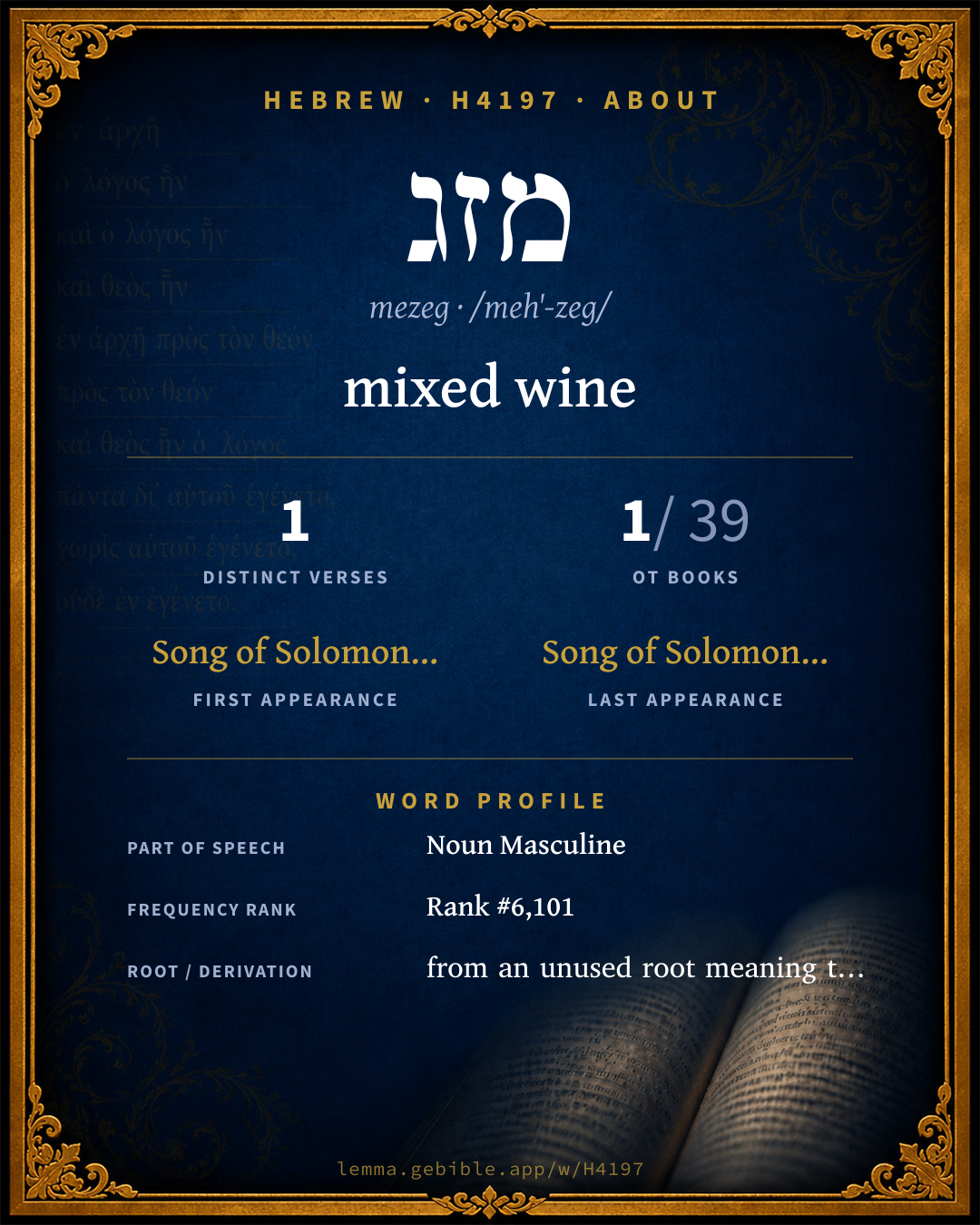
מֶ֫זֶג
mixed wine
Full lexicon entry — Brown-Driver-Briggs (BDB)
From Brown-Driver-Briggs (BDB)
Where this word appears
Grammar key — what these labels mean
Noun type
- Common
- A common noun — a general class of person, place, or thing (“king,” “city,” “water”), not a specific name.
State
- Absolute
- The independent form of a noun, not bound to a following word.
Gender
- Masculine
- Grammatically masculine.
Number
- Singular
- One.
Every verse where H4197 appears — 1 distinct verse across 1 book. Click any verse to open its interlinear word-by-word view. Verse text shown in the World English Bible for context — . Each verse’s Hebrew form is shown with its reference; the English is not keyword-highlighted, since the data carries no word-level English alignment. Use “Compare translations” on any verse to read it across multiple English versions. This concordance covers the Hebrew Bible; Septuagint (Greek Old Testament) occurrences are not indexed here.
Song of Solomon 1 verse
About this entry
At a glance — auto-summarized from this page’s data, not written by a person. Every figure links to its source below. This summary describes the numbers; it doesn’t interpret them.
At its core, מזג (mezeg) means “mixed wine.” The Hebrew Bible uses it only 1 verse. The word gravitates to Song of Solomon (100%). A true hapax — its single appearance is Song of Solomon 7:2. Dig into 1-verse concordance and the renderings breakdown below.
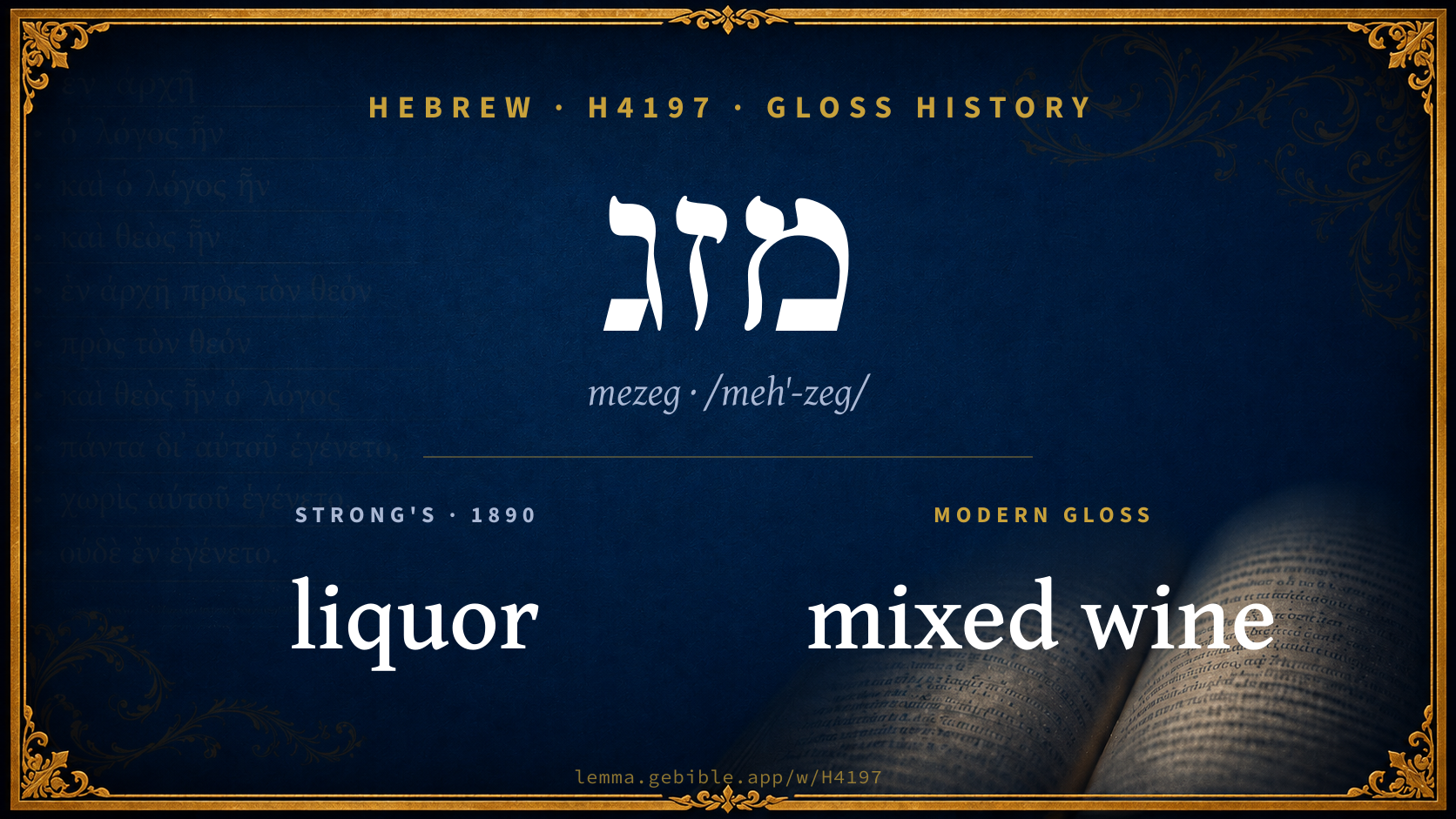
Gloss history
Strong's 1890 vs modern scholarship
About this word
Strong's H4197 catalogs a Hebrew word from the Hebrew Old Testament.
These counts are not copied from any lexicon or concordance. They are computed here, from the morphology-tagged Hebrew Old Testament. What Lemma adds →
- 1
- distinct verses
- The word appears in 1 distinct verse.
- 1 / 39
- OT books
- The word appears in 1 of 39 Old Testament books.
- #6,101
- by frequency
- Rank #6,101 (rank 6,101 of 8,640 Hebrew words by occurrence).
View all 1 occurrence in the concordance →
Most concentrated in
- Song of Solomon 1 verse 100%
By section of the Old Testament
By traditional corpus
Conventional, traditional groupings — biblical authorship is debated, so this is a traditional corpus grouping, not an authorship claim. Each share is this word’s portion of its verses in that division of the Hebrew canon. Each figure is a share of the word’s 1 distinct verse.
- Writings (Ketuvim) 1 verse · 100%
How translations render this word
Counts come from each version’s own published word-to-Strong’s tagging or interlinear alignment — an approximate guide to how each version renders this word, not a word-level alignment the data otherwise carries. Because each total is that version’s own tagged count, the per-version totals vary from one another and need not match the appearance or distinct-verse counts above. These counts may also differ from a printed concordance because Lemma counts each distinctly tagged rendering and does not collapse phrase taggings into a single head-word total. This is a fixed set of word-tagged versions (KJV, ASV, BSB, ULT) and does not change with the reading translation you choose elsewhere. Each version’s license is shown beside its name below (and on Sources).
- King James Version: Liquor 1×
- American Standard Version: Wine 1×
- Berean Standard Bible: Blended wine 1×
- unfoldingWord Literal Text: Spiced wine 1×
King James Version Public Domain
Renders H4197 across 1 tagged occurrence — most commonly:
American Standard Version Public Domain
Renders H4197 across 1 tagged occurrence — most commonly:
Berean Standard Bible Public Domain
Renders H4197 across 1 tagged occurrence — most commonly:
unfoldingWord Literal Text CC BY-SA 4.0
Renders H4197 across 1 tagged occurrence — most commonly:
Senses in BDB
The 1 sense BDB distinguishes for this word, in lexicon order (not ranked by frequency or importance). The full entry — with sub-senses — is in the Lexicon Entry tab.
- mixture, mixed wine
Word origin
[ מֶ֫זֶג ] n.m. mixture, i.e. mixed wine;— Ct 7:3
— Brown-Driver-Briggs (Oxford 1906, public domain), digitized via Sefaria, supplemented by the OpenScriptures HebrewLexicon (CC BY 4.0). See Sources.
Origin: from an unused root meaning to mingle (water with wine)
Jastrow Dictionary
A second Hebrew/Aramaic lexicon for comparison, covering Aramaic and post-biblical (Talmudic, Targumic, Midrashic) usage that the biblical-Hebrew BDB does not. Matched by lemma rather than by Strong’s number, so a lemma may carry more than one Jastrow headword (shown separately below), and the entries cover usage well beyond the Bible.
מָזַג
- (denom. of מֶזֶג; b. h. to mix wine with water, spices &c.; to temper; in gen. to fill the cups, to offer drink. Ab. Zar. 58ᵇ (to one who used מְסָכוֹ) ואימא מְזָגוֹ why do you not say m’zago? Ib. יין שמזגו נכרי wine which a gentile mixed for drinking. Ib. 59ᵃ חמרא דמָזְגוּ נכרים וכ׳ wine which gentiles mixed and Jews drank. Pes. X, 2 מזגו לו כוס וכ׳ they (the attendants) offer him the first cup &c. Num. R. s. 1 (ref. to Cant. VII, 3) מי שהוא מוֹזֵג … מוֹזֵג וכ׳ (not מזוג) he who mixes wine properly, mixes one third wine with two thirds water; Tanḥ. B’midb. 4. Pes. VII, 13 לִמְזוֹג to serve the wine; a. fr.—Part. pass. מָזוּנ a) mixed (wine), opp. חַי. Ib. 108ᵇ. Neg. I, 2 כיין המ׳ בשלג the color of red wine mixed with snow, v. פָּתַךְ. Nidd. II, 6 כמ׳ like mixed wine; expl. ib. 7 שני חלקים וכ׳ two thirds water &c., v. supra; Sabb. 75ᵃ; a. fr.—b) combined. Num. R. s. 2, beg. בי"ח מקומות … מְזוּגִין in eighteen biblical passages are Moses and Aaron combined (the predicate being in the singular number as if they were one person). e.g. Song of Solomon 7:3
- to be mixed. Y. Ab. Zar. V, 45ᵃ bot. אפי׳ נ׳ כל צרכו וכ׳ even if the quantity finally added to produce the required proportion was a permitted substance; Y. Orl. II, 62ᵇ bot.
- to clarify, make clear. Cant. R. to VII, 4 (play on מזג, ib.) the Sanhedrin שהוא מְמַוֵּג וכ׳ which makes the law clear for her (the congregation).
מְזַג
- Targ. Y. Ex. XXX, 33 (h. text ירקח). Targ. Prov. IX, 2. Targ. II Esth. I, 8; a. fr.—B. Mets. 60ᵃ מַזְגֵּיה טעמיה וכ׳ he mixed it, (and) when he tasted it &c. Erub. 54ᵃ אשכחיה … דקא מָזֵיג ליה וכ׳ he found his servant when he was about to mix the wine for him; אִימְזְגֵיה אנא I will mix it myself; Ned. 55ᵃ. Lam. R. to I, 1 רבתי (חד מאת׳ 6) (in an enigma) תרין מַזְגִּין two give drink (the breasts). Ex. R. s. 45 תרין אפין מזגין וכ׳ two angry faces putting hot water into the drink!, i.e. one adding to the other’s wrath, instead of placating; Midr. Till. to Ps. XXV, 4 מרגזין רתחין (corr. acc.; cmp. Deut. R. s. 3). [Lev. R. s. 28, end מזגיה, v. אֲזִי.] Gen. R. s. 63 (read:] מַזְגָּהּ קדמיהון, and tempered the bath before them (v. נְצַח); a. e.—Part. pass. מָזִיג, מְזִיגָא. Yoma 81ᵇ מ׳ מי אמרי Ar. (ed. מזוג) did I say, ‘tempered’ (vinegar)?
- same. Targ. Is. LXV, 11.
- same, esp. to mix drugs. Part. מַמְזִיג apothecary. Targ. Y. Ex. XXX, 25 [read:] בשמא עובד מ׳; ib. 35 (h. text רֹקֵחַ).
מְזָג
- M’zag (Mizgag), eponymous hero of a tribe answering to Mazices, Mazyes (Maxyes) in Northern Africa (v. Sm. Greek a. Roman Geogr. s. v. Mauretania). Targ. Y. Gen. X, 7; Targ. I Chr. I, 9 (ed. Lag. מזגג); ib. 32 (h. text דדן).
מֶזֶג
- [clearing, refining; fr. which מָזַג to clear (dark) wine by dilution &c.,]
- 1. mixture. Sifra Vayikra, N’dab., Par. 5, ch. VII לא במ׳ not in a mixture of water and wine. Nidd. II, 7 (19ᵃ) וכמ׳ Y. a. Bab. ed. (Mish. כמזוג), v. מָזַג. Y. ib. II, 50ᵇ top וכמ׳ אבא … מזוג נראה מבחוץ (not וכמזגי) ‘and like mixed wine’, says Abba …, like a cup filled with mixed wine, seen from without (through the glass). Bab. ib. 20ᵃ חוץ ממ׳ except the discharge which has the color of a mixture of one third wine &c.; a. e.
- 2. temperament, disposition. Gen. R. s. 28 מִזְגּוֹ … רע (not רעה) the king’s disposition is bad (he is illiberal).
A Dictionary of the Targumim, the Talmud Babli and Yerushalmi, and the Midrashic Literature (Marcus Jastrow; London, Luzac, 1903) — Public Domain. Digitized via Sefaria. Digitized via Sefaria. Full attribution on Sources.
Septuagint verse parallels
This word appears in 1 verse that also exists in the Greek Old Testament (Septuagint), out of the 1 Hebrew verse it occurs in. You can read those verses in Greek by switching the Old Testament edition to the Septuagint.
Read these verses in the Septuagint
This is a verse-level parallel only — the same verses exist in both the Hebrew and Greek Old Testaments. No word-level Hebrew↔Greek correspondence is claimed: the data carries no such alignment, so no Greek word is shown as this Hebrew word’s translation. Coverage is not total — the Septuagint omits the deuterocanon and renumbers the Psalms, so some Hebrew verses have no direct Greek parallel.