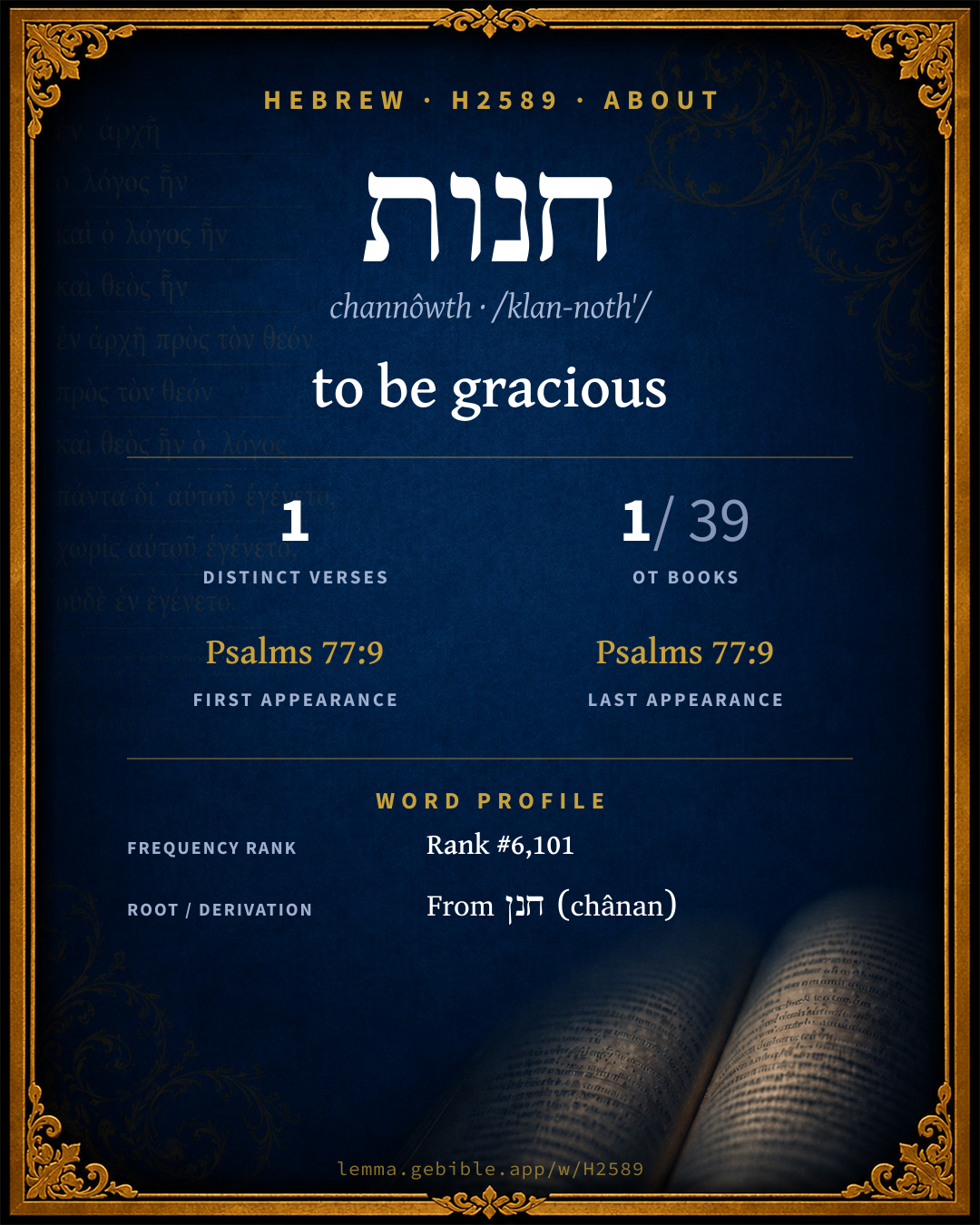
חַנּוֹת
to be gracious
‘to be gracious’ is one of 2 main senses fuller range ↓
Full lexicon entry — Brown-Driver-Briggs (BDB)
From Brown-Driver-Briggs (BDB)
Where this word appears
Grammar key — what these labels mean
Part of speech
- Verb
- An action or state-of-being word.
Stem
- Piel
- An intensive or resultative active stem.
Form
- Infinitive Construct
- A bound verbal noun, frequently with prepositions (“to write / in writing”).
Every verse where H2589 appears — 1 distinct verse across 1 book. Click any verse to open its interlinear word-by-word view. Verse text shown in the World English Bible for context — . Each verse’s Hebrew form is shown with its reference; the English is not keyword-highlighted, since the data carries no word-level English alignment. Use “Compare translations” on any verse to read it across multiple English versions. This concordance covers the Hebrew Bible; Septuagint (Greek Old Testament) occurrences are not indexed here.
Psalms 1 verse
About this entry
At a glance — auto-summarized from this page’s data, not written by a person. Every figure links to its source below. This summary describes the numbers; it doesn’t interpret them.
The Hebrew word חנות centers on the idea of “to be gracious.” A scarce word — 1 verse in all of the Hebrew Bible. The word gravitates to Psalms (100%). A true hapax — its single appearance is Psalms 77:9. The lexicon spreads it across several senses; see its full sense range. For the data behind this summary, explore the sense tree and the renderings breakdown below.
Gloss history
Strong's 1890 vs modern scholarship
About this word
Strong's H2589 catalogs a Hebrew word from the Hebrew Old Testament.
These counts are not copied from any lexicon or concordance. They are computed here, from the morphology-tagged Hebrew Old Testament. What Lemma adds →
- 1
- distinct verses
- The word appears in 1 distinct verse.
- 1 / 39
- OT books
- The word appears in 1 of 39 Old Testament books.
- #6,101
- by frequency
- Rank #6,101 (rank 6,101 of 8,640 Hebrew words by occurrence).
View all 1 occurrence in the concordance →
Most concentrated in
- Psalms 1 verse 100%
By section of the Old Testament
By traditional corpus
Conventional, traditional groupings — biblical authorship is debated, so this is a traditional corpus grouping, not an authorship claim. Each share is this word’s portion of its verses in that division of the Hebrew canon. Each figure is a share of the word’s 1 distinct verse.
- Writings (Ketuvim) 1 verse · 100%
How translations render this word
Counts come from each version’s own published word-to-Strong’s tagging or interlinear alignment — an approximate guide to how each version renders this word, not a word-level alignment the data otherwise carries. Because each total is that version’s own tagged count, the per-version totals vary from one another and need not match the appearance or distinct-verse counts above. These counts may also differ from a printed concordance because Lemma counts each distinctly tagged rendering and does not collapse phrase taggings into a single head-word total. This is a fixed set of word-tagged versions (KJV, ASV, BSB, ULT) and does not change with the reading translation you choose elsewhere. Each version’s license is shown beside its name below (and on Sources).
- King James Version: Be gracious 1×, I intreated 1×
- American Standard Version: Be gracious 1×, Supplication 1×
- unfoldingWord Literal Text: Be gracious 1×
King James Version Public Domain
Renders H2589 across 2 tagged occurrences — most commonly:
American Standard Version Public Domain
Renders H2589 across 2 tagged occurrences — most commonly:
unfoldingWord Literal Text CC BY-SA 4.0
Renders H2589 across 1 tagged occurrence — most commonly:
Senses in the full BDB
What do BDB’s symbols mean?
BDB uses these scholarly abbreviations:
| Symbol | Meaning |
|---|---|
| 𝔊 | the Septuagint (the ancient Greek translation, LXX) |
| 𝔙 | the Vulgate (the Latin translation) |
| 𝔖 | the Syriac version (the Peshitta) |
| 𝔗 | the Targum (the Aramaic translation) |
| ψ | the Psalms |
| √ | root (the underlying root or stem) |
| ‖ | parallel passage (a synonymous or contrasted parallel) |
| † | the dagger: every passage where the word occurs is cited |
The 6 senses and sub-senses the full Brown-Driver-Briggs lexicon distinguishes for this word, in lexicon order (not ranked by frequency), with BDB’s own verbatim wording and sub-sense lettering. Shown in Hebrew script with BDB’s own scholarly abbreviations. The condensed entry is in the Lexicon Entry tab.
Qal
- Pf. חָנָה 1 S 26:5 Is 29:1; וְחָנִ֫יתִי consec. Is 29:3 Zc 9:8; חָנוּ Nu 2:34 + 2 times; וְחָנוּ consec. Nu 1:52; Impf. וַיִּחַן Gn 26:17 + 9 times; 3 fs. תַּחֲנֶה ψ 27:3; יַחֲנוּ Nu 1:50 + 13 times Nu + Ex 14:2: וַיַּחֲנוּ Ex 13:20 + 79 times (of which 42 in Nu 33); וַיַּחֲנוּן Ju 11:18; 2 mpl. תַּחֲנוּ Ex 14:2; 1 pl. וַנַּחֲנֶה Ezr 8:15; Imv. חֲנֵה 2 S 12:28; חֲנוּ Nu 31:19; Je 50:29; Inf. חֲנוֹת Ju 19:9; חֲנֹת Nu 1:51; sf. חֲנֹתֵנוּ Nu 10:31; חֲנֹתְכֶם Dt 1:33; Pt. חֹנֶה Ex 18:5 ψ 34:8; f. חֹנָה 2 S 23:13; 1 Ch 11:15; הֹנָ֑ךְ ψ 53:6; pl. חֹנִים Ex 14:9 + 11 times; חוֹנִים Nu 2:2; Na 3:17;— e.g. 1 Samuel 26:5
- 1. decline, of day drawing to its close חֲנוֹת הַיּוֹם Ju 19:9 (‖ רָפָה הַיּ׳ לַעֲרוֹב; also נְטוֹת הַיּ׳ v 8; הַיּוֹם רַד מְאֹד v 11). e.g. Judges 19:9
- 2. encamp (proposes verge toward, incline to, settle at, of goal of day’s march):—
- a. of single nomad Gn 26:17 (J; sq. ב), 33:18 (E; sq. אֶת־פני). e.g. Genesis 26:17
- b. of Israel at Exod. and in wilderness Ex 13:20 (ב) 14:2 (לִפְנֵי), v 2 (עַל), + c. 80 times (Hex chiefly P); also (abs.) Nu 9:18, 20, 22, 23 cf. Ezr 8:15; Ne 11:30 so they encamped (i.e. settled, or were settled) from Beersheba to the valley of Hinnom (‖ ישׁבו v 25). e.g. Exodus 13:20
- c. of armies: (1) Israel (conquering Cannan, etc.) Jos 4:19; 5:10 + often; (2) Philistines 1 S 4:1; 13:16; 2 S 23:23 +; usually sq. ב loc. Nu 10:31; 1 S 4:1; 13:16 Jos 4:19; 1 S 13:5 + 63 times (וַיַּחֲנוּ בְ 2 S 24:5 read וַיָּחֵלּוּ מִן 𝔊L We Dr v. חלל); so of locusts in hedges (in sim.) Na 3:17; also sq. עַל = by, near Ex 14:2, 9; 15:27; Nu 1:52; 2:2, 5, 12, 27; 3:29; 35 (על ירך), 33:10; Ju 7:1; 1 S 4:1; על־פני השׂדה (על in diff. sense) 2 S 11:11; sq. עַל also = against, encamp with hostile purpose Jos 10:5, 31, 34 Ju 6:4; 20:19 1 S 11:1; 2 S 12:28; 1 K 16:15; 2 K 25:1; 2 Ch 32:1; Je 50:29; 52:4 ψ 27:3; sq. אֶל־ in same sense Jos 11:5; metaph. of God’s hostility to apostate Jerusalem (על) Is 29:3; sq. also לְ = at, by Nu 2:34; Zc 9:8; אשׁר … שָׁם Ex 18:5; 1 S 26:5; sq. סביב לְ for protection Nu 1:50, 53, cf. metaph. ψ 34:8, but also hostility Jb 19:12; also sq. other prep. and prep. phrases, e.g. מֵעֵבֶר Nu 21:13; מחוץ Nu 31:19; בין 1 S 17:1; נגד 1 K 20:27 etc.; sq. acc. loc. 2 S 17:26; sq. sf. acc. with hostile sense הֹנָ֑ךְ ψ 53:6; without prep. or noun foll., in sense of encamp, be or abide in encampment Nu 9:18, 20, 22, 23; Ezr 8:15; 2 S 11:11 +; poet. of David in Jerusalem, Is 29:1 city in which David fixed his camp. e.g. Joshua 4:19
Senses from the full Brown-Driver-Briggs lexicon (Brown, Driver, Briggs; Oxford 1906 — public domain), digitized via Sefaria, supplemented by the OpenScriptures HebrewLexicon (CC BY 4.0). Full attribution on Sources.
Word origin
vb. decline, bend down, encamp (Aramaic ܚܢܳܐ to aim at, incline towards, reach; Zinj. מחנת cstr. camp, Inscr. Panammu13, 16, 17; Arabic حَنَا bend, curve, bend down; Assyrian mûnu, mênu and tênû couch, mânîtu, house, ZimBP 44, 45 Dl in Zim117)—
— Brown-Driver-Briggs (Oxford 1906, public domain), digitized via Sefaria, supplemented by the OpenScriptures HebrewLexicon (CC BY 4.0). See Sources.
Derived from חנן (chânan) (H2603) — to be gracious.
Jastrow Dictionary
A second Hebrew/Aramaic lexicon for comparison, covering Aramaic and post-biblical (Talmudic, Targumic, Midrashic) usage that the biblical-Hebrew BDB does not. Matched by lemma rather than by Strong’s number, so a lemma may carry more than one Jastrow headword (shown separately below), and the entries cover usage well beyond the Bible.
חָנוּת
- tent, esp. tradesman’s shop, tavern; meat-market &c. Tosef. Pes. I (II), 19; Pes. 31ᵇ. Ab. III, 16 הח׳ פתוחה וכ׳ the shop is open, the shop-keeper gives on credit, i.e. man has free volition and Providence is long-suffering &c.—Gitt. 67ᵃ ח׳ מיוזנת well-stocked shop (a man of vast learning and readiness), v. יָזַן. Toh. VI, 3 ח׳ שהיא טמאה ed. Dehr. (ed. שהוא טמא); a. fr.—Pl. חֲנֻיּ׳ חֲנוּיּוֹת. Ib.—B. Mets. 88ᵃ, v. הִינִי 3). Ḥull. 95ᵃ תשע ח׳ וכ׳ if there are nine meat-shops (in one market) all of which sell &c.; Pes. 9ᵇ; Nidd. 18ᵃ; Keth. 15ᵃ. Sabb. 35ᵇ שניה להבטיל מלאכה מעיר וַחֲנוּיּוֹתֶיהָ Ms. M. (ed. להבטיל עיר וחנויות) the second signal was given to stop work in the town and in its shops. Ib. וננעלו הח׳ and the stores were closed. Ib. 15ᵃ גלתה … לה בח׳ the Sanhedrin were removed from the Temple and held their meetings in the market; (Ab. Zar. 8ᵇ בחנות); a. fr.
A Dictionary of the Targumim, the Talmud Babli and Yerushalmi, and the Midrashic Literature (Marcus Jastrow; London, Luzac, 1903) — Public Domain. Digitized via Sefaria. Digitized via Sefaria. Full attribution on Sources.
Same root — word family
Other BDB entries built from the same root as H2589, grouped by Strong’s listed origin. These share a root / origin per the lexicon — not necessarily a shared meaning. Each links to that word’s own entry.
Derives from
Shares the same root
- חן chên H2580 grace
- חנה chânâh H2583 to encamp
- חנון channûwn H2587 gracious
- חנינה chănîynâh H2594 compassion
- חנן chănan H2604 to show favour
- תחנה tᵉchinnâh H8467 supplication
- תחנון tachănûwn H8469 supplication
Proper names from this root
People and places named from this root — a name, not an additional meaning of the word.
- חנה Channâh H2584 Hannah
- חנון Chânûwn H2586 Hanun
- חניאל Channîyʼêl H2592 Hanniel
- חנן Chânân H2605 Hanan
- חננאל Chănanʼêl H2606 Hananeel
- חנני Chănânîy H2607 Hanani
- חנניה Chănanyâh H2608 Hananiah
- חנתן Channâthôn H2615 Hannathon
Compare all same-root words → Showing 4 of 17 — not the complete family. 8 of the same-root words are proper names (people or places). They share a root, not necessarily a meaning.
Septuagint verse parallels
This word appears in 1 verse that also exists in the Greek Old Testament (Septuagint), out of the 1 Hebrew verse it occurs in. You can read those verses in Greek by switching the Old Testament edition to the Septuagint.
Read these verses in the Septuagint
This is a verse-level parallel only — the same verses exist in both the Hebrew and Greek Old Testaments. No word-level Hebrew↔Greek correspondence is claimed: the data carries no such alignment, so no Greek word is shown as this Hebrew word’s translation. Coverage is not total — the Septuagint omits the deuterocanon and renumbers the Psalms, so some Hebrew verses have no direct Greek parallel.