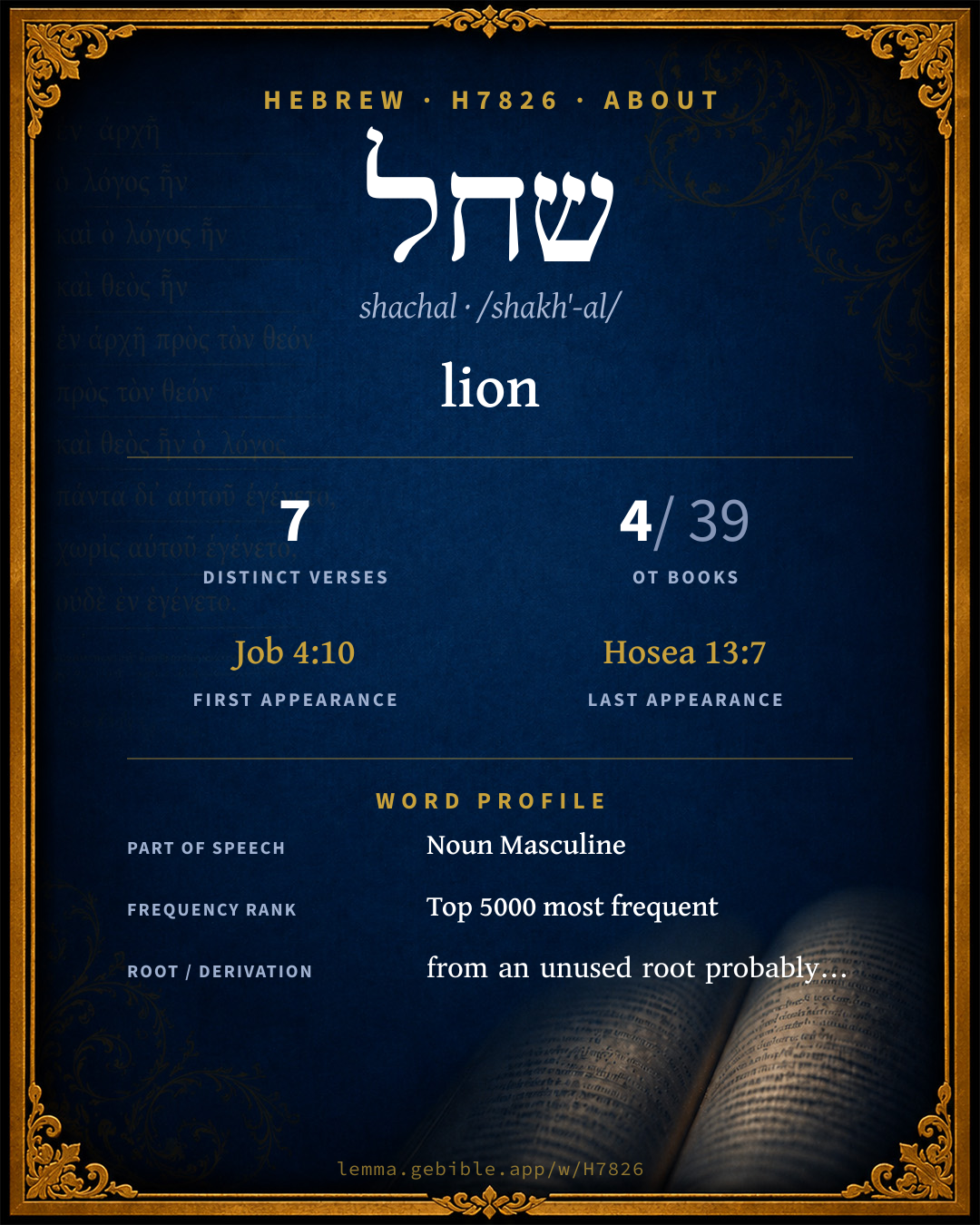
שַׁ֫חַל
lion
‘lion’ is one of 2 main senses fuller range ↓
Full lexicon entry — Brown-Driver-Briggs (BDB)
From Brown-Driver-Briggs (BDB)
Where this word appears
Grammar key — what these labels mean
Part of speech
- Noun
- A naming word — a person, place, thing, or idea.
Noun type
- Common
- A common noun — a general class of person, place, or thing (“king,” “city,” “water”), not a specific name.
State
- Absolute
- The independent form of a noun, not bound to a following word.
Gender
- Masculine
- Grammatically masculine.
Number
- Singular
- One.
Every verse where H7826 appears — 7 distinct verses across 4 books. Click any verse to open its interlinear word-by-word view. Verse text shown in the World English Bible for context — . Each verse’s Hebrew form is shown with its reference; the English is not keyword-highlighted, since the data carries no word-level English alignment. Use “Compare translations” on any verse to read it across multiple English versions. This concordance covers the Hebrew Bible; Septuagint (Greek Old Testament) occurrences are not indexed here.
Job 3 verses
- Job 4:10 שָׁ֑חַל n c ms The roaring of the lion, and the voice of the fierce lion, The teeth of the young lions, are broken.
- Job 10:16 כַּ/שַּׁ֣חַל prep det + n c ms If my head is held high, you hunt me like a lion. Again you show yourself powerful to me.
- Job 28:8 שָֽׁחַל n c ms The proud animals have not trodden it, Nor has the fierce lion passed by there.
Psalms 1 verse
Proverbs 1 verse
Hosea 2 verses
- Hosea 5:14 כַ/שַּׁ֨חַל֙ prep det + n c ms For I will be to Ephraim like a lion, And like a young lion to the house of Judah. I myself will tear in pieces and go away. I will carry off, and there will be no one to deliver.
- Hosea 13:7 שָׁ֑חַל n c ms Therefore am I to them like a lion; Like a leopard I will lurk by the path.
About this entry
At a glance — auto-summarized from this page’s data, not written by a person. Every figure links to its source below. This summary describes the numbers; it doesn’t interpret them.
The Hebrew noun שחל centers on the idea of “lion.” Its earliest occurrence is Job 4:10. Spanning 7 verses in 4 books, it ranks among the uncommon words of the Hebrew Bible. Job dominates its distribution — 3 of 7 verses. Lexicons map it across 2 senses. For the data behind this summary, explore the sense tree and the renderings breakdown below.
Gloss history
Strong's 1890 vs modern scholarship
About this word
Strong's H7826 catalogs a Hebrew word from the Hebrew Old Testament.
These counts are not copied from any lexicon or concordance. They are computed here, from the morphology-tagged Hebrew Old Testament. What Lemma adds →
- 7
- distinct verses
- The word appears in 7 distinct verses.
- 4 / 39
- OT books
- The word appears in 4 of 39 Old Testament books.
- #2,835
- by frequency
- Top 5000 most frequent Hebrew words (rank 2,835 of 8,640 Hebrew words by occurrence).
View all 7 occurrences in the concordance →
By section of the Old Testament
By traditional corpus
Conventional, traditional groupings — biblical authorship is debated, so this is a traditional corpus grouping, not an authorship claim. Each share is this word’s portion of its verses in that division of the Hebrew canon. Each figure is a share of the word’s 7 distinct verses.
- Writings (Ketuvim) 5 verses · 71%
- Prophets (Nevi'im) 2 verses · 29%
How translations render this word
Counts come from each version’s own published word-to-Strong’s tagging or interlinear alignment — an approximate guide to how each version renders this word, not a word-level alignment the data otherwise carries. Because each total is that version’s own tagged count, the per-version totals vary from one another and need not match the appearance or distinct-verse counts above. These counts may also differ from a printed concordance because Lemma counts each distinctly tagged rendering and does not collapse phrase taggings into a single head-word total. This is a fixed set of word-tagged versions (KJV, ASV, BSB, ULT) and does not change with the reading translation you choose elsewhere. Each version’s license is shown beside its name below (and on Sources).
- King James Version: Fierce lion 3×, Lion 2×
- American Standard Version: Lion 2×
- Berean Standard Bible: Lion 4×
- unfoldingWord Literal Text: Lion 3×, Like a lion 2×
King James Version Public Domain
Renders H7826 across 7 tagged occurrences — most commonly:
Plus 2 renderings that appear only once — usually multi-word phrases or single function words the recovered tagging swept in, not distinct renderings.
American Standard Version Public Domain
Renders H7826 across 7 tagged occurrences — most commonly:
Plus 5 renderings that appear only once — usually multi-word phrases or single function words the recovered tagging swept in, not distinct renderings.
Berean Standard Bible Public Domain
Renders H7826 across 7 tagged occurrences — most commonly:
Plus 3 renderings that appear only once — usually multi-word phrases or single function words the recovered tagging swept in, not distinct renderings.
unfoldingWord Literal Text CC BY-SA 4.0
Renders H7826 across 7 tagged occurrences — most commonly:
Plus 2 renderings that appear only once — usually multi-word phrases or single function words the recovered tagging swept in, not distinct renderings.
Senses in BDB
The 2 senses BDB distinguishes for this word, in lexicon order (not ranked by frequency or importance). The full entry — with sub-senses — is in the Lexicon Entry tab.
- lion
- of Jehovah, wicked men (figuratively)
Word origin
n.m. lion (poet.);—abs. שׁ׳ Ho 5:14 +, שָׁ֑חַל Jb 4:10 +;—lion, sim. of י׳, toward Israel Ho 5:14 (‖ כְּפִיר), 13:7 (‖ נָמֵר); of guilty men Jb 4:10 (‖ אַרְיֵה, כְּפִירִים); fig. of foes ψ 91:13 (‖ כְּפִיר); lion, as hunted Jb 10:16 (in sim.); lit. 28:8; Pr 26:13
— Brown-Driver-Briggs (Oxford 1906, public domain), digitized via Sefaria, supplemented by the OpenScriptures HebrewLexicon (CC BY 4.0). See Sources.
Origin: from an unused root probably meaning to roar
Jastrow Dictionary
A second Hebrew/Aramaic lexicon for comparison, covering Aramaic and post-biblical (Talmudic, Targumic, Midrashic) usage that the biblical-Hebrew BDB does not. Matched by lemma rather than by Strong’s number, so a lemma may carry more than one Jastrow headword (shown separately below), and the entries cover usage well beyond the Bible.
חֵיל I
- (חוּל, v. חַיִיל) surrounding, esp. Ḥel, a place within the fortification of the Temple. Midd. I, 5. Snh. 88ᵇ. Par. III, 11; Targ. Y. Num. XIX, 9; a. fr.
חל
- , Y. Ned. IV, beg. 39ᶜ bot כגון החל מן נונייה, read: כגון הדין חֶלְמוֹן נ׳ as, for instance, fish-raw.—Y. Ab. Zar. II, 40ᵈ top כחל לה, read: כחללה, v. חֲלָלָא.
חָל
- , perf. a. part. of חוּל.
חַל I
- , v. חֲלַל
חַל II
- (חלל, cmp. חָלֵי) weak, mild (wine). Targ. Y. Deut. VIII, 8, opp. חָרִיף.
חַל III
- vinegar, v. חָלָא III.
חָלָא III
- (חול or חלל) [turned, spoiled,] vinegar. Targ. O. Num. VI, 3 חַל; Y. חֲלָא. Targ. Ps. LXIX, 22 חָ׳ ed. (Ms. חֲ׳). Targ. Prov. XXV, 20 חלא ed. Lag. (ed. חֵילָא, Ms. חוֹ׳). Targ. Ruth II, 14.—Ab. Zar. 12ᵇ. Gen. R. s. 39, v. זוּל I ch.—Ḥull. 120ᵃ ח׳ דקריש Ar. (ed. חלב) a jellied vinegar sauce of meat; a. fr.—Y. Maasr. III, 50ᵈ bot. ח׳ בר חמרא a deteriorated son, v. חוֹמֶץ; Ḥull. 105ᵃ. [Y. Ter. VII, 45ᵈ bot. בחלא, read: בחַקְלָא.]
*שָׁחַל I
- (cmp. שָׁחַק; Arab.saḥala decorticavit) to rub off, peel
- (cmp. כָּסַף Hif.) to grow white, be frightened. Ab. d’R. N., 2ⁿᵈ vers., ch. XLIII (ed. Schechter, p. 122) שחל שהכל מְשַׁחֲלִין לפניו the lion is called shaḥal, because all grow white before him; (Yalk. Prov. 959 שחל שחָלִים לפניו because they tremble before him, prob. corrupt).
שָׁחַל II
- (v.חָלַל, חֲלַל II; cmp. Assyr. סחל to perforate, Del. Assyr. Handw., p. 493) to move in a hollow space, slip.—Part. pass. שָׁחוּל a) slipped. Y. Sabb. XV, beg. 15ᵃ בחבל ש׳ היא מתני׳ the Mishnah speaks of a rope drawn through a loop (not knotted). Ib. חבל שהוא משוחל בפסיקיא וכ׳ if a looped rope be meant, (of which the Mishnah says,) ‘you may tie up the broken rope with a fascia, but not with a rope, but R. Judah allows’—this would imply that the Rabbis do not allow it (and why should they not?).—b) v. שָׁחוּל.
- to pass through a hollow space (חַלּוֹן) or groove; to slide. Bets. 35ᵇ (ref. to Mish. ib. V, 1 משילין) חד תני משילין וחד תני מַשְׁחִילִין one reads mashshilin (fr. נָשַׁל), and another reads mashḥilin, you may let fruit slide down through an aperture in the roof (אֲרוּבָּה) &c.; מאן דתני משחילין וכ׳ he that reads mashḥilin is not wrong, for we read (Bekh. VI, 7) &c., v. שָׁחוּל. Y. ib. V, beg. 62ᵈ היה … משחילין דרך חלון if there is an aperture in the roof, you may let the fruit down by the aperture. Y. Yoma II, 39ᶜ מַשְׁחִיל ותורם he lets the wood slide (down the altar), and then removes the ashes. Y. Kil. IX, end, 32ᵈ חוט שהִשְׁחִילוֹ במחט (not למחט) a thread which one threaded through the eye of a needle; Y. Sabb. VII, 10ᶜ bot. Midr. Till. to Ps. XVIII, 41 ה׳ עשו עצמו וכ׳ Esau threaded his way through and went into the cave; ib. ה׳ וצף וכ׳ ed. Bub., v. צָפַף. Yalk. Ruth 606 שאלו הש׳ לה קללה אחת וכ׳ (later ed. התחיל, corr. acc.) for, if he (Boaz) had let down a single curse on her (Ruth), how could I (David) have risen?; Pesik. Vayhi, p. 63ᵃ שאלו השאיל … מלמטן וכ׳ (corr. acc.) for, if he had let down on her a single curse from above (‘below’ euphem. for ‘above’) &c.; Pesik. R. s. 17 התחיל (corr. acc.); Ruth R. to III, 10 (s. 6, beg.) החיש לה (corr. acc.).—Part. pass. מוּשְׁחָל. Lev. R. s. 36 (ref. to Prov. XI, 21) וזרע … שמ׳ מבין … נמלט ‘the seed of righteous men’ that slips through between two righteous men (like Ahaz between a pious father and a pious son) escapes; (Y. Snh. X, 27ᵈ זרע שהוא מוטל וכ׳). e.g. Proverbs 11:21
- to be looped; part. מְשׁוּחָל, v. supra.
שְׁחַל
- 1. to let slip; to draw out of. Targ. O. Ex. II, 10 (Y. ed. Vien. שַׁחֵילְ׳ Pa.; h. text משה). Targ. I Chr. IV, 18.—Ber. 8ᵃ כמִשְׁחַל בניתא וכ׳, v. בִּינְתָא II (perh. to be read: כמְשַׁחֵל Pa.).
- 2. to discharge through pores, exude. Yoma 78ᵃ דמִישְׁחַל שָׁחֵיל it (the unglazed earthen vessel) lets the moisture ooze through.
שַׁחַל
- cmp. Assyr. šaḥâlu to cry) lion. Snh. 95ᵃ; Ab. d’R. N. XXXIX; ib., 2ⁿᵈ vers., ch. XLIII (ed. Schechter, p. 122) ש׳ שהכל משחלין וכ׳, v. שָׁחַל I.
A Dictionary of the Targumim, the Talmud Babli and Yerushalmi, and the Midrashic Literature (Marcus Jastrow; London, Luzac, 1903) — Public Domain. Digitized via Sefaria. Digitized via Sefaria. Full attribution on Sources.
Forms in the corpus
The 5 distinct written forms H7826 takes in the Hebrew Bible, most frequent first — each parse links to that state’s occurrences in the concordance. Hebrew forms include their vowel points and cantillation, so a single lemma takes many written forms.
| Form | Parsing | Example | Uses |
|---|---|---|---|
| שַׁ֣חַל | Noun, Common, Masculine, Singular, Absolute | Proverbs 26:13 | 2 |
| שָׁ֑חַל | Noun, Common, Masculine, Singular, Absolute | Hosea 13:7 | 2 |
| כַ/שַּׁ֨חַל֙ | Noun, Common, Masculine, Singular, Absolute | Hosea 5:14 | 1 |
| כַּ/שַּׁ֣חַל | Noun, Common, Masculine, Singular, Absolute | Job 10:16 | 1 |
| שָֽׁחַל | Noun, Common, Masculine, Singular, Absolute | Job 28:8 | 1 |
Same root — word family
Other BDB entries built from the same root as H7826, grouped by Strong’s listed origin. These share a root / origin per the lexicon — not necessarily a shared meaning. Each links to that word’s own entry.
Derived from this word
Compare all same-root words → They share a root, not necessarily a meaning.
Septuagint verse parallels
This word appears in 7 verses that also exist in the Greek Old Testament (Septuagint), out of the 7 Hebrew verses it occurs in. You can read those verses in Greek by switching the Old Testament edition to the Septuagint.
Read these verses in the Septuagint
This is a verse-level parallel only — the same verses exist in both the Hebrew and Greek Old Testaments. No word-level Hebrew↔Greek correspondence is claimed: the data carries no such alignment, so no Greek word is shown as this Hebrew word’s translation. Coverage is not total — the Septuagint omits the deuterocanon and renumbers the Psalms, so some Hebrew verses have no direct Greek parallel.