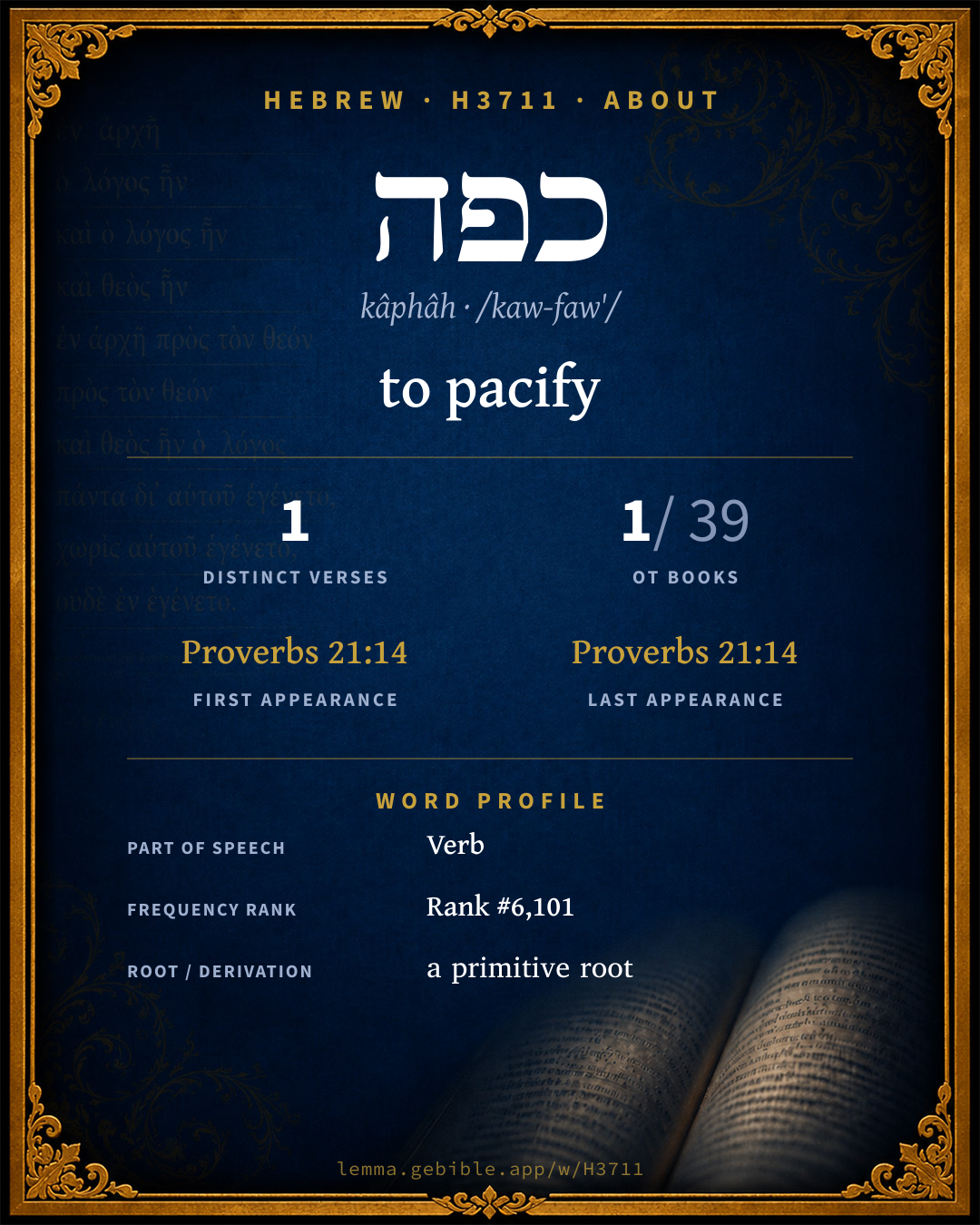
כָּפָה
to pacify
Full lexicon entry — Brown-Driver-Briggs (BDB)
From Brown-Driver-Briggs (BDB)
Where this word appears
Grammar key — what these labels mean
Part of speech
- Verb
- An action or state-of-being word.
Stem
- Qal
- The basic, simple active stem — the plain form of the verb (“he wrote”).
Form
- Imperfect
- An incomplete, ongoing, or future action (“he will / would write”).
Person
- 3rd Person
- The one spoken about (“he / she / it / they”).
Gender
- Masculine
- Grammatically masculine.
Number
- Singular
- One.
Every verse where H3711 appears — 1 distinct verse across 1 book. Click any verse to open its interlinear word-by-word view. Verse text shown in the World English Bible for context — . Each verse’s Hebrew form is shown with its reference; the English is not keyword-highlighted, since the data carries no word-level English alignment. Use “Compare translations” on any verse to read it across multiple English versions. This concordance covers the Hebrew Bible; Septuagint (Greek Old Testament) occurrences are not indexed here.
Proverbs 1 verse
About this entry
At a glance — auto-summarized from this page’s data, not written by a person. Every figure links to its source below. This summary describes the numbers; it doesn’t interpret them.
כפה (kâphâh) is a Hebrew verb most often rendered “to pacify.” A scarce word — 1 verse in all of the Hebrew Bible. It clusters heavily in Proverbs, which alone accounts for 100% of its uses. Its lone occurrence is Proverbs 21:14. For the data behind this summary, explore the sense tree and the renderings breakdown below.
Gloss history
Strong's 1890 vs modern scholarship
About this word
Strong's H3711 catalogs a Hebrew word from the Hebrew Old Testament.
These counts are not copied from any lexicon or concordance. They are computed here, from the morphology-tagged Hebrew Old Testament. What Lemma adds →
- 1
- distinct verses
- The word appears in 1 distinct verse.
- 1 / 39
- OT books
- The word appears in 1 of 39 Old Testament books.
- #6,101
- by frequency
- Rank #6,101 (rank 6,101 of 8,640 Hebrew words by occurrence).
View all 1 occurrence in the concordance →
Most concentrated in
- Proverbs 1 verse 100%
By section of the Old Testament
By traditional corpus
Conventional, traditional groupings — biblical authorship is debated, so this is a traditional corpus grouping, not an authorship claim. Each share is this word’s portion of its verses in that division of the Hebrew canon. Each figure is a share of the word’s 1 distinct verse.
- Writings (Ketuvim) 1 verse · 100%
How translations render this word
Counts come from each version’s own published word-to-Strong’s tagging or interlinear alignment — an approximate guide to how each version renders this word, not a word-level alignment the data otherwise carries. Because each total is that version’s own tagged count, the per-version totals vary from one another and need not match the appearance or distinct-verse counts above. These counts may also differ from a printed concordance because Lemma counts each distinctly tagged rendering and does not collapse phrase taggings into a single head-word total. This is a fixed set of word-tagged versions (KJV, ASV, BSB, ULT) and does not change with the reading translation you choose elsewhere. Each version’s license is shown beside its name below (and on Sources).
- King James Version: Pacifieth 1×
- American Standard Version: Pacifieth 1×
- Berean Standard Bible: Soothes 1×
- unfoldingWord Literal Text: Subdues 1×
King James Version Public Domain
Renders H3711 across 1 tagged occurrence — most commonly:
American Standard Version Public Domain
Renders H3711 across 1 tagged occurrence — most commonly:
Berean Standard Bible Public Domain
Renders H3711 across 1 tagged occurrence — most commonly:
unfoldingWord Literal Text CC BY-SA 4.0
Renders H3711 across 1 tagged occurrence — most commonly:
Senses in BDB
The 1 sense BDB distinguishes for this word, in lexicon order (not ranked by frequency or importance). The full entry — with sub-senses — is in the Lexicon Entry tab.
- (Qal) to sooth, subdue, pacify
Word origin
[ כָּפָה ] vb. prob. subdue;—only Qal Pr 21:14
— Brown-Driver-Briggs (Oxford 1906, public domain), digitized via Sefaria, supplemented by the OpenScriptures HebrewLexicon (CC BY 4.0). See Sources.
Origin: a primitive root
Jastrow Dictionary
A second Hebrew/Aramaic lexicon for comparison, covering Aramaic and post-biblical (Talmudic, Targumic, Midrashic) usage that the biblical-Hebrew BDB does not. Matched by lemma rather than by Strong’s number, so a lemma may carry more than one Jastrow headword (shown separately below), and the entries cover usage well beyond the Bible.
כֵּיפָה
- (v. כֵּיף)
- 1. ball, stone. Ohol. VIII, 5 כֵּיפַת הברד hail-stone.
- 2. resin (or something similar) found in balls. Tosef. Dem. I, 29 כֵּפַת המרחץ ed. Zuck. (Var. בפת, emend. by El. Wil. קופת) resin used (with oil) in the bath-room.—כֵּיפַת הירדן Jordan-resin, amber (an adapt. of Eridanus, v. Sm. Ant. s. v. Electrum, Lübker’s Reallex. s. v. Electron). Kerith. 6ᵃ (one of the ingredients of frankincense).
- 3. ball, lump. Y. Sabb. V, 7ᵇ bot. (in Chald. dict.), v. גְּבִינְתָּא.
כִּפָּה
- , v. כִּיפָּה
כֵּפָה
- , v. כֵּיפָה
כפי
- v. כָּפַף)
- 1. to bend over, invert, turn upside down. Tam. V, 5 היה כּוֹפֶה עליהן וכ׳ he inverts a large vessel and puts it over them (the coals). Ib. כּוֹפִין אותה וכ׳ they invert it over &c. Pesik. Ekhah, p. 123ᵃ כ׳ סיח את המנורה the ass (of gold, given as a bribe to the judge) has upset the lamp (offered on the other side; whence a proverbial expression for litigants outbidding each other in bribery); Y. Yoma I, 38ᶜ bot.; Lev. R. s. 21; Pesik. Aḥăré, p. 177ᵃ.—Esp. כ׳ את המיטה to upset the couch, to place the mattresses on or near the floor, as a sign of mourning, opp. to זָקַף. M. Kat. 15ᵇ top [euphemistic version, read with Ms. M.:] דמות … בכם ובעונותיכם … כְּפוּ מיטותיכן וכ׳ I (the Lord) had placed my image among you, and for your sins I upset it (decreed death), upset now your beds; Y. Ber. III, 6ᵃ top; Y. M. Kat. III, 83ᵃ top כְּפֵה מיטתך. Ib. כבר כְּפִינוּם we have already lowered them (the couches); Y. Ber. III, 5ᵈ bot. כפיטם (corr. acc.). Keth. 4ᵇ כּוֹפֶה מיטתו he lowers his couch (when his wife is in mourning); כּוֹפָה מיטתה she lowers &c. (when her husband is in mourning); a. fr.—Part. pass. כָּפוּי, f. כְּפוּיָה, pl. כְּפוּיִים, כְּפוּיוֹת. Tosef. Ohol. XII, 2 סאה כ׳ על פיה a dry measure turned upside down. Lam. R. introd. (R. Ḥăn. 3) (play on כפי המלח, v. כַּף) כְּפוּיֵי מלחמה those upset by war. Y. Ber. III, 6ᵃ top מטה כ׳ a lowered couch; a. fr.—Esp. כְּפוּי טובה one on whom kindness is upset, ungrateful, unappreciative. Ab. Zar. 5ᵃ כפויי טובה בני וכ׳ you ungrateful ones, sons of ungrateful ones. Lev. R. s. 4; a. fr.
- 2. to press, force. Keth. V, 5 כּוֹפָהּ לעשות וכ׳ he may compel her to work in wool. Yeb. 106ᵃ, a. fr. כּוֹפִין אותו עד וכ׳ the court uses means of coercion, until he says ‘I will’, opp. to בעל כרחו. Sot. 46ᵇ כ׳ ללויה we force a host to escort (protect) his guest on parting. B. Bath. 12ᵇ כגון זו כ׳ על מדת סדום in such a case we apply force on the ground of the law of equity (v. סְדוֹם). Y. Peah I, 15ᵈ; Y. Kidd. I, 61ᶜ top וכוֹפִין do we compel (a son to support his father)? Ib. כופין את הבן we do compel &c.—R. Hash. 28ᵃ כְּפָאוֹ ואכל וכ׳ if somebody forced him, and he ate Matsah (on the first Passover night). Ib. כ׳ שד a demon possessed him. Ib. כְּפָאוּהוּ פרסיים Persians (gentiles) forced him; a. fr.—[Snh. 70ᵇ כפאתו, v. כָּפַת.]—V. כּוּף I a. כָּפַף.
- 1. to be inverted, upset; to be forced. Y. M. Kat. l. c. ויִכָּפֶה הסרסור let the agent (of sin, the evil inclination) be overpowered (by mourning ceremonies); Y. Ber. l. c. ויכ׳ כפה (corr. acc.). Ib. 5ᵈ bot.; Y. M. Kat. l. c. אינה נִכְפֵּית need not be upturned, v. דַּרְגֵּשׁ; a. fr.
- 2. to be overtaken by a demon, esp. to be epileptic. Lev. R. s. 26 ישראל … שנִכְפּוּ an Israelite and a priest that were afflicted &c.—Pes. 112ᵇ אותו תינוק נִכְפֶּה that child will become epileptic. Ib. בנים נִכְפִּין epileptic children; Keth. 60ᵇ (Chald. form) בני נִכְפֵּי. Tosef. B. Bath. IV, 5 נִכְפֵּית היא she is subject to epileptic attacks; B. Mets. 80ᵃ. Yeb. 64ᵇ משפחת נִכְפִּין a family subject to epilepsy.
A Dictionary of the Targumim, the Talmud Babli and Yerushalmi, and the Midrashic Literature (Marcus Jastrow; London, Luzac, 1903) — Public Domain. Digitized via Sefaria. Digitized via Sefaria. Full attribution on Sources.
Septuagint verse parallels
This word appears in 1 verse that also exists in the Greek Old Testament (Septuagint), out of the 1 Hebrew verse it occurs in. You can read those verses in Greek by switching the Old Testament edition to the Septuagint.
Read these verses in the Septuagint
This is a verse-level parallel only — the same verses exist in both the Hebrew and Greek Old Testaments. No word-level Hebrew↔Greek correspondence is claimed: the data carries no such alignment, so no Greek word is shown as this Hebrew word’s translation. Coverage is not total — the Septuagint omits the deuterocanon and renumbers the Psalms, so some Hebrew verses have no direct Greek parallel.