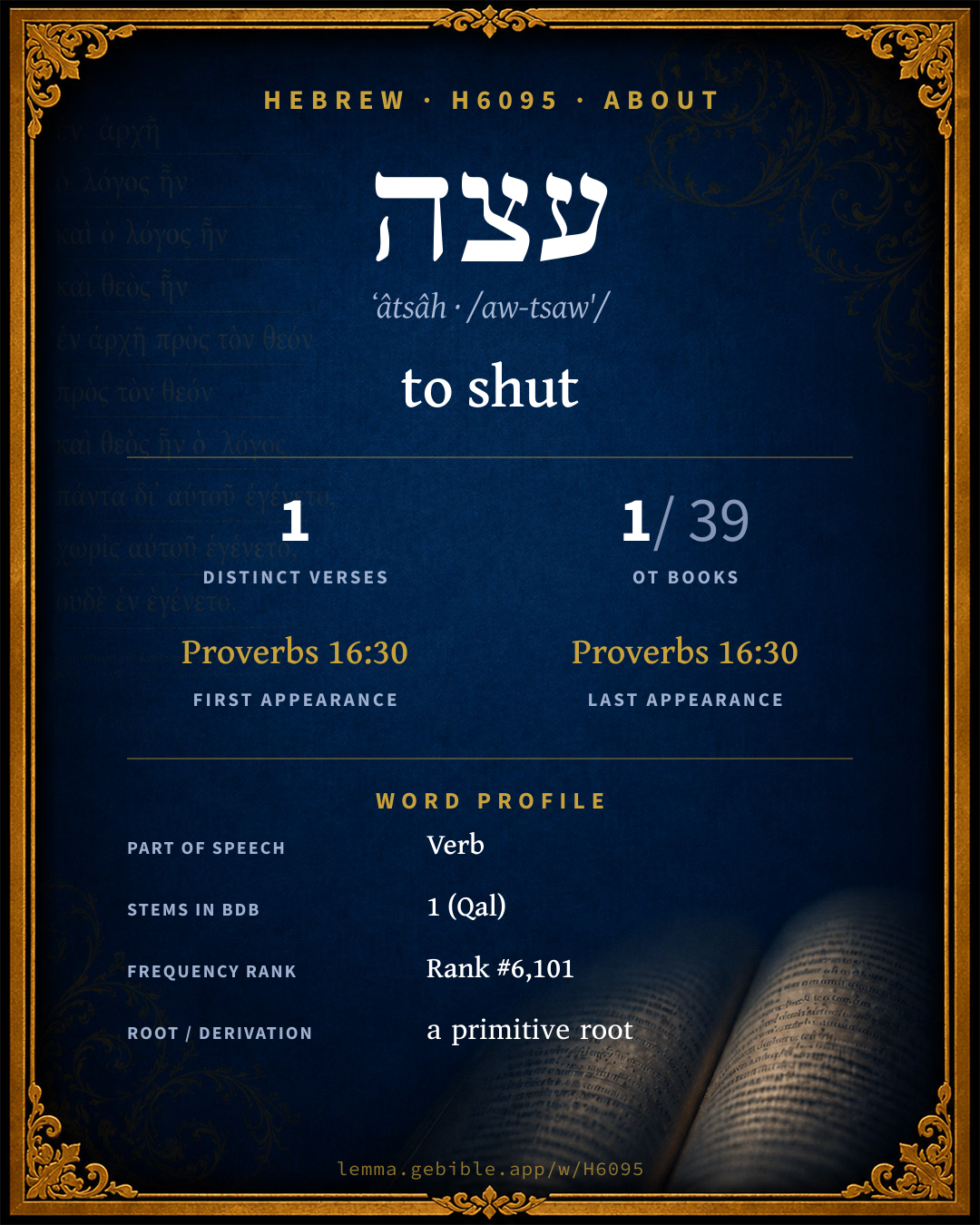
עָצָה
to shut
Full lexicon entry — Brown-Driver-Briggs (BDB)
From Brown-Driver-Briggs (BDB)
Where this word appears
Grammar key — what these labels mean
Part of speech
- Verb
- An action or state-of-being word.
Stem
- Qal
- The basic, simple active stem — the plain form of the verb (“he wrote”). Here: ‘act.’
Form
- Participle Active
- A verbal adjective expressing ongoing or characteristic action (“writing / one who writes”).
State
- Absolute
- The independent form of a noun, not bound to a following word.
Gender
- Masculine
- Grammatically masculine.
Number
- Singular
- One.
Every verse where H6095 appears — 1 distinct verse across 1 book. Click any verse to open its interlinear word-by-word view. Verse text shown in the World English Bible for context — . Each verse’s Hebrew form is shown with its reference; the English is not keyword-highlighted, since the data carries no word-level English alignment. Use “Compare translations” on any verse to read it across multiple English versions. This concordance covers the Hebrew Bible; Septuagint (Greek Old Testament) occurrences are not indexed here.
Proverbs 1 verse
About this entry
At a glance — auto-summarized from this page’s data, not written by a person. Every figure links to its source below. This summary describes the numbers; it doesn’t interpret them.
עצה (ʻâtsâh) is a Hebrew verb most often rendered “to shut.” The Hebrew Bible uses it only 1 verse. It clusters heavily in Proverbs, which alone accounts for 100% of its uses. It occurs only once, in Proverbs 16:30. From the same root come עץ, עצה and מעץ. For the data behind this summary, explore the sense tree and the renderings breakdown below.
Gloss history
Strong's 1890 vs modern scholarship
About this word
Strong's H6095 catalogs a Hebrew word from the Hebrew Old Testament.
These counts are not copied from any lexicon or concordance. They are computed here, from the morphology-tagged Hebrew Old Testament. What Lemma adds →
- 1
- distinct verses
- The word appears in 1 distinct verse.
- 1 / 39
- OT books
- The word appears in 1 of 39 Old Testament books.
- #6,101
- by frequency
- Rank #6,101 (rank 6,101 of 8,640 Hebrew words by occurrence).
View all 1 occurrence in the concordance →
Most concentrated in
- Proverbs 1 verse 100%
By section of the Old Testament
By traditional corpus
Conventional, traditional groupings — biblical authorship is debated, so this is a traditional corpus grouping, not an authorship claim. Each share is this word’s portion of its verses in that division of the Hebrew canon. Each figure is a share of the word’s 1 distinct verse.
- Writings (Ketuvim) 1 verse · 100%
How translations render this word
Counts come from each version’s own published word-to-Strong’s tagging or interlinear alignment — an approximate guide to how each version renders this word, not a word-level alignment the data otherwise carries. Because each total is that version’s own tagged count, the per-version totals vary from one another and need not match the appearance or distinct-verse counts above. These counts may also differ from a printed concordance because Lemma counts each distinctly tagged rendering and does not collapse phrase taggings into a single head-word total. This is a fixed set of word-tagged versions (KJV, ASV, BSB, ULT) and does not change with the reading translation you choose elsewhere. Each version’s license is shown beside its name below (and on Sources).
- King James Version: He shutteth 1×
- American Standard Version: He that shutteth 1×
- Berean Standard Bible: He who winks 1×
- unfoldingWord Literal Text: One who shuts 1×
King James Version Public Domain
Renders H6095 across 1 tagged occurrence — most commonly:
American Standard Version Public Domain
Renders H6095 across 1 tagged occurrence — most commonly:
Berean Standard Bible Public Domain
Renders H6095 across 1 tagged occurrence — most commonly:
unfoldingWord Literal Text CC BY-SA 4.0
Renders H6095 across 1 tagged occurrence — most commonly:
Senses in the full BDB
What do BDB’s symbols mean?
BDB uses these scholarly abbreviations:
| Symbol | Meaning |
|---|---|
| 𝔊 | the Septuagint (the ancient Greek translation, LXX) |
| 𝔙 | the Vulgate (the Latin translation) |
| 𝔖 | the Syriac version (the Peshitta) |
| 𝔗 | the Targum (the Aramaic translation) |
| ψ | the Psalms |
| √ | root (the underlying root or stem) |
| ‖ | parallel passage (a synonymous or contrasted parallel) |
| † | the dagger: every passage where the word occurs is cited |
The 1 sense the full Brown-Driver-Briggs lexicon distinguishes for this word, in lexicon order (not ranked by frequency), with BDB’s own verbatim wording and sub-sense lettering. Shown in Hebrew script with BDB’s own scholarly abbreviations. The condensed entry is in the Lexicon Entry tab.
Qal
- Pt. act. עֹצֶה עֵינָיו Pr 16:30 he that shuts his eyes (SS cp. עצּם [Is 29:10], which Gr reads). e.g. Proverbs 16:30
Senses from the full Brown-Driver-Briggs lexicon (Brown, Driver, Briggs; Oxford 1906 — public domain), digitized via Sefaria, supplemented by the OpenScriptures HebrewLexicon (CC BY 4.0). Full attribution on Sources.
Word origin
vb. shut (Ar. (و et ى) غَضَا iv. shut eyes; Ethiopic ዐጸወ shut door);—
— Brown-Driver-Briggs (Oxford 1906, public domain), digitized via Sefaria, supplemented by the OpenScriptures HebrewLexicon (CC BY 4.0). See Sources.
Origin: a primitive root
Jastrow Dictionary
A second Hebrew/Aramaic lexicon for comparison, covering Aramaic and post-biblical (Talmudic, Targumic, Midrashic) usage that the biblical-Hebrew BDB does not. Matched by lemma rather than by Strong’s number, so a lemma may carry more than one Jastrow headword (shown separately below), and the entries cover usage well beyond the Bible.
עֵצָה I
- v. עֵץ)
- 1. trees, plantation. Y. Sabb. III, 6ᵃ; Y. Succ. I, end, 52ᶜ התיר ע׳ שבים allowed the carrying of things on the Sabbath from trees in the water (on an island) to the water and vice versa (cmp. Erub. 67ᵇ סלע שבים); Y. Erub. VIII, end, 25ᵇ
- 2. pea-stalks. Sabb. VII, 4, expl. ib. 76ᵃ תבן של מיני קיטניות. Ohol. XVIII, 2, contrad. to קש.
עֵצָה II
- counsel, advice, plan, consultation, council. Gen. R. s. 74 נוטלין ע׳ they hold council, v. רֶוַוח. Sot. 11ᵃ (ref. to Ex. I, 10) הוא התחיל בע׳ תחלה he was the first to propose (the destruction of Israel). Ib. שלשה היו באותה ע׳ three men took part in that consultation. Meg. 12ᵇ ניטלה ע׳ ממנו counsel (legal wisdom) has been taken away from us. Sot. 11ᵇ שפנה מעֲצַת מרגלים he turned away from the council of the spies. Gitt. 58ᵃ, a. e. אם אתה שומע לעֲצָתִי if thou wouldst listen to my advice. Tanḥ. Haăz. 8 ובעצתי אל וכ׳ and if you follow my advice, do not risk your life for her. B. Bath. 118ᵃ, a. fr. ע׳ טובה קמשמע לן good advice is meant by it (not a law); a. fr.—Pl. עֵצוֹת. Kidd. 80ᵇ (in Chald. dict.), v. עוּץ. Midr. Till. to Ps. I, 3 שהיה יועץ ע׳ ומתקיימות וכ׳ who suggested plans which were executed, and which turned out well; a. e. e.g. Exodus 1:10
עֵצָה
- ch., v. עֵצָא
עָצֶה
- v. עֲצֵי) backbone, spine. Sifra Vayikra, N’dab., Par. 14, ch. XIX (ref. to Lev. IV, 9) יכנס לפנים מן הע׳ he must go inside of the backbone, i.e. cut off a portion of the spine; Yalk. Lev. 462. e.g. Leviticus 4:9
עֲצָה
- , v. עֲצֵי
עֲצֵי
- 1. to press, squeeze; to oppress, esp. (= h. עָשַׁק) to withhold what is due to a neighbor. Targ. Y. Lev. V, 23. Targ. Y. II ib. 21 עֲצָה some ed. (not עֵ׳). Targ. Y. II, Deut. XXIV, 14; a. e.—Part. pass. עָצֵי, pl. עַצְיָין. Targ. Y. ib. XXVIII, 29.
- 2. to be hard, dry; sapless. Part. pl. עֶצְיָין. Targ. Y. II, Num. XIII, 20 (21).
A Dictionary of the Targumim, the Talmud Babli and Yerushalmi, and the Midrashic Literature (Marcus Jastrow; London, Luzac, 1903) — Public Domain. Digitized via Sefaria. Digitized via Sefaria. Full attribution on Sources.
Same root — word family
Other BDB entries built from the same root as H6095, grouped by Strong’s listed origin. These share a root / origin per the lexicon — not necessarily a shared meaning. Each links to that word’s own entry.
Derived from this word
Proper names from this root
People and places named from this root — a name, not an additional meaning of the word.
Compare all same-root words → 1 of the same-root words is a proper name (a person or place). They share a root, not necessarily a meaning.