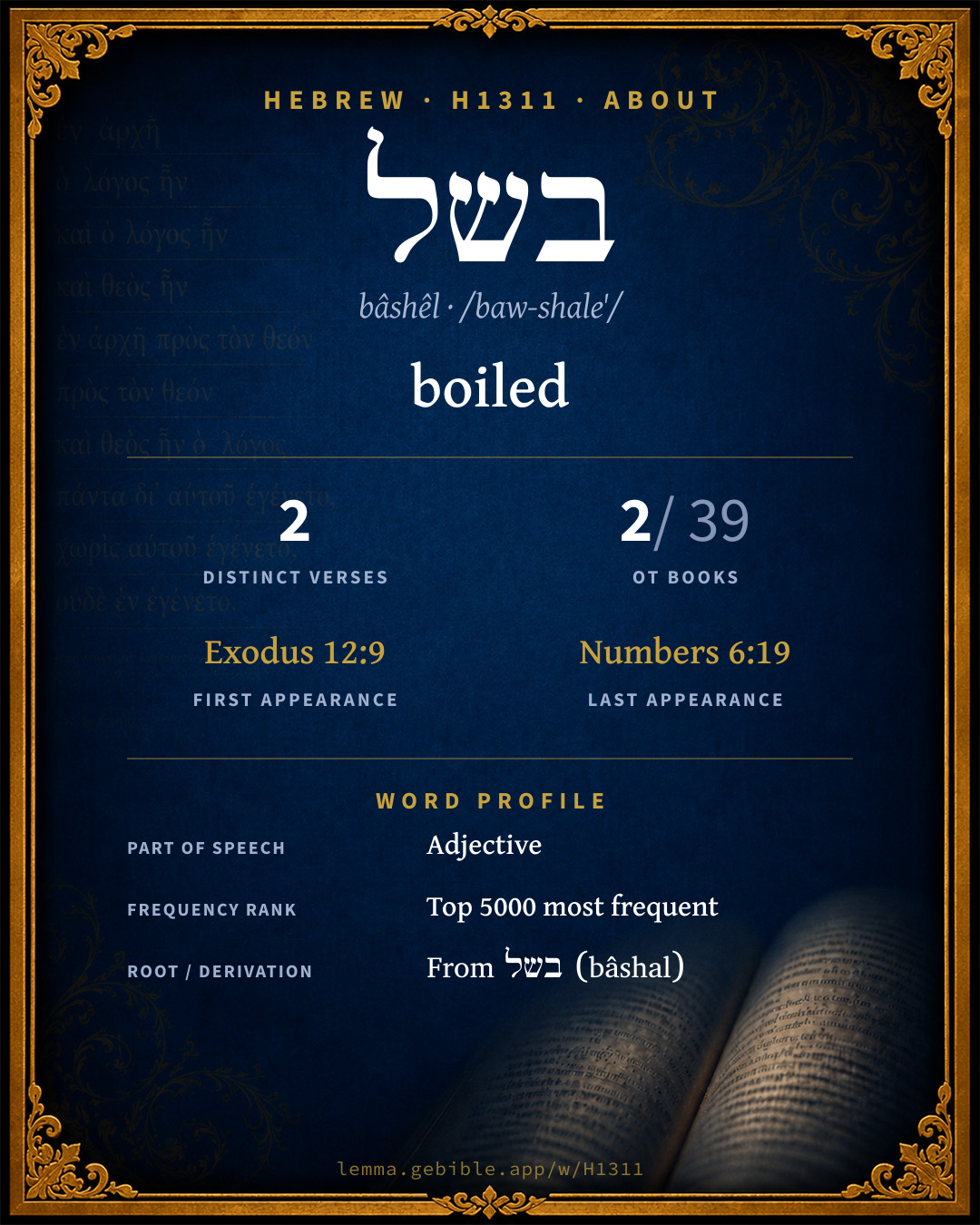
בָּשֵׁל
boiled
Full lexicon entry — Brown-Driver-Briggs (BDB)
From Brown-Driver-Briggs (BDB)
Where this word appears
Grammar key — what these labels mean
Part of speech
- Adjective
- A word that describes or qualifies a noun.
State
- Absolute
- The independent form of a noun, not bound to a following word.
Gender
- Feminine
- Grammatically feminine.
- Masculine
- Grammatically masculine.
Number
- Singular
- One.
Grammatical forms
- Adjective, Adjective, Feminine, Singular, Absolute 1 time (50%)
- Adjective, Adjective, Masculine, Singular, Absolute 1 time (50%)
Parsed forms decoded from the imported morphology (morphhb / Westminster Leningrad Codex — WLC text public domain, morphhb tagging CC BY 4.0), counted across 2 parsed occurrences — not distinct verses.
Every verse where H1311 appears — 2 distinct verses across 2 books. Click any verse to open its interlinear word-by-word view. Verse text shown in the World English Bible for context — . Each verse’s Hebrew form is shown with its reference; the English is not keyword-highlighted, since the data carries no word-level English alignment. Use “Compare translations” on any verse to read it across multiple English versions. This concordance covers the Hebrew Bible; Septuagint (Greek Old Testament) occurrences are not indexed here.
Exodus 1 verse
Numbers 1 verse
About this entry
At a glance — auto-summarized from this page’s data, not written by a person. Every figure links to its source below. This summary describes the numbers; it doesn’t interpret them.
בשל (bâshêl) is a Hebrew adjective most often rendered “boiled.” A scarce word — 2 verses in all of the Hebrew Bible. Exodus dominates its distribution — 1 of 2 verses. Debuting at Exodus 12:9, it then recurs through the corpus. Related forms include בשל and מבשלה. For the data behind this summary, explore the sense tree and the renderings breakdown below.
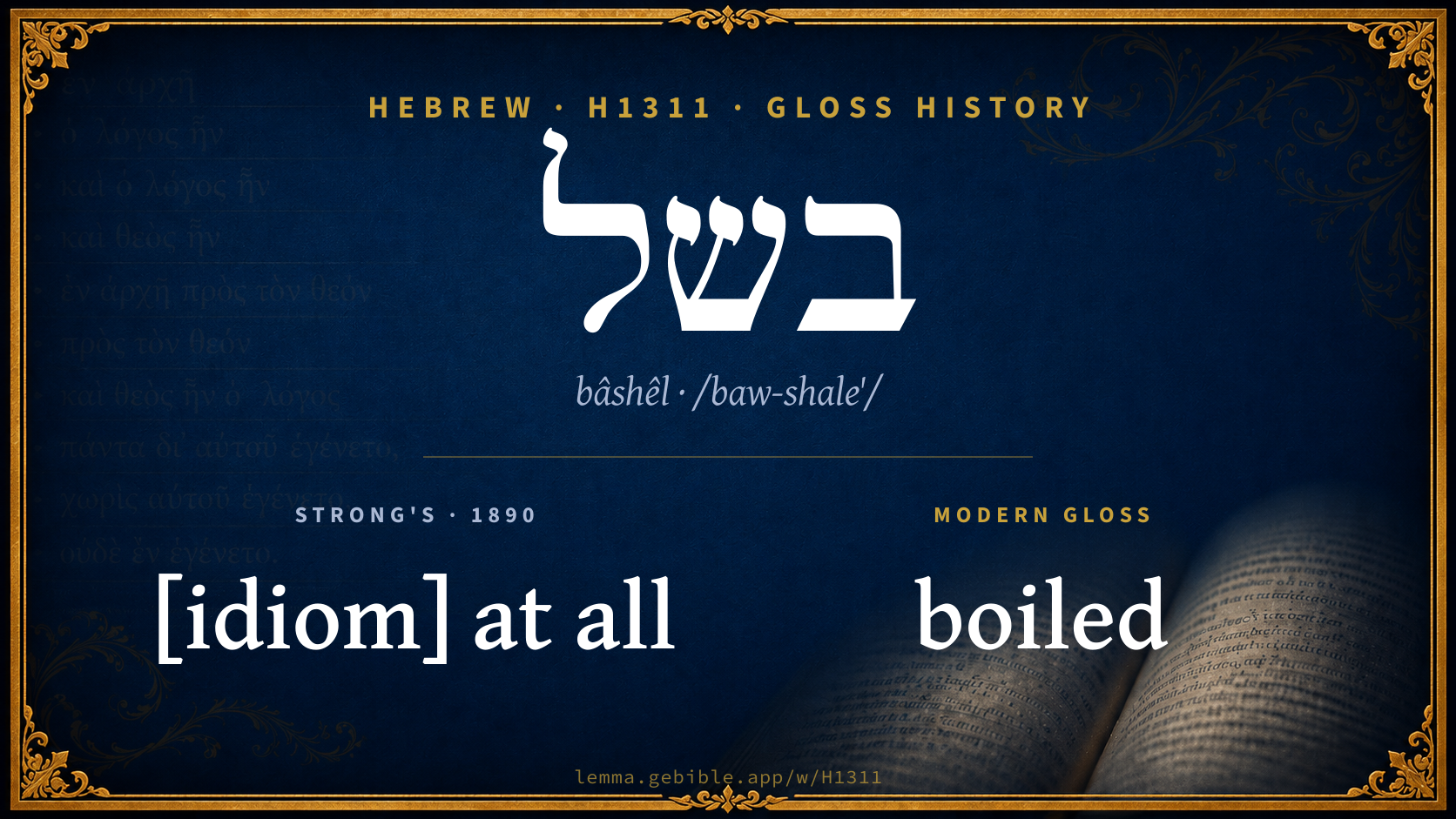
Gloss history
Strong's 1890 vs modern scholarship
About this word
Strong's H1311 catalogs a Hebrew word from the Hebrew Old Testament.
These counts are not copied from any lexicon or concordance. They are computed here, from the morphology-tagged Hebrew Old Testament. What Lemma adds →
- 2
- distinct verses
- The word appears in 2 distinct verses.
- 2 / 39
- OT books
- The word appears in 2 of 39 Old Testament books.
- #4,807
- by frequency
- Top 5000 most frequent Hebrew words (rank 4,807 of 8,640 Hebrew words by occurrence).
View all 2 occurrences in the concordance →
By traditional corpus
Conventional, traditional groupings — biblical authorship is debated, so this is a traditional corpus grouping, not an authorship claim. Each share is this word’s portion of its verses in that division of the Hebrew canon. Each figure is a share of the word’s 2 distinct verses.
- Torah (Pentateuch) 2 verses · 100%
How translations render this word
Counts come from each version’s own published word-to-Strong’s tagging or interlinear alignment — an approximate guide to how each version renders this word, not a word-level alignment the data otherwise carries. Because each total is that version’s own tagged count, the per-version totals vary from one another and need not match the appearance or distinct-verse counts above. These counts may also differ from a printed concordance because Lemma counts each distinctly tagged rendering and does not collapse phrase taggings into a single head-word total. This is a fixed set of word-tagged versions (KJV, ASV, BSB, ULT) and does not change with the reading translation you choose elsewhere. Each version’s license is shown beside its name below (and on Sources).
- King James Version: Sodden 1×
- American Standard Version: Boiled 1×
- Berean Standard Bible: Boiled 1×, Boiling 1×
- unfoldingWord Literal Text: Boiled 1×, Or boiled 1×
King James Version Public Domain
Renders H1311 across 1 tagged occurrence — most commonly:
Not rendered by a distinct English word in 1 further occurrence.
American Standard Version Public Domain
Renders H1311 across 1 tagged occurrence — most commonly:
Berean Standard Bible Public Domain
Renders H1311 across 2 tagged occurrences — most commonly:
unfoldingWord Literal Text CC BY-SA 4.0
Renders H1311 across 2 tagged occurrences — most commonly:
Senses in BDB
The 1 sense BDB distinguishes for this word, in lexicon order (not ranked by frequency or importance). The full entry — with sub-senses — is in the Lexicon Entry tab.
- cooked, boiled
Word origin
בָּשֵׁל adj. cooked, boiled
— Brown-Driver-Briggs (Oxford 1906, public domain), digitized via Sefaria, supplemented by the OpenScriptures HebrewLexicon (CC BY 4.0). See Sources.
Derived from בשל (bâshal) (H1310) — to boil.
Jastrow Dictionary
A second Hebrew/Aramaic lexicon for comparison, covering Aramaic and post-biblical (Talmudic, Targumic, Midrashic) usage that the biblical-Hebrew BDB does not. Matched by lemma rather than by Strong’s number, so a lemma may carry more than one Jastrow headword (shown separately below), and the entries cover usage well beyond the Bible.
בָּשַׁל
- to ripen, boil, be done (through natural or artificial heat). Y. Snh. VIII, beg. 26ᵃ ב׳ הזרע וכ׳ when the seed boils inside (maturity of genital organs), the pot outside becomes dark (genitals are covered with hair).
- to mature, cook, roast. Snh. 95ᵇ לבַשֵּׁל פירות to make the fruits ripen. Ḥull. 98ᵇ; a. fr.—Pes. 112ᵃ לא תְבַשֵּׁל וכ׳ cook not in a pot which thy neighbor has used before thee (i.e. marry not a divorced woman).—Part. Pu. מְבוּשָּׁל. Ned. VI, 1 הנודר מן המב׳ וכ׳ he who vows abstinence from anything boiled, is permitted to partake of roasts &c. Ib. 49ᵃ באתרא … קרו מב׳ in R. J.’s place they call roast likewise m’bushshal (cmp. II Chr. XXXV, 13); a. fr. e.g. 2 Chronicles 35:13
- , Nithpa. נִתְבַּשֵּׁל to be boiled, done, ripe. Ter. X, 11. Ḥull. VII, 4; a. fr.—Ib. 98ᵇ top, v. בָּשֵׁל.—Sot. 11ᵃ; Ex. R. s. 1 בקדרה שבשלו וכ׳ in the pot they boiled in, they were boiled, (they were done by as they did by others).
בְּשַׁל
- as preced. Kal. Targ. O. Gen. XL, 10 ed. Berl. בְּשִׁילוּ (ed. בַּשִּׁילוּ, Pa.); Y. בָּשְׁלוּ; ib. IX, 20.—Part. pass. בָּשִׁיל, בְּשִׁילָא. Targ. O. Num. VI, 19; a. e.—Ab. Zar. 38ᵃ אי לא הוה הפיך בה הוה ב׳ וכ׳ Ms. M. (ed. less corr.) if he (the gentile) had not turned it, it would have been done in two hours.
- as preced. Pi. Targ. I Kings XIX, 21; a. fr.; v. supra.—Ab. Zar. 38ᵃ לבַשּׁוּלֵי מנא to bake (in the furnace) the earthen vessel, contrad. to לשרורי to glaze, finish. Ḥull. 110ᵃ ריבעא … בעי לב׳ how much milk is required to boil a quarter of a litra of meat?
- as preced. Hithpa. Targ. Y. Deut. XXVI, 2; a. e.—Targ. I Sam. II, 13 כמִיבְּשַׁל (Var. כמְבַשֵּׁל).—Ab. Zar. 29ᵇ אִיבְּשִׁיל.
בָּשֵׁל
- preced.) ripe, boiled, done. זרוע בשלה the boiled shoulder due to the priest (Num. VI, 19). Ḥull. 98ᵃ bot. both derive it מז׳ ב׳ from the process prescribed for the priest’s gift &c. Ib. 98ᵇ top אין ב׳ אלא שלמה when it says, ‘the shoulder boiled’ it means entire (not carved). Ib. אין ב׳ אלא שנתבשל וכ׳ when it says, ‘He shall take &c. from the ram’ it means that it must be boiled joined to (or jointly with) the body of the ram. Tanḥ. Vayera 5 Abraham בלעה בשילה swallowed the fig ripe, i.e. spoke deliberately, opp. פגה; Gen. R. s. 49 אמר בישולה (corr. acc.). e.g. Numbers 6:19
שַׁל
- v. שַׁלְוָה) carelessness, negligence. Sot. 35ᵃ (expl. II Sam. VII, 7) על עיסקי שַׁלּוֹ for his careless handling (of the Ark); Num. R. s. 420; Yalk. Sam. 142; Num. R. s. 2112 על השל מפני ששגגת וכ׳ ‘for the carelessness’, because an involuntary act of a scholar counts as a wilful act. e.g. 2 Samuel 7:7
שַׁל ²
- , v. שַׁלְצִיּוֹן
שֶׁל
- , v. שֶׁ־) belonging to, of. Ab. II, 2 בנו של ר׳ וכ׳ the son of &c. Ib. 12 יהי ממון … כשֶׁלְּךָ let thy neighbor’s property be as dear to thee as thine own. Ib. V, 10 האומר שֶׁלִּי שלי ושֶׁלְּךָ שֶׁלָּךְ he who says, what is mine is mine, and what is thine is thine. B. Mets. I, 1 זה אומר כולה שלי וכ׳ one says, it belongs entirely to me &c. Ib. 30ᵃ שהיתה מלאכה שֶׁלּוֹ … משל חבירו when his own work is more valuable than that required for his neighbor, i.e. when by helping his neighbor he would lose more than he could save for his neighbor. Gen. R. s. 49 אמרו לו מה נאמר … שאכלנו מִשֶּׁלּוֹ they (the strangers entertained by Araham) said to him, what shall we say? Said he, say, blessed be the God of the world of whose belongings we have partaken; a. v. fr.—Kidd. 57ᵇ שחוט שלי בשלי וכ׳ (not לי) slaughter what is owing to me (the sacrifice) on what belongs to me (on Temple grounds), and what is for thee, on thy own ground.
A Dictionary of the Targumim, the Talmud Babli and Yerushalmi, and the Midrashic Literature (Marcus Jastrow; London, Luzac, 1903) — Public Domain. Digitized via Sefaria. Digitized via Sefaria. Full attribution on Sources.
Forms in the corpus
The 2 distinct written forms H1311 takes in the Hebrew Bible, most frequent first — each parse links to that state’s occurrences in the concordance. Hebrew forms include their vowel points and cantillation, so a single lemma takes many written forms.
| Form | Parsing | Example | Uses |
|---|---|---|---|
| בְּשֵׁלָה֮ | Adjective, Adjective, Feminine, Singular, Absolute | Numbers 6:19 | 1 |
| וּ/בָשֵׁ֥ל | Adjective, Adjective, Masculine, Singular, Absolute | Exodus 12:9 | 1 |
Same root — word family
Other BDB entries built from the same root as H1311, grouped by Strong’s listed origin. These share a root / origin per the lexicon — not necessarily a shared meaning. Each links to that word’s own entry.
Derives from
Shares the same root
Compare all same-root words → They share a root, not necessarily a meaning.
Septuagint verse parallels
This word appears in 2 verses that also exist in the Greek Old Testament (Septuagint), out of the 2 Hebrew verses it occurs in. You can read those verses in Greek by switching the Old Testament edition to the Septuagint.
Read these verses in the Septuagint
This is a verse-level parallel only — the same verses exist in both the Hebrew and Greek Old Testaments. No word-level Hebrew↔Greek correspondence is claimed: the data carries no such alignment, so no Greek word is shown as this Hebrew word’s translation. Coverage is not total — the Septuagint omits the deuterocanon and renumbers the Psalms, so some Hebrew verses have no direct Greek parallel.