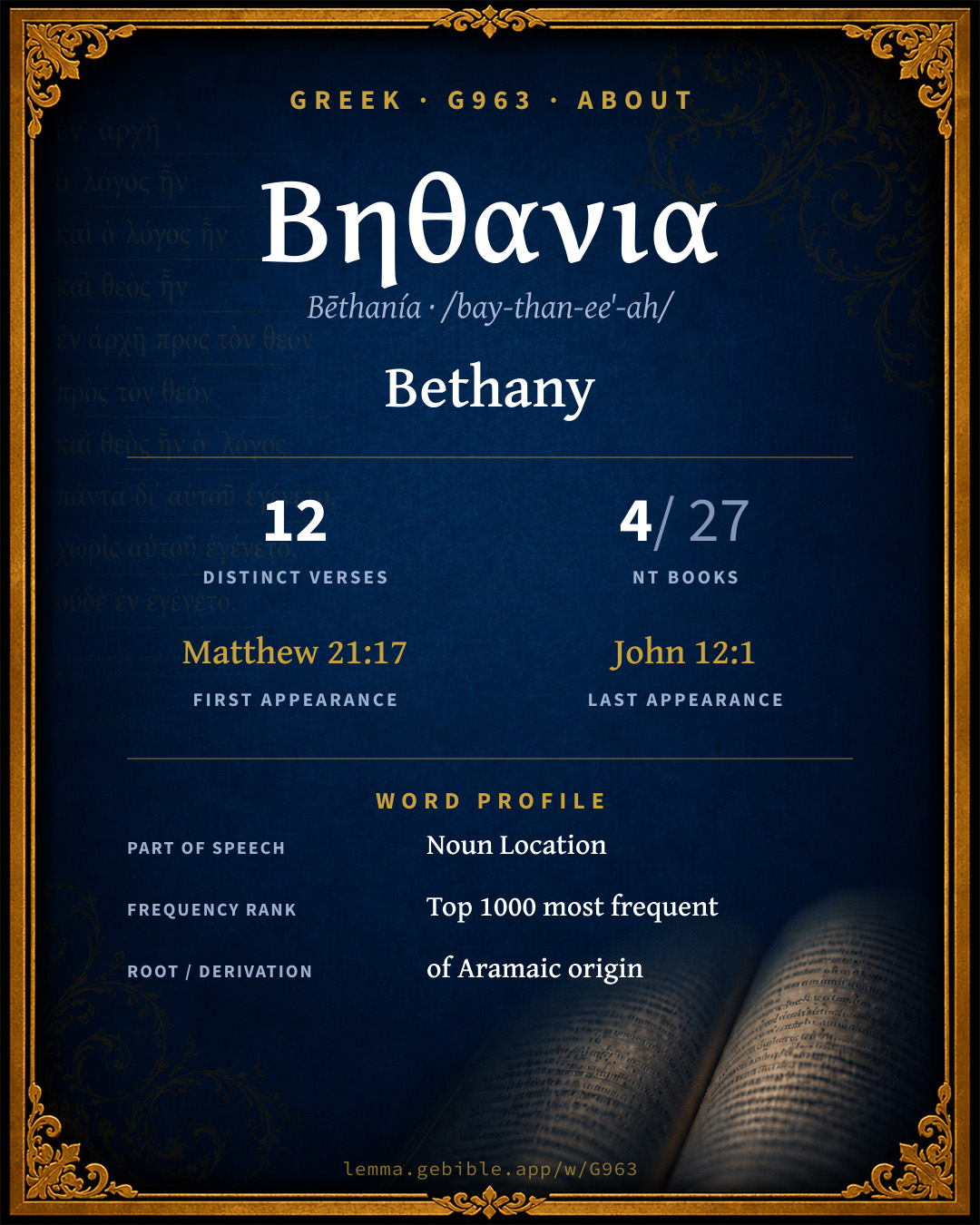
Βηθανία
Bethany
Thayer's lists 3 entries for ‘Bethany’ fuller range ↓
Full lexicon entry — Thayer's Greek Lexicon
From Thayer's Greek Lexicon
Where this word appears
See every Accusative-case word in the Greek New Testament →
Grammar key — what these labels mean
Part of speech
- Noun
- A naming word — a person, place, thing, or idea.
Case
- Accusative
- The case of the direct object and of extent.
- Dative
- The case of the indirect object, means, or location — “to / for / with / in.”
- Genitive
- The case of source, possession, or “of” — answers “whose / from what.”
- Nominative
- The case of the subject (and the predicate nominative).
Gender
- Feminine
- Grammatically feminine.
Number
- Singular
- One.
Grammatical forms
- Noun, Accusative, Singular, Feminine 6 times (50%)
- Noun, Dative, Singular, Feminine 3 times (25%)
- Noun, Genitive, Singular, Feminine 2 times (17%)
- Noun, Nominative, Singular, Feminine 1 time (8%)
Parsed forms decoded from the imported morphology (Robinson–Tischendorf, public domain), counted across 12 parsed occurrences — not distinct verses.
Every verse where G963 appears — 12 distinct verses across 4 books. Click any verse to open its interlinear word-by-word view. Verse text shown in the World English Bible for context — . Each verse’s Greek form is shown with its reference; the English is not keyword-highlighted, since the data carries no word-level English alignment. Use “Compare translations” on any verse to read it across multiple English versions. This concordance covers the Greek New Testament; Septuagint (Greek Old Testament) occurrences of this word are not indexed here.
Matthew 2 verses
Mark 4 verses
- Mark 11:1 Βηθανίαν n acc sg fem When they drew near to Jerusalem, to Bethsphage and Bethany, at the Mount of Olives, he sent two of his disciples,
- Mark 11:11 Βηθανίαν n acc sg fem Jesus entered into the temple in Jerusalem. When he had looked around at everything, it being now evening, he went out to Bethany with the twelve.
- Mark 11:12 Βηθανίας n gen sg fem The next day, when they had come out from Bethany, he was hungry.
- Mark 14:3 Βηθανίᾳ n dat sg fem While he was at Bethany, in the house of Simon the leper, as he sat at the table, a woman came having an alabaster jar of ointment of pure nard-- very costly. She broke the jar, and poured it over his head.
Luke 2 verses
John 4 verses
- John 1:28 Βηθανίᾳ n dat sg fem These things were done in Bethany beyond the Jordan, where John was baptizing.
- John 11:1 Βηθανίας n gen sg fem Now a certain man was sick, Lazarus from Bethany, of the village of Mary and her sister, Martha.
- John 11:18 Βηθανία n nom sg fem Now Bethany was near Jerusalem, about fifteen stadia away.
- John 12:1 Βηθανίαν n acc sg fem Then six days before the Passover, Jesus came to Bethany, where Lazarus was, who had been dead, whom he raised from the dead.
About this entry
At a glance — auto-summarized from this page’s data, not written by a person. Every figure links to its source below. This summary describes the numbers; it doesn’t interpret them.
Βηθανια — transliterated Bēthanía — is a Greek name carrying the sense “Bethany.” Debuting at Matthew 21:17, it then recurs through the corpus. The Greek New Testament uses it across 12 verses — uncommon. More than a third of its appearances fall in Mark. Each statement above links to its evidence; the full detail follows below.
Gloss history
Strong's 1890 vs modern scholarship
About this word
Strong's G963 catalogs a Greek word from the Greek New Testament.
These counts are not copied from any lexicon or concordance. They are computed here, from the morphology-tagged Greek New Testament. What Lemma adds →
- 12
- distinct verses
- The word appears in 12 distinct verses.
- 4 / 27
- NT books
- The word appears in 4 of 27 New Testament books.
- #904
- by frequency
- Top 1000 most frequent Greek words (rank 904 of 5,347 Greek words by occurrence).
View all 12 occurrences in the concordance →
By section of the New Testament
By traditional corpus
Conventional, traditional groupings — biblical authorship is debated, so this is a traditional corpus grouping, not an authorship claim. Some books belong to more than one corpus (Luke is in both the Gospels and the Lukan corpus, and so on), so these shares overlap and need not total 100%. Each figure is a share of the word’s 12 distinct verses.
- Gospels 12 verses · 100%
- Johannine 4 verses · 33%
- Lukan (Luke–Acts) 2 verses · 17%
How translations render this word
Counts come from each version’s own published word-to-Strong’s tagging or interlinear alignment — an approximate guide to how each version renders this word, not a word-level alignment the data otherwise carries. Because each total is that version’s own tagged count, the per-version totals vary from one another and need not match the appearance or distinct-verse counts above. These counts may also differ from a printed concordance because Lemma counts each distinctly tagged rendering and does not collapse phrase taggings into a single head-word total. This is a fixed set of word-tagged versions (KJV, ASV, BSB, ULT) and does not change with the reading translation you choose elsewhere. Each version’s license is shown beside its name below (and on Sources).
- King James Version: Bethany 11×
- American Standard Version: Bethany 11×
- Berean Standard Bible: Bethany 12×
- unfoldingWord Literal Text: Bethany 12×
King James Version Public Domain
Renders G963 across 11 tagged occurrences — most commonly:
American Standard Version Public Domain
Renders G963 across 11 tagged occurrences — most commonly:
Berean Standard Bible Public Domain
Renders G963 across 12 tagged occurrences — most commonly:
unfoldingWord Literal Text CC BY-SA 4.0
Renders G963 across 12 tagged occurrences — most commonly:
Senses in Thayer's
The 3 senses Thayer's distinguishes for this word, in lexicon order (not ranked by frequency or importance). The full entry — with sub-senses — is in the Lexicon Entry tab.
- Bethany = "house of dates" or, "house of misery"
- a village at the Mount of Olives, about two miles (3 km) from Jerusalem, on or near the normal road to Jericho
- a town or village on the east bank of the Jordan, where John was baptising
Word origin
Origin: of Aramaic origin
Of Chaldee origin; date house ; Bethany a place in Palestine : - Bethany.
— Strong’s Exhaustive Concordance (1890), public domain.
Forms in the corpus
The 4 distinct written forms G963 takes in the Greek New Testament, most frequent first — each parse links to that case’s occurrences in the concordance.
| Form | Parsing | Example | Uses |
|---|---|---|---|
| Βηθανίαν Bēthanían | Noun, Accusative, Singular, Feminine | Matthew 21:17 | 6 |
| Βηθανίᾳ Bēthanía | Noun, Dative, Singular, Feminine | Matthew 26:6 | 3 |
| Βηθανίας Bēthanías | Noun, Genitive, Singular, Feminine | Mark 11:12 | 2 |
| Βηθανία Bēthanía | Noun, Nominative, Singular, Feminine | John 11:18 | 1 |
Bible dictionary
Public-domain dictionary articles matched to this entry by name (Bethany). A biblical name can be shared by more than one person or place, so an article may treat several.
Easton's Bible Dictionary · M. G. Easton, 1897
House of dates. (1.) The Revised Version in John 1:28 has this word instead of Bethabara, on the authority of the oldest manuscripts. It appears to have been the name of a place on the east of Jordan.
(2.) A village on the south-eastern slope of the Mount of Olives (Mark 11:1), about 2 miles east of Jerusalem, on the road to Jericho. It derived its name from the number of palm-trees which grew there. It was the residence of Lazarus and his sisters. It is frequently mentioned in connection with memorable incidents in the life of our Lord (Matt. 21:17; 26:6; Mark 11:11, 12; 14:3; Luke 24:50; John 11:1; 12:1). It is now known by the name of el-Azariyeh, i.e., "place of Lazarus," or simply Lazariyeh. Seen from a distance, the village has been described as "remarkably beautiful, the perfection of retirement and repose, of seclusion and lovely peace." Now a mean village, containing about twenty families.
Smith's Bible Dictionary · William Smith, 1863
In the Revised Version for Bethabara, (John 1:28) where Jesus was baptized by John. It was probably an obscure village near Bethabara, and in time its name faded out and was replaced by the larger and more important Bethabara.
(house of dates, or house of misery), a village which, scanty as are the notices of it contained in Scripture, is more intimately associated in our minds than perhaps any other place with the most familiar acts and scenes of the last days of the life of Christ. It was situated "at" the Mount of Olives, (Mark 11:1; Luke 19:29) about fifteen stadia (furlongs, i.e. 1 1/2 or 2 miles) from Jerusalem (John 11:18) on or near the usual road From Jericho to the city, (Luke 19:29) comp. Mark 11:1 comp. Mark 10:46 And close by the west(?) of another village called Bethphage, the two being several times mentioned together. Bethany was the home of Mary and Martha and Lazarus, and is now known by a name derived from Lazarus--el-Azariyeh or Lazarieh . It lies on the eastern slope of the Mount of Olives, fully a mile beyond the summit, and not very far from the point at which the road to Jericho begins its more sudden descent towards the Jordan valley. El-'Azariyeh is a ruinous and wretched village, a wild mountain hamlet of some twenty families. Bethany has been commonly explained "house of dates," but it more probably signifies "house of misery." H. Dixon, "Holy Land," ii. 214, foll.
Hitchcock's Bible Names Dictionary · Roswell D. Hitchcock, 1869
the house of song; the house of affliction
Classic public-domain reference works; full attribution on Sources.