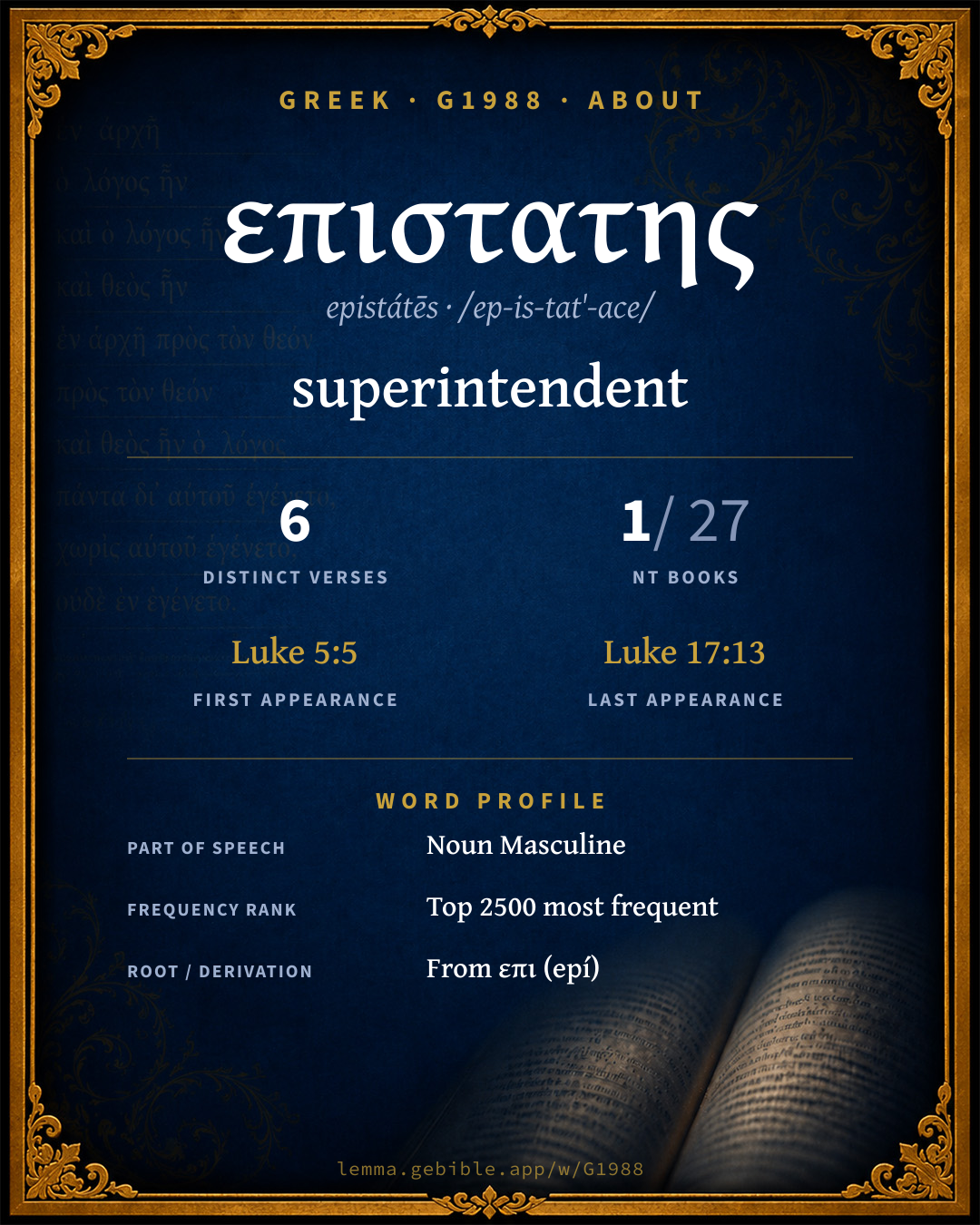
ἐπιστάτης
superintendent
Full lexicon entry — Thayer's Greek Lexicon
From Thayer's Greek Lexicon
Where this word appears
Grammar key — what these labels mean
Part of speech
- Noun
- A naming word — a person, place, thing, or idea.
Case
- Vocative
- The case of direct address (“O Lord”).
Gender
- Masculine
- Grammatically masculine.
Number
- Singular
- One.
Every verse where G1988 appears — 6 distinct verses across 1 book. Click any verse to open its interlinear word-by-word view. Verse text shown in the World English Bible for context — . Each verse’s Greek form is shown with its reference; the English is not keyword-highlighted, since the data carries no word-level English alignment. Use “Compare translations” on any verse to read it across multiple English versions. This concordance covers the Greek New Testament; Septuagint (Greek Old Testament) occurrences of this word are not indexed here.
Luke 6 verses
- Luke 5:5 ἐπιστάτα n voc sg masc Simon answered him, "Master, we worked all night, and took nothing; but at your word I will let down the net."
- Luke 8:24 ἐπιστάτα ἐπιστάτα n voc sg masc n voc sg masc They came to him, and awoke him, saying, "Master, master, we are dying!" He awoke, and rebuked the wind and the raging of the water, and they ceased, and it was calm.
- Luke 8:45 ἐπιστάτα n voc sg masc Jesus said, "Who touched me?" When all denied it, Peter and those with him said, "Master, the multitudes press and jostle you, and you say, 'Who touched me?'"
- Luke 9:33 ἐπιστάτα n voc sg masc It happened, as they were parting from him, that Peter said to Jesus, "Master, it is good for us to be here. Let's make three tents: one for you, and one for Moses, and one for Elijah," not knowing what he said.
- Luke 9:49 ἐπιστάτα n voc sg masc John answered, "Master, we saw someone casting out demons in your name, and we forbade him, because he doesn't follow with us."
- Luke 17:13 ἐπιστάτα n voc sg masc They lifted up their voices, saying, "Jesus, Master, have mercy on us!"
About this entry
At a glance — auto-summarized from this page’s data, not written by a person. Every figure links to its source below. This summary describes the numbers; it doesn’t interpret them.
επιστατης — transliterated epistátēs — is a Greek noun carrying the sense “superintendent.” Its uses cluster heavily in Luke (100% of all occurrences). With 6 verses in 1 book, it is an uncommon word in the Greek New Testament. It first appears in Luke 5:5. From the same root come επι, επαγγελλω and επαγω. See the sense tree, 6-verse concordance, and the renderings breakdown below.
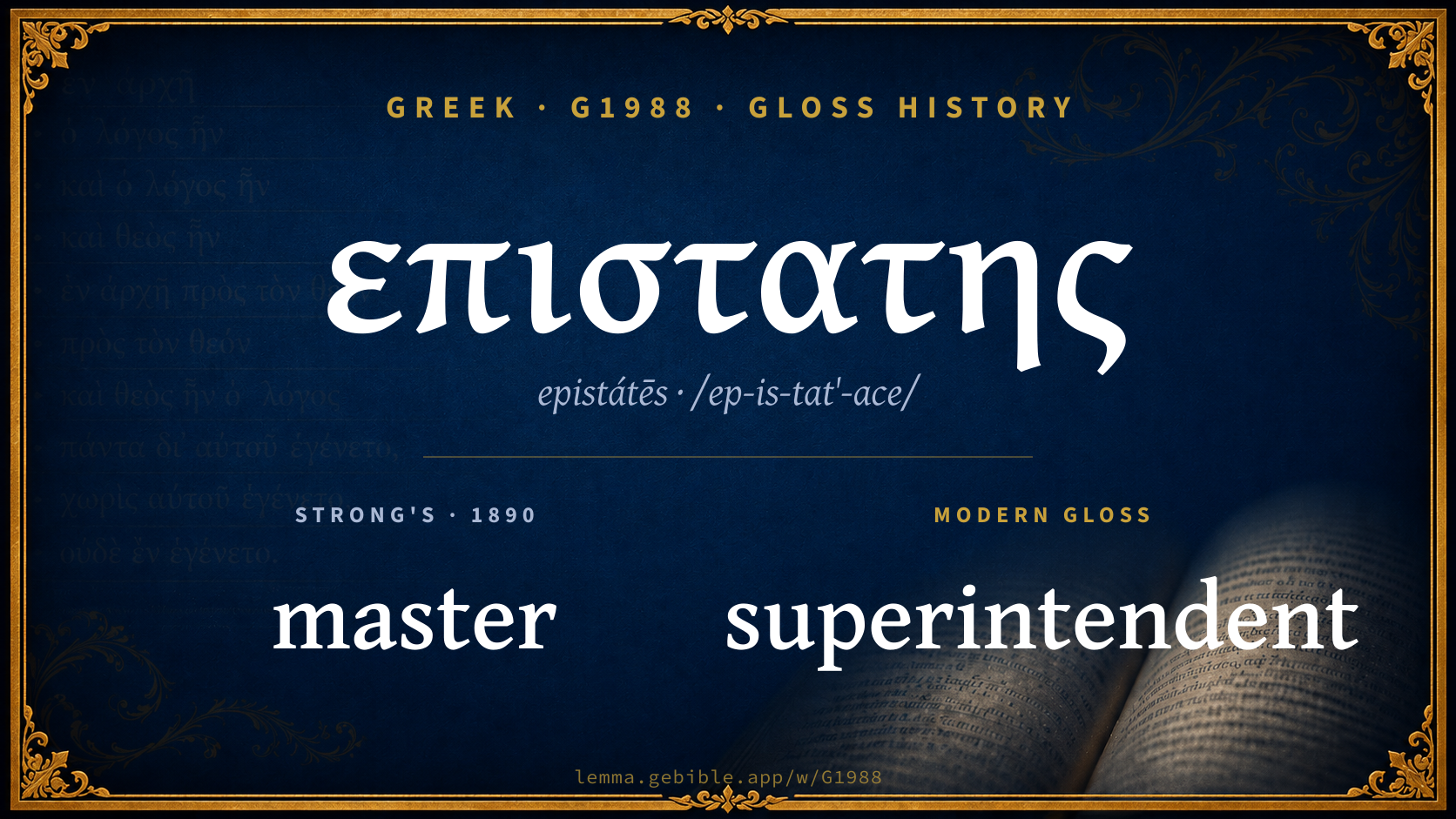
Gloss history
Strong's 1890 vs modern scholarship
About this word
Strong's G1988 catalogs a Greek word from the Greek New Testament.
These counts are not copied from any lexicon or concordance. They are computed here, from the morphology-tagged Greek New Testament. What Lemma adds →
- 6
- distinct verses
- The word appears in 6 distinct verses.
- 1 / 27
- NT books
- The word appears in 1 of 27 New Testament books.
- #1,358
- by frequency
- Top 2500 most frequent Greek words (rank 1,358 of 5,347 Greek words by occurrence).
View all 6 occurrences in the concordance →
Most concentrated in
- Luke 6 verses 100%
By section of the New Testament
By traditional corpus
Conventional, traditional groupings — biblical authorship is debated, so this is a traditional corpus grouping, not an authorship claim. Some books belong to more than one corpus (Luke is in both the Gospels and the Lukan corpus, and so on), so these shares overlap and need not total 100%. Each figure is a share of the word’s 6 distinct verses.
- Gospels 6 verses · 100%
- Lukan (Luke–Acts) 6 verses · 100%
How translations render this word
Counts come from each version’s own published word-to-Strong’s tagging or interlinear alignment — an approximate guide to how each version renders this word, not a word-level alignment the data otherwise carries. Because each total is that version’s own tagged count, the per-version totals vary from one another and need not match the appearance or distinct-verse counts above. These counts may also differ from a printed concordance because Lemma counts each distinctly tagged rendering and does not collapse phrase taggings into a single head-word total. This is a fixed set of word-tagged versions (KJV, ASV, BSB, ULT) and does not change with the reading translation you choose elsewhere. Each version’s license is shown beside its name below (and on Sources).
- King James Version: Master 7×
- American Standard Version: Master 7×
- Berean Standard Bible: Master 7×
- unfoldingWord Literal Text: Master 7×
King James Version Public Domain
Renders G1988 across 7 tagged occurrences — most commonly:
American Standard Version Public Domain
Renders G1988 across 7 tagged occurrences — most commonly:
Berean Standard Bible Public Domain
Renders G1988 across 7 tagged occurrences — most commonly:
unfoldingWord Literal Text CC BY-SA 4.0
Renders G1988 across 7 tagged occurrences — most commonly:
Senses in Thayer's
The 1 sense Thayer's distinguishes for this word, in lexicon order (not ranked by frequency or importance). The full entry — with sub-senses — is in the Lexicon Entry tab.
- any sort of superintendent or overseer
Word origin
Derived from επι (epí) (G1909) — upon.
Same root — word family
Other Thayer's entries built from the same root as G1988, grouped by Strong’s listed origin. These share a root / origin per the lexicon — not necessarily a shared meaning. Each links to that word’s own entry.
Derives from
Shares the same root
- επαγγελλω epangéllō G1861 to announce
- επαγω epágō G1863 to bring upon
- επαγωνιζομαι epagōnízomai G1864 to contend
- επαθροιζω epathroízō G1865 to gather together
- επαινεω epainéō G1867 to approve
- επαινος épainos G1868 approval
- επαιρω epaírō G1869 to lift up
- επαισχυνομαι epaischýnomai G1870 to be ashamed
- επαιτεω epaitéō G1871 to ask repeatedly
- επακουω epakoúō G1873 to give ear to
- επακροαομαι epakroáomai G1874 to listen to
- επαν epán G1875 after
- επαναγκες epánankes G1876 necessarily
- επαναγω epanágō G1877 to lead back
- επαναμιμνησκω epanamimnḗskō G1878 to remind
- επαναπαυομαι epanapaúomai G1879 to rest upon
- επανερχομαι epanérchomai G1880 to return
- επανισταμαι epanístamai G1881 to raise up against
- επανορθωσις epanórthōsis G1882 correction
- επανω epánō G1883 above
- επαρκεω eparkéō G1884 to avail
- επαρχια eparchía G1885 office of governor
- επαυλις épaulis G1886 farm
- επαυριον epaúrion G1887 the next day
+110 more words share this root (not shown).
Proper names from this root
People and places named from this root — a name, not an additional meaning of the word.
Compare all same-root words → Showing 4 of 137 — not the complete family. 1 of the same-root words is a proper name (a person or place). They share a root, not necessarily a meaning.
Septuagint usage
The same Greek word επιστατης appears 9 times in the Greek Old Testament (Septuagint), across 9 verses in 5 books.
- 9
- LXX occurrences
- Tagged occurrences of this Greek word in the Septuagint.
- 9
- verses
- Distinct Septuagint verses containing this word.
- 5 / 39
- OT books
- The word appears in 5 of the 39 Old Testament books.
Sample Septuagint occurrences
- Exodus 1:11 ἐπιστάτης
- 1 Kings 2:35 ἐπιστάτης
- 2 Kings 25:19 ἐπιστάτης
- 2 Chronicles 2:1 ἐπιστάτης
- Jeremiah 36:21 ἐπιστάτης
Septuagint occurrences (same lexeme)
Every verse where the same Strong’s number (G1988) appears in the Greek Septuagint. Verse text shown in the World English Bible for context; the Greek form is the matched word — the English is not keyword-highlighted.
- Exodus 1:11 ἐπιστάτης Therefore they set taskmasters over them to afflict them with their burdens. They built storage cities for Pharaoh: Pithom and Raamses.
- Exodus 5:14 ἐπιστάτης The officers of the children of Israel, whom Pharaoh's taskmasters had set over them, were beaten, and demanded, "Why haven't you fulfilled your quota both yesterday and today, in making brick as before?"
- 1 Kings 2:35 ἐπιστάτης The king put Benaiah the son of Jehoiada in his room over the host; and Zadok the priest did the king put in the room of Abiathar.
- 1 Kings 5:30 ἐπιστάτης
- 2 Kings 25:19 ἐπιστάτης and out of the city he took an officer who was set over the men of war; and five men of those who saw the king's face, who were found in the city; and the scribe, the captain of the host, who mustered the people of the land; and sixty men of the people of the land, who were found in the city.
- 2 Chronicles 2:1 ἐπιστάτης Now Solomon purposed to build a house for the name of Yahweh, and a house for his kingdom.
- 2 Chronicles 31:12 ἐπιστάτης They brought in the offerings and the tithes and the dedicated things faithfully: and over them Conaniah the Levite was ruler, and Shimei his brother was second.
- Jeremiah 36:21 ἐπιστάτης So the king sent Jehudi to get the scroll; and he took it out of the chamber of Elishama the scribe. Jehudi read it in the ears of the king, and in the ears of all the princes who stood beside the king.
- Jeremiah 52:25 ἐπιστάτης and out of the city he took an officer who was set over the men of war; and seven men of those who saw the king's face, who were found in the city; and the scribe of the captain of the host, who mustered the people of the land; and sixty men of the people of the land, who were found in the midst of the city.
These are occurrences of the same Greek lexeme (G1988) in the Septuagint — not a translation of any one Hebrew word. The store carries no word-level Hebrew↔Greek alignment, so no Hebrew original is asserted here. Counts come from the recovered LXX Strong's tagging — high-frequency vocabulary is well covered, while rare or late forms may be untagged — so they reflect tagged occurrences and may slightly undercount.