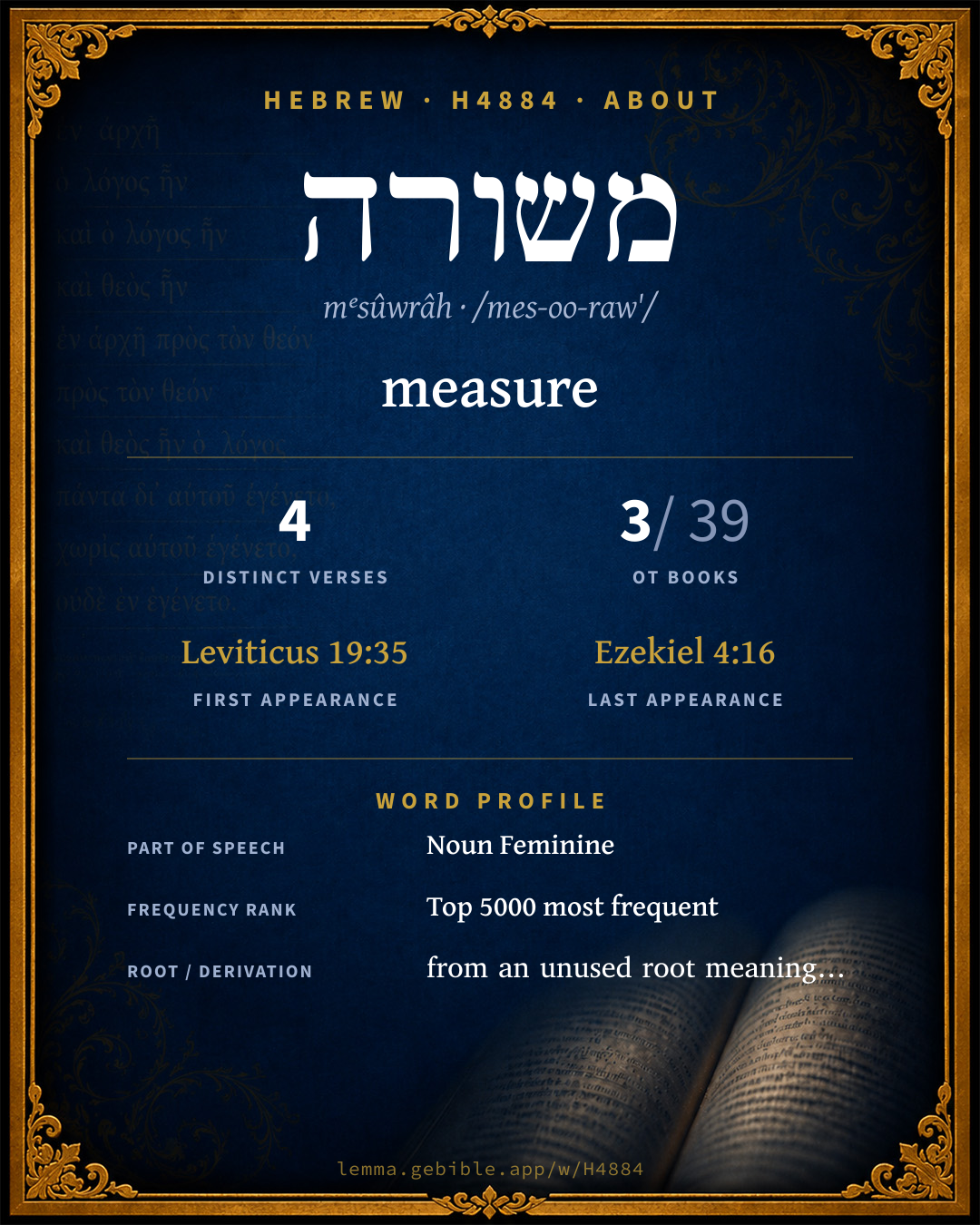
מְשׂוּרָה
measure
Full lexicon entry — Brown-Driver-Briggs (BDB)
From Brown-Driver-Briggs (BDB)
Where this word appears
Grammar key — what these labels mean
Part of speech
- Noun
- A naming word — a person, place, thing, or idea.
Noun type
- Common
- A common noun — a general class of person, place, or thing (“king,” “city,” “water”), not a specific name.
State
- Absolute
- The independent form of a noun, not bound to a following word.
Gender
- Feminine
- Grammatically feminine.
Number
- Singular
- One.
Every verse where H4884 appears — 4 distinct verses across 3 books. Click any verse to open its interlinear word-by-word view. Verse text shown in the World English Bible for context — . Each verse’s Hebrew form is shown with its reference; the English is not keyword-highlighted, since the data carries no word-level English alignment. Use “Compare translations” on any verse to read it across multiple English versions. This concordance covers the Hebrew Bible; Septuagint (Greek Old Testament) occurrences are not indexed here.
Leviticus 1 verse
1 Chronicles 1 verse
Ezekiel 2 verses
- Ezekiel 4:11 בִּ/מְשׂוּרָ֥ה prep + n c fs You shall drink water by measure, the sixth part of a hin: from time to time shall you drink.
- Ezekiel 4:16 בִּ/מְשׂוּרָ֥ה prep + n c fs Moreover he said to me, Son of man, behold, I will break the staff of bread in Jerusalem: and they shall eat bread by weight, and with fearfulness; and they shall drink water by measure, and in dismay:
About this entry
At a glance — auto-summarized from this page’s data, not written by a person. Every figure links to its source below. This summary describes the numbers; it doesn’t interpret them.
משורה — transliterated mᵉsûwrâh — is a Hebrew noun carrying the sense “measure.” The Hebrew Bible uses it only 4 verses. Its uses cluster heavily in Ezekiel (50% of all occurrences). Its earliest occurrence is Leviticus 19:35. See the sense tree, 4-verse concordance, and the renderings breakdown below.
Gloss history
Strong's 1890 vs modern scholarship
About this word
Strong's H4884 catalogs a Hebrew word from the Hebrew Old Testament.
These counts are not copied from any lexicon or concordance. They are computed here, from the morphology-tagged Hebrew Old Testament. What Lemma adds →
- 4
- distinct verses
- The word appears in 4 distinct verses.
- 3 / 39
- OT books
- The word appears in 3 of 39 Old Testament books.
- #3,696
- by frequency
- Top 5000 most frequent Hebrew words (rank 3,696 of 8,640 Hebrew words by occurrence).
View all 4 occurrences in the concordance →
Most concentrated in
- Ezekiel 2 verses 50%
- Leviticus 1 verse 25%
- 1 Chronicles 1 verse 25%
By section of the Old Testament
By traditional corpus
Conventional, traditional groupings — biblical authorship is debated, so this is a traditional corpus grouping, not an authorship claim. Each share is this word’s portion of its verses in that division of the Hebrew canon. Each figure is a share of the word’s 4 distinct verses.
- Prophets (Nevi'im) 2 verses · 50%
- Torah (Pentateuch) 1 verse · 25%
- Writings (Ketuvim) 1 verse · 25%
How translations render this word
Counts come from each version’s own published word-to-Strong’s tagging or interlinear alignment — an approximate guide to how each version renders this word, not a word-level alignment the data otherwise carries. Because each total is that version’s own tagged count, the per-version totals vary from one another and need not match the appearance or distinct-verse counts above. These counts may also differ from a printed concordance because Lemma counts each distinctly tagged rendering and does not collapse phrase taggings into a single head-word total. This is a fixed set of word-tagged versions (KJV, ASV, BSB, ULT) and does not change with the reading translation you choose elsewhere. Each version’s license is shown beside its name below (and on Sources).
- King James Version: Measure 2×
- American Standard Version: Measure 2×
- Berean Standard Bible: Measure 1×, Measurements of quantity 1×, Or volume 1×
- unfoldingWord Literal Text: Measure 1×, Measured out to 1×, Or in volume 1×
King James Version Public Domain
Renders H4884 across 4 tagged occurrences — most commonly:
Plus 2 renderings that appear only once — usually multi-word phrases or single function words the recovered tagging swept in, not distinct renderings.
American Standard Version Public Domain
Renders H4884 across 5 tagged occurrences — most commonly:
Plus 3 renderings that appear only once — usually multi-word phrases or single function words the recovered tagging swept in, not distinct renderings.
Berean Standard Bible Public Domain
Renders H4884 across 4 tagged occurrences — most commonly:
unfoldingWord Literal Text CC BY-SA 4.0
Renders H4884 across 4 tagged occurrences — most commonly:
Senses in BDB
The 1 sense BDB distinguishes for this word, in lexicon order (not ranked by frequency or importance). The full entry — with sub-senses — is in the Lexicon Entry tab.
- measure
Word origin
n.f. measure, of water, Ez 4:11, 16 (‖ מִשְׁקָל); capacity in gen., Lv 19:35 (+ מִדָּה, מִשְׁקָל), 1 Ch 23:29 (deriv. dub.)
— Brown-Driver-Briggs (Oxford 1906, public domain), digitized via Sefaria, supplemented by the OpenScriptures HebrewLexicon (CC BY 4.0). See Sources.
Origin: from an unused root meaning apparently to divide
Jastrow Dictionary
A second Hebrew/Aramaic lexicon for comparison, covering Aramaic and post-biblical (Talmudic, Targumic, Midrashic) usage that the biblical-Hebrew BDB does not. Matched by lemma rather than by Strong’s number, so a lemma may carry more than one Jastrow headword (shown separately below), and the entries cover usage well beyond the Bible.
מְשׂוּרָה
- (b. h.) m’surah, a measure of capacity, one thirty-sixth of a Log. Ab. ch. VI (adopted fr. Ez. V, 11). B. Mets. 61ᵇ; B. Bath. 89ᵇ.—Sifra K’dosh. Par. 3, ch. VIII במ׳ זו זיר הגדול ‘in measure’ (Lev. XIX, 35) that means you must leave a large crest (in dry measure), v. זֵיר. e.g. Ezekiel 5:11
שׁוּרָה
- (שרר) [chain,] line, row. Y. Yoma VIII, end, 45ᶜ (ref. to יָשֹׁר, Job XXXIII, 27) יעשה ש׳ של אנשים וכ׳ let him form a line of men, and say, I have sinned &c.; (Bab. ib. 87ᵃ צריך לפייסו בשלש שורות וכ׳ must beg his pardon in the presence of three rows of three men each). Ber. III, 2 עד שלא יגיעו לש׳ before they reach the line (of comforters). Snh. 19ᵃ כשהוא עובר בש׳ וכ׳ when he passes in the line to comfort others; וכשהוא עומד בש׳ וכ׳ and when he stands in the line to be comforted; Tosef. ib. IV, 1, sq. Kil. III, 3 ש׳ של ירק אחר a row (in the bed) of a different kind of vegetable. Dem. VII, 8 ש׳ החיצונה the outer row (of wine vessels); a. v. fr.—Trnsf. rule of conduct. Gen. R. s. 93 כהוגן וכש׳, v. הוֹגָן. B. Mets. 73ᵇ נוהג כש׳ he conducts himself properly. Snh. 105ᵇ אהבה מבטלת ש׳ של גדולה love disregards the rule of dignified conduct (causes men to do things ordinarily left to servants); שנאה מבטלת ש׳ וכ׳ so does hatred disregard &c.; Gen. R. s. 55 מקלקלת את הש׳; a. fr.—שׁוּרַת הדין the line of justice, strict law; לפנים מש׳ הדין inside the line of justice, equity, v. דִּין II. Gitt. IV, 4 ש׳ הדין העבד וכ׳ by strict law the hypothecated slave (emancipated by his owner) owes to the mortgagee nothing, but for the sake of social order, we force his second master (the mortgagee) to write a letter of emancipation &c. Mekh. Yithro, ʿAmal., s. 2 (ref. to Ex. XVIII, 20) ואת המעשה זה ש׳ הדין … לפנים מש׳ הדין ‘the deed’, that means strict law, ‘which they shall do’, that means equity; a. fr.—Pl. שׁוּרוֹת. Y. Ber. IV, 7ᵈ top תלמידי … ש׳ ש׳ ככרם the students at college who were arrayed in rows like (the vines in) the vineyard. Kil. IV, 5 שתי ש׳ two rows of vines. Dem. l. c. עשר ש׳ וכ׳ ten rows of ten wine vessels each. Y. Bicc. III, 65ᶜ bot. אב̇ … עושין לו ש׳ וכ׳ when the president enters (college), they must form lines for him, and he passes those which he chooses; (Hor. 13ᵇ שורה אחת מכאן וכ׳ one line on each side). Mekh. B’shall., ʿĂmal., s. 1 העומדים בש׳ המלחמה who stand in the battle lines; a. fr. e.g. Job 33:27
A Dictionary of the Targumim, the Talmud Babli and Yerushalmi, and the Midrashic Literature (Marcus Jastrow; London, Luzac, 1903) — Public Domain. Digitized via Sefaria. Digitized via Sefaria. Full attribution on Sources.
Forms in the corpus
The 3 distinct written forms H4884 takes in the Hebrew Bible, most frequent first — each parse links to that state’s occurrences in the concordance. Hebrew forms include their vowel points and cantillation, so a single lemma takes many written forms.
| Form | Parsing | Example | Uses |
|---|---|---|---|
| בִּ/מְשׂוּרָ֥ה | Noun, Common, Feminine, Singular, Absolute | Ezekiel 4:11 | 2 |
| וּ/בַ/מְּשׂוּרָֽה | Noun, Common, Feminine, Singular, Absolute | Leviticus 19:35 | 1 |
| מְשׂוּרָ֖ה | Noun, Common, Feminine, Singular, Absolute | 1 Chronicles 23:29 | 1 |
Septuagint verse parallels
This word appears in 4 verses that also exist in the Greek Old Testament (Septuagint), out of the 4 Hebrew verses it occurs in. You can read those verses in Greek by switching the Old Testament edition to the Septuagint.
Read these verses in the Septuagint
This is a verse-level parallel only — the same verses exist in both the Hebrew and Greek Old Testaments. No word-level Hebrew↔Greek correspondence is claimed: the data carries no such alignment, so no Greek word is shown as this Hebrew word’s translation. Coverage is not total — the Septuagint omits the deuterocanon and renumbers the Psalms, so some Hebrew verses have no direct Greek parallel.