
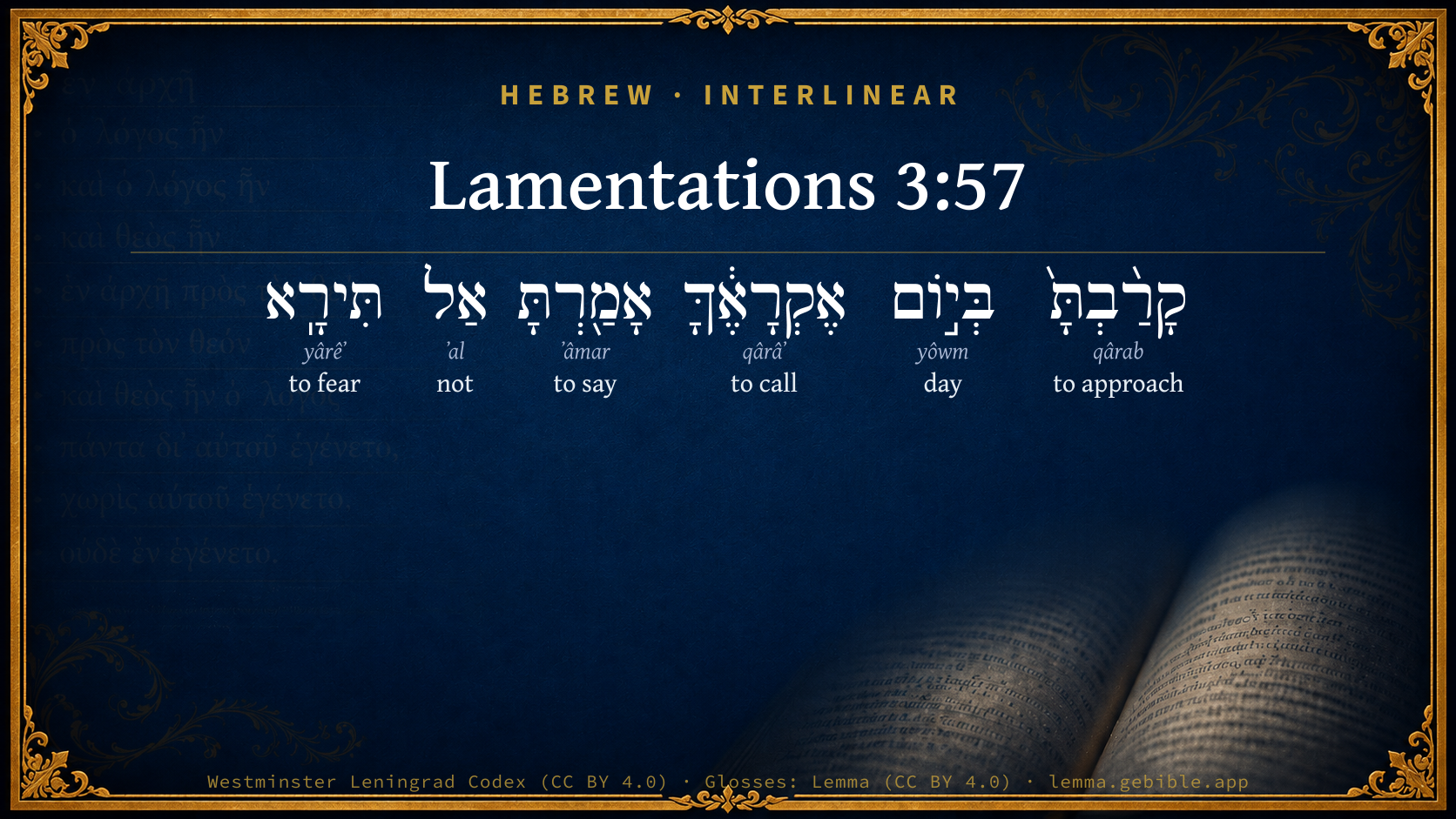
Lamentations 3:57

Hebrew (Westminster Leningrad Codex) Lamentations 3:57 appears in the Hebrew Old Testament. The text above is from the Westminster Leningrad Codex. Each word links to its Strong’s number, a concise gloss, and parsing drawn from the Open Scriptures Hebrew Bible morphology. Click any word for its full Brown-Driver-Briggs (BDB) entry.
Download image
Cite this verse

Lamentations 3:57 (World English Bible). Public Domain. Lemma interlinear Bible study tool, https://lemma.gebible.app/v/lamentations/3/57.

Show BibTeX & RIS
BibTeX
RIS
English Translation
You drew near in the day that I called on you; you said, Don't be afraid.
World English Bible · Public Domain
Download a study sheet

One document with this verse’s original text, its word-by-word gloss line, the meaning frame, cross-references with their text, attributed commentary, and full source and license credits — printable, and it pastes into notes with its structure intact.

This verse Autodidact and up

Study sheet (.html) Plain text (.txt)

A passage Seminary Student

Up to 50 verses in one chapter. A passage sheet keeps up to 6 commentary sources and 12 cross-references per verse, in the order this page ranks them, and says so on the sheet whenever that leaves anything out. Ask for a single verse and you get the Autodidact verse sheet above.

Everything on this page stays free to read, with no account — the sheet is a download of what is already on screen, not access to it.

Want to remove ads? Support Godless Engineer
Compare translations 3

The same verse in 3 English versions, stacked beneath the original-language interlinear above. Click any original word for its lexicon entry.

Each is an independent rendering of the whole verse — the interlinear is not word-aligned to these translations.

Highlighted words mark where these versions differ — a whole-verse word diff, not a word-by-word alignment.

  • World English Bible Public Domain
    You drew near in the day that I called on you; you said, Don't be afraid.
  • King James Version Public Domain
    Thou drewest near in the day that I called upon thee: thou saidst, Fear not.
  • unfoldingWord Literal Text CC BY-SA 4.0
    You drew near on the day I called on you; you said, “Do not fear.” RESH

unfoldingWord Literal Text — © unfoldingWord, licensed CC BY-SA 4.0. Word-aligned USFM3 via Door43 (git.door43.org/unfoldingWord/en_ult).

Versions to compare (up to 4)

3 of 4 selected

Show all 18 translations

Every available English version of this verse, each an independent rendering of the whole verse.

  • World English Bible Public Domain
    You drew near in the day that I called on you; you said, Don't be afraid.
  • Berean Standard Bible Public Domain
    You drew near when I called on You; You said, “Do not be afraid.”
  • Majority Standard Bible Public Domain
    You drew near when I called on You; You said, “Do not be afraid.”
  • King James Version Public Domain
    Thou drewest near in the day that I called upon thee: thou saidst, Fear not.
  • American Standard Version (1901) Public Domain
    Thou drewest near in the day that I called upon thee; thou saidst, Fear not.
  • Revised Version (1885) Public Domain
    Thou drewest near in the day that I called upon thee: thou saidst, Fear not.
  • Geneva Bible (1599) Public Domain
    Thou drewest neere in the day that I called vpon thee: thou saydest, Feare not.
  • Douay-Rheims (1899) Public Domain
    Coph. Thou drewest near in the day, when I called upon thee, thou saidst: Fear not.
  • Young's Literal Translation Public Domain
    Thou hast drawn near in the day I call Thee, Thou hast said, Fear not.
  • Literal Standard Version CC BY-SA 4.0
    You have drawn near in the day I call You, You have said, Do not fear.
  • Unlocked Literal Bible CC BY-SA 4.0
    You came near on the day I called on you; you said, 'Do not fear.'
  • unfoldingWord Literal Text CC BY-SA 4.0
    You drew near on the day I called on you; you said, “Do not fear.” RESH
  • Darby Bible Public Domain
    Thou drewest near in the day that I called upon thee; thou saidst, Fear not.
  • World Messianic Bible Public Domain
    You came near in the day that I called on you. You said, “Don’t be afraid.”
  • Webster's Bible Public Domain
    Thou drewest near in the day that I called upon thee: thou saidst, Fear not.
  • Free Bible Version CC BY-SA 4.0
    You came to me when I called you, and you told me, “Don't be afraid!”
  • Bible in Basic English Public Domain
    You came near in the day when I made my prayer to you: you said, Have no fear.
  • JPS Tanakh (1917) Public Domain
    Thou drewest near in the day that I called upon Thee; Thou saidst: 'Fear not.'

Literal Standard Version (2020), Covenant Press — licensed CC BY-SA 4.0. Text via the HelloAO Bible API (eBible.org). Unlocked Literal Bible (unfoldingWord) — licensed CC BY-SA 4.0. Text via the HelloAO Bible API (eBible.org). unfoldingWord Literal Text — © unfoldingWord, licensed CC BY-SA 4.0. Word-aligned USFM3 via Door43 (git.door43.org/unfoldingWord/en_ult). Free Bible Version, Dr. Jonathan Gallagher — licensed CC BY-SA 4.0. Text via the HelloAO Bible API (eBible.org).

Word by word

More ways to search: Search by grammar → Find every occurrence → Compare this word →

Practice this passage: Drill this verse → Learn its vocabulary →

About this verse

These counts appear in no published source. They are computed here, from the morphology-tagged text and Lemma’s own curated glosses. What Lemma adds →

6
words
6
distinct lemmas
Prophets
section

Grammatical profile

  • 4 verbs
  • 1 noun
  • 1 particle

Verb forms

  • קָרַ֨בְתָּ֙ Qal · Perfect
  • אֶקְרָאֶ֔ךָּ Qal · Imperfect
  • אָמַ֖רְתָּ Qal · Perfect
  • תִּירָֽא Qal · Jussive

Hebrew & Septuagint length

In English translation the verse runs 16 words from the Hebrew and 20 from the Septuagint (LXX English) — closely comparable.

A rough comparison of the two English renderings, which tokenize alike — not a word-level alignment.

Word counts can differ between the Hebrew and the Greek without any difference in meaning — e.g. the Hebrew direct-object marker אֵת has no separate Greek word, and Greek often adds the article ὁ.

Cross-references

12

Topical passages linked to Lamentations 3:57 in the Treasury of Scripture Knowledge — connected by theme and wording, ordered by reader-vote popularity; previews shown in the World English Bible.

  • Isaiah 41:10 Don't you be afraid, for I am with you; don't be dismayed, for I am your God; I will strengthen you; yes, I will help you; yes, I will uphold you with the right hand of my righteousness.
  • James 4:8 Draw near to God, and he will draw near to you. Cleanse your hands, you sinners; and purify your hearts, you double-minded.
  • Isaiah 58:9 Then shall you call, and Yahweh will answer; you shall cry, and he will say, Here I am. If you take away from the midst of you the yoke, the putting forth of the finger, and speaking wickedly;
  • Isaiah 41:14 Don't be afraid, you worm Jacob, and you men of Israel; I will help you, says Yahweh, and your Redeemer is the Holy One of Israel.
  • Revelation 2:10 Don't be afraid of the things which you are about to suffer. Behold, the devil is about to throw some of you into prison, that you may be tested; and you will have oppression for ten days. Be faithful to death, and I will give you the crown of life.
  • Psalms 145:18 Yahweh is near to all those who call on him, To all who call on him in truth.
  • Isaiah 43:1–2 But now thus says Yahweh who created you, Jacob, and he who formed you, Israel: Don't be afraid, for I have redeemed you; I have called you by your name, you are mine.
  • Acts 18:9 The Lord said to Paul in the night by a vision, "Don't be afraid, but speak and don't be silent;
  • Acts 27:24 saying, 'Don't be afraid, Paul. You must stand before Caesar. Behold, God has granted you all those who sail with you.'
  • Psalms 69:18 Draw near to my soul, and redeem it. Ransom me because of my enemies.
  • Jeremiah 1:17 You therefore gird up your loins, and arise, and speak to them all that I command you: don't be dismayed at them, lest I dismay you before them.
  • Revelation 1:17 When I saw him, I fell at his feet like a dead man. He laid his right hand on me, saying, "Don't be afraid. I am the first and the last,

Cross-references courtesy of OpenBible.info (CC BY 4.0).

Hebrew and Greek witnesses Masoretic Hebrew ↔ Greek Septuagint

The same verse in the two great witnesses to the Old Testament, shown verse-for-verse.

These are two independent witnesses, not word-aligned to each other, and the Septuagint is shown in lemma (dictionary) form.

Hebrew Lamentations 3:57 Masoretic · Westminster Leningrad Codex

קָרַ֨בְתָּ֙ בְּי֣וֹם אֶקְרָאֶ֔ךָּ אָמַ֖רְתָּ אַל תִּירָֽא

You drew near in the day that I called on you; you said, Don't be afraid.

World English Bible · Public Domain

Greek LXX Lamentations 3:57 Septuagint · lemma form

εἰς ὁ βοήθεια ἐγώ ἐγγίζω ἐν ὅς σύ ἡμέρα ἐπικαλέω εἶπον ἐγώ μή φοβέω

You drew near to my help: in the day wherein I called upon you you said to me, Fear not.

LXX2012 (modern English Septuagint) · Public Domain

Hebrew: Westminster Leningrad Codex (CC BY 4.0). Greek: Septuagint (public domain); English from LXX2012 (modern English Septuagint) (Public Domain). How the Septuagint differs from the Hebrew →

Commentary

Notes on Lamentations 3:57 from classic Christian and Jewish commentators (each source and its license shown beneath its notes). The classic Christian expositions comment on the surrounding passage and are grouped to its opening verse, so a note may address several verses; the Jewish commentaries on the Tanakh (Rashi and others) are per-verse, so they appear only where the commentator wrote on this verse.

Lemma curates 59 commentaries, every one of them public domain or Creative Commons licensed, each selected and text-cleaned for this edition rather than reprinted as found. About our sources →

Trapp's Complete Commentary

John Trapp

Lam 3:57 Thou drewest near in the day [that] I called upon thee: thou saidst, Fear not.

Ver. 57. Thou drawest near.] This thou hast done, and this I hope thou yet wilt do. Experience breedeth confidence.

John Trapp, A Commentary or Exposition upon All the Books of the Old and New Testament (1647–1656) — public domain. Text from a community e-Sword module.

Jamieson, Fausset & Brown

Robert Jamieson, A. R. Fausset & David Brown

Thou drewest near--with Thy help (Jam 4:8).

Jamieson, Fausset & Brown — Commentary Critical and Explanatory on the Whole Bible (1871) — public domain (CC PDM 1.0). Text via the HelloAO Bible API.

Adam Clarke's Commentary

Verse 57. Fear not.] How powerful is this word when spoken by the Spirit of the Lord to a disconsolate heart. To every mourner we may say, on the authority of God, Fear not! God will plead thy cause, and redeem thy soul.

Adam Clarke's Commentary on the Bible (1810–1826) — public domain. Text from a community e-Sword/MySword module.

John Calvin's Commentaries

Here the Prophet tells us that he had experienced the goodness of God, because he had not suffered a repulse when he prayed. And this doctrine is especially useful to us, that is, to call to mind that we had not in time past prayed in vain. For we may hence feel assured, that as God ever continues like himself, he will be ever ready to help us when- ever we implore his protection. This, then, is the reason why the Prophet declares here that he had experienced the readiness of God to hear prayer: Thou didst come nigh, he says, in the day when I called on thee; thou didst say, Fear not And this approach or coming nigh refers to what was real or actually done, that God had stretched forth his hand and helped his servants. Since, then, they had been confirmed by such evidences, they had the privilege of ever fleeing to God. God, indeed, supplies us with reasons for hope, when he once and again aids us; and it is the same as though he testified that he will ever be the same as we have once and again found him to be.

He then adds an explanation, Thou didst say, Fear not He does not mean that God had spoken; but, as I have said, he thus sets forth the fact, that he had not sought God in vain, for he had relieved him. Though God may not speak, yet when we find that our prayers are heard by him, it is the same as though he raised us up and removed from us every fear. The sum of what is said is, that God had been propitious to his servants whenever they cried to him. It now follows, —

John Calvin's Commentaries (1540-1563) — public domain. Text from the Calvin Translation Society English edition (1840s-50s) via the Christian Classics Ethereal Library (ccel.org). Calvin's coverage is partial (roughly two-thirds of the Bible); uncommented books and verses are honest gaps, never fabricated. The 19th-century editor's footnotes and remarks are omitted so the notes are faithfully Calvin's own voice.

The Cambridge Bible for Schools and Colleges

gen. ed. J. J. S. Perowne

57. Thou drewest near] Cp. Psa_145:18.

The Cambridge Bible for Schools and Colleges (gen. ed. J. J. S. Perowne; Cambridge University Press, 1878–1918) — public domain. Text from a community e-Sword module.

John Gill's Exposition

The lips of those that rose up against me,.... This is to be connected with the preceding words; and expresses the same thing in different language. The sense is, that the Lord heard the words which dropped from the lips of his enemies; their sarcasms, flouts, and jeers; their bitter reflections, severe invectives, and scornful language:

and their device against me all the day; or, "their meditation of ill against me"; or, "their speech", or discourse (x); which all turned upon the same topic. Schultens (y) derives the word from the Arabic word which signifies to mock and scoff, or pursue anyone with ironical and satirical expressions; and so may intend here contumelious and reproachful language.

(x) "meditationem istorum", Pagninus, Montanus, Junius & Tremellius, Piscator; "loquelam eorum", Michaelis. (y) Animadv. Philol. p. 436. "maledixit verborum contumelia insectatus fuit, peculiariter carmine seu satyra, et subsannavit, vituperavit", Golius, col. 2515.

John Gill's Exposition of the Whole Bible (1746–1763) — public domain (CC PDM 1.0). Text via the HelloAO Bible API.

Matthew Poole's English Annotations

There was a time when I was in distress, and called upon time, and thou didst draw near unto me. God is never far off from any of us, as to his essential presence; nor is it possible that he should, for he filleth all places. But he is said to be near us or far off from us, as he manifests, or doth not manifest, his goodness to us by acts of gracious providence: of that drawing near the text speaketh. God being infinite in goodness and mercy, is spoken of as absent from those persons and places where he is not showing mercy, and present only there where he showeth forth his goodness, and to be drawing nigh to them to whom he beginneth to show mercy.

Thou saidst, Fear not; thou didst encourage me formerly upon my prayer.

Matthew Poole's English Annotations on the Holy Bible (1683–1685) — public domain. Text from a community e-Sword/MySword module.

The Pulpit Commentary

Thou drewest near, etc. The sacred poet reminds Jehovah of his former gracious interpositions.

"Fear not!

The recollection of how God has forbidden one not to fear in the past is a plea in praying that he will remove the ground of fear in the present.

I WE MUCH NEED DIVINE ENCOURAGEMENTS TO OVERCOME FEAR.

1. In real danger. It is not only the coward who fears. Indifference often gets the credit of courage. Many fear not simply because they are blind. To see would be to tremble. For the great powers of the universe, "the terror by night and the arrow that flieth by day," and the spiritual temptations that threaten our souls, are too strong for us.

2. In the threatening aspect of the future. Heavy clouds will gather to windward. Storms are plainly brewing out at sea. Whether they will burst over our heads or not we cannot say. But the very uncertainty adds to the terror; for fear feeds on vague alarms and may be conquered when the worst is known.

3. In the mystery of life. Even when we see no threatening danger the awful unknown is peopled to our imagination with strange horrors.

4. In the fears of otters. Nothing is so contagious as fear. Hence the madness of panics. It is hard to be brave among the timorous.

5. In hours of weakness. When we are weary courage flags. We can be brave at noon, but midnight awakens fear. Guilt is full of alarm.

II WE HAVE MANY DIVINE ENCOURAGEMENTS TO OVERCOME FEAR.

1. In directly urging usher to fear. He has said, "Fear not!" He will not mock with empty words.

2. In promises of help. The Scriptures teem with words of grace for troubled souls, as when they are bidden to cast their burden upon God because he will sustain them, to call upon him in the day of trouble and he will hear them, etc. By the veracity and honour of God we have enough assurance in any one of these promises to dispel fear.

3. In the fatherly character of God. If we had no instruction not to fear and no promise of help, we might still know enough of God to rest confident that all must be well when we are in his hands. The child fears nothing when nestling on its mother"s bosom. Who shall fear that leans upon the bosom of God?

4. In our personal relations with God. Let it be noted that everybody under all circumstances is not to be urged to east fears to the wind. The guilty should fear. The impenitent have no excuse for abandoning fear. They who are at enmity with God should dwell in great trembling. It is when reconciled through Christ, forgiven and restored to our home, that as redeemed souls we can shake off fear.

III DIVINE ASSURANCES AGAINST FEAR SHOULD INSPIRE OUR PRAYERS FOR HELP IN DANGER. We are to remember how God has bidden us not to fear. Here is a grand source of confidence when we cry for help. For it is the very Word of God that has led us to stand facing the storm. His action must be true to his Word. Nevertheless, we do need to pray for help in danger. God"s promises are conditional. When he dissuades us from fear it is on the understanding that we seek refuge beneath the covert of his wings. To the storm tossed soul he says, "Fear not!" but he expects that soul to welcome him as its Pilot. Then the storm will be weathered. God"s assurance of safety is for those who turn to his protection. It is those who are "in Christ Jesus" for whom there is no condemnation, and who therefore need fear nothing.

Vers. 57, 58. Prayer heard and answered.

How natural that the mind of a pious man should, in seasons of distress and calamity, revert to the bygone days, remember the clouds by which they were overcast, and take encouragement at the vivid recollection of gracious interposition and help!

I THE DAY OF DELIVERANCE.

1. This was a day of need and of distress, of sore need and of bitter distress.

2. It was a day of prayer, a day in which Divine aid had been zealously and urgently implored.

II THE VOICE OF THE DELIVERER. "Thou saidst, Fear not!" How often are these words represented by the prophets to have been spoken by Jehovah! How often by the evangelists to have been spoken by Christ! They seem to constitute a "note" of Divine utterance. They are as reassuring and consolatory to man as they are appropriate and becoming to God.

III THE FACT OF DELIVERANCE. Comforting words are welcome; how much more the exercise of mighty power! This passage depicts

(1) the approach of the mighty One, and

(2) the redemption of the captive"s life.

What was literally true of Jeremiah"s bodily condition is true of the spiritual state of sinful man; and all temporal interpositions are an emblem of the delivering, the redemptive grace of God in Jesus Christ.

IV THE ACKNOWLEDGMENT OF DELIVERANCE. The testimony of the prophet is an example to all who have experienced the blessedness of Divine love and grace. Such acknowledgment should be grateful, cordial, public, and everlasting. T.

The Pulpit Commentary (1880–1919), ed. H.D.M. Spence-Jones & Joseph S. Exell — public domain. Text from a community e-Sword module.

Rashi

Rabbi Shlomo Yitzchaki (Rashi)

You did draw near when I called on You So were You accustomed in the early days to draw near to me on the day I called.

Rashi on the Tanakh — English translations: “The Judaica Press complete Tanach with Rashi, translated by A. J. Rosenberg” (CC BY 4.0); “Pentateuch with Rashi's commentary by M. Rosenbaum and A.M. Silbermann, 1929-1934” (public domain); “The Metsudah Tanach series, Lakewood, N.J” (CC BY 4.0); and “The Book of Joshua, Metsudah Publications, 1997” (CC BY 4.0). Text via Sefaria.

Lesson kit

Teaching starters — assembled from the data on this page, not authored interpretation. Every prompt links to the verse data it draws on. Edit before teaching.

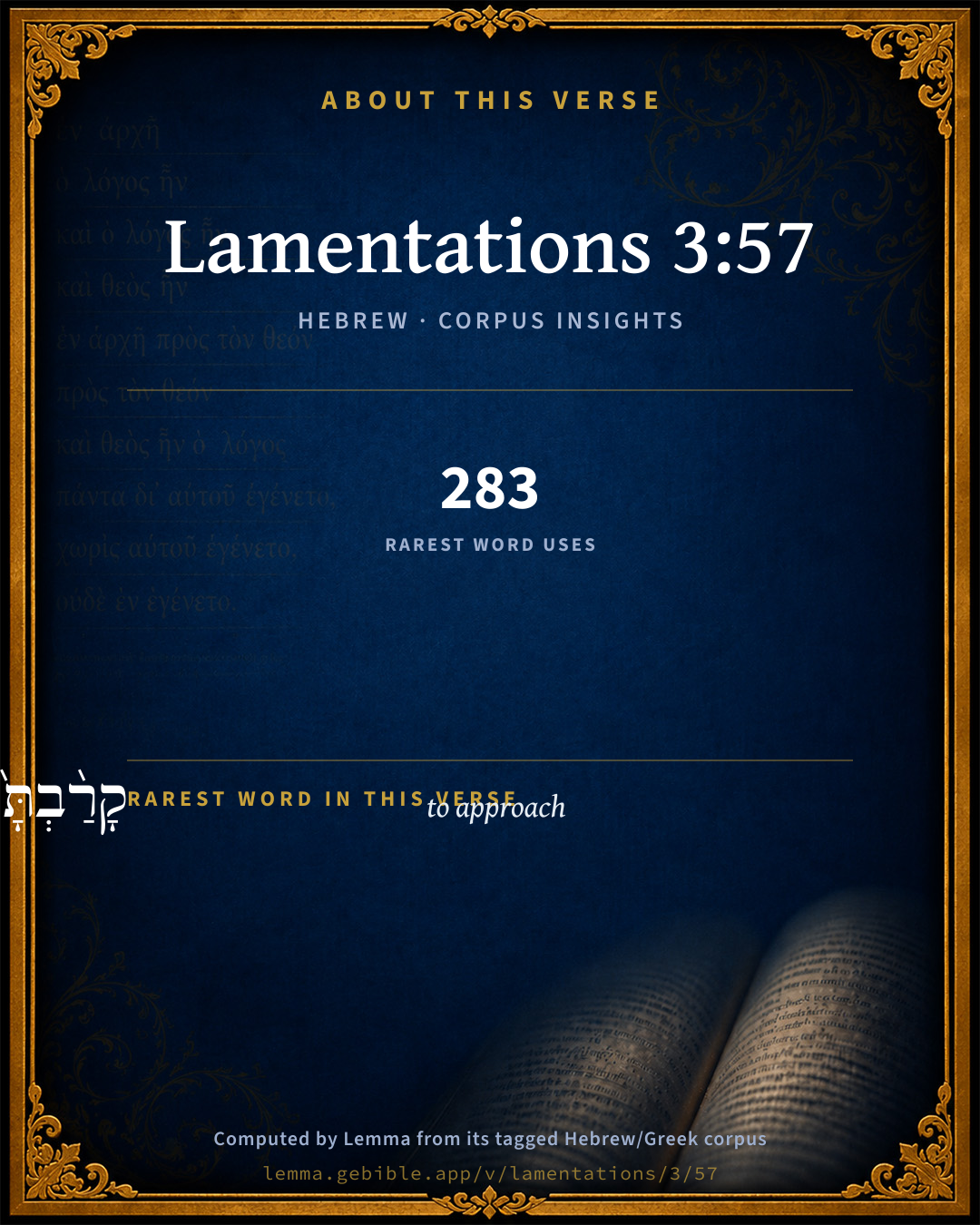
Lamentations, in the Prophets, opens this verse with 6 words (6 distinct Hebrew lemmas). Its most distinctive word is qârab (“to approach”). A historical commentator’s framing appears above. Read the whole chapter for the surrounding context.

Discussion questions

  1. What does “to approach” (qârab) contribute to the verse as a whole?
  2. Isaiah 41:10 shares this passage’s theme. How do the two illuminate each other?
  3. The translations on this page render this verse differently — a whole-verse word diff, not a word-by-word alignment. What might account for the different wordings?
  4. The verb «קָרַ֨בְתָּ֙» is Qal Perfect. How does its form color the action?
  5. Reading how Trapp's Complete Commentary and Jamieson, Fausset & Brown read this verse, where do the two commentators agree and where do they part?

Things to notice

Reading settings

Reading text

Shown beneath each verse's original-language words.

Old Testament
Old Testament edition

Read the OT as the Masoretic Hebrew (MT) or the Greek Septuagint (LXX).

English shown for the Greek Septuagint (in the Hebrew ↔ Greek comparison).

Comparing translations? Open the Compare panel on any verse page to stack up to four side by side.