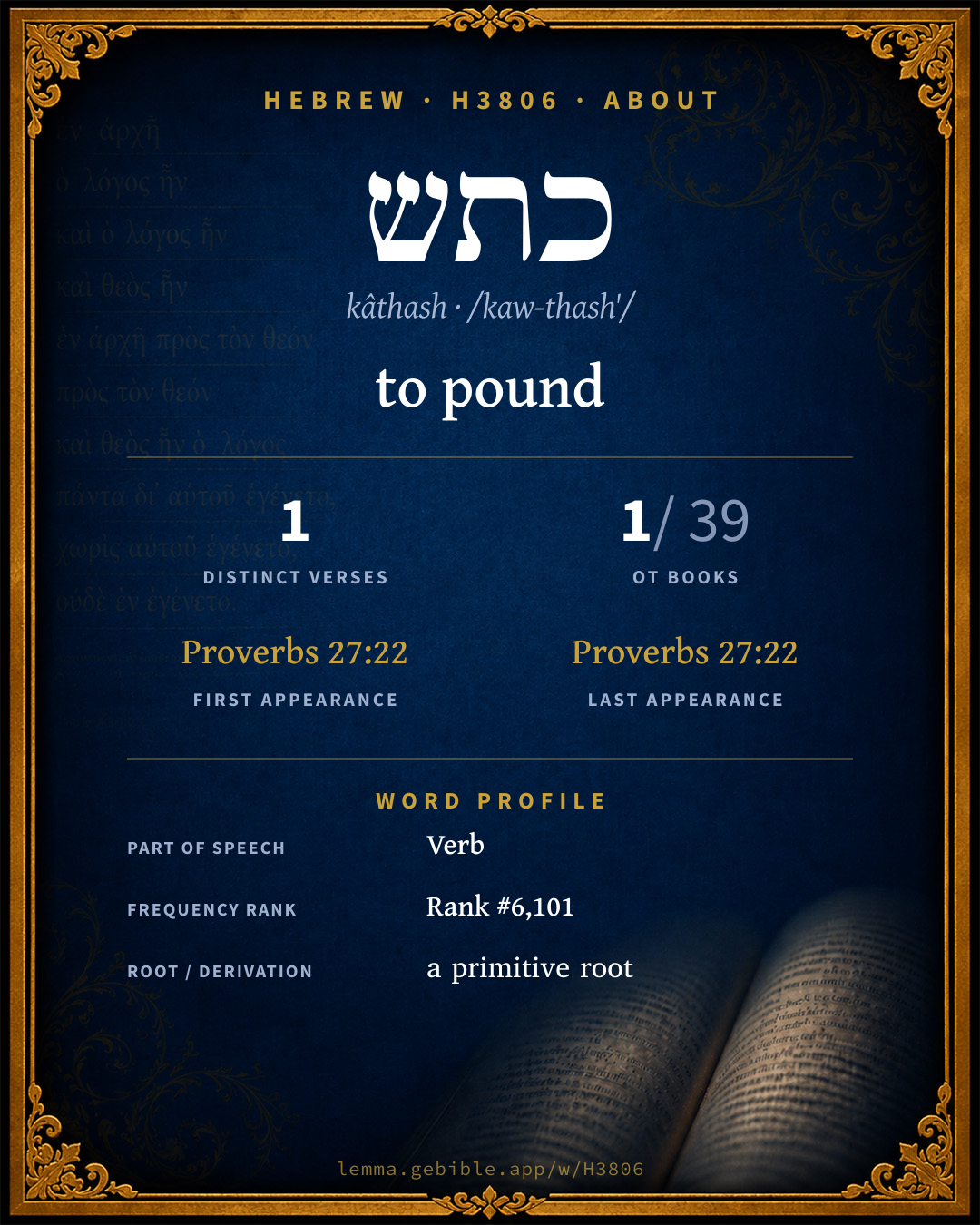
כָּתַשׁ
to pound
Full lexicon entry — Brown-Driver-Briggs (BDB)
From Brown-Driver-Briggs (BDB)
Where this word appears
Grammar key — what these labels mean
Part of speech
- Verb
- An action or state-of-being word.
Stem
- Qal
- The basic, simple active stem — the plain form of the verb (“he wrote”).
Form
- Imperfect
- An incomplete, ongoing, or future action (“he will / would write”).
Person
- 2nd Person
- The one addressed (“you”).
Gender
- Masculine
- Grammatically masculine.
Number
- Singular
- One.
Every verse where H3806 appears — 1 distinct verse across 1 book. Click any verse to open its interlinear word-by-word view. Verse text shown in the World English Bible for context — . Each verse’s Hebrew form is shown with its reference; the English is not keyword-highlighted, since the data carries no word-level English alignment. Use “Compare translations” on any verse to read it across multiple English versions. This concordance covers the Hebrew Bible; Septuagint (Greek Old Testament) occurrences are not indexed here.
Proverbs 1 verse
About this entry
At a glance — auto-summarized from this page’s data, not written by a person. Every figure links to its source below. This summary describes the numbers; it doesn’t interpret them.
At its core, כתש (kâthash) means “to pound.” A scarce word — 1 verse in all of the Hebrew Bible. Its uses cluster heavily in Proverbs (100% of all occurrences). Its lone occurrence is Proverbs 27:22. Sharing its root, it stands alongside מכתש. Dig into 1-verse concordance and the renderings breakdown below.
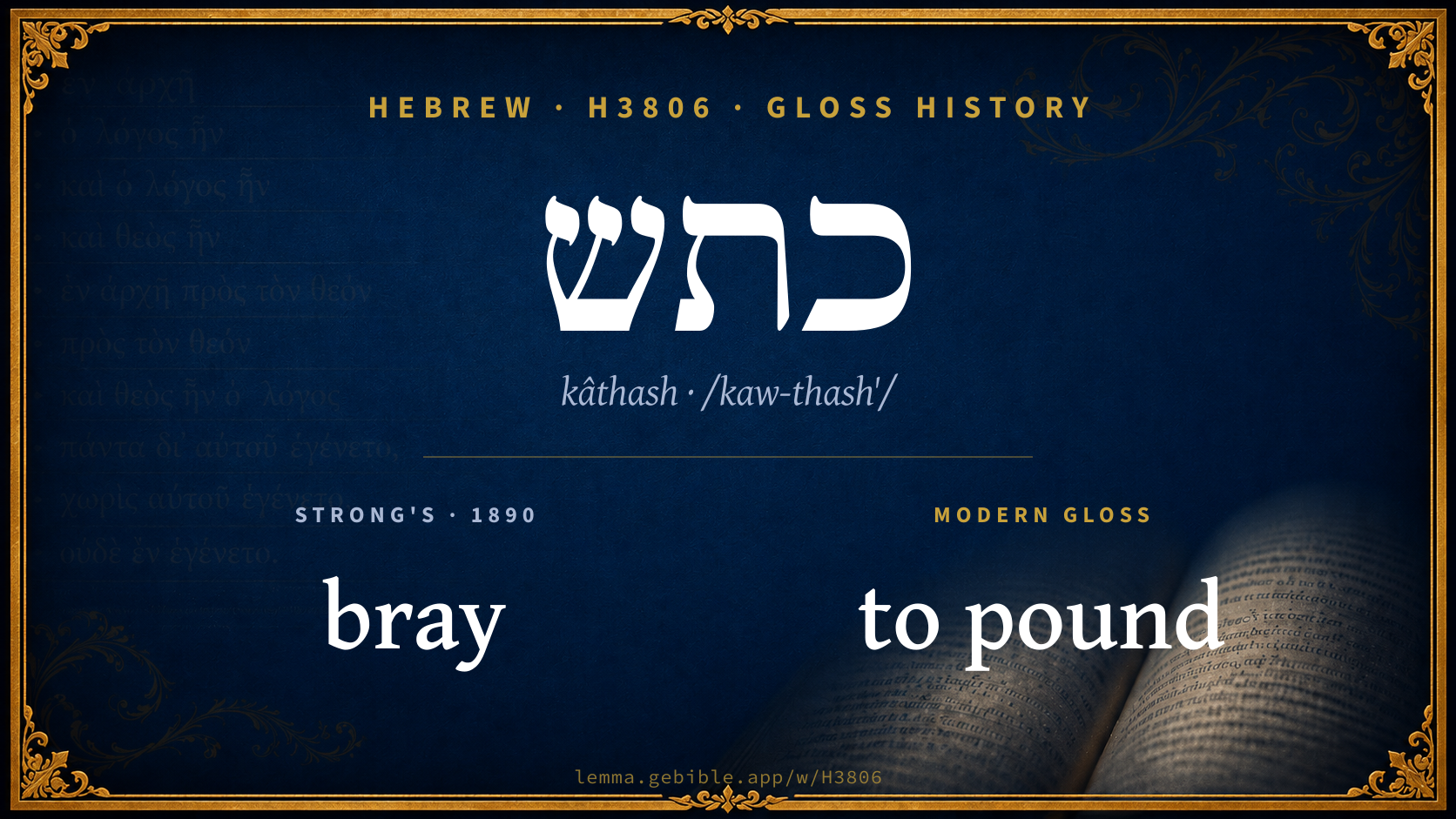
Gloss history
Strong's 1890 vs modern scholarship
About this word
Strong's H3806 catalogs a Hebrew word from the Hebrew Old Testament.
These counts are not copied from any lexicon or concordance. They are computed here, from the morphology-tagged Hebrew Old Testament. What Lemma adds →
- 1
- distinct verses
- The word appears in 1 distinct verse.
- 1 / 39
- OT books
- The word appears in 1 of 39 Old Testament books.
- #6,101
- by frequency
- Rank #6,101 (rank 6,101 of 8,640 Hebrew words by occurrence).
View all 1 occurrence in the concordance →
Most concentrated in
- Proverbs 1 verse 100%
By section of the Old Testament
By traditional corpus
Conventional, traditional groupings — biblical authorship is debated, so this is a traditional corpus grouping, not an authorship claim. Each share is this word’s portion of its verses in that division of the Hebrew canon. Each figure is a share of the word’s 1 distinct verse.
- Writings (Ketuvim) 1 verse · 100%
How translations render this word
Counts come from each version’s own published word-to-Strong’s tagging or interlinear alignment — an approximate guide to how each version renders this word, not a word-level alignment the data otherwise carries. Because each total is that version’s own tagged count, the per-version totals vary from one another and need not match the appearance or distinct-verse counts above. These counts may also differ from a printed concordance because Lemma counts each distinctly tagged rendering and does not collapse phrase taggings into a single head-word total. This is a fixed set of word-tagged versions (KJV, ASV, BSB, ULT) and does not change with the reading translation you choose elsewhere. Each version’s license is shown beside its name below (and on Sources).
- King James Version: Thou shouldest bray 1×
- American Standard Version: Thou shouldest bray 1×
- Berean Standard Bible: You grind 1×
- unfoldingWord Literal Text: You pound 1×
King James Version Public Domain
Renders H3806 across 1 tagged occurrence — most commonly:
American Standard Version Public Domain
Renders H3806 across 1 tagged occurrence — most commonly:
Berean Standard Bible Public Domain
Renders H3806 across 1 tagged occurrence — most commonly:
unfoldingWord Literal Text CC BY-SA 4.0
Renders H3806 across 1 tagged occurrence — most commonly:
Senses in BDB
The 1 sense BDB distinguishes for this word, in lexicon order (not ranked by frequency or importance). The full entry — with sub-senses — is in the Lexicon Entry tab.
- (Qal) to pound, mix by pounding, pound fine, bray
Word origin
[ כָּתַשׁ ] vb. pound, pound fine, bray;— Qal Pr 27:22
— Brown-Driver-Briggs (Oxford 1906, public domain), digitized via Sefaria, supplemented by the OpenScriptures HebrewLexicon (CC BY 4.0). See Sources.
Origin: a primitive root
Jastrow Dictionary
A second Hebrew/Aramaic lexicon for comparison, covering Aramaic and post-biblical (Talmudic, Targumic, Midrashic) usage that the biblical-Hebrew BDB does not. Matched by lemma rather than by Strong’s number, so a lemma may carry more than one Jastrow headword (shown separately below), and the entries cover usage well beyond the Bible.
כָּתַשׁ
- v. כָּתַת)
- 1. to crush (olives), to pound, beat Shebi. IV, 9 כּוֹתֵש וסך וכ׳ he may crush olives and use the oil for ointment in the field. Sabb. 74ᵃ וליחשוב נמי כותש let the Mishnah (Sabb. VII, 2) count (among the forbidden labors) also pounding (grain), v. כְּתִישָׁה. Men. VIII, 4 (86ᵃ), Tanḥ. Ḥuck. 8; Pesik. Par., p. 40ᵃ וכוֹתְשִׁין אותה and pound it (the burnt body). Koh. R. to VII, 2 ולמה כותשין על הלב why do mourners beat their hearts?; a. e.—Part. pass. כָּתוּשׁ, f. כְּתוּשָׁה crushed. Men. 86ᵇ, v. כָּתִית.—Trnsf. defloured. Y. Kidd. I, 59ᵃ top, v. חָרַף.—2) to press, to be closely joined, grouped; שער כּוֹתֵשׁ a thick hair crown, i.e. ramifications forming a sort of arbor. Peah II, 3 אם היה ש׳ כ׳ if the ramifications are intertwined; Y. ib. 17ᵃ top [read:] מה כ׳ כעלי במכתש וכ׳ (v. R. S. to Kil. V, 3) what does this כותש mean? Does it mean, like the pestle in the mortar (i.e. the partition is formed by a depression in the ground between the two fields, out of which the fence rises), or does it mean, pressing upon (overgrowing) the fence? Answ. מן מה דתנינן סער כותש ואין הגדר כותש וכ׳ reading as we do ‘the hair (ramification) presses’, and not ‘the fence presses’, it is evident that it means ‘overgrowing the fence.’
- to be crushed, pounded. Tanḥ. Ki Thabo 3 מה השמן הזה נ׳ וכ׳ as oil is pounded, and the more it is pounded, the better it becomes, v. כְּתִישָׁה. Ter. I, 8 זתים הנִכְתָּשִׁין crushed olives. Tosef. ib. III, 14 עתידין לִיכָּתֵשׁ designated for pounding; a. fr.
- to crush to powder.—Part. pass. מְכוּתָּשׁ, f. מְכוּתֶּשֶׁת. Tosef. Ohol. II, 5 some ed. (oth. מְכוּתֶּתֶת, ed. Zuck. מכתתת; Y. Naz. VIII, 56ᶜ מְכוּתָּתִין).
- [to come in contact with,] to wrestle, fight (cmp. גָּשַׁש). Y. Peah IV, 18ᵇ top שנים שהיו מִתְכַּתְּשִׁין וכ׳ if two persons were fighting about a (forgotten) sheaf; Tosef. Peah II, 2 מִכַּתְּשִׁין ed. Zuck. (Var. מתכשין, corr. acc.). Sifré Deut. 37 ד׳ מלכיות מִתְכַּתְּשׁוֹת וכ׳ (ed. Fr. מתכחשות) four governments disputed about it (each naming it differently); Yalk. Num. 743 מתרחשות (corr. acc.); Pesik. Zutr. Deut. ed. Bub. p. 9 מלכים מִתְכַּתְּשִׁין …; ib. p. 30 מתכבש׳ (corr. acc.).
כְּתַשׁ
- 1. to crush. Targ. Y. Ex. XXX, 36.—Part. pass. כָּתִישׁ, f. כָּתִישָׁא; pl. כָּתִישִׁין; כָּתִישַׁן. Targ. Ex. XXVII, 20. Targ. Y. Lev. XXII, 24 (h. text כָּתוּת).
- 2. (= h. נגע) to touch, strike, afflict. Part. pass. as ab. Targ. Ps. LXXIII, 14 (ed. Wil. כַּתִּישׁ). Targ. Is. XXVIII, 1 (h. text הלומי). Ib. LIV, 4; a. e.—Dem. מַכְתַּשׁ.
- 1. to wrestle, fight. Targ. Y. Gen. XXXII, 25, sq.—Gen. R. s. 48, beg. הות מִכַּתְּשָׁא וכ׳ was quarrelling with her maid. Lev. R. s. 9 ולא חמית … מִתְכַּתְּשִׁין וכ׳ and I never saw two quarrel with one another without making peace between them. Lev. R. s. 22 פשושין מכתשין Ar. ed. Koh. (ed. ציפרין מתנציין).
- 2. mostly Ithpe. אִתְכְּתַשׁ to be smitten, afflicted (with leprosy). Targ. Ps. LXXIII, 5. Targ. Y. Ex. II, 23 (cmp. Ex. R. s. 1). Targ. Y. Gen. XVI, 1.—[Gen. R. s. 44; Yalk. ib. 77, v. כְּשַׁשׁ.]
- to press, beg persistently. Shebu. 30ᵇ; Ḥull. 7ᵇ, v. בְּתַשׁ.
A Dictionary of the Targumim, the Talmud Babli and Yerushalmi, and the Midrashic Literature (Marcus Jastrow; London, Luzac, 1903) — Public Domain. Digitized via Sefaria. Digitized via Sefaria. Full attribution on Sources.
Same root — word family
Other BDB entries built from the same root as H3806, grouped by Strong’s listed origin. These share a root / origin per the lexicon — not necessarily a shared meaning. Each links to that word’s own entry.
Derived from this word
Compare all same-root words → They share a root, not necessarily a meaning.
Septuagint verse parallels
This word appears in 1 verse that also exists in the Greek Old Testament (Septuagint), out of the 1 Hebrew verse it occurs in. You can read those verses in Greek by switching the Old Testament edition to the Septuagint.
Read these verses in the Septuagint
This is a verse-level parallel only — the same verses exist in both the Hebrew and Greek Old Testaments. No word-level Hebrew↔Greek correspondence is claimed: the data carries no such alignment, so no Greek word is shown as this Hebrew word’s translation. Coverage is not total — the Septuagint omits the deuterocanon and renumbers the Psalms, so some Hebrew verses have no direct Greek parallel.