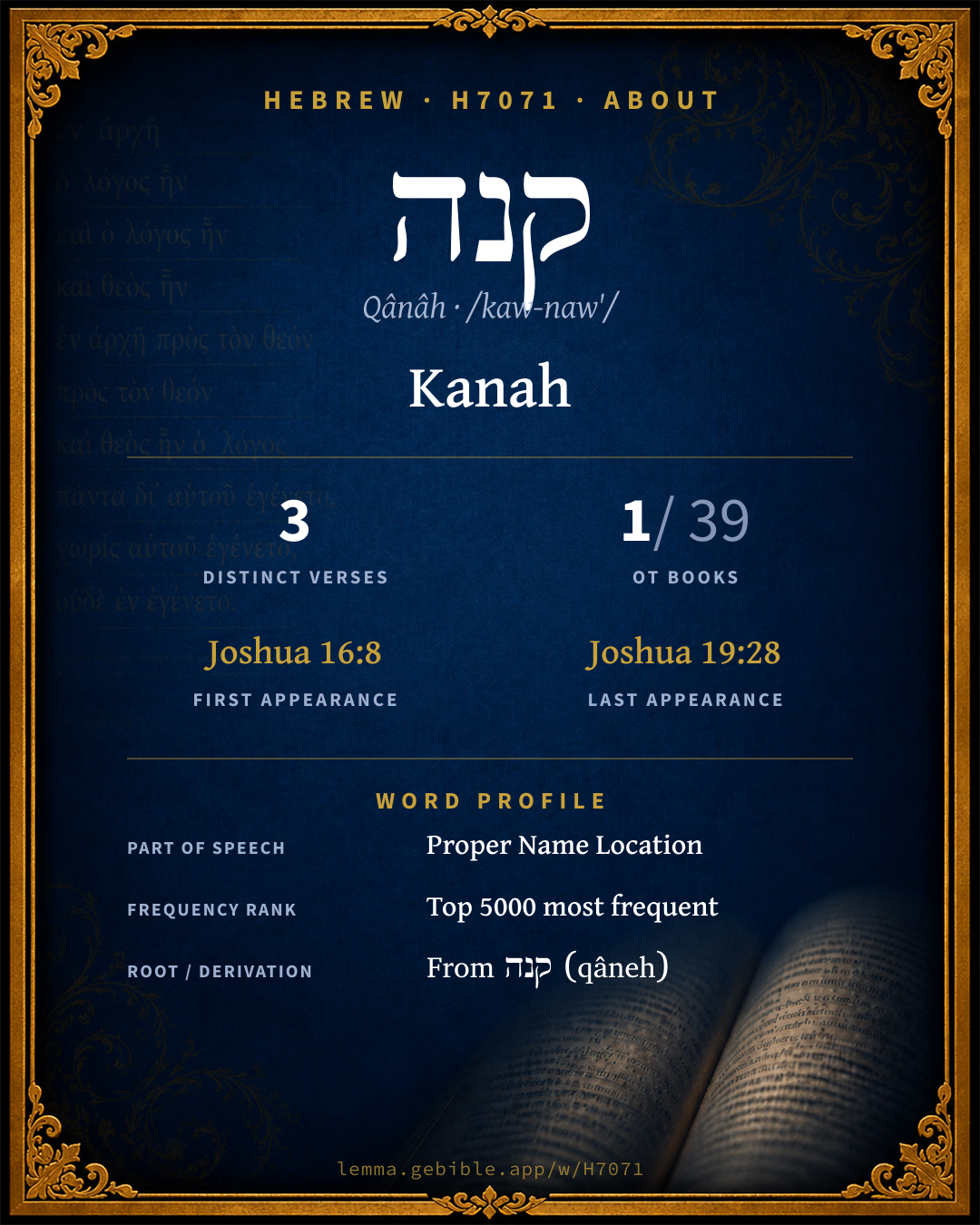
קָנָה
Kanah
BDB lists 3 entries for ‘Kanah’ fuller range ↓
Full lexicon entry — Brown-Driver-Briggs (BDB)
From Brown-Driver-Briggs (BDB)
Where this word appears
Grammar key — what these labels mean
Part of speech
- Noun
- A naming word — a person, place, thing, or idea.
Noun type
- Proper
- A name of a specific person, place, or people (e.g. Abraham, Zion, Israel).
Every verse where H7071 appears — 3 distinct verses across 1 book. Click any verse to open its interlinear word-by-word view. Verse text shown in the World English Bible for context — . Each verse’s Hebrew form is shown with its reference; the English is not keyword-highlighted, since the data carries no word-level English alignment. Use “Compare translations” on any verse to read it across multiple English versions. This concordance covers the Hebrew Bible; Septuagint (Greek Old Testament) occurrences are not indexed here.
Joshua 3 verses
- Joshua 16:8 קָנָ֔ה n Proper From Tappuah the border went along westward to the brook of Kanah; and the goings out of it were at the sea. This is the inheritance of the tribe of the children of Ephraim according to their families;
- Joshua 17:9 קָנָ֜ה n Proper The border went down to the brook of Kanah, southward of the brook: these cities belonged to Ephraim among the cities of Manasseh: and the border of Manasseh was on the north side of the brook, and the goings out of it were at the sea:
- Joshua 19:28 וְ/קָנָ֑ה conj + n Proper and Ebron, and Rehob, and Hammon, and Kanah, even to great Sidon;
About this entry
At a glance — auto-summarized from this page’s data, not written by a person. Every figure links to its source below. This summary describes the numbers; it doesn’t interpret them.
קנה — transliterated Qânâh — is a Hebrew name carrying the sense “Kanah.” With only 3 verses it sits in the long tail of Hebrew Bible vocabulary. Its uses cluster heavily in Joshua (100% of all occurrences). It first appears in Joshua 16:8. Each statement above links to its evidence; the full detail follows below.
Gloss history
Strong's 1890 vs modern scholarship
About this word
Strong's H7071 catalogs a Hebrew word from the Hebrew Old Testament.
These counts are not copied from any lexicon or concordance. They are computed here, from the morphology-tagged Hebrew Old Testament. What Lemma adds →
- 3
- distinct verses
- The word appears in 3 distinct verses.
- 1 / 39
- OT books
- The word appears in 1 of 39 Old Testament books.
- #4,179
- by frequency
- Top 5000 most frequent Hebrew words (rank 4,179 of 8,640 Hebrew words by occurrence).
View all 3 occurrences in the concordance →
Most concentrated in
- Joshua 3 verses 100%
By section of the Old Testament
By traditional corpus
Conventional, traditional groupings — biblical authorship is debated, so this is a traditional corpus grouping, not an authorship claim. Each share is this word’s portion of its verses in that division of the Hebrew canon. Each figure is a share of the word’s 3 distinct verses.
- Prophets (Nevi'im) 3 verses · 100%
How translations render this word
Counts come from each version’s own published word-to-Strong’s tagging or interlinear alignment — an approximate guide to how each version renders this word, not a word-level alignment the data otherwise carries. Because each total is that version’s own tagged count, the per-version totals vary from one another and need not match the appearance or distinct-verse counts above. These counts may also differ from a printed concordance because Lemma counts each distinctly tagged rendering and does not collapse phrase taggings into a single head-word total. This is a fixed set of word-tagged versions (KJV, ASV, BSB, ULT) and does not change with the reading translation you choose elsewhere. Each version’s license is shown beside its name below (and on Sources).
BDB lists this Strong’s number as 2 distinct words (homographs). Each count above pools all of them and is not split by sense — see the Senses section below. A low-frequency rendering may belong to a different one of those words, not the primary meaning.
- King James Version†: Kanah 3×
- American Standard Version†: Kanah 3×
- Berean Standard Bible†: Kanah 3×
- unfoldingWord Literal Text†: Kanah 3×
King James Version Public Domain
Renders H7071 across 3† tagged occurrences — most commonly:
American Standard Version Public Domain
Renders H7071 across 3† tagged occurrences — most commonly:
Berean Standard Bible Public Domain
Renders H7071 across 3† tagged occurrences — most commonly:
unfoldingWord Literal Text CC BY-SA 4.0
Renders H7071 across 3† tagged occurrences — most commonly:
11 senses and sub-senses in the full BDB
Hebrew verbs can shift meaning by stem (binyan): Qal is the basic action, Niphal is often passive or reflexive, Piel often intensifies or makes it factitive, and Hiphil is typically causative. The senses below are grouped under the stem BDB assigns to each.
What do BDB’s symbols mean?
BDB uses these scholarly abbreviations:
| Symbol | Meaning |
|---|---|
| 𝔊 | the Septuagint (the ancient Greek translation, LXX) |
| 𝔙 | the Vulgate (the Latin translation) |
| 𝔖 | the Syriac version (the Peshitta) |
| 𝔗 | the Targum (the Aramaic translation) |
| ψ | the Psalms |
| √ | root (the underlying root or stem) |
| ‖ | parallel passage (a synonymous or contrasted parallel) |
| † | the dagger: every passage where the word occurs is cited |
The 11 senses and sub-senses the full Brown-Driver-Briggs lexicon distinguishes for this word, in lexicon order (not ranked by frequency), with BDB’s own verbatim wording and sub-sense lettering. Shown in Hebrew script with BDB’s own scholarly abbreviations. The condensed entry is in the Lexicon Entry tab. See also the Forms in the corpus table below.
קנה I get, acquire (NH = BH
Qal
- Pf. 3 ms. ק׳ Gn 25:10 +; sf. קָנֶ֑ךָ Dt 32:6, קָנָהוּ Lv 27:24; 3 fs. קָֽנְתָה ψ 78:54; 2 ms. קָנִיתָ Ex 15:16 +, etc.; Impf. 3 ms. יִקְנֶה Lv 22:11 +, וַיִּ֫קֶן Gn 33:19 +, etc.; Imv. ms. קְנֵה Gn 47:19 +; Inf. abs. קָנֹה Lv 25:14 1 Ch 21:24, קָנוֹ 2 S 24:24; cstr. קְנֹה Pr 16:16, קְנוֹת Pr 16:16 +, etc.; Pt. קֹנֶה Dt 28:68, קוֹנֶה Pr 15:32 +, etc.;— e.g. Genesis 25:10
- 1. get, acquire (all poet.):
- a. of God as originating, creating, קֹנֵה שָׁמַיִם וָאָרֶץ Gn 14:19, 22, Dt 32:6 (Isr.), ψ 139:13 (כִּלְיֹתָ֑י); Pr 8:22 (חכמה q.v.). e.g. Genesis 14:19
- b. of God as victoriously redeeming his people Ex 15:16; Is 11:11 ψ 74:2 (‖ גָּאַל); obj. הַר־זֶה 78:54. e.g. Exodus 15:16
- c. of Eve, acquiring, קַיִן, אֶת־י׳ (i.e. with the help of), Gn 4:1 (J). e.g. Genesis 4:1
- d. of acquiring wisdom, knowledge (only Pr): Pr 1:5; 4:5(×2), 7(×2); 15:32; 16:16(×2); 17:16; 18:15; 19:8; 23:23. e.g. Proverbs 1:5
- 2. elsewhere buy Ex 21:2 (E), Gn 47:20, 22 (J), 50:13 (P), Lv 27:24 (P), Dt 28:68; Is 24:2; Je 13:1; Ez 7:12 Pr 20:14 +; קֹנֶה owner, as purchaser Lv 25:30 (P); Is 1:3; Zc 11:5 +. e.g. Exodus 21:2
Niphal
- be bought: Pf. 3 ms. נִקְנָה Je 32:43; Impf. 3 mpl. יִקָּנוּ v 15. e.g. Jeremiah 32:43
Hiphil
- Pf. 3 ms. sf. אָדָם הִקְנַנִי Zc 13:5; AV makes denom. of מִקְנֶה cattle; Thes RV MartiKau Buhl caused (one) to purchase me, i.e. made me a bondman; אֲדָמָה קִנְיָנִי.—Pt. מַקְנֶה v. קנא. e.g. Zechariah 13:5
קנה II
- 1. of wady between Ephr. and Manass., נַחַל ק׳ Jos 16:8; 17:9 (both P), Κα(ρα)να, Καναι, etc.; identif. by RobBR iii. 135 with Wady Kânah, S. and SW. of Nablûs, cf. BuhlGeogr. 101, 105. e.g. Joshua 16:8
- 2. loc. in Asher, 19:28, Καν(θ)α(ν), etc.; prob. Ḳâna, SE. from Tyre RobBR ii. 455 f. Buhl 229, Egyptian Kaʾnô WMMAs. u. Eur. 181, and perhaps TelAm. Ḳanû.
Senses from the full Brown-Driver-Briggs lexicon (Brown, Driver, Briggs; Oxford 1906 — public domain), digitized via Sefaria, supplemented by the OpenScriptures HebrewLexicon (CC BY 4.0). Full attribution on Sources.
Word origin
vb. get, acquire (NH = BH; Ph. (Pun.) מקנא, property [in cattle]; Assyrian ḳanû, gain, acquire, MeissnSuppl. 85; Arabic قَنَا (و, ى) acquire, procure; Sab. קני acquire, possess, CIS iv, no. 89, 5, 6, קני n. property id. ib. no. 3, 8, 29, 3; Ethiopic ቀነየ: acquire, subjugate; Aramaic קְנָא, ܩܢܳܐ, acquire);—
— Brown-Driver-Briggs (Oxford 1906, public domain), digitized via Sefaria, supplemented by the OpenScriptures HebrewLexicon (CC BY 4.0). See Sources.
Derived from קנה (qâneh) (H7070) — reed.
Jastrow Dictionary
A second Hebrew/Aramaic lexicon for comparison, covering Aramaic and post-biblical (Talmudic, Targumic, Midrashic) usage that the biblical-Hebrew BDB does not. Matched by lemma rather than by Strong’s number, so a lemma may carry more than one Jastrow headword (shown separately below), and the entries cover usage well beyond the Bible.
קָנָה
- , v. קני II
קִנָּה
- =
- 1. = קֵן nest;
- 2. (קָנַן) affirmation, oath, vow. ק׳ מאי ק׳ של תרנגולין … לשון דקונם מיבעי if a person used the word ḳinnah to introduce a vow, how is it? did he mean a nest of chickens (in which case there would be no vow), or has it the meaning of confirmation like ḳonam? It remains doubtful.
קָנֶה
- calamus, reed; anything resembling a reed, branch of a candlestick; windpipe &c. Cant. R. to I, 6 (legend about the origin of Rome) ירד … ק׳ גדול וכ׳ Michael the archangel came down and planted a large reed in the sea &c. Taan. 20ᵃ לעולם … רך כק׳ וכ׳ man must at all times be yielding like a reed and not unbending like a cedar, v. קוֹלְמוֹס. Tosef. Sabb. XII (XIII), 14 ק׳ של מנורה the branch of a candlestick; Sabb. 47ᵃ קְנֵה מנורה; Y. ib. XII, 13ᶜ קְנֵי. Ib. ק׳ של ציידין a part of the composite pole which the hunters use (to reach the nests); Bab. l. c. קְ׳ סיידין of the whitewashers; Tosef. l. c. ציידין (Var. ס׳). Ker. 5ᵃ קְנֵה בשם sweet calamus. Kel. XVII, 16 קְ׳ מאזניים the beam of the balance. Ib. ק׳ של עני וכ׳ the poor man’s cane which has a receptacle for water.—דחה בק׳, v. דָּחָה.—Ber. 61ᵃ bot. ק׳ מוציא קול the windpipe produces sound. Ḥull. 21ᵇ; Zeb. 65ᵇ עד שמגיע … לק׳ until he reaches (with his nail) the gullet or the windpipe. Ḥull. 28ᵇ (in Chald. dict.) נבדקיה לק׳ וכ׳ let him examine the windpipe and cut it &c. Men. XI, 6 עשרים … כחצי ק׳ חלול twenty-eight staves shaped like a segment of a hollow reed; a. fr.—Ohol. I, 8 ק׳ = קְנֵה זרוע forearm.—קְנֵה שפה, v. קָמָה.—הושיט בק׳ [to hold forth on a cane,] to treat lightly, consider unimportant. Num. R. s. 8 end דבר … והושיטו לו בק׳ (not והושיטה) something for which that ancestor prostrated himself in prayer (Gen. XXVIII, 20) …, and now comes this man (Aquila) and holds it up to contempt!; Yalk. Gen. 123; Gen. R. s. 70. Ib. את מושיטו לזה בק׳ dost thou make it appear contemptible to this man?; Koh. R. to VII, 8.—Pl. קָנִים, קָנִין. Men. l. c. Ib. סידור ק׳ the arrangement of the staves between the cakes of the show-bread. Kel. XVII, 17, a. fr. מחצלת ק׳ a reed mat. Ex. R. s. 35 (ref. to Ps. LXVIII, 31) חיה הדרה בין הק׳ the beast that dwells among the reeds (Rome, v. Cant. R. to I, 6, quoted above). Gen. R. s. 1 עשיר … לק׳ he is a rich man and needs no reeds (for his house); הרי הוא צריך לקְנֵי המדה he still needs the measuring rods; a. fr. e.g. Genesis 28:20
קָנֶה ²
- ch., v. קָנֵי
קני
- (cmp. Arab. ḳana) to be hot.
- (b. h.)
- 1. to be jealous; to envy. Lam. R. introd. (R. Joḥ. 1) לא קִנֵּאתִי בה I was not jealous of her; מפני מה קִנֵּאתָ לע"ז וכ׳ why art thou jealous of an idol in which there is no reality?; a. e.—Esp. ק׳ לאשתו to suspect one’s wife of unbecoming conduct; to accuse of faithlessness; to warn one’s wife. Sot. I, 1 המְקַנֵּא … מקנא לה על פי שנים he who suspects his wife … must bring charges against her based on a warning given in the presence of two witnesses. Ib. 2 כיצד מקנא לה אומר לה בפני שנים אל תדברי וכ׳ how must he warn her? If he says before two witnesses, do not speak (associate) with that man, and she does so, she is still permitted to him for marital life &c. Tosef. ib. I, 1 [read:] המקנא לאשתו מקנא על פי עד אחד וכ׳ (ed. Zuck. המְקַנֶּה, Var. מקנה) he who wants to proceed against his wife, must bring charges based on a statement of warning by one witness or on his own statement; Sot. 2ᵇ. Ib. 2ᵃ אסור לקַנְּאוֹת it is forbidden to warn one’s wife (in the presence of witnesses). Ib. 3ᵃ מותר לק׳ it is permitted &c. M. Kat. 18ᵇ (ref. to Ps. CVI, 16) שכל … קי׳ לאשתו ממשה every one of them warned his wife in jealousy of Moses. Num. R. s. 9 ע"י איש הוא מקנה אותה וכ׳ he may bring charges on the ground of suspicious conduct towards a man (human being) but not &c. Ib. בית רין מְקַנְּאִין להם וכ׳ (some ed. מְקַנִּין) the court takes proceedings in their (the husbands’) behalf &c.; a. fr. e.g. Psalms 106:16
- 2. to arouse jealousy; to provoke. Meg. 15ᵇ קִנְּאַתּוּ במלך וכ׳ she (by inviting Haman) aroused against him the jealousy of the king and the jealousy of the (other) princes. Num. R. l. c. שהיא מְקַנְּאָה להקב"ה וכ׳ for she provokes the Lord and her husband; a. e.
- to be jealous; to be incensed. Men. 109ᵇ נ׳ בו … בשמעי אחיו Onias was jealous of his brother Shimei. Snh. 105ᵇ בכל אדם מִתְקַנֵּא וכ׳ a man is envious of all except his son and his pupil. Meg. 13ᵃ מִתְקַנְּאָה, v. יָרֵךְ. Ab. Zar. 54ᵇ מפני מה מתקנא בעובדיה וכ׳ why is he jealous of (incensed against) those who worship it (the idol), and is not jealous of (takes no revenge on) itself? Meg. 19ᵃ מה … שנ׳ בכל וכ׳ what reason had Haman to take revenge on all the Jews?; a. fr.
A Dictionary of the Targumim, the Talmud Babli and Yerushalmi, and the Midrashic Literature (Marcus Jastrow; London, Luzac, 1903) — Public Domain. Digitized via Sefaria. Digitized via Sefaria. Full attribution on Sources.
Forms in the corpus
The 3 distinct written forms H7071 takes in the Hebrew Bible, most frequent first — each parse links to that state’s occurrences in the concordance. Hebrew forms include their vowel points and cantillation, so a single lemma takes many written forms.
| Form | Parsing | Example | Uses |
|---|---|---|---|
| וְ/קָנָ֑ה | Noun, Proper | Joshua 19:28 | 1 |
| קָנָ֔ה | Noun, Proper | Joshua 16:8 | 1 |
| קָנָ֜ה | Noun, Proper | Joshua 17:9 | 1 |
Bible dictionary
Public-domain dictionary articles matched to this entry by name (Kanah). A biblical name can be shared by more than one person or place, so an article may treat several.
Easton's Bible Dictionary · M. G. Easton, 1897
Reedy; brook of reeds. (1.) A stream forming the boundary between Ephraim and Manasseh, from the Mediterranean eastward to Tappuah (Josh. 16:8). It has been identified with the sedgy streams that constitute the Wady Talaik, which enters the sea between Joppa and Caesarea. Others identify it with the river' Aujeh.
(2.) A town in the north of Asher (Josh. 19:28). It has been identified with Ain-Kana, a village on the brow of a valley some 7 miles south-east of Tyre. About a mile north of this place are many colossal ruins strown about. And in the side of a neighbouring ravine are figures of men, women, and children cut in the face of the rock. These are supposed to be of Phoenician origin.
Smith's Bible Dictionary · William Smith, 1863
(a place of reeds).
+ One of the places which formed the landmarks of the boundary of Asher; apparently next to Zidon-rabbah, or "great Zidon." (Joshua 19:28) + The river, a stream falling into the Mediterranean, which formed the division between the territories of Ephraim and Manasseh, the former on the sought, the latter on the north. (Joshua 16:8; 17:9)
Hitchcock's Bible Names Dictionary · Roswell D. Hitchcock, 1869
of reeds
Classic public-domain reference works; full attribution on Sources.
Septuagint verse parallels
This word appears in 3 verses that also exist in the Greek Old Testament (Septuagint), out of the 3 Hebrew verses it occurs in. You can read those verses in Greek by switching the Old Testament edition to the Septuagint.
Read these verses in the Septuagint
This is a verse-level parallel only — the same verses exist in both the Hebrew and Greek Old Testaments. No word-level Hebrew↔Greek correspondence is claimed: the data carries no such alignment, so no Greek word is shown as this Hebrew word’s translation. Coverage is not total — the Septuagint omits the deuterocanon and renumbers the Psalms, so some Hebrew verses have no direct Greek parallel.