
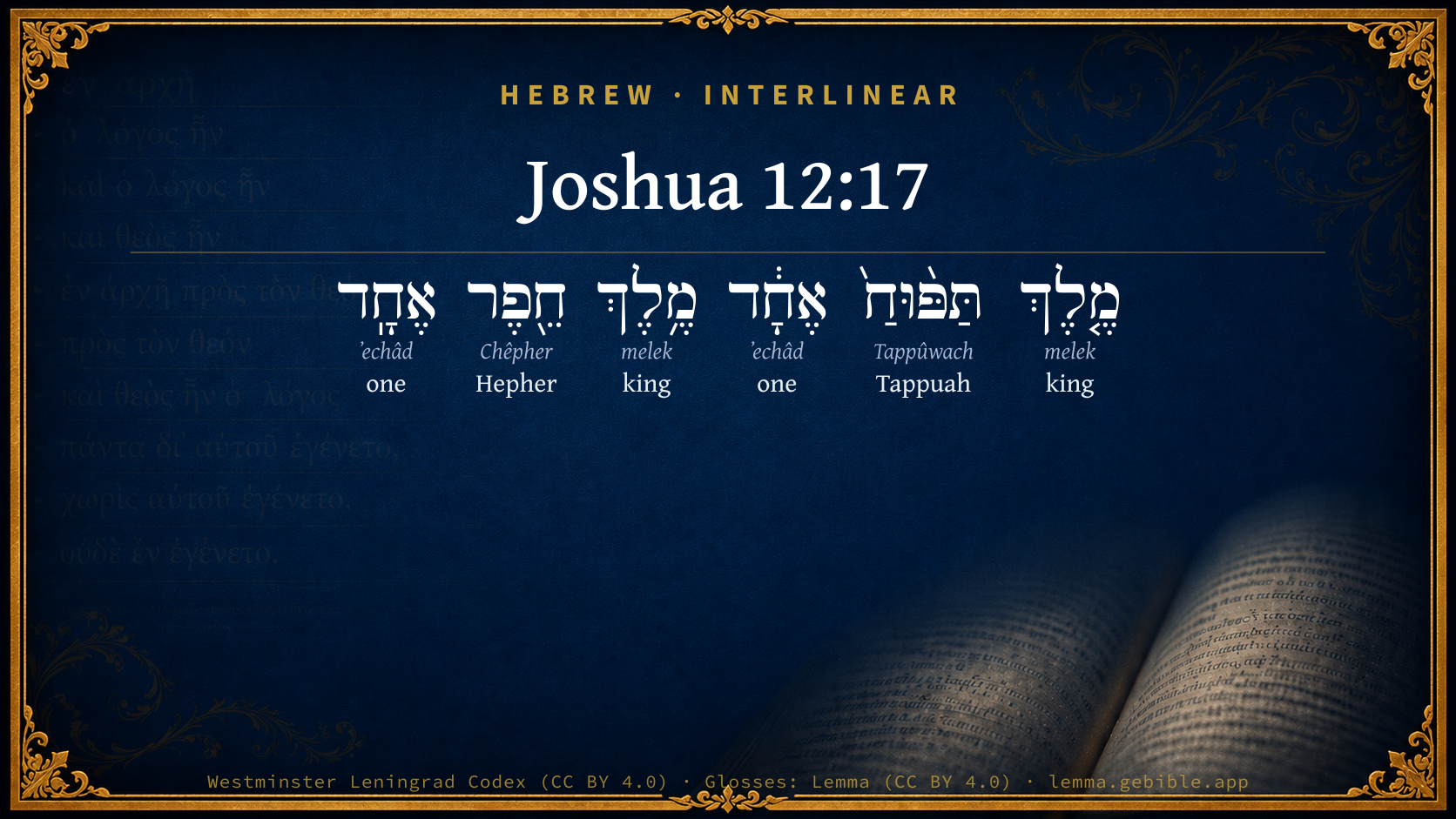
Joshua 12:17

Hebrew (Westminster Leningrad Codex) Joshua 12:17 appears in the Hebrew Old Testament. The text above is from the Westminster Leningrad Codex. Each word links to its Strong’s number, a concise gloss, and parsing drawn from the Open Scriptures Hebrew Bible morphology. Click any word for its full Brown-Driver-Briggs (BDB) entry.
Download image
Cite this verse

Joshua 12:17 (World English Bible). Public Domain. Lemma interlinear Bible study tool, https://lemma.gebible.app/v/joshua/12/17.

Show BibTeX & RIS
BibTeX
RIS
English Translation
the king of Tappuah, one; the king of Hepher, one;
World English Bible · Public Domain
Highlights
  • 1 first appearance in the Hebrew Bible
Full analysis ↓
Download a study sheet

One document with this verse’s original text, its word-by-word gloss line, the meaning frame, cross-references with their text, attributed commentary, and full source and license credits — printable, and it pastes into notes with its structure intact.

This verse Autodidact and up

Study sheet (.html) Plain text (.txt)

A passage Seminary Student

Up to 50 verses in one chapter. A passage sheet keeps up to 6 commentary sources and 12 cross-references per verse, in the order this page ranks them, and says so on the sheet whenever that leaves anything out. Ask for a single verse and you get the Autodidact verse sheet above.

Everything on this page stays free to read, with no account — the sheet is a download of what is already on screen, not access to it.

Want to remove ads? Support Godless Engineer
Compare translations 3

The same verse in 3 English versions, stacked beneath the original-language interlinear above. Click any original word for its lexicon entry.

Each is an independent rendering of the whole verse — the interlinear is not word-aligned to these translations.

Highlighted words mark where these versions differ — a whole-verse word diff, not a word-by-word alignment.

  • World English Bible Public Domain
    the king of Tappuah, one; the king of Hepher, one;
  • King James Version Public Domain
    The king of Tappuah, one; the king of Hepher, one;
  • unfoldingWord Literal Text CC BY-SA 4.0
    the king of Tappuah, one; the king of Hepher, one;

unfoldingWord Literal Text — © unfoldingWord, licensed CC BY-SA 4.0. Word-aligned USFM3 via Door43 (git.door43.org/unfoldingWord/en_ult).

Versions to compare (up to 4)

3 of 4 selected

Show all 18 translations

Every available English version of this verse, each an independent rendering of the whole verse.

  • World English Bible Public Domain
    the king of Tappuah, one; the king of Hepher, one;
  • Berean Standard Bible Public Domain
    the king of Tappuah, one; the king of Hepher, one;
  • Majority Standard Bible Public Domain
    the king of Tappuah, one; the king of Hepher, one;
  • King James Version Public Domain
    The king of Tappuah, one; the king of Hepher, one;
  • American Standard Version (1901) Public Domain
    the king of Tappuah, one; the king of Hepher, one;
  • Revised Version (1885) Public Domain
    the king of Tappuah, one; the king of Hepher, one;
  • Geneva Bible (1599) Public Domain
    The King of Tappuah, one: the King of Hepher, one:
  • Douay-Rheims (1899) Public Domain
    The king of Taphua one, the king of Opher one,
  • Young's Literal Translation Public Domain
    The king of Tappuah, one; The king of Hepher, one;
  • Literal Standard Version CC BY-SA 4.0
    the king of Tappuah, one; the king of Hepher, one;
  • Unlocked Literal Bible CC BY-SA 4.0
    the king of Tappuah, the king of Hepher,
  • unfoldingWord Literal Text CC BY-SA 4.0
    the king of Tappuah, one; the king of Hepher, one;
  • Darby Bible Public Domain
    the king of Tappuah, one; the king of Hepher, one;
  • World Messianic Bible Public Domain
    the king of Tappuah, one; the king of Hepher, one;
  • Webster's Bible Public Domain
    The king of Tappuah, one; the king of Hepher, one;
  • Free Bible Version CC BY-SA 4.0
    The king of Tappuah. The king of Hepher.
  • Bible in Basic English Public Domain
    The king of Tappuah, one; the king of Hepher, one;
  • JPS Tanakh (1917) Public Domain
    the king of Tappuah, one; the king of Hepher, one;

Literal Standard Version (2020), Covenant Press — licensed CC BY-SA 4.0. Text via the HelloAO Bible API (eBible.org). Unlocked Literal Bible (unfoldingWord) — licensed CC BY-SA 4.0. Text via the HelloAO Bible API (eBible.org). unfoldingWord Literal Text — © unfoldingWord, licensed CC BY-SA 4.0. Word-aligned USFM3 via Door43 (git.door43.org/unfoldingWord/en_ult). Free Bible Version, Dr. Jonathan Gallagher — licensed CC BY-SA 4.0. Text via the HelloAO Bible API (eBible.org).

Word by word

More ways to search: Search by grammar → Find every occurrence → Compare this word →

Practice this passage: Drill this verse → Learn its vocabulary →

About this verse

These counts appear in no published source. They are computed here, from the morphology-tagged text and Lemma’s own curated glosses. What Lemma adds →

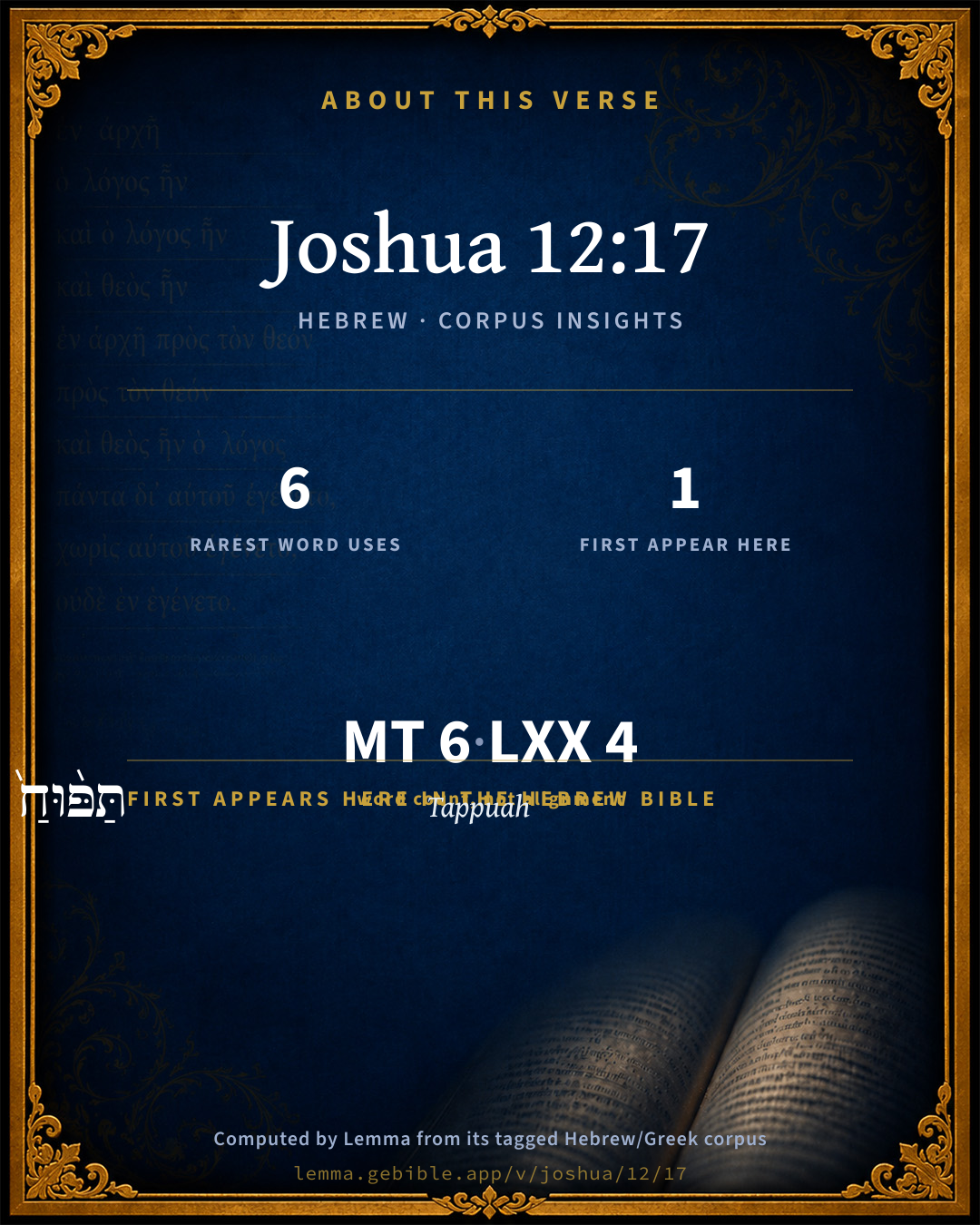
6
words
4
distinct lemmas
Historical
section

Notable vocabulary

The rarest word here is תַּפּ֨וּחַ֙ Tappuah H8599 — appearing just 6 times in the whole Hebrew Bible.

First appearance in Scripture

This word makes its first canonical appearance in the Hebrew Bible here:

  • תַּפּ֨וּחַ֙ Tappuah H8599

Shared distinctive vocabulary

תַּפּ֨וּחַ֙ Tappuah H8599 occurs in 5 verses of the Hebrew Bible. Also found in:

Grammatical profile

  • 4 nouns
  • 2 adjectives

Repetition

Words recur within this verse — often emphatic in Hebrew:

  • מֶ֤לֶךְ king H4428 ×2
  • אֶחָ֔ד one H259 ×2

Hebrew & Septuagint length

In English translation the verse runs 10 words from the Hebrew and 8 from the Septuagint (LXX English) — closely comparable.

A rough comparison of the two English renderings, which tokenize alike — not a word-level alignment.

Word counts can differ between the Hebrew and the Greek without any difference in meaning — e.g. the Hebrew direct-object marker אֵת has no separate Greek word, and Greek often adds the article ὁ.

In the original languages it is 6 Hebrew tokens and 4 Greek tokens — but the two are counted differently (Hebrew bundles its prefixes and suffixes into one token; the Greek is in lemma form), so that isn’t a like-for-like length.

Cross-references

3

Topical passages linked to Joshua 12:17 in the Treasury of Scripture Knowledge — connected by theme and wording, ordered by reader-vote popularity; previews shown in the World English Bible.

  • 1 Kings 4:10 Ben Hesed, in Arubboth (to him [pertained] Socoh, and all the land of Hepher);
  • Joshua 15:34 and Zanoah, and En Gannim, Tappuah, and Enam,
  • Joshua 19:13 and from there it passed along eastward to Gath Hepher, to Eth-kazin; and it went out at Rimmon which stretches to Neah;

Cross-references courtesy of OpenBible.info (CC BY 4.0).

Hebrew and Greek witnesses Masoretic Hebrew ↔ Greek Septuagint

The same verse in the two great witnesses to the Old Testament, shown verse-for-verse.

These are two independent witnesses, not word-aligned to each other, and the Septuagint is shown in lemma (dictionary) form.

Hebrew Joshua 12:17 Masoretic · Westminster Leningrad Codex

מֶ֤לֶךְ תַּפּ֨וּחַ֙ אֶחָ֔ד מֶ֥לֶךְ חֵ֖פֶר אֶחָֽד

the king of Tappuah, one; the king of Hepher, one;

World English Bible · Public Domain

Greek LXX Joshua 12:17 Septuagint · lemma form

βασιλεύς ταφουγ βασιλεύς οφερ

the king of Taphut, the king of Opher,

LXX2012 (modern English Septuagint) · Public Domain

Hebrew: Westminster Leningrad Codex (CC BY 4.0). Greek: Septuagint (public domain); English from LXX2012 (modern English Septuagint) (Public Domain). How the Septuagint differs from the Hebrew →

Targum (Aramaic paraphrase)

1

The Targum is the ancient Jewish Aramaic paraphrase of the Hebrew Scriptures — an interpretive translation, not the Hebrew text itself. Onkelos (literal) and Pseudo-Jonathan (expansive) render the Torah, and Jonathan the Prophets. Coverage is partial: where no permissively-licensed English translation exists for a verse, only the Aramaic is shown. This is verse-level text, not a word-by-word alignment to the Hebrew.

  1. Targum Jonathan Prophets (Joshua–Malachi)
    מַלְכָּא דְתַּפּוּחַ חָד מַלְכָּא דְחֵפֶר חָד:

    (no public-domain English translation for this verse)

    Targum Jonathan — Aramaic: “Mikraot Gedolot” (public domain). English: “Sefaria Community Translation” (CC0 1.0 (public-domain dedication)); “London "Chaldee Paraphrase," 1871” (public domain). Text via Sefaria.

Commentary

Notes on Joshua 12:17 from classic Christian and Jewish commentators (each source and its license shown beneath its notes). The classic Christian expositions comment on the surrounding passage and are grouped to its opening verse, so a note may address several verses; the Jewish commentaries on the Tanakh (Rashi and others) are per-verse, so they appear only where the commentator wrote on this verse.

Lemma curates 59 commentaries, every one of them public domain or Creative Commons licensed, each selected and text-cleaned for this edition rather than reprinted as found. About our sources →

Adam Clarke's Commentary

Verse 17. Tappuah] There were two places of this name: one in the tribe of Judah, Jos 15:34, and another in the tribe of Ephraim on the borders of Manasseh; but which of the two is meant here cannot be ascertained. See Clarke on Jos 15:53.

Hepher] The same, according to Calmet, as Ophrah in the tribe of Benjamin, Jos 18:23.

Adam Clarke's Commentary on the Bible (1810–1826) — public domain. Text from a community e-Sword/MySword module.

The Cambridge Bible for Schools and Colleges

gen. ed. J. J. S. Perowne

17. Tappuah] In the Shephelah, or lowland of Judah, on the lower slopes of the mountains of the N. W. portion of Judah, about 12 miles W. of Jerusalem. Now called Teffûh.

Hepher] Mentioned in 1Ki_4:10. Situation not known.

The Cambridge Bible for Schools and Colleges (gen. ed. J. J. S. Perowne; Cambridge University Press, 1878–1918) — public domain. Text from a community e-Sword module.

John Gill's Exposition

The king of Tappuah, one,.... Which Jerom calls (l) Thaffu; it signifies an apple, and perhaps had its name from plenty of that fruit that grew there: a city of this name fell to the tribe of Judah, Jos 15:34; where also was another place called Bethtappuah, Jos 15:53; and both different from another Tappuah on the border of Manasseh, which belonged to the tribe of Ephraim, Jos 17:8; by some thought to be meant here:

the king of Hepher, one; mention is made of Gittahhepher as on the border of Zebulun, Jos 19:13; the same with Gathhepher, of which place was the Prophet Jonah, Kg2 14:25; and of the land of Hepher in Kg1 4:10; which is said by Jerom to be in the same tribe, and not far from Diocaesarea or Zippore; and we read of a Chepher or Hepher in the Jewish writings (m), which, according to the account of it there given, could not be far from the same place, at least it must be less than twelve miles from it.

(l) De loc. Heb. fol. 95. C. (m) T. Hieros. Sheviith, fol. 37. 3. Vajikra Rabba, sect. 20. fol. 161. 4.

John Gill's Exposition of the Whole Bible (1746–1763) — public domain (CC PDM 1.0). Text via the HelloAO Bible API.

Whedon's Commentary on the Bible

Daniel D. Whedon

17. Tappuah and Hepher are unknown. The former is enumerated, in Jos_15:34, among the cities of the valley of Judah, and is distinguished from Beth-Tappuah (Jos_15:53) in the mountains.

Daniel D. Whedon (gen. ed.), Commentary on the Old and New Testaments (1874–1909) — public domain. Text from a community e-Sword module.

The Pulpit Commentary

Tappuah. Literally "apple city." It is difficult say whether this was Tappuah in Judah, (Jos_15:34; cf. ver. 53) or in Manasseh. (Jos_16:8 Jos_17:7, Jos_17:8) The mention of Aphekah in Jos_15:53, and of Aphek here, would suggest the former, or the mention of Socoh in Jos_15:34 (see below on Hepher). But the mention of Lasharon, the fact that there is more than one other Aphek, that Tappuah on the borders of Ephraim and Manasseh seems to have been an important city, and that the cities of the south are mentioned first, those of the north afterwards, and that Tappuah seems to lie about midway, suggest the more northern city. This is Knobel"s opinion. Gesenius inclines to the southern Tappuah. Conder identifies it with Yassfif, at the head of the Wady Kanah, southeast of Shechem. Vandevelde with Atuf, four hours northeast by east from Shechem. Keil prefers the former site. Hepher. This appears, from 1Ki_4:10, to have been near to Socoh, but nothing more is known of it. Aphek. Literally, fortress, though some think it comes from a Syriac root kindred to the Hebrew, signifying to hold fast, to embrace, and that it has reference to the sensual worship of Ashtaroth and Thammuz. There were several towns of this name. (see notes on Jos_13:4 Jos_15:53 Jos_19:30) Lasharon is probably the same as Sharon, or Hasharon. (Isa_33:9) This is the plain between Joppa and Carmel (Vandevelde). Conder and Kuobel identify with Sarona, or Saroneh, a place near the sea of Tiberias. See, however, Act_8:32-38. Madon is mentioned in Jos_11:1, and has been conjecturally identified with Madin, near the sea of Galilee. Shimron-meron is also mentioned in Jos_11:1. It appears amongthe cities assigned to Zebulun in Jos_19:15. Ewald ("Hist. Israel," 2:2 c.) remarks on "the antiquity of this list, referring as it does to citieswhich are never heard of again. Achshaph lay within the borders of Asher. (Jos_19:25) It has been supposed to be the modern Yasif, near the shores of the Mediterranean. (see note on Jos_11:1) Taanach and Megiddo are frequently mentioned together. (see Jos_17:11 Jud 1:27 5:19) The former became a Levitical city. The latter, being in the great plain of Jezreel, or Esdraelon, lay in the way of most Eastern conquerors. Hence we find it mentioned in the Karnak inscription by the name of Magedi in the victorious expedition of Thothmes III, in which "the whole of the Syrian, Palestinian, and Arabian nations were overcome and forced to pay tribute." (Cooper, "Egyptian Obelisks," p. 33; see also "Records of the Past," 1:30). The great battle on the slopes of Mount Tabor was carried on as far as Megiddo. (Jud_1:5:19) Not far from this were the Midianites pitched, who fell victims to the valour of Gideon. (Jud_1:7) Another and a disastrous battle of Megiddo, against the king of Egypt, weakened Judaea, and caused it to fall an easy victory to the power of Nebuchadnezzar. (2Ki_23:29, 30 2Ch_35:20-24) The valley of Megiddo, or Megiddon, is mentioned in Zec_12:11. Solomon fortified Megiddo, (1Ki_9:15) assigned it to Baana, the son of Ahilud, with Taanach, as one of the cities required to provide food for the royal household. (1Ki_4:12) And the Jewish writer of the Apocalypse makes this great battlefield of his race the scene of the battle of the great day of the Almighty. (Rev_16:14, Rev_16:16) For Armageddon is Har Mageddon, the mountain of Mageddon, or Megiddo. Megiddo and Taanach are also found in later periods of Egyptian history. The Mohar mentioned above (Jos_1:4) notices the former among the places he visited ("Records of the Past," vol. 2), while the latter is among the places captured by Shishak, as an inscription testifies. The latest explorers reject the identification with Lcgio, or Lejjun, and suggest Mejedda, at the foot of Gilboa, near Beth-shean. See Palestine Exploration Fund, Quarterly Paper, January, 1877.

The Pulpit Commentary (1880–1919), ed. H.D.M. Spence-Jones & Joseph S. Exell — public domain. Text from a community e-Sword module.

unfoldingWord translationNotes

Door43 World Missions Community

Tappuah ... Hepher ... Aphek ... Lasharon ... Madon ... Hazor ... Shimron Meron ... Akshaph

These are the names of cities. (See: How to Translate Names)

translationWords

king

unfoldingWord translationNotes — © Distant Shores Media and the Door43 World Missions Community, licensed CC BY-SA 4.0. Source: git.door43.org/Door43/en_tn.

Lesson kit

Teaching starters — assembled from the data on this page, not authored interpretation. Every prompt links to the verse data it draws on. Edit before teaching.

Joshua, in the Historical, opens this verse with 6 words (4 distinct Hebrew lemmas). Its most distinctive word is Tappûwach (“Tappuah”). A historical commentator’s framing appears above. Read the whole chapter for the surrounding context.

Discussion questions

  1. What does “Tappuah” (Tappûwach) contribute to the verse as a whole?
  2. This is the first place “Tappuah” appears in Scripture (first appears here). What does its debut here establish?
  3. How does Joshua 15:34, which shares the word «Tappuah», read alongside this verse?
  4. What does the repetition of “king” (2× in this one verse) do in this verse?
  5. Compare how Adam Clarke's Commentary and The Cambridge Bible for Schools and Colleges read this verse. Where do they agree or differ?

Things to notice

Reading settings

Reading text

Shown beneath each verse's original-language words.

Old Testament
Old Testament edition

Read the OT as the Masoretic Hebrew (MT) or the Greek Septuagint (LXX).

English shown for the Greek Septuagint (in the Hebrew ↔ Greek comparison).

Comparing translations? Open the Compare panel on any verse page to stack up to four side by side.