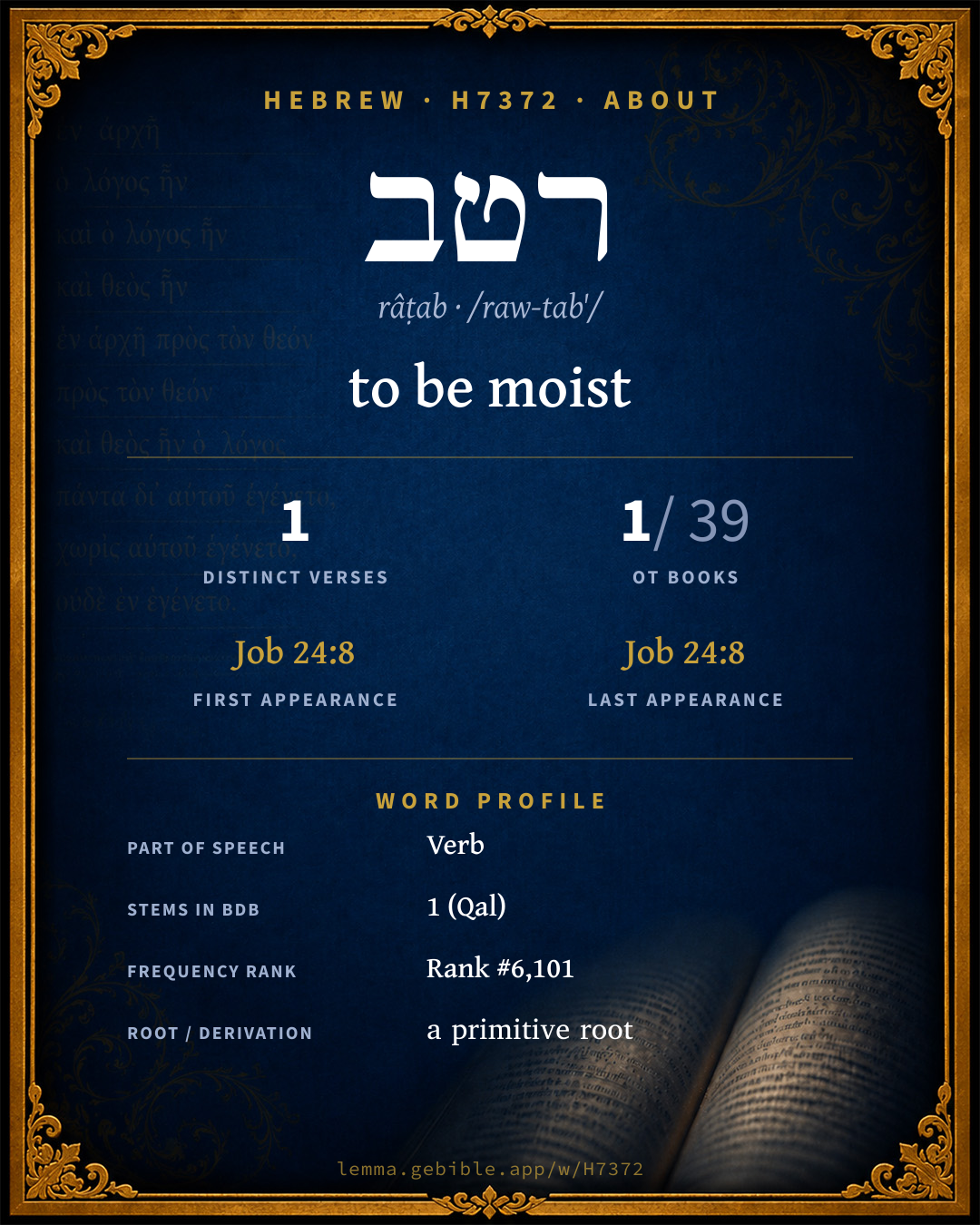
רָטֵב
to be moist
Full lexicon entry — Brown-Driver-Briggs (BDB)
From Brown-Driver-Briggs (BDB)
Where this word appears
Grammar key — what these labels mean
Part of speech
- Verb
- An action or state-of-being word.
Stem
- Qal
- The basic, simple active stem — the plain form of the verb (“he wrote”).
Form
- Imperfect
- An incomplete, ongoing, or future action (“he will / would write”).
Person
- 3rd Person
- The one spoken about (“he / she / it / they”).
Gender
- Masculine
- Grammatically masculine.
Number
- Plural
- More than one (in Hebrew, generally three or more).
Every verse where H7372 appears — 1 distinct verse across 1 book. Click any verse to open its interlinear word-by-word view. Verse text shown in the World English Bible for context — . Each verse’s Hebrew form is shown with its reference; the English is not keyword-highlighted, since the data carries no word-level English alignment. Use “Compare translations” on any verse to read it across multiple English versions. This concordance covers the Hebrew Bible; Septuagint (Greek Old Testament) occurrences are not indexed here.
Job 1 verse
About this entry
At a glance — auto-summarized from this page’s data, not written by a person. Every figure links to its source below. This summary describes the numbers; it doesn’t interpret them.
“to be moist” is the headline sense of the Hebrew verb רטב (râṭab). It is rare — just 1 verse in the entire Hebrew Bible. More than three-quarters of its appearances fall in Job. Scripture uses it exactly once, at Job 24:8. It shares a root with רטב. See the sense tree, 1-verse concordance, and the renderings breakdown below.
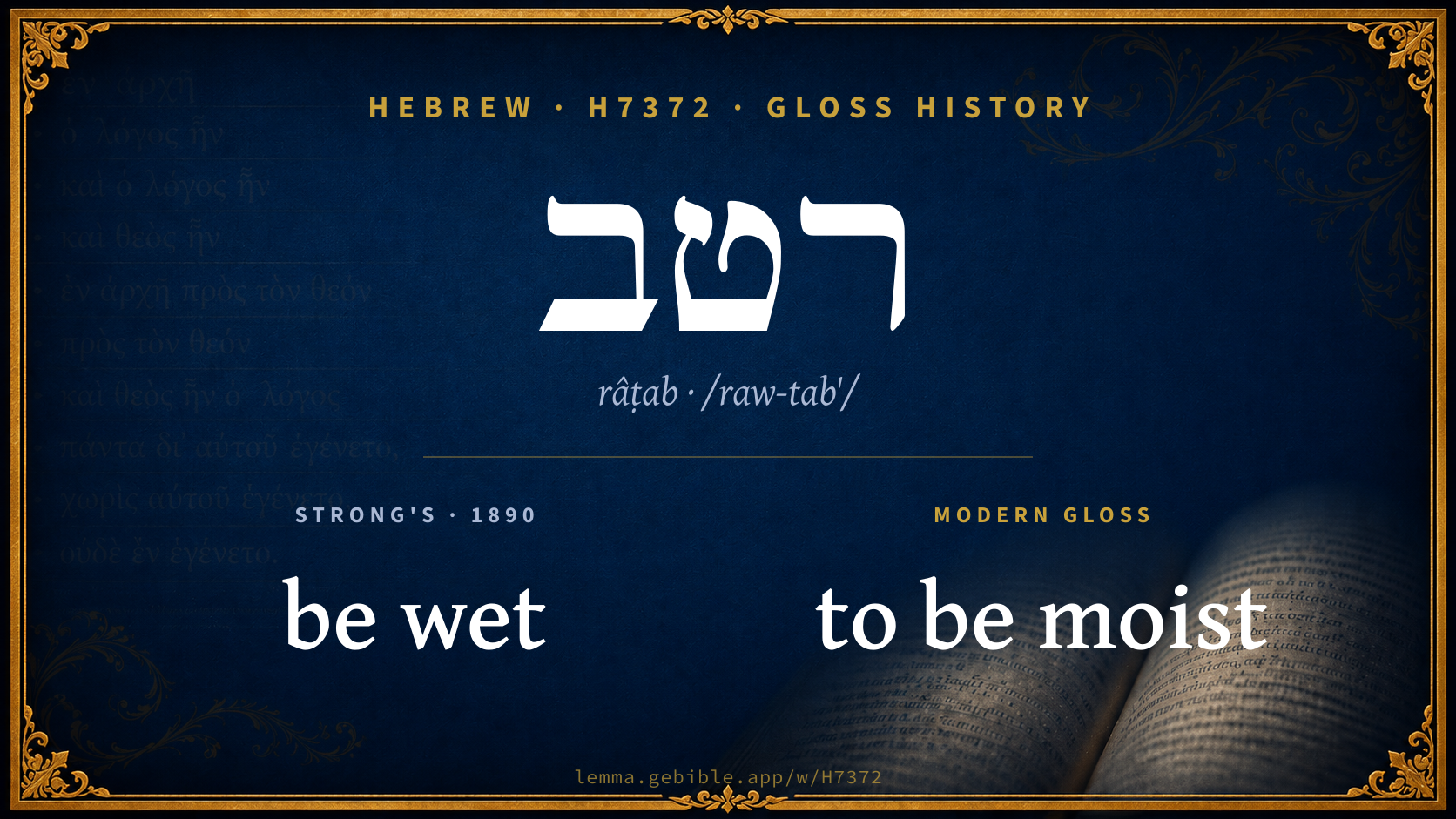
Gloss history
Strong's 1890 vs modern scholarship
About this word
Strong's H7372 catalogs a Hebrew word from the Hebrew Old Testament.
These counts are not copied from any lexicon or concordance. They are computed here, from the morphology-tagged Hebrew Old Testament. What Lemma adds →
- 1
- distinct verses
- The word appears in 1 distinct verse.
- 1 / 39
- OT books
- The word appears in 1 of 39 Old Testament books.
- #6,101
- by frequency
- Rank #6,101 (rank 6,101 of 8,640 Hebrew words by occurrence).
View all 1 occurrence in the concordance →
Most concentrated in
- Job 1 verse 100%
By section of the Old Testament
By traditional corpus
Conventional, traditional groupings — biblical authorship is debated, so this is a traditional corpus grouping, not an authorship claim. Each share is this word’s portion of its verses in that division of the Hebrew canon. Each figure is a share of the word’s 1 distinct verse.
- Writings (Ketuvim) 1 verse · 100%
How translations render this word
Counts come from each version’s own published word-to-Strong’s tagging or interlinear alignment — an approximate guide to how each version renders this word, not a word-level alignment the data otherwise carries. Because each total is that version’s own tagged count, the per-version totals vary from one another and need not match the appearance or distinct-verse counts above. These counts may also differ from a printed concordance because Lemma counts each distinctly tagged rendering and does not collapse phrase taggings into a single head-word total. This is a fixed set of word-tagged versions (KJV, ASV, BSB, ULT) and does not change with the reading translation you choose elsewhere. Each version’s license is shown beside its name below (and on Sources).
- King James Version: They are wet 1×
- American Standard Version: They are wet 1×
- Berean Standard Bible: Drenched 1×
- unfoldingWord Literal Text: They are wet 1×
King James Version Public Domain
Renders H7372 across 1 tagged occurrence — most commonly:
American Standard Version Public Domain
Renders H7372 across 1 tagged occurrence — most commonly:
Berean Standard Bible Public Domain
Renders H7372 across 1 tagged occurrence — most commonly:
unfoldingWord Literal Text CC BY-SA 4.0
Renders H7372 across 1 tagged occurrence — most commonly:
Senses in the full BDB
What do BDB’s symbols mean?
BDB uses these scholarly abbreviations:
| Symbol | Meaning |
|---|---|
| 𝔊 | the Septuagint (the ancient Greek translation, LXX) |
| 𝔙 | the Vulgate (the Latin translation) |
| 𝔖 | the Syriac version (the Peshitta) |
| 𝔗 | the Targum (the Aramaic translation) |
| ψ | the Psalms |
| √ | root (the underlying root or stem) |
| ‖ | parallel passage (a synonymous or contrasted parallel) |
| † | the dagger: every passage where the word occurs is cited |
The 1 sense the full Brown-Driver-Briggs lexicon distinguishes for this word, in lexicon order (not ranked by frequency), with BDB’s own verbatim wording and sub-sense lettering. Shown in Hebrew script with BDB’s own scholarly abbreviations. The condensed entry is in the Lexicon Entry tab.
Qal
- Impf. 3 ms. מִזֶּרֶם הָרִים יִרְטָ֑בוּ Jb 24:8. e.g. Job 24:8
Senses from the full Brown-Driver-Briggs lexicon (Brown, Driver, Briggs; Oxford 1906 — public domain), digitized via Sefaria, supplemented by the OpenScriptures HebrewLexicon (CC BY 4.0). Full attribution on Sources.
Word origin
vb. be moist (NH id.; Assyrian raṭâbu, ii. moisten; Arabic رَطُبَ / رَطِبَ, Ethiopic ረጥበ Aramaic רְטַב, ܪܛܶܒ, all be moist);—
— Brown-Driver-Briggs (Oxford 1906, public domain), digitized via Sefaria, supplemented by the OpenScriptures HebrewLexicon (CC BY 4.0). See Sources.
Origin: a primitive root
Jastrow Dictionary
A second Hebrew/Aramaic lexicon for comparison, covering Aramaic and post-biblical (Talmudic, Targumic, Midrashic) usage that the biblical-Hebrew BDB does not. Matched by lemma rather than by Strong’s number, so a lemma may carry more than one Jastrow headword (shown separately below), and the entries cover usage well beyond the Bible.
רָטַב
- (b. h.)
- 1. to drip, be moist, juicy, green.
- 2. to moisten, v. רָטָה.—Part. pass. רָטוּב (b. h. רָטֹב); f. רְטוּבָה; pl. רְטוּבִים, רְטוּבִין; רְטוּבוֹת (interch. with רוֹטֵב &c.). Koh. R. to VI, 6; Lev. R. s. 4, v. סִילּוֹן I. Num. R. s. 3, beg. תמרים רטובים (some ed. רוֹטְבִין) juicy (good) dates, opp. נובלות; Midr. Till. to Ps. XCII, 13. T’bul Yom III, 6 תמרים רטובות (Ar. ed. pr. רוֹטְבוֹת); a. fr.—[Num. R. s. 1021 ונוטל את הרטוב some ed., read: הרוֹטֶב.]
- 1. same, same, to be green, succulent; to thrive. Lev. R. s. 23 וישראל מַרְטִיבִין והולכים and Israel shall thrive more and more; Cant. R. to II, 2. Ib. כשושנת … שמַרְטֶבֶת והולכת like the lily of the valleys, which is continually green; a. e.—ה׳ מעשים טובים to be succulent with good deeds. Ib. 1 הִרְטַבְתִּי מ׳ ט׳ כשושנה I became filled with the sap of good deeds like the lily; Midr. Till. to Ps. I, 3 ה׳ במעשים וכ׳. Gen. R. s. 81, end (ref. to לוז, Gen. XXXV, 6) כל מי … ה׳ מצות ומ׳ ט׳ כלוז whosoever entered it became filled with pious acts and good deeds like a nut-tree; (ib. s. 69, a. e. הטריף, v. טָרַף); a. fr. e.g. Genesis 35:6
- 2. to cover with green foliage, to improvise a cover with foliage. Ib. s. 68 מה רטיבה ה׳ וכ׳ what was the cover which he (Jacob) prepared? ‘The beams of our house are cedars’ (Cant. I, 17); Cant. R. to I, 17 ומה הרטבה ה׳ מהן (strike out מהן); (Yalk. Gen. 119 ומה טריפה הטריף, Var. רטיבה ה׳, v. טָרַף).—[Cant. R. to VI, 10 מרטבת, v. שָׁבַה Hithpa.] e.g. Song of Solomon 1:17
רְטַב I
- ch. same; v. רַטִּיב
- to moisten, give sap to. Targ. Y. Deut. XXVIII, 23.
- to be green, moist. Targ. Y. II, Ex. III, 2 מִרְטִיב (some ed. מֵרְ׳). Ib. 3 (ed. Vien. מַרְטִיב Af.).—Succ. 53ᵇ כמה דמידלי טפי מִירְטַב עלמא (differ. in Ms. M., v. Rabb. D. S. a. l. note) the higher the waters of the deep rise, the more is vegetation moistened.
רְטַב II
- (preced.) juice, broth (v. רוֹטְבָא). Targ. Is. LXV, 4 ed. Wil., a. Ar. Var. (ed. Lag. a. oth. רְטַף; h. text מרק).
רֶטֶב
- (preced. wds.; v. רוֹטָב) green fruit, esp. dates. Y. Maasr. I, 48ᵈ bot. ניקורי ר׳ באביהן fruit during development showing bites of serpents; Tosef. Kel. B. Bath. V, 6 רוטב.
A Dictionary of the Targumim, the Talmud Babli and Yerushalmi, and the Midrashic Literature (Marcus Jastrow; London, Luzac, 1903) — Public Domain. Digitized via Sefaria. Digitized via Sefaria. Full attribution on Sources.
Same root — word family
Other BDB entries built from the same root as H7372, grouped by Strong’s listed origin. These share a root / origin per the lexicon — not necessarily a shared meaning. Each links to that word’s own entry.
Derived from this word
Compare all same-root words → They share a root, not necessarily a meaning.
Septuagint verse parallels
This word appears in 1 verse that also exists in the Greek Old Testament (Septuagint), out of the 1 Hebrew verse it occurs in. You can read those verses in Greek by switching the Old Testament edition to the Septuagint.
Read these verses in the Septuagint
This is a verse-level parallel only — the same verses exist in both the Hebrew and Greek Old Testaments. No word-level Hebrew↔Greek correspondence is claimed: the data carries no such alignment, so no Greek word is shown as this Hebrew word’s translation. Coverage is not total — the Septuagint omits the deuterocanon and renumbers the Psalms, so some Hebrew verses have no direct Greek parallel.