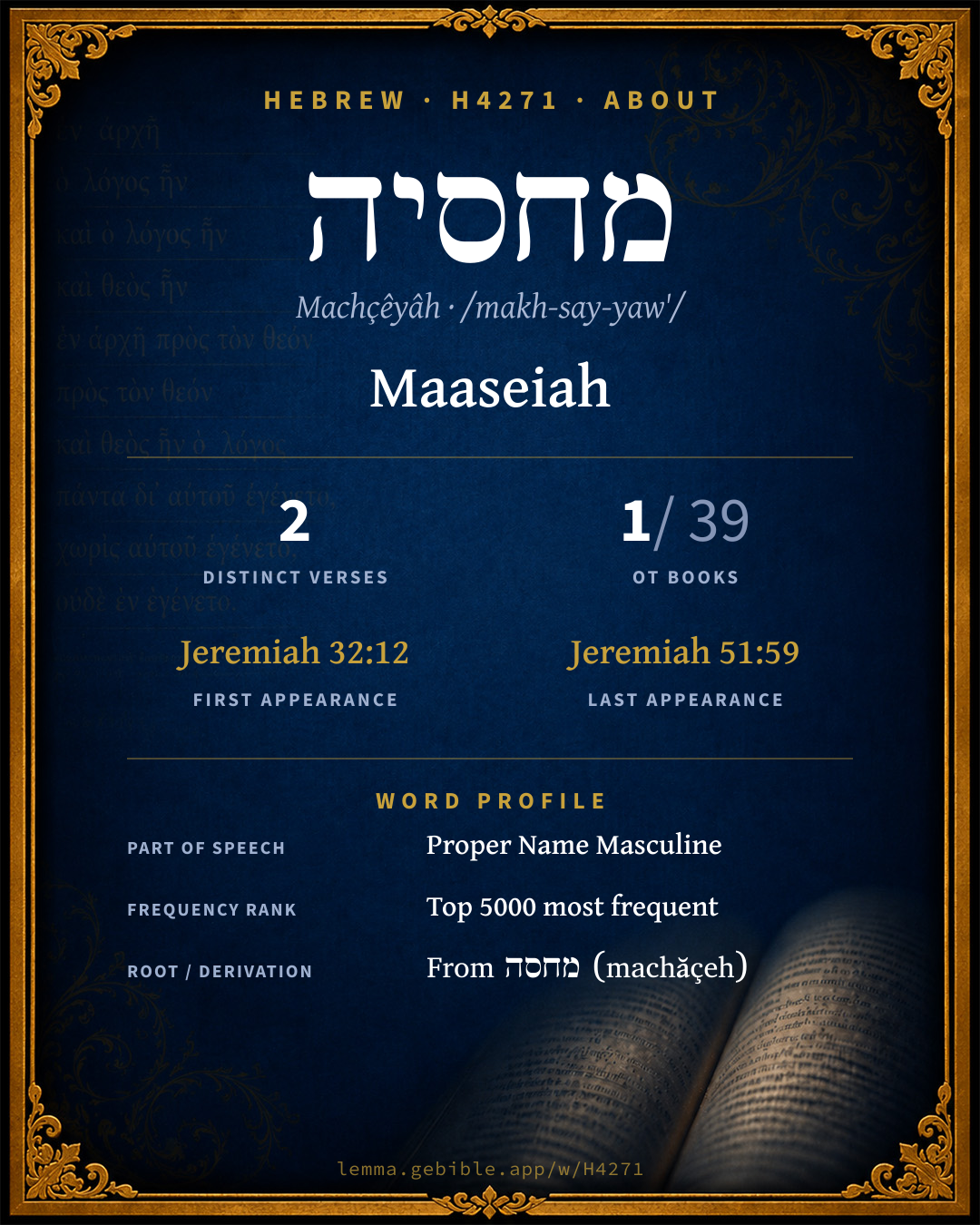
מַחְסֵיָה
Maaseiah
BDB lists 3 entries for ‘Maaseiah’ fuller range ↓
Full lexicon entry — Brown-Driver-Briggs (BDB)
From Brown-Driver-Briggs (BDB)
Where this word appears
Grammar key — what these labels mean
Part of speech
- Noun
- A naming word — a person, place, thing, or idea.
Noun type
- Proper
- A name of a specific person, place, or people (e.g. Abraham, Zion, Israel).
Every verse where H4271 appears — 2 distinct verses across 1 book. Click any verse to open its interlinear word-by-word view. Verse text shown in the World English Bible for context — . Each verse’s Hebrew form is shown with its reference; the English is not keyword-highlighted, since the data carries no word-level English alignment. Use “Compare translations” on any verse to read it across multiple English versions. This concordance covers the Hebrew Bible; Septuagint (Greek Old Testament) occurrences are not indexed here.
Jeremiah 2 verses
- Jeremiah 32:12 מַחְסֵיָה֒ n Proper and I delivered the deed of the purchase to Baruch the son of Neriah, the son of Mahseiah, in the presence of Hanamel my uncle's son, and in the presence of the witnesses who subscribed the deed of the purchase, before all the Jews who sat in the court of the guard.
- Jeremiah 51:59 מַחְסֵיָה֒ n Proper The word which Jeremiah the prophet commanded Seraiah the son of Neriah, the son of Mahseiah, when he went with Zedekiah the king of Judah to Babylon in the fourth year of his reign. Now Seraiah was chief chamberlain.
About this entry
At a glance — auto-summarized from this page’s data, not written by a person. Every figure links to its source below. This summary describes the numbers; it doesn’t interpret them.
The Hebrew name מחסיה centers on the idea of “Maaseiah.” The Hebrew Bible uses it only 2 verses. The word gravitates to Jeremiah (100%). Its earliest occurrence is Jeremiah 32:12. Dig into 2-verse concordance and the renderings breakdown below.
Gloss history
Strong's 1890 vs modern scholarship
About this word
Strong's H4271 catalogs a Hebrew word from the Hebrew Old Testament.
These counts are not copied from any lexicon or concordance. They are computed here, from the morphology-tagged Hebrew Old Testament. What Lemma adds →
- 2
- distinct verses
- The word appears in 2 distinct verses.
- 1 / 39
- OT books
- The word appears in 1 of 39 Old Testament books.
- #4,807
- by frequency
- Top 5000 most frequent Hebrew words (rank 4,807 of 8,640 Hebrew words by occurrence).
View all 2 occurrences in the concordance →
Most concentrated in
- Jeremiah 2 verses 100%
By section of the Old Testament
By traditional corpus
Conventional, traditional groupings — biblical authorship is debated, so this is a traditional corpus grouping, not an authorship claim. Each share is this word’s portion of its verses in that division of the Hebrew canon. Each figure is a share of the word’s 2 distinct verses.
- Prophets (Nevi'im) 2 verses · 100%
How translations render this word
Counts come from each version’s own published word-to-Strong’s tagging or interlinear alignment — an approximate guide to how each version renders this word, not a word-level alignment the data otherwise carries. Because each total is that version’s own tagged count, the per-version totals vary from one another and need not match the appearance or distinct-verse counts above. These counts may also differ from a printed concordance because Lemma counts each distinctly tagged rendering and does not collapse phrase taggings into a single head-word total. This is a fixed set of word-tagged versions (KJV, ASV, BSB, ULT) and does not change with the reading translation you choose elsewhere. Each version’s license is shown beside its name below (and on Sources).
- King James Version: Maaseiah 2×
- American Standard Version: Mahseiah 2×
- Berean Standard Bible: Mahseiah 2×
King James Version Public Domain
Renders H4271 across 2 tagged occurrences — most commonly:
American Standard Version Public Domain
Renders H4271 across 2 tagged occurrences — most commonly:
Berean Standard Bible Public Domain
Renders H4271 across 2 tagged occurrences — most commonly:
Senses in BDB
The 3 senses BDB distinguishes for this word, in lexicon order (not ranked by frequency or importance). The full entry — with sub-senses — is in the Lexicon Entry tab.
- Maaseiah = "Jehovah is a shelter"
- a priest and ancestor of Baruch, the friend and scribe of Jeremiah
- ancestor of Seraiah who carried Jeremiah's book to Babylon
Word origin
n.pr.m. (י׳ is a refuge) ancestor of Baruch and Seraiah Je 32:12 (Baer מַחֲס׳) 51:59.
— Brown-Driver-Briggs (Oxford 1906, public domain), digitized via Sefaria, supplemented by the OpenScriptures HebrewLexicon (CC BY 4.0). See Sources.
Derived from מחסה (machăçeh) (H4268) — refuge.
Bible dictionary
Public-domain dictionary articles matched to this entry by name (Maaseiah). A biblical name can be shared by more than one person or place, so an article may treat several.
Easton's Bible Dictionary · M. G. Easton, 1897
The work of Jehovah. (1.) One of the Levites whom David appointed as porter for the ark (1 Chr. 15:18, 20).
(2.) One of the "captains of hundreds" associated with Jehoiada in restoring king Jehoash to the throne (2 Chr. 23:1).
(3.) The "king's son," probably one of the sons of king Ahaz, killed by Zichri in the invasion of Judah by Pekah, king of Israel (2 Chr. 28:7).
(4.) One who was sent by king Josiah to repair the temple (2 Chr. 34:8). He was governor (Heb. sar, rendered elsewhere in the Authorized Version "prince," "chief captain," chief ruler") of Jerusalem.
(5.) The father of the priest Zephaniah (Jer. 21:1; 37:3).
(6.) The father of the false prophet Zedekiah (Jer. 29:21).
Maase'iah, refuge is Jehovah, a priest, the father of Neriah (Jer. 32:12; 51:59).
Smith's Bible Dictionary · William Smith, 1863
(work of the Lord), the name of four persons who had married foreign wives. In the time of Ezra,
+ A descendant of Jeshua the priest. (Ezra 10:18) + A priest, of the sons of Harim. (Ezra 10:21) + A priest, of the sons of Pashur. (Ezra 10:22) + One of the laymen, a descendant of Pahath-moab. (Ezra 10:30) + The father of Azariah. (Nehemiah 3:23) + One of those who stood on the right hand of Ezra when he read the law to the people. (Nehemiah 8:4) + A Levite who assisted on the same occasion. (Nehemiah 8:7) + One of the heads of the people whose descendants signed the covenant with Nehemiah. (Nehemiah 10:25) + Son of Baruch the descendant of Pharez the son of Judah, (Nehemiah 11:5) + A Benjamite, ancestor of Sallu. (Nehemiah 11:7) + Two priests of this name are mentioned, (Nehemiah 12:41,42) as taking part in the musical service which accompanied the dedication of the wall of Jerusalem under Ezra. One of them is probably the same as No. 6. + Father of Zephaniah, who was a priest in the reign of Zedekiah. (Jeremiah 21:1; 29:25; 37:3) + Father of Zedekiah the false prophet. (Jeremiah 29:21) + One of the Levites of the second rank, appointed by David to sound "with psaltries on Alamoth." (1 Chronicles 15:18,20) + The son of Adaiah, and one of the captains of hundreds in the reign of Joash king of Judah. (2 Chronicles 23:1) + An officer of high rank in the reign of Uzziah. (2 Chronicles 26:11) He was probably a Levite, comp: (1 Chronicles 23:4) and engaged in a semi-military capacity. + The "king's son," killed by Zichri the Ephraimitish hero in the invasion of Judah by Pekah king of Israel, during the reign of Ahaz. (2 Chronicles 28:7) + The governor of Jerusalem in the reign of Josiah. (2 Chronicles 34:8) + The son of Shallum, a Levite of high rank in the reign of Jehoiakim. (Jeremiah 35:4) comp, 1Chr 9:19 + A priest; ancestor of Baruch and Seraiah, the sons of Neriah. (Jeremiah 32:12; 51:59)
Hitchcock's Bible Names Dictionary · Roswell D. Hitchcock, 1869
the work of the Lord
Classic public-domain reference works; full attribution on Sources.
Septuagint verse parallels
This word appears in 1 verse that also exists in the Greek Old Testament (Septuagint), out of the 2 Hebrew verses it occurs in. You can read those verses in Greek by switching the Old Testament edition to the Septuagint.
Read these verses in the Septuagint
This is a verse-level parallel only — the same verses exist in both the Hebrew and Greek Old Testaments. No word-level Hebrew↔Greek correspondence is claimed: the data carries no such alignment, so no Greek word is shown as this Hebrew word’s translation. Coverage is not total — the Septuagint omits the deuterocanon and renumbers the Psalms, so some Hebrew verses have no direct Greek parallel.