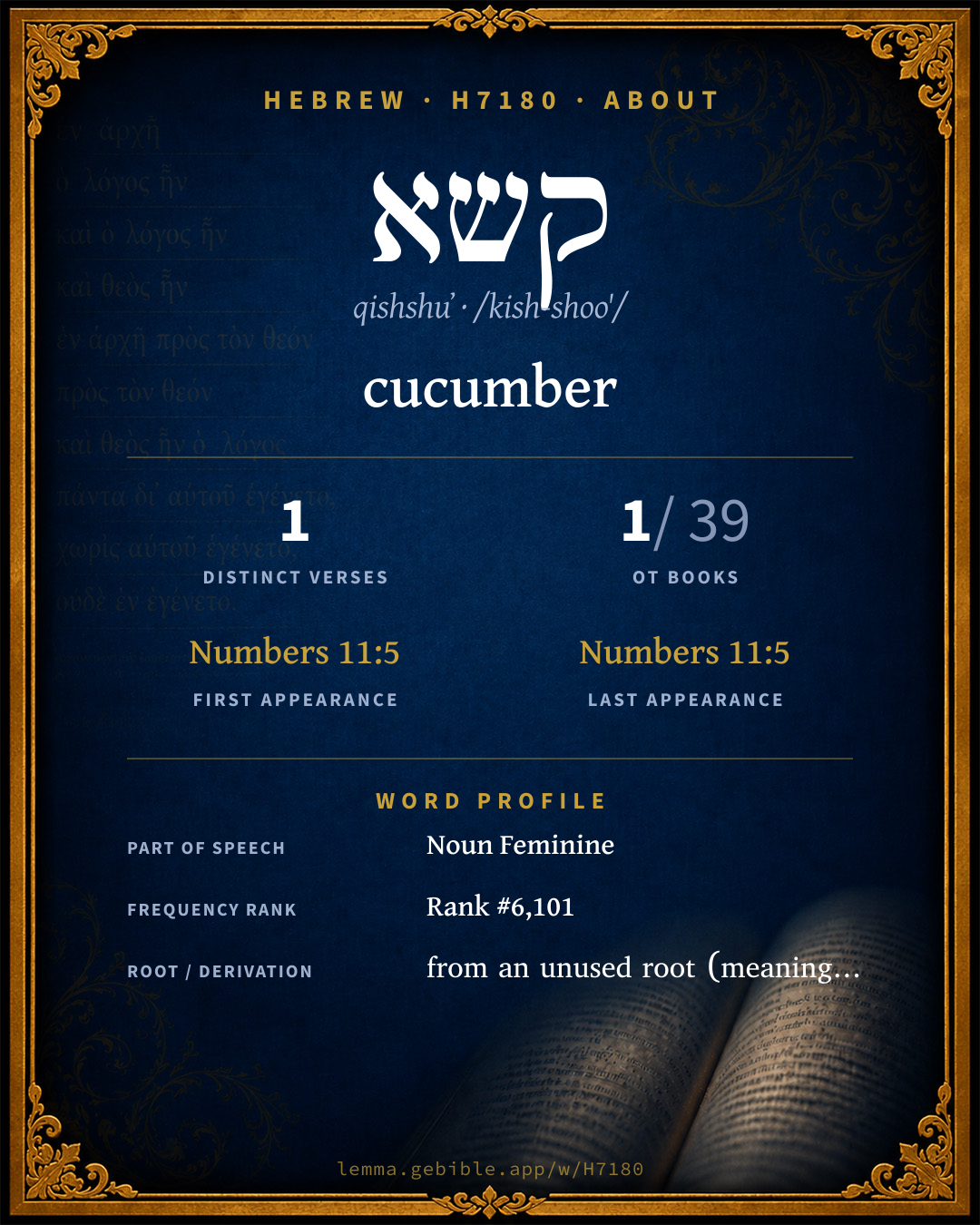
קִשֻּׁאָה
cucumber
Full lexicon entry — Brown-Driver-Briggs (BDB)
From Brown-Driver-Briggs (BDB)
Where this word appears
Grammar key — what these labels mean
Noun type
- Common
- A common noun — a general class of person, place, or thing (“king,” “city,” “water”), not a specific name.
State
- Absolute
- The independent form of a noun, not bound to a following word.
Gender
- Feminine
- Grammatically feminine.
Number
- Plural
- More than one (in Hebrew, generally three or more).
Every verse where H7180 appears — 1 distinct verse across 1 book. Click any verse to open its interlinear word-by-word view. Verse text shown in the World English Bible for context — . Each verse’s Hebrew form is shown with its reference; the English is not keyword-highlighted, since the data carries no word-level English alignment. Use “Compare translations” on any verse to read it across multiple English versions. This concordance covers the Hebrew Bible; Septuagint (Greek Old Testament) occurrences are not indexed here.
Numbers 1 verse
About this entry
At a glance — auto-summarized from this page’s data, not written by a person. Every figure links to its source below. This summary describes the numbers; it doesn’t interpret them.
“cucumber” is the headline sense of the Hebrew noun קשא (qishshuʼ). It occurs a mere 1 verse across Scripture. More than three-quarters of its appearances fall in Numbers. Scripture uses it exactly once, at Numbers 11:5. Related forms include מקשה. The sections below give every sense, occurrence, and version rendering.
Gloss history
Strong's 1890 vs modern scholarship
About this word
Strong's H7180 catalogs a Hebrew word from the Hebrew Old Testament.
These counts are not copied from any lexicon or concordance. They are computed here, from the morphology-tagged Hebrew Old Testament. What Lemma adds →
- 1
- distinct verses
- The word appears in 1 distinct verse.
- 1 / 39
- OT books
- The word appears in 1 of 39 Old Testament books.
- #6,101
- by frequency
- Rank #6,101 (rank 6,101 of 8,640 Hebrew words by occurrence).
View all 1 occurrence in the concordance →
Most concentrated in
- Numbers 1 verse 100%
By section of the Old Testament
By traditional corpus
Conventional, traditional groupings — biblical authorship is debated, so this is a traditional corpus grouping, not an authorship claim. Each share is this word’s portion of its verses in that division of the Hebrew canon. Each figure is a share of the word’s 1 distinct verse.
- Torah (Pentateuch) 1 verse · 100%
How translations render this word
Counts come from each version’s own published word-to-Strong’s tagging or interlinear alignment — an approximate guide to how each version renders this word, not a word-level alignment the data otherwise carries. Because each total is that version’s own tagged count, the per-version totals vary from one another and need not match the appearance or distinct-verse counts above. These counts may also differ from a printed concordance because Lemma counts each distinctly tagged rendering and does not collapse phrase taggings into a single head-word total. This is a fixed set of word-tagged versions (KJV, ASV, BSB, ULT) and does not change with the reading translation you choose elsewhere. Each version’s license is shown beside its name below (and on Sources).
- King James Version: Cucumbers 1×
- American Standard Version: Cucumbers 1×
- Berean Standard Bible: Along with the cucumbers 1×
- unfoldingWord Literal Text: Cucumbers 1×
King James Version Public Domain
Renders H7180 across 1 tagged occurrence — most commonly:
American Standard Version Public Domain
Renders H7180 across 1 tagged occurrence — most commonly:
Berean Standard Bible Public Domain
Renders H7180 across 1 tagged occurrence — most commonly:
unfoldingWord Literal Text CC BY-SA 4.0
Renders H7180 across 1 tagged occurrence — most commonly:
Senses in BDB
The 1 sense BDB distinguishes for this word, in lexicon order (not ranked by frequency or importance). The full entry — with sub-senses — is in the Lexicon Entry tab.
- cucumber
Word origin
[ קִשֻּׁאָה ] n.f. cucumber;—pl. Nu 11:5.
— Brown-Driver-Briggs (Oxford 1906, public domain), digitized via Sefaria, supplemented by the OpenScriptures HebrewLexicon (CC BY 4.0). See Sources.
Origin: from an unused root (meaning to be hard)
Jastrow Dictionary
A second Hebrew/Aramaic lexicon for comparison, covering Aramaic and post-biblical (Talmudic, Targumic, Midrashic) usage that the biblical-Hebrew BDB does not. Matched by lemma rather than by Strong’s number, so a lemma may carry more than one Jastrow headword (shown separately below), and the entries cover usage well beyond the Bible.
קַשָּׁא I
- Targ. Ex. XV, 7. Targ. Is. XL, 24.—Pl. קַשִּׁין. Gen. R. s. 35 (play on קשתי, Gen. IX, 13) ק׳ דפֵירַי the straw of my fruit (the least of my works); Yalk. ib. 61. e.g. Genesis 9:13
קַשָּׁא II
- (קְשַׁשׁ; cmp. קַשִּׁישׁ), בַּר ק׳ elder, officer. Sabb. 110ᵃ top. B. Bath. 110ᵇ top מאן כו לירות אטו בר ק׳ וכ׳ (כּוּ = כְּהוּ, not בו) who else should be the heir? should the officer of the town be the heir? [oth. opin. (v. קָשַׁש I) collector.]
קְשָׁא
- , v. קְשֵׁי
קְשֵׁי
- 1. to be hard, difficult. Targ. Deut. I, 17. Ib. XV, 18; a. e.—Yoma 28ᵇ קָשׁוּ משמשא are harder (on the eye) &c., v. שַׁבְרִירֵי; a. fr.
- 2. to find a thing difficult to understand, to object, argue against, dispute. Y. Ter. V, 43ᶜ bot. ר׳ סימון קַשְׁיְיתָהּ … קיימה R. Simon argued against it (refuted it), but R. Ba. … proved it to be correct. Y. Kidd. III, 64ᶜ top [read:] לא כבר קְשׁוּנְתָּהּ הרי עולם לא כבר קַשְׁיְתָהּ וכ׳ have not mountains of the world (great scholars) disputed it? did not R. El. dispute it in the presence of &c.; Y. Ned. VIII, 40ᵈ sq. (corr. acc.). B. Kam. 66ᵇ האי מילתא ק׳ בה רבה לרב וכ׳ Rabbah argued this difficulty before R. Joseph for twenty-two years, and it was not solved; Keth. 42ᵇ האי … קְשָׁאֵי רבה ורב וכ׳ Rabbah and R. Joseph discussed this difficulty &c.—Part. קָשֵׁי; f. קַשְׁיָא, q. v.
- 3. to get old, v. קְשַׁשׁ II.
- 1. to be in pain of travailing. Targ. Gen. XXXV, 17 בקַשָּׁיוּתָהּ (not בקַשְׁיוּ׳). Targ. O. ib. 16 (Y. II Ithpa.).
- 2. to perplex. Pes. 78ᵇ מתניתן קַשִּׁיתֵיה וכ׳ the Mishnah perplexed him; why does it read &c.
- 1. to harden, make difficult. Targ. Ex. VII, 3. Targ. II Kings II, 10. Targ. I Kings XII, 4. Targ. Ps. XCV, 8; a. fr.
- 2. to be hard on, press heavily. Cant. R. to II, 16 כד הוה צערא קשי עלוי … וכד הוה מַקְשֵׁי וכ׳ when his suffering was severe, he said, God the faithful, but when it was severer on him than necessary &c.
- 3. to argue against, object, dispute. Targ. Job VI, 6 Ms. Var. מדלית מַקְשׁה עליה when there is none to dispute it.—Yeb. 77ᵃ top א׳ להו דואג כל הני קושייתא Doeg brought up before them all those arguments. Y. Yoma I, 38ᵈ bot. עד דאת מַקְשֵׁי … קְשַׁיְיתָהּ על וכ׳ (not קשייתא) instead of offering objection against R. J., rather offer it against &c.; a. v. fr.
- 1. to be in pain of travailing. Targ. Y. II, Gen. XXXV, 16, v. supra.
- 2. to be difficult, perplexing. Yeb. 40ᵃ ומִיקְּשֵׁה היא דאיקשי לך וכ׳ (Rashi דקשיא) it was perplexing to thee, and thou didst reverse it.
A Dictionary of the Targumim, the Talmud Babli and Yerushalmi, and the Midrashic Literature (Marcus Jastrow; London, Luzac, 1903) — Public Domain. Digitized via Sefaria. Digitized via Sefaria. Full attribution on Sources.
Same root — word family
Other BDB entries built from the same root as H7180, grouped by Strong’s listed origin. These share a root / origin per the lexicon — not necessarily a shared meaning. Each links to that word’s own entry.
Derived from this word
Compare all same-root words → They share a root, not necessarily a meaning.
Septuagint verse parallels
This word appears in 1 verse that also exists in the Greek Old Testament (Septuagint), out of the 1 Hebrew verse it occurs in. You can read those verses in Greek by switching the Old Testament edition to the Septuagint.
Read these verses in the Septuagint
This is a verse-level parallel only — the same verses exist in both the Hebrew and Greek Old Testaments. No word-level Hebrew↔Greek correspondence is claimed: the data carries no such alignment, so no Greek word is shown as this Hebrew word’s translation. Coverage is not total — the Septuagint omits the deuterocanon and renumbers the Psalms, so some Hebrew verses have no direct Greek parallel.