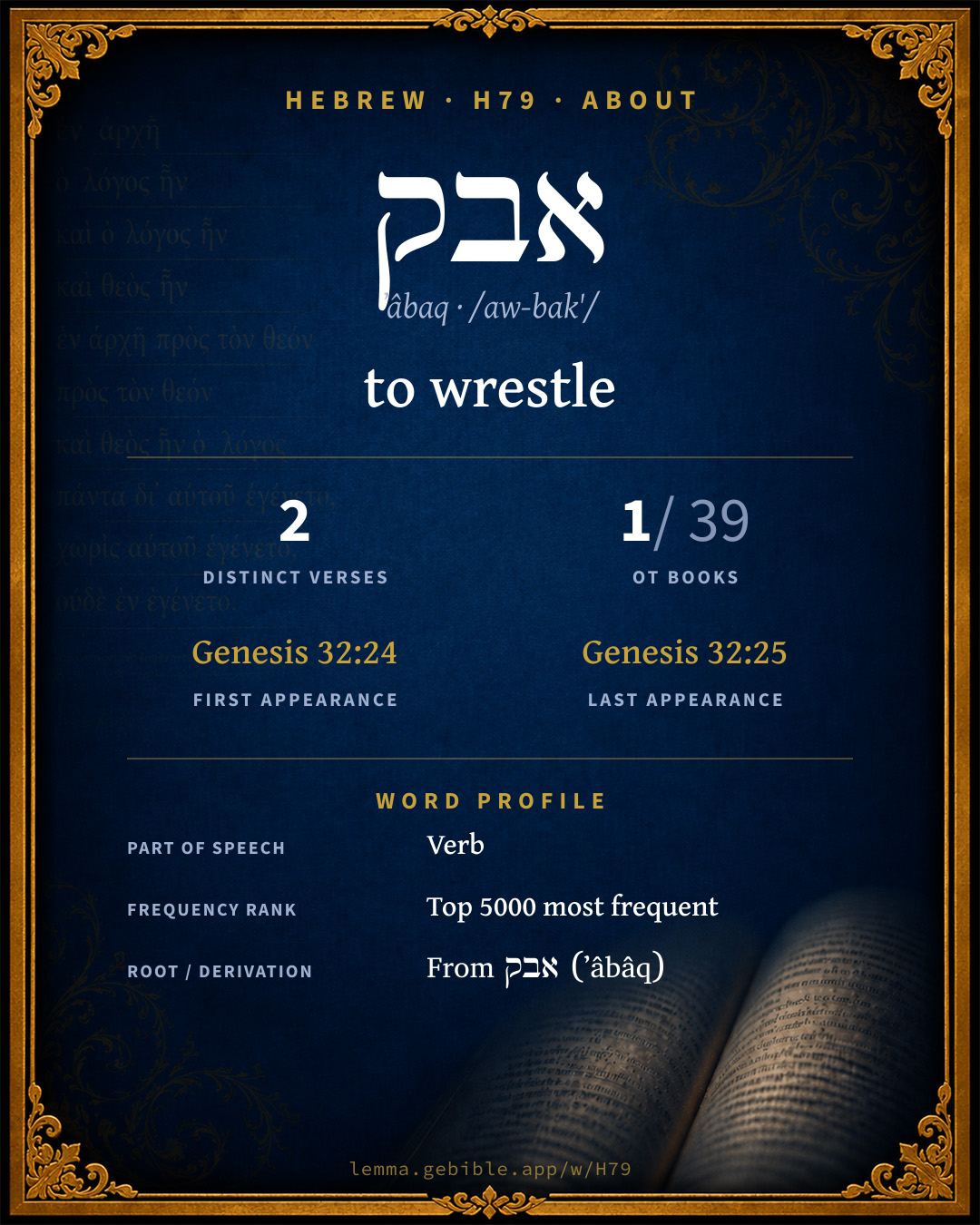
אָבַק
to wrestle
Full lexicon entry — Brown-Driver-Briggs (BDB)
From Brown-Driver-Briggs (BDB)
Where this word appears
Grammar key — what these labels mean
Stem
- Niphal
- Usually the simple passive or reflexive of the Qal (“he was written”).
Form
- Sequential Imperfect
- An imperfect with prefixed waw — the standard past-narrative form (waw-consecutive imperfect).
- Infinitive Construct
- A bound verbal noun, frequently with prepositions (“to write / in writing”).
Person
- 3rd Person
- The one spoken about (“he / she / it / they”).
Gender
- Masculine
- Grammatically masculine.
Number
- Singular
- One.
Grammatical forms
- Verb, Niphal, Sequential Imperfect, 3rd Person, Masculine, Singular 1 time (50%)
- Verb, Niphal, Infinitive Construct 1 time (50%)
Parsed forms decoded from the imported morphology (morphhb / Westminster Leningrad Codex — WLC text public domain, morphhb tagging CC BY 4.0), counted across 2 parsed occurrences — not distinct verses.
Every verse where H79 appears — 2 distinct verses across 1 book. Click any verse to open its interlinear word-by-word view. Verse text shown in the World English Bible for context — . Each verse’s Hebrew form is shown with its reference; the English is not keyword-highlighted, since the data carries no word-level English alignment. Use “Compare translations” on any verse to read it across multiple English versions. This concordance covers the Hebrew Bible; Septuagint (Greek Old Testament) occurrences are not indexed here.
Genesis 2 verses
- Genesis 32:24 וַ/יֵּאָבֵ֥ק conj + Niphal wimpf 3ms Jacob was left alone, and wrestled with a man there until the breaking of the day.
- Genesis 32:25 בְּ/הֵֽאָבְק֖/וֹ prep + Niphal inf.cs + sfx pers 3ms When he saw that he didn't prevail against him, he touched the hollow of his thigh, and the hollow of Jacob's thigh was strained, as he wrestled.
About this entry
At a glance — auto-summarized from this page’s data, not written by a person. Every figure links to its source below. This summary describes the numbers; it doesn’t interpret them.
אבק — transliterated ʼâbaq — is a Hebrew verb carrying the sense “to wrestle.” With only 2 verses it sits in the long tail of Hebrew Bible vocabulary. Its uses cluster heavily in Genesis (100% of all occurrences). Debuting at Genesis 32:24, it then recurs through the corpus. From the same root come אבק and אבקה. Each statement above links to its evidence; the full detail follows below.
Gloss history
Strong's 1890 vs modern scholarship
About this word
Strong's H79 catalogs a Hebrew word from the Hebrew Old Testament.
These counts are not copied from any lexicon or concordance. They are computed here, from the morphology-tagged Hebrew Old Testament. What Lemma adds →
- 2
- distinct verses
- The word appears in 2 distinct verses.
- 1 / 39
- OT books
- The word appears in 1 of 39 Old Testament books.
- #4,807
- by frequency
- Top 5000 most frequent Hebrew words (rank 4,807 of 8,640 Hebrew words by occurrence).
View all 2 occurrences in the concordance →
Most concentrated in
- Genesis 2 verses 100%
By section of the Old Testament
By traditional corpus
Conventional, traditional groupings — biblical authorship is debated, so this is a traditional corpus grouping, not an authorship claim. Each share is this word’s portion of its verses in that division of the Hebrew canon. Each figure is a share of the word’s 2 distinct verses.
- Torah (Pentateuch) 2 verses · 100%
How translations render this word
Counts come from each version’s own published word-to-Strong’s tagging or interlinear alignment — an approximate guide to how each version renders this word, not a word-level alignment the data otherwise carries. Because each total is that version’s own tagged count, the per-version totals vary from one another and need not match the appearance or distinct-verse counts above. These counts may also differ from a printed concordance because Lemma counts each distinctly tagged rendering and does not collapse phrase taggings into a single head-word total. This is a fixed set of word-tagged versions (KJV, ASV, BSB, ULT) and does not change with the reading translation you choose elsewhere. Each version’s license is shown beside its name below (and on Sources).
- King James Version: Alone and there wrestled 1×, He wrestled 1×
- American Standard Version: Alone 1×, He wrestled with him 1×
- Berean Standard Bible: Wrestled 2×
- unfoldingWord Literal Text: And 1×, He wrestled 1×, Wrestled 1×
King James Version Public Domain
Renders H79 across 2 tagged occurrences — most commonly:
American Standard Version Public Domain
Renders H79 across 2 tagged occurrences — most commonly:
Berean Standard Bible Public Domain
Renders H79 across 2 tagged occurrences — most commonly:
unfoldingWord Literal Text CC BY-SA 4.0
Renders H79 across 3 tagged occurrences — most commonly:
Senses in BDB
The 1 sense BDB distinguishes for this word, in lexicon order (not ranked by frequency or importance). The full entry — with sub-senses — is in the Lexicon Entry tab.
- (Niphal) to wrestle, grapple (get dusty), bedust
Word origin
[ אָבַק ] vb. denom. Niph. wrestle Gn 32:25
— Brown-Driver-Briggs (Oxford 1906, public domain), digitized via Sefaria, supplemented by the OpenScriptures HebrewLexicon (CC BY 4.0). See Sources.
Derived from אבק (ʼâbâq) (H80) — dust.
Jastrow Dictionary
A second Hebrew/Aramaic lexicon for comparison, covering Aramaic and post-biblical (Talmudic, Targumic, Midrashic) usage that the biblical-Hebrew BDB does not. Matched by lemma rather than by Strong’s number, so a lemma may carry more than one Jastrow headword (shown separately below), and the entries cover usage well beyond the Bible.
אָבָק
- v. אֲבַק,, (thick, whirling) dust, powder. Sabb. III, 3 אֲבַק דרכים the (heated) sand on the roads. Ḥull. 91ᵃ. Cant. R. to III, 6; a. fr.—הסופרים א׳ the refuse of writing material, or the colored sand strewn over the writing. Sabb. XII, 5 וכ׳ כתב במשקין if one writes (on the Sabb.) with a fluid or sap of fruits (instead of ink), or in the sand on roads or in the writer’s powder.—Trnsf. (cmp. אֲבַק) connection, something akin to, shade of, as א׳ לשון הרע a shade of slander; רבית א׳ a shade of usury; א׳ של שביעית an agricultural occupation indirectly related to those forbidden in the Sabbath year; v. infr.—Pl. אֲבָקוֹת. Tosef. Ab. Zar. I, 10 ארבע א׳ הן (ed. Zuck. אבקאות) the word abak in its figur. sense is applied to four things; cmp. B. Bath. 165ᵃ; B. Mets. 61ᵇ; 67ᵃ; Succ. 40ᵇ
אָבַק
- , Pi. אִבֵּק, אִיבֵּק (denom. of foreg.) to cover with powder, esp. plants, for fertilizing. Shebi. II, 2 מְאַבְּקִין (cmp. Y. Ib. a. l.). M. Kat. 3ᵃ. Y. Sabb. VII, 10ᵃ top.—Part. pass. מְאוּבָּק powdered. Y. Bicc. I, 63ᵈ bot. מאונקות (read מְאוּבָּ׳) grapes fertilized with powder. [Ar. “to remove the dust”(?)]
- to be covered, or cover one’s self with dust. Gen. R. s. 43.—Metaph. to sit at one’s feet as a disciple. Aboth. I, 4.
אֲבַק
- (√אב, עב, cmp. אבך, חבק)
- 1. to entangle, twist, twine. Men. 42ᵃ אביק להו מיבק (perh. אַבֵּיק Pa.) he twined (the show-fringes) with loops.
- 2. (neut. v.) to be attached to, cling to (idolatry etc.). Snh. 64ᵃ; Ab. Zar. 14ᵇ. Ib. 17ᵃ א׳ בה טובא he was very deeply attached to sensuality.
אָבָק ²
- ch. = h. אָבָק. Targ. Ex. IX, 9; a. e.
אבק
- Tosef. Mikv. V, 7, read אָבִיק.
A Dictionary of the Targumim, the Talmud Babli and Yerushalmi, and the Midrashic Literature (Marcus Jastrow; London, Luzac, 1903) — Public Domain. Digitized via Sefaria. Digitized via Sefaria. Full attribution on Sources.
Forms in the corpus
The 2 distinct written forms H79 takes in the Hebrew Bible, most frequent first — each parse links to that stem’s occurrences in the concordance. Hebrew forms include their vowel points and cantillation, so a single lemma takes many written forms.
| Form | Parsing | Example | Uses |
|---|---|---|---|
| בְּ/הֵֽאָבְק֖/וֹ | Verb, Niphal, Infinitive Construct | Genesis 32:25 | 1 |
| וַ/יֵּאָבֵ֥ק | Verb, Niphal, Sequential Imperfect, 3rd Person, Masculine, Singular | Genesis 32:24 | 1 |
Same root — word family
Other BDB entries built from the same root as H79, grouped by Strong’s listed origin. These share a root / origin per the lexicon — not necessarily a shared meaning. Each links to that word’s own entry.
Derives from
Shares the same root
Derived from this word
Compare all same-root words → They share a root, not necessarily a meaning.
Septuagint verse parallels
This word appears in 2 verses that also exist in the Greek Old Testament (Septuagint), out of the 2 Hebrew verses it occurs in. You can read those verses in Greek by switching the Old Testament edition to the Septuagint.
Read these verses in the Septuagint
This is a verse-level parallel only — the same verses exist in both the Hebrew and Greek Old Testaments. No word-level Hebrew↔Greek correspondence is claimed: the data carries no such alignment, so no Greek word is shown as this Hebrew word’s translation. Coverage is not total — the Septuagint omits the deuterocanon and renumbers the Psalms, so some Hebrew verses have no direct Greek parallel.