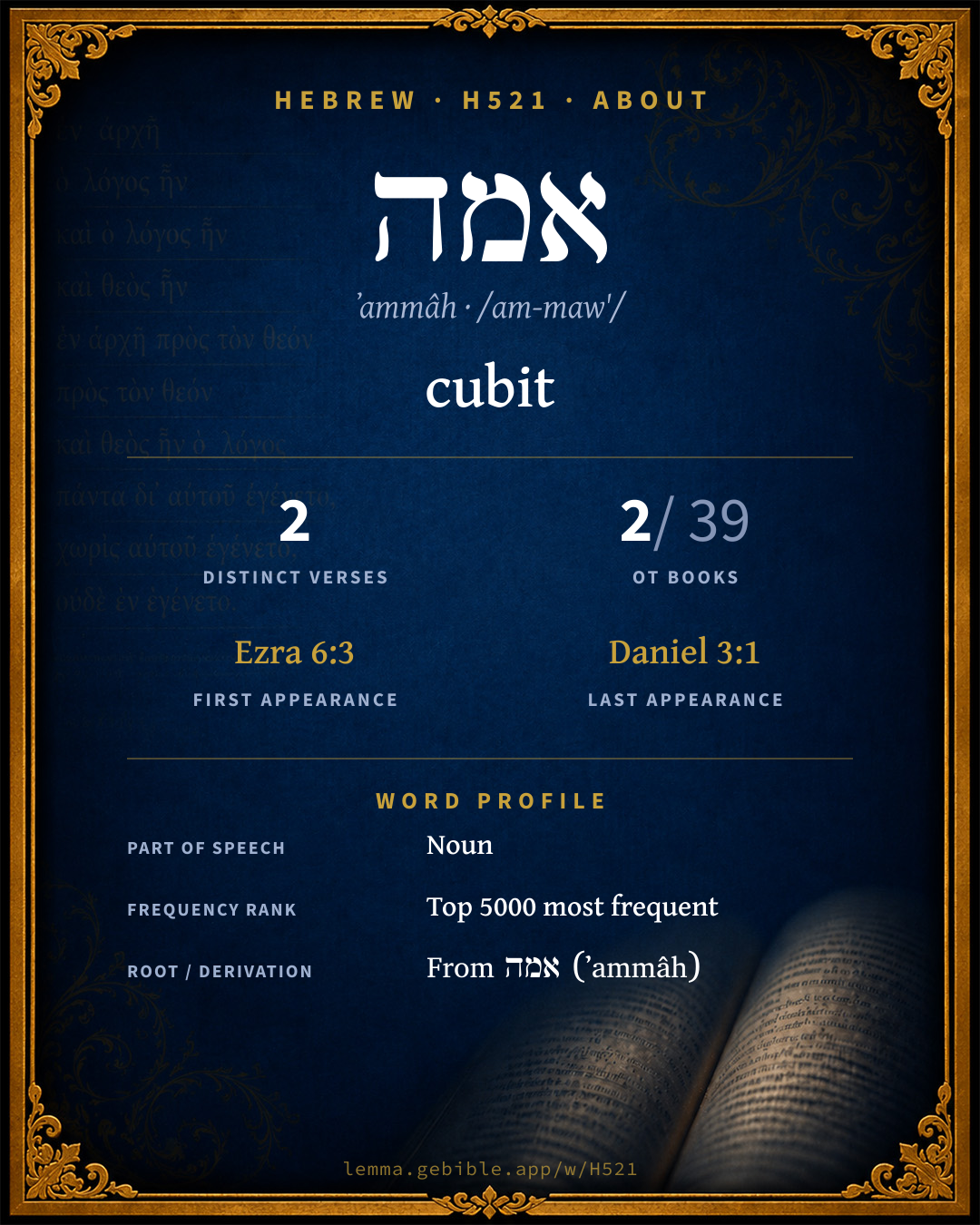
אַמָּה
cubit
Full lexicon entry — Brown-Driver-Briggs (BDB)
From Brown-Driver-Briggs (BDB)
Where this word appears
Grammar key — what these labels mean
Part of speech
- Noun
- A naming word — a person, place, thing, or idea.
Noun type
- Common
- A common noun — a general class of person, place, or thing (“king,” “city,” “water”), not a specific name.
State
- Absolute
- The independent form of a noun, not bound to a following word.
Gender
- Feminine
- Grammatically feminine.
Number
- Plural
- More than one (in Hebrew, generally three or more).
- Singular
- One.
Grammatical forms
- Noun, Common, Feminine, Plural, Absolute 2 times (50%)
- Noun, Common, Feminine, Singular, Absolute 2 times (50%)
Parsed forms decoded from the imported morphology (morphhb / Westminster Leningrad Codex — WLC text public domain, morphhb tagging CC BY 4.0), counted across 4 parsed occurrences — not distinct verses.
Every verse where H521 appears — 2 distinct verses across 2 books. Click any verse to open its interlinear word-by-word view. Verse text shown in the World English Bible for context — . Each verse’s Hebrew form is shown with its reference; the English is not keyword-highlighted, since the data carries no word-level English alignment. Use “Compare translations” on any verse to read it across multiple English versions. This concordance covers the Hebrew Bible; Septuagint (Greek Old Testament) occurrences are not indexed here.
Ezra 1 verse
Daniel 1 verse
About this entry
At a glance — auto-summarized from this page’s data, not written by a person. Every figure links to its source below. This summary describes the numbers; it doesn’t interpret them.
אמה — transliterated ʼammâh — is a Hebrew noun carrying the sense “cubit.” The Hebrew Bible uses it only 2 verses. Its uses cluster heavily in Ezra (50% of all occurrences). Its earliest occurrence is Ezra 6:3. Sharing its root, it stands alongside אמה and אמה. Each statement above links to its evidence; the full detail follows below.
Gloss history
Strong's 1890 vs modern scholarship
About this word
Strong's H521 catalogs a Hebrew word from the Hebrew Old Testament.
These counts are not copied from any lexicon or concordance. They are computed here, from the morphology-tagged Hebrew Old Testament. What Lemma adds →
- 2
- distinct verses
- The word appears in 2 distinct verses.
- 2 / 39
- OT books
- The word appears in 2 of 39 Old Testament books.
- #3,696
- by frequency
- Top 5000 most frequent Hebrew words (rank 3,696 of 8,640 Hebrew words by occurrence).
View all 2 occurrences in the concordance →
By traditional corpus
Conventional, traditional groupings — biblical authorship is debated, so this is a traditional corpus grouping, not an authorship claim. Each share is this word’s portion of its verses in that division of the Hebrew canon. Each figure is a share of the word’s 2 distinct verses.
- Writings (Ketuvim) 2 verses · 100%
How translations render this word
Counts come from each version’s own published word-to-Strong’s tagging or interlinear alignment — an approximate guide to how each version renders this word, not a word-level alignment the data otherwise carries. Because each total is that version’s own tagged count, the per-version totals vary from one another and need not match the appearance or distinct-verse counts above. These counts may also differ from a printed concordance because Lemma counts each distinctly tagged rendering and does not collapse phrase taggings into a single head-word total. This is a fixed set of word-tagged versions (KJV, ASV, BSB, ULT) and does not change with the reading translation you choose elsewhere. Each version’s license is shown beside its name below (and on Sources).
BDB lists this Strong’s number as 4 distinct words (homographs). Each count above pools all of them and is not split by sense — see the Senses section below. A low-frequency rendering may belong to a different one of those words, not the primary meaning.
- King James Version†: Cubits 4×
- American Standard Version†: Cubits 4×
- Berean Standard Bible†: Cubits 4×
- unfoldingWord Literal Text†: Cubits 4×
King James Version Public Domain
Renders H521 across 4† tagged occurrences — most commonly:
American Standard Version Public Domain
Renders H521 across 4† tagged occurrences — most commonly:
Berean Standard Bible Public Domain
Renders H521 across 4† tagged occurrences — most commonly:
unfoldingWord Literal Text CC BY-SA 4.0
Renders H521 across 5† tagged occurrences — most commonly:
Plus 1 rendering that appears only once — usually multi-word phrases or single function words the recovered tagging swept in, not distinct renderings.
Senses in the full BDB
What do BDB’s symbols mean?
BDB uses these scholarly abbreviations:
| Symbol | Meaning |
|---|---|
| 𝔊 | the Septuagint (the ancient Greek translation, LXX) |
| 𝔙 | the Vulgate (the Latin translation) |
| 𝔖 | the Syriac version (the Peshitta) |
| 𝔗 | the Targum (the Aramaic translation) |
| ψ | the Psalms |
| √ | root (the underlying root or stem) |
| ‖ | parallel passage (a synonymous or contrasted parallel) |
| † | the dagger: every passage where the word occurs is cited |
The 2 senses and sub-senses the full Brown-Driver-Briggs lexicon distinguishes for this word, in lexicon order (not ranked by frequency), with BDB’s own verbatim wording and sub-sense lettering. Shown in Hebrew script with BDB’s own scholarly abbreviations. The condensed entry is in the Lexicon Entry tab. See also the Forms in the corpus table below.
אמה I only mother-city, metropolis (cf. אֵם 2 S 20
אמה II ell, cubit (SI אמה
- 1. cubit, so אַמַּת־אִישׁ i.e. ordinary cubit, Dt 3:11 (cf. Is 8:1); in Ez 40:5; 43:13 is a cubit one hand-breadth longer, cf. 2 Ch 3:3 א׳ בַּמִּדָּה הָרִאשׁוֹנָה; absol. length dub., cf. SmithDict. Bib., art. Weights and Measures; LepsiusLängenmaasse der Alten, SBAk 1883, 1195 f. identif. with Egyptian, longer cubit.525 m., shorter.450 m.; v. also Id.Bab.-Assyrian Längenmaasse 1877; MBAk 1877, 741 OppertGGA 1878, 1055; Rev. d’Assyrian i. 124 (also on the Bab. ‘half-cubit’ =.270 m. HptAJPh 1888, 419 HomSemiten i. 501); on א׳ אַצִּילָה Ez 41:8 cf. Sm & Co (Co del.); חֲמֵשׁ אמות קָנִים Ez 42:16 Kt, read מֵאוֹת so Qr Co; chiefly in Ex 25–27. 36–38 (56 times) 1 K 6.7 (45 times) 2 Ch 3.4 (21 times) Ez 40–43 (86 times); a (one) cubit = אַמָּה Gn 6:16 Ex 25:10, 23 +; הָאַמָּה Ez 43:14; א׳ אַחַת Ez 40:12(×2), 42(×3); 42:4; 43:14; two cubits = אַמָּתַיִם Ex 25:10, 17, 23; 30:2; 37:1, 6, 10, 25 Nu 11:31; שְׁתַּיִם אַמּוֹת Ez 40:9; 41:3, 22; 43:14; c. num. 1–10 א׳ mostly pl. after num. Ex 26:16; 27:1(×3) 1 K 6:10 Je 52:22 Ez 40:5, 7, 9 +; c. num. 11–1000 +, it mostly foll. num. in sing. Gn 6:15(×3) Ex 27:12, 13; 38:13, 14, 15 Nu 35:4 Jos 3:4 1 K 6:2(×2), 3; 7:15(×2) Je 52:21 Ez 40:49(×2) +; seld. foll. in pl. Ez 40:11 (del. Co) v 27 (Co sg.) 42:2; so also עֶשְׂרִים וְחָמֵשׁ אַמּוֹת Ez 40:13, 29 but חָמֵשׁ וְעֶשְׂרִים אֵמָּה Ez 40:25, 30, 33, 36; (late) also in pl. precedes all num. 2 Ch 3:3(×2), 4, 8(×2) +; 6:13 Ez 42:2; also often בָּאַמָּה foll. all num. Ex 26:2(×2), 8(×2); 27:9, 18; 36:9(×2), 15 Nu 35:5(×4) 1 K 6:6(×3); 7:23(×3) 2 Ch 4:2(×3) Ez 40:21; 47:3 Zc 5:2(×2) +, cf. לְאַמּוֹת חָמֵשׁ 2 Ch 3:11; often א׳ וָחֵצִי Ex 25:10(×3), 17(×2) +, also א׳ וַחֲצִי הָא׳ Ex 26:16; 36:21 1 K 7:31, 32, 35 etc.; cf. שֵׁשׁ אַמּוֹת וָזָ֑רֶת 1 S 17:4; sq. בַּמִּדָּה in measurement Jos 3:4 2 Ch 3:3. e.g. Deuteronomy 3:11
- 2. †measure, full measure, limit, only אַמַּת בִּצְעֵךְ the measure of thy gain-making Je 51:13 (‖ קִצֵּךְ). e.g. Jeremiah 51:13
אמה III (etym. & meaning dub.
אמה IV loc. hill near Gibeon, גִּבְעַת־אַמָּה 2 S 2
Senses from the full Brown-Driver-Briggs lexicon (Brown, Driver, Briggs; Oxford 1906 — public domain), digitized via Sefaria, supplemented by the OpenScriptures HebrewLexicon (CC BY 4.0). Full attribution on Sources.
Word origin
II. n.f. only mother-city, metropolis (cf. אֵם 2 S 20:19 & Ph.); in phrase מֶתֶג הָאַמָּה authority of mother-city 2 S 8:1; v. מֶתֶג; cf. Dr.
III. n.f. ell, cubit (SI אמה; so Sab. DHMZMG 1865, 613; Aramaic ܐܰܡܳܐ, אַמָּא; Assyrian ammatu Nor280; Ethiopic እመት etym. dub.; Thes al. mater brachii, i.e. length of fore-arm; others from √ ii. אמם, أَمَّ precede, be in front, & hence fore-arm cf. Di Is 6:4; DlPr 109 MV der. immediately from √ אמם be wide (v. supr.), אַמָּה = distance, & hence a particular distance, ell, cubit)—א׳ abs. Gn 6:15 +; cstr. אַמַּת Dt 3:11 Je 51:13; du. אַמָּתַיִם Ex 25:10 +; pl. אַמּוֹת Ex 26:16 +;—
IV. n.f. (etym. & meaning dub.; Thes foundation (cf. Talm. AW), from אֵם in metaph. sense, cf. MV; De on Is 6:4 der. similarly, but makes support of superliminaria (cf. 𝔊 𝔖 𝔙); Ew Di from √ ii. אמם = أَمَّ precede, whence إِمَامٌ front; DlPr 110 tr. holder from √ אמם be wide, hence contain, hold) only אַמּוֹת הַסִּפִּים Is 6:4.
V. n.pr.loc. hill near Gibeon, גִּבְעַת־אַמָּה 2 S 2:24.
— Brown-Driver-Briggs (Oxford 1906, public domain), digitized via Sefaria, supplemented by the OpenScriptures HebrewLexicon (CC BY 4.0). See Sources.
Derived from אמה (ʼammâh) (H520) — cubit.
Jastrow Dictionary
A second Hebrew/Aramaic lexicon for comparison, covering Aramaic and post-biblical (Talmudic, Targumic, Midrashic) usage that the biblical-Hebrew BDB does not. Matched by lemma rather than by Strong’s number, so a lemma may carry more than one Jastrow headword (shown separately below), and the entries cover usage well beyond the Bible.
אַמָּה
- , v. אֵם)
- 1. fore-arm, arm. Sot. 12ᵇ; Ex. R. s. 1 אמתה חד אמר ידה the word אמתה (Ex. II, 5)—one says it means אַמָּתָהּ, her arm, the other says it means אֲמָתָהּ, her maid-servant (v. אָמָה).—Lam. R. introd. (R. Josh. 2) א׳ דבצלי׳ an arm (direction-post) &c.; v. בְּצַל; Koh. R. to XII, 7 אם.—אַמַּת (בית) השחי the arm up to the axilla, arm-pit, name of an opening in a Temple door; v. however, infra. 4).—2) cubit, a measure equal to the distance from the elbow to the tip of the middle-finger. Keth. 5ᵇ; Men. 11ᵃ זו א׳ this one (the middle-finger) is used for defining the cubit measure. Kel. XVII, 10 אַמַּת הבנין וכ׳ the standard cubit of the Temple proportions was six, that of the vessels five hand-breadths. Sabb. 31ᵃ א׳ הבנין the builder’s cubit (instrument).—א׳ על א׳ square-cubit. Yoma 31ᵃ; a. e.—Zeb. 62ᵇ (גרומה) א׳ גדומה; Y. Yoma IV, 41ᶜ bot. גמודה a reduced cubit; v. גָּדַם; also called א׳ בת ששה עצבות a cubit of six hand-breadths pressed together (sorrowing), opp. to א׳ (בת ששה) שוחקות a cubit of six wide-spread (laughing) hand-breadths. Erub. 3ᵇ. Y. Shek. VI, end, 50ᵇ.—Gen. R. s. 31 (א׳) תביקין Theban (Egypt.) cubit(?). B. Bath. 99ᵇ אמה בית השלחין land for digging a dyke of one cubit’s width; א׳ בית הקילון (Var. קלון, סילון) land for a creek or pond for watering cattle and washing clothes, of one cubit’s width. e.g. Exodus 2:5
- 3. (= אצבע) membrum virile. Sabb. 108ᵇ. Nidd. 13ᵃ sq. B. Kam. 19ᵇ
- 4. prop. river-arm, hence canal, dyke, sewer. Peah II, 2 אַמַּת המים.—Yoma V, 6 אלו ואלו מתערבין בא׳ the blood of both was mixed in the sewer; Tam. III, 6; B. Mets. 33ᵃ; Y. Hor. III, 48ᵇ top אמת (בית) השחי a sewer in the Temple called the duct of the arm-pit (from its shape; v. Grætz Monatsschr. 1880, p. 289; [emendation שית unnecessary]; v. supra.—Pl. אַמֹּות cubits. Kel. XVII, 10; a. fr.
אָמָה
- v. אֵם; cmp. preced.) hand-maid. Sot. 12ᵇ, v. preced.; a. e.—Pl. אֲמָהוֹת. Y. Snh. II, 20ᵇ bot.; v. אֵם; a. e.
A Dictionary of the Targumim, the Talmud Babli and Yerushalmi, and the Midrashic Literature (Marcus Jastrow; London, Luzac, 1903) — Public Domain. Digitized via Sefaria. Digitized via Sefaria. Full attribution on Sources.
Forms in the corpus
The 2 distinct written forms H521 takes in the Hebrew Bible, most frequent first — each parse links to that state’s occurrences in the concordance. Hebrew forms include their vowel points and cantillation, so a single lemma takes many written forms.
| Form | Parsing | Example | Uses |
|---|---|---|---|
| אַמִּ֣ין | Noun, Common, Feminine, Singular, Absolute | Daniel 3:1 | 3 |
| אַמִּ֥ין | Noun, Common, Feminine, Plural, Absolute | Ezra 6:3 | 1 |
Same root — word family
Other BDB entries built from the same root as H521, grouped by Strong’s listed origin. These share a root / origin per the lexicon — not necessarily a shared meaning. Each links to that word’s own entry.
Derives from
Proper names from this root
People and places named from this root — a name, not an additional meaning of the word.
Compare all same-root words → 1 of the same-root words is a proper name (a person or place). They share a root, not necessarily a meaning.
Septuagint verse parallels
This word appears in 2 verses that also exist in the Greek Old Testament (Septuagint), out of the 2 Hebrew verses it occurs in. You can read those verses in Greek by switching the Old Testament edition to the Septuagint.
Read these verses in the Septuagint
This is a verse-level parallel only — the same verses exist in both the Hebrew and Greek Old Testaments. No word-level Hebrew↔Greek correspondence is claimed: the data carries no such alignment, so no Greek word is shown as this Hebrew word’s translation. Coverage is not total — the Septuagint omits the deuterocanon and renumbers the Psalms, so some Hebrew verses have no direct Greek parallel.