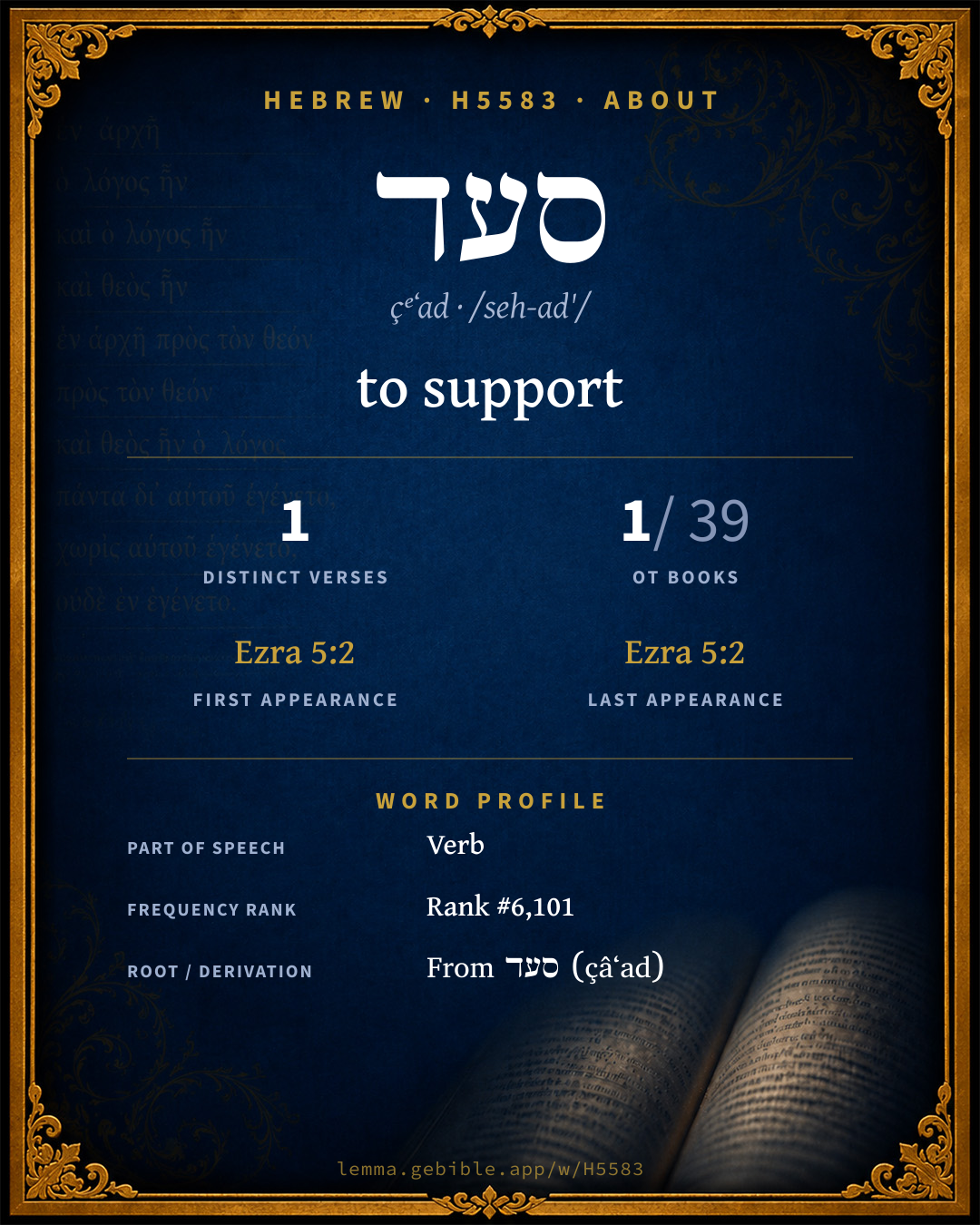
סְעַד
to support
Full lexicon entry — Brown-Driver-Briggs (BDB)
From Brown-Driver-Briggs (BDB)
Where this word appears
Grammar key — what these labels mean
Part of speech
- Verb
- An action or state-of-being word.
Stem
- Piel
- An intensive or resultative active stem.
Form
- Participle Active
- A verbal adjective expressing ongoing or characteristic action (“writing / one who writes”).
State
- Absolute
- The independent form of a noun, not bound to a following word.
Gender
- Masculine
- Grammatically masculine.
Number
- Plural
- More than one (in Hebrew, generally three or more).
Every verse where H5583 appears — 1 distinct verse across 1 book. Click any verse to open its interlinear word-by-word view. Verse text shown in the World English Bible for context — . Each verse’s Hebrew form is shown with its reference; the English is not keyword-highlighted, since the data carries no word-level English alignment. Use “Compare translations” on any verse to read it across multiple English versions. This concordance covers the Hebrew Bible; Septuagint (Greek Old Testament) occurrences are not indexed here.
Ezra 1 verse
About this entry
At a glance — auto-summarized from this page’s data, not written by a person. Every figure links to its source below. This summary describes the numbers; it doesn’t interpret them.
סעד (çᵉʻad) is a Hebrew verb most often rendered “to support.” It is rare — just 1 verse in the entire Hebrew Bible. It clusters heavily in Ezra, which alone accounts for 100% of its uses. A true hapax — its single appearance is Ezra 5:2. From the same root come סעד and מסעד. For the data behind this summary, explore the sense tree and the renderings breakdown below.
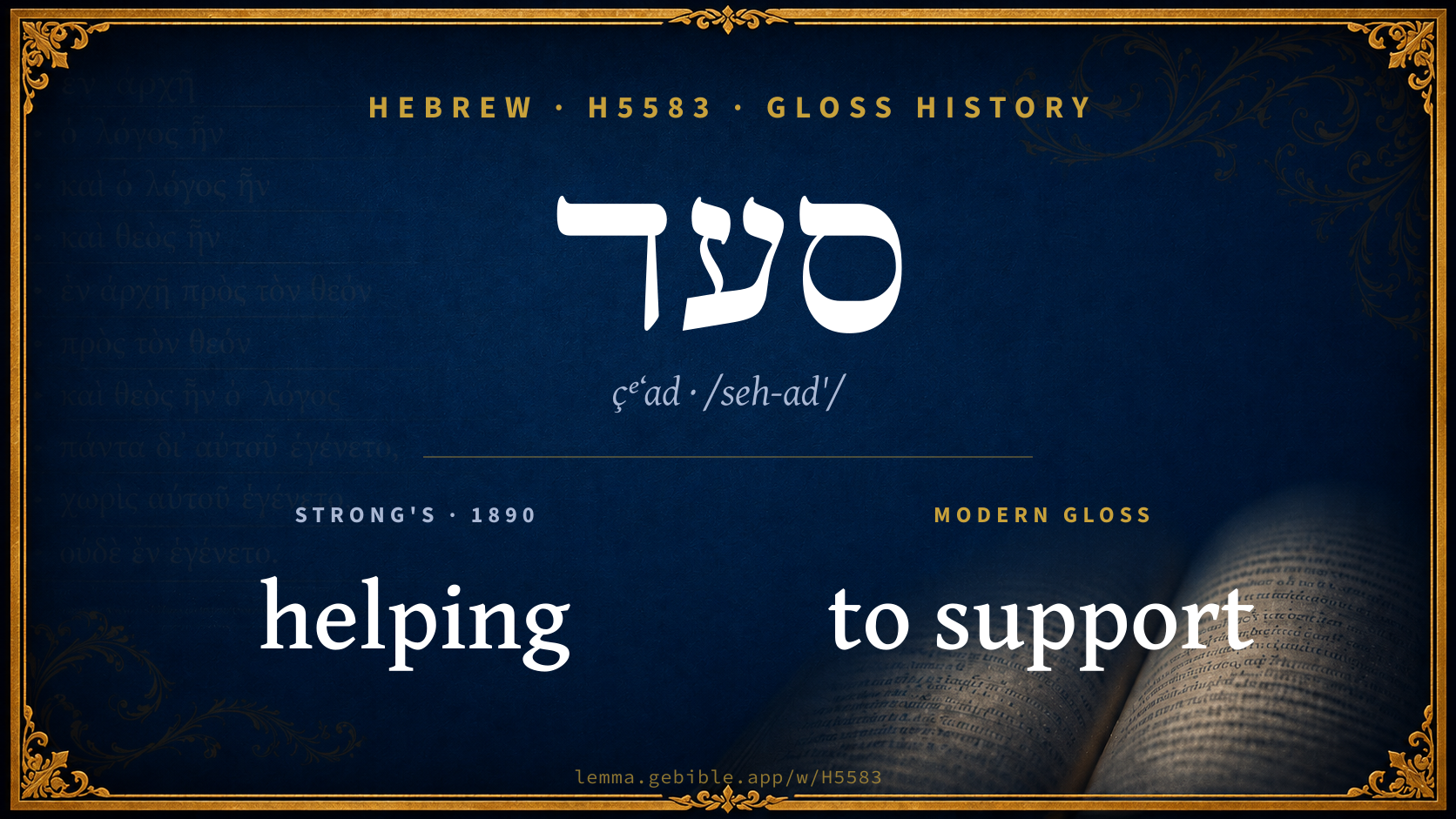
Gloss history
Strong's 1890 vs modern scholarship
About this word
Strong's H5583 catalogs a Hebrew word from the Hebrew Old Testament.
These counts are not copied from any lexicon or concordance. They are computed here, from the morphology-tagged Hebrew Old Testament. What Lemma adds →
- 1
- distinct verses
- The word appears in 1 distinct verse.
- 1 / 39
- OT books
- The word appears in 1 of 39 Old Testament books.
- #6,101
- by frequency
- Rank #6,101 (rank 6,101 of 8,640 Hebrew words by occurrence).
View all 1 occurrence in the concordance →
Most concentrated in
- Ezra 1 verse 100%
By section of the Old Testament
By traditional corpus
Conventional, traditional groupings — biblical authorship is debated, so this is a traditional corpus grouping, not an authorship claim. Each share is this word’s portion of its verses in that division of the Hebrew canon. Each figure is a share of the word’s 1 distinct verse.
- Writings (Ketuvim) 1 verse · 100%
How translations render this word
Counts come from each version’s own published word-to-Strong’s tagging or interlinear alignment — an approximate guide to how each version renders this word, not a word-level alignment the data otherwise carries. Because each total is that version’s own tagged count, the per-version totals vary from one another and need not match the appearance or distinct-verse counts above. These counts may also differ from a printed concordance because Lemma counts each distinctly tagged rendering and does not collapse phrase taggings into a single head-word total. This is a fixed set of word-tagged versions (KJV, ASV, BSB, ULT) and does not change with the reading translation you choose elsewhere. Each version’s license is shown beside its name below (and on Sources).
- King James Version: Helping 1×
- American Standard Version: Helping them 1×
- Berean Standard Bible: Helping 1×
- unfoldingWord Literal Text: Supporting 1×
King James Version Public Domain
Renders H5583 across 1 tagged occurrence — most commonly:
American Standard Version Public Domain
Renders H5583 across 1 tagged occurrence — most commonly:
Berean Standard Bible Public Domain
Renders H5583 across 1 tagged occurrence — most commonly:
unfoldingWord Literal Text CC BY-SA 4.0
Renders H5583 across 1 tagged occurrence — most commonly:
Senses in BDB
The 1 sense BDB distinguishes for this word, in lexicon order (not ranked by frequency or importance). The full entry — with sub-senses — is in the Lexicon Entry tab.
- (Aphel) to support, sustain
Word origin
[ סְעַד ] vb. Pa. support, sustain;— Ezr 5:2.
— Brown-Driver-Briggs (Oxford 1906, public domain), digitized via Sefaria, supplemented by the OpenScriptures HebrewLexicon (CC BY 4.0). See Sources.
Derived from סעד (çâʻad) (H5582) — to support.
Jastrow Dictionary
A second Hebrew/Aramaic lexicon for comparison, covering Aramaic and post-biblical (Talmudic, Targumic, Midrashic) usage that the biblical-Hebrew BDB does not. Matched by lemma rather than by Strong’s number, so a lemma may carry more than one Jastrow headword (shown separately below), and the entries cover usage well beyond the Bible.
סָעַד
- 1. to support, strengthen. Lam. R. to II, 2; Y. Taan. IV, 68ᵈ bot. לא תִסְעוֹד, v. סָבַף. Midr. Till. to Ps. XLI, 3 אני סוֹעֲדוֹ ומעמידו I will strengthen and raise him (from his sick-bed); a. fr.
- 2. (with or without לב) to satisfy the appetite, to satiate. Midr. Till. to Ps. CIV, 15 הלחם סוֹעד (ed. Bub. לבב) bread satiates, v. מְזוֹנִיתָא. Yalk. Lev. 675 (ref. to Lev. XXVI, 26) לרבות כל סוֹעֲדֵי לחם (fr. a noun סוֹעָד) this include all supports by bread (all substitutes of food); Sifra B’ḥuck. Par. 2, ch. VI מְסָעֲדֵי or מִסְעֲדֵי. e.g. Leviticus 26:26
- 3. (denom. of סְעוּדָה) to dine. Ḥull. 7ᵇ רצונך סְעוֹד אצלי please dine with me. Erub. 53ᵇ מדוע אינך סוֹעֵד why dost thou not eat?; כבר סָעַדְתִּי וכ׳ I have had my meal in daytime; a. fr.—Sabb. 62ᵇ במה סָעַדְתָּ היום what did you dine on to-day? (a lascivious metaphor).—[Ib. 12ᵇ ששכינה סועד, v. סָעַר I.]
- to support, assist. Yalk. Num. 760 לסַעֲדָהּ in order to keep her (the cow) steady (on the ship). Sabb. XVIII, 3 אבל מְסַעֲדִין but you may assist (an animal in child-birth); expl. ib. 128ᵇ. Ib. (quot. fr. Tosef. ib. XV (XVI), 2) כיצד מסעדין אוחזין וכ׳ (Tosef. l. c. מסייעין).
סְעַד
- 1. to assist, help. Targ. I Sam. VII, 12 (ed. Wil. Pa.).—Targ. Gen. XXVII, 37 (h. text סמך); a. fr.—Lam. R. to II, 2 לא נִסְעוֹד וכ׳, v. סְכַף.
- 2. (with or without לִיבָּא) to dine, eat. Targ. Jud. XIX, 5. Targ. Ps. XIV, 4.—Gitt. 67ᵇ מאי טעמא לא סָעֵיד מר גבן why will you not dine with us?
- 3. to satiate, contrad. to זון and to גרר. Ber. 35ᵇ חמרא סָעֵיד wine satisfies; נהמא מִיסְעַד סעיד וכ׳ bread satisfies but does not exhilarate; a. e.
- to support, help. Targ. II Chr. XXVIII, 23. Targ. Y. Ex. XVII, 12.
- to be supported. Targ. Is. V, 6.
סַעַד
- (preced.) support, auxiliary. Tosef. Snh. II, 4 עושין אותן ס׳ לשנה we consider each of these circumstances an auxiliary reason for intercalation; Snh. 11ᵃ; Y. ib. I, 18ᵈ top (corr. acc.).
סְעַד ²
- 1. same, support, assistance. Targ. I Kings X, 12 סעד Bxt. (ed. סְעִיד). Targ. Gen. XXI, 20; a. fr.—Lam. R. to II, 2 ברייא בסַעֲדֵיכוֹן מן אלין the Lord help you against these (Romans); (Y. Taan. IV, 69ᵃ ברייכון סְעוֹדִינְכוֹן, סְעוֹדוּנ׳).—Pl. סַעֲדִין, constr. סַעֲדֵי. Targ. Y. Lev. XXVI, 26 (v. סָעַד).
- 2. food. Targ. Ruth II, 14.—
- *3. סַעֲדִין root of the Cyperus Rotundus. Gen. R. s. 72 (expl. דודאים, Gen. XXX, 14) ס׳ Ar. (ed. שעורין). e.g. Genesis 30:14
A Dictionary of the Targumim, the Talmud Babli and Yerushalmi, and the Midrashic Literature (Marcus Jastrow; London, Luzac, 1903) — Public Domain. Digitized via Sefaria. Digitized via Sefaria. Full attribution on Sources.
Same root — word family
Other BDB entries built from the same root as H5583, grouped by Strong’s listed origin. These share a root / origin per the lexicon — not necessarily a shared meaning. Each links to that word’s own entry.
Derives from
Shares the same root
Compare all same-root words → They share a root, not necessarily a meaning.
Septuagint verse parallels
This word appears in 1 verse that also exists in the Greek Old Testament (Septuagint), out of the 1 Hebrew verse it occurs in. You can read those verses in Greek by switching the Old Testament edition to the Septuagint.
Read these verses in the Septuagint
This is a verse-level parallel only — the same verses exist in both the Hebrew and Greek Old Testaments. No word-level Hebrew↔Greek correspondence is claimed: the data carries no such alignment, so no Greek word is shown as this Hebrew word’s translation. Coverage is not total — the Septuagint omits the deuterocanon and renumbers the Psalms, so some Hebrew verses have no direct Greek parallel.