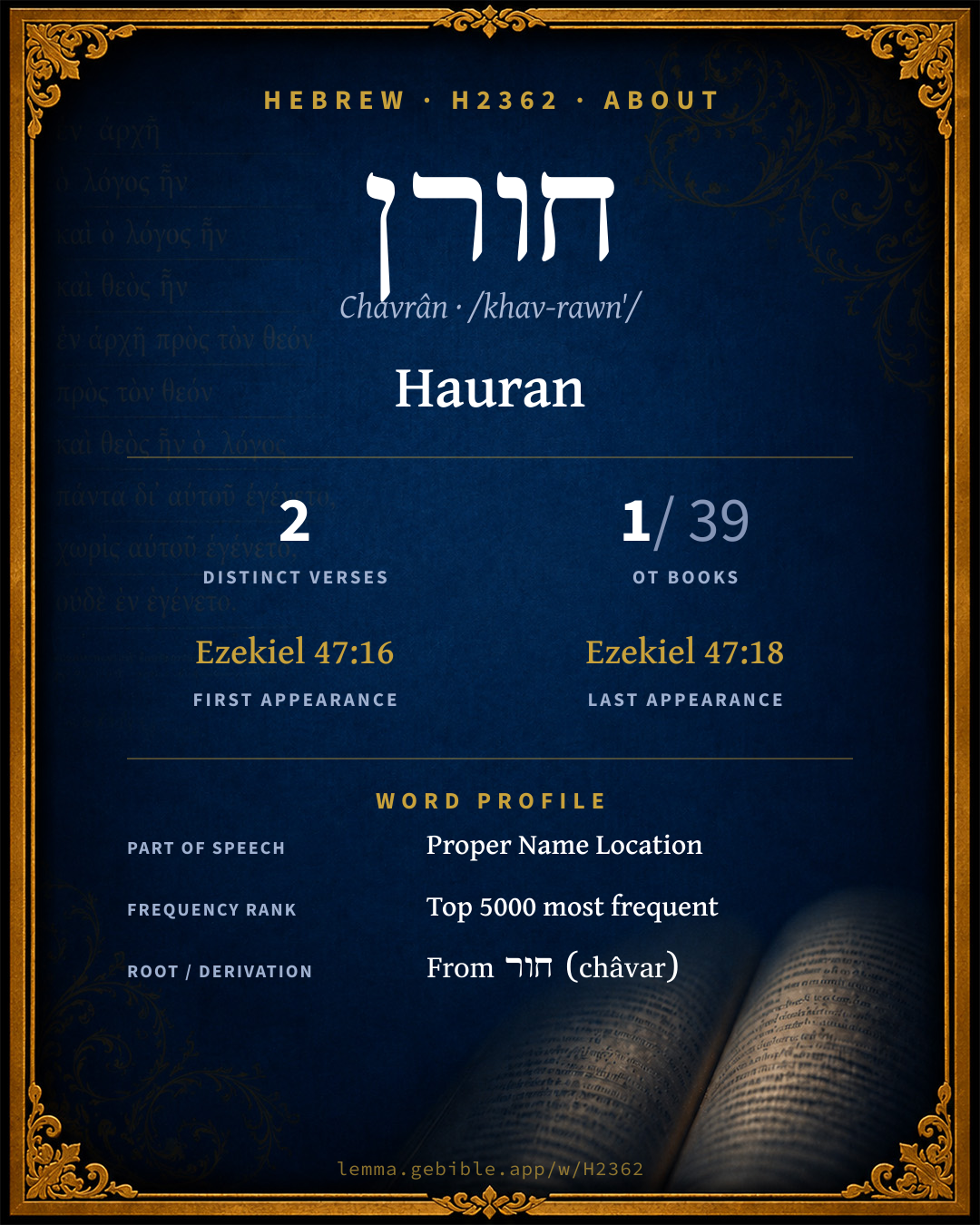
חַוְרָן
Hauran
BDB lists 2 entries for ‘Hauran’ fuller range ↓
Full lexicon entry — Brown-Driver-Briggs (BDB)
From Brown-Driver-Briggs (BDB)
Where this word appears
Grammar key — what these labels mean
Part of speech
- Noun
- A naming word — a person, place, thing, or idea.
Noun type
- Proper
- A name of a specific person, place, or people (e.g. Abraham, Zion, Israel).
Every verse where H2362 appears — 2 distinct verses across 1 book. Click any verse to open its interlinear word-by-word view. Verse text shown in the World English Bible for context — . Each verse’s Hebrew form is shown with its reference; the English is not keyword-highlighted, since the data carries no word-level English alignment. Use “Compare translations” on any verse to read it across multiple English versions. This concordance covers the Hebrew Bible; Septuagint (Greek Old Testament) occurrences are not indexed here.
Ezekiel 2 verses
- Ezekiel 47:16 חַוְרָֽן n Proper Hamath, Berothah, Sibraim, which is between the border of Damascus and the border of Hamath; Hazer Hatticon, which is by the border of Hauran.
- Ezekiel 47:18 חַוְרָ֣ן n Proper The east side, between Hauran and Damascus and Gilead, and the land of Israel, shall be the Jordan; from the [north] border to the east sea shall you measure. This is the east side.
About this entry
At a glance — auto-summarized from this page’s data, not written by a person. Every figure links to its source below. This summary describes the numbers; it doesn’t interpret them.
The Hebrew name חורן centers on the idea of “Hauran.” It occurs a mere 2 verses across Scripture. Ezekiel dominates its distribution — 2 of 2 verses. Debuting at Ezekiel 47:16, it then recurs through the corpus. For the data behind this summary, explore 2-verse concordance and the renderings breakdown below.
Gloss history
Strong's 1890 vs modern scholarship
About this word
Strong's H2362 catalogs a Hebrew word from the Hebrew Old Testament.
These counts are not copied from any lexicon or concordance. They are computed here, from the morphology-tagged Hebrew Old Testament. What Lemma adds →
- 2
- distinct verses
- The word appears in 2 distinct verses.
- 1 / 39
- OT books
- The word appears in 1 of 39 Old Testament books.
- #4,807
- by frequency
- Top 5000 most frequent Hebrew words (rank 4,807 of 8,640 Hebrew words by occurrence).
View all 2 occurrences in the concordance →
Most concentrated in
- Ezekiel 2 verses 100%
By section of the Old Testament
By traditional corpus
Conventional, traditional groupings — biblical authorship is debated, so this is a traditional corpus grouping, not an authorship claim. Each share is this word’s portion of its verses in that division of the Hebrew canon. Each figure is a share of the word’s 2 distinct verses.
- Prophets (Nevi'im) 2 verses · 100%
How translations render this word
Counts come from each version’s own published word-to-Strong’s tagging or interlinear alignment — an approximate guide to how each version renders this word, not a word-level alignment the data otherwise carries. Because each total is that version’s own tagged count, the per-version totals vary from one another and need not match the appearance or distinct-verse counts above. These counts may also differ from a printed concordance because Lemma counts each distinctly tagged rendering and does not collapse phrase taggings into a single head-word total. This is a fixed set of word-tagged versions (KJV, ASV, BSB, ULT) and does not change with the reading translation you choose elsewhere. Each version’s license is shown beside its name below (and on Sources).
- King James Version: Hauran 2×
- American Standard Version: Hauran 2×
- Berean Standard Bible: Hauran 2×
- unfoldingWord Literal Text: Hauran 2×
King James Version Public Domain
Renders H2362 across 2 tagged occurrences — most commonly:
American Standard Version Public Domain
Renders H2362 across 2 tagged occurrences — most commonly:
Berean Standard Bible Public Domain
Renders H2362 across 2 tagged occurrences — most commonly:
unfoldingWord Literal Text CC BY-SA 4.0
Renders H2362 across 2 tagged occurrences — most commonly:
Senses in BDB
The 2 senses BDB distinguishes for this word, in lexicon order (not ranked by frequency or importance). The full entry — with sub-senses — is in the Lexicon Entry tab.
- Hauran = "caverns"
- a province of Palestine east of the Sea of Galilee…
Word origin
n.pr.terr. (meaning unknown; conjectures are:—black-land (as basaltic region), supported by حَوْر black, dial. of Yemen, Maltzan ZMG 1874, 230, and tokens of immigration from Yemen into Ḥaurân, Wetzst in De Job 2, 598; ZKW 1884, 120; land of caves, Thes Hi-Sm, Porter Dict. Bib., and hollow, GASmGeogr. 552, who comp. Heb. חור hole; but this prob. from iii. חרר, and Arabic خَوْر, hollow, diff. from حَوْرَان )—district SE. from Mt. Hermon, extending between Jaulan and Lejah, toward Syriac desert; only גְּבוּל חַוְרָ֑ן Ez 47:16 cf. מִבֵּין חַוְרָ֥ן וּמִבֵּין דַּמֶּשֶׂק v 18; = Assyrian Ḫaurani DlPa 294; 𝔊 Αυρανιτις, and so JosAnt. xv. 10, 1 etc., Arabic حَوْرَان. On this district v. Wetzst Hauran, (1860) and in De Job 2, 597 ff. BdPal 195 ff. SchumacherAcross the Jordan, 1889; ZPV xii. 1889, 225 ff. (with map) GASmGeogr. 552 f. 609 ff.
— Brown-Driver-Briggs (Oxford 1906, public domain), digitized via Sefaria, supplemented by the OpenScriptures HebrewLexicon (CC BY 4.0). See Sources.
Derived from חור (châvar) (H2357) — to be white.
Jastrow Dictionary
A second Hebrew/Aramaic lexicon for comparison, covering Aramaic and post-biblical (Talmudic, Targumic, Midrashic) usage that the biblical-Hebrew BDB does not. Matched by lemma rather than by Strong’s number, so a lemma may carry more than one Jastrow headword (shown separately below), and the entries cover usage well beyond the Bible.
חַוְרָן
- , v. חַוְורָן
חוֹרָן
- = אוֹחֲרָן, another, next; last. Targ. Y. Lev. XIX, 6. Targ. Y. Ex. IX, 6. Targ. Job XX, 18; a. e.—Y. Pes. VI, 33ᵃ bot. דח׳ מקדש וכ׳ that another man will sanctify &c. Y. Peah II, 17ᵃ bot. וחרנה אמר and the other (scholar) says; Y. Ter. II, 41ᶜ top וחרינה; a. fr.—Pl. חוֹרָנִין, חוֹרוֹנִין. Targ. I Chr. XXIII, 17; a. e.—Y. Peah VIII, 21ᵇ top לח׳ to other people (not himself).—Fem. חוֹרָנַיְתָא, חוֹרָנַיְי׳, חוֹרַנְתָּא (… תָּה). Targ. Y. Ex. XXI, 10 (ed. Amst. אוֹחְרַנְתָּא). Targ. II Chr. III, 12; a. e.—Y. Sabb. II, 5ᵃ sq. ח׳ למה why the other sacrifice?—Pl. חוֹרַנְיָין, חוֹרַנְיָיתָא. Targ. I Chr. XXIII, 27.—Y. Sabb. X, end, 12ᵈ; a. fr.
A Dictionary of the Targumim, the Talmud Babli and Yerushalmi, and the Midrashic Literature (Marcus Jastrow; London, Luzac, 1903) — Public Domain. Digitized via Sefaria. Digitized via Sefaria. Full attribution on Sources.
Forms in the corpus
The 2 distinct written forms H2362 takes in the Hebrew Bible, most frequent first — each parse links to that state’s occurrences in the concordance. Hebrew forms include their vowel points and cantillation, so a single lemma takes many written forms.
| Form | Parsing | Example | Uses |
|---|---|---|---|
| חַוְרָ֣ן | Noun, Proper | Ezekiel 47:18 | 1 |
| חַוְרָֽן | Noun, Proper | Ezekiel 47:16 | 1 |
Same root — word family
Other BDB entries built from the same root as H2362, grouped by Strong’s listed origin. These share a root / origin per the lexicon — not necessarily a shared meaning. Each links to that word’s own entry.
Derives from
Shares the same root
Proper names from this root
People and places named from this root — a name, not an additional meaning of the word.
Compare all same-root words → Showing 4 of 5 — not the complete family. 1 of the same-root words is a proper name (a person or place). They share a root, not necessarily a meaning.
Bible dictionary
Public-domain dictionary articles matched to this entry by name (Hauran). A biblical name can be shared by more than one person or place, so an article may treat several.
Easton's Bible Dictionary · M. G. Easton, 1897
Cave-land, mentioned only in Ezek. 47:16, 18. It was one of the ancient divisions of Bashan (q.v.), and lay on the south-east of Gaulanitis or the Jaulan, and on the south of Lejah, extending from the Arnon to the Hieromax. It was the most fertile region in Syria, and to this day abounds in the ruins of towns, many of which have stone doors and massive walls. It retains its ancient name. It was known by the Greeks and Romans as "Auranitis."
Smith's Bible Dictionary · William Smith, 1863
(caverns), a province of Palestine twice mentioned by Ezekiel. (Ezekiel 47:16,17) There can be little doubt that it is identical with the well-known Greek province of Auranitis and the modern Hauran east of the Sea of Galilee, on the borders of the desert, in the tetrarchy of Philip.
Hitchcock's Bible Names Dictionary · Roswell D. Hitchcock, 1869
a hole; liberty; whiteness
Classic public-domain reference works; full attribution on Sources.
Septuagint verse parallels
This word appears in 2 verses that also exist in the Greek Old Testament (Septuagint), out of the 2 Hebrew verses it occurs in. You can read those verses in Greek by switching the Old Testament edition to the Septuagint.
Read these verses in the Septuagint
This is a verse-level parallel only — the same verses exist in both the Hebrew and Greek Old Testaments. No word-level Hebrew↔Greek correspondence is claimed: the data carries no such alignment, so no Greek word is shown as this Hebrew word’s translation. Coverage is not total — the Septuagint omits the deuterocanon and renumbers the Psalms, so some Hebrew verses have no direct Greek parallel.