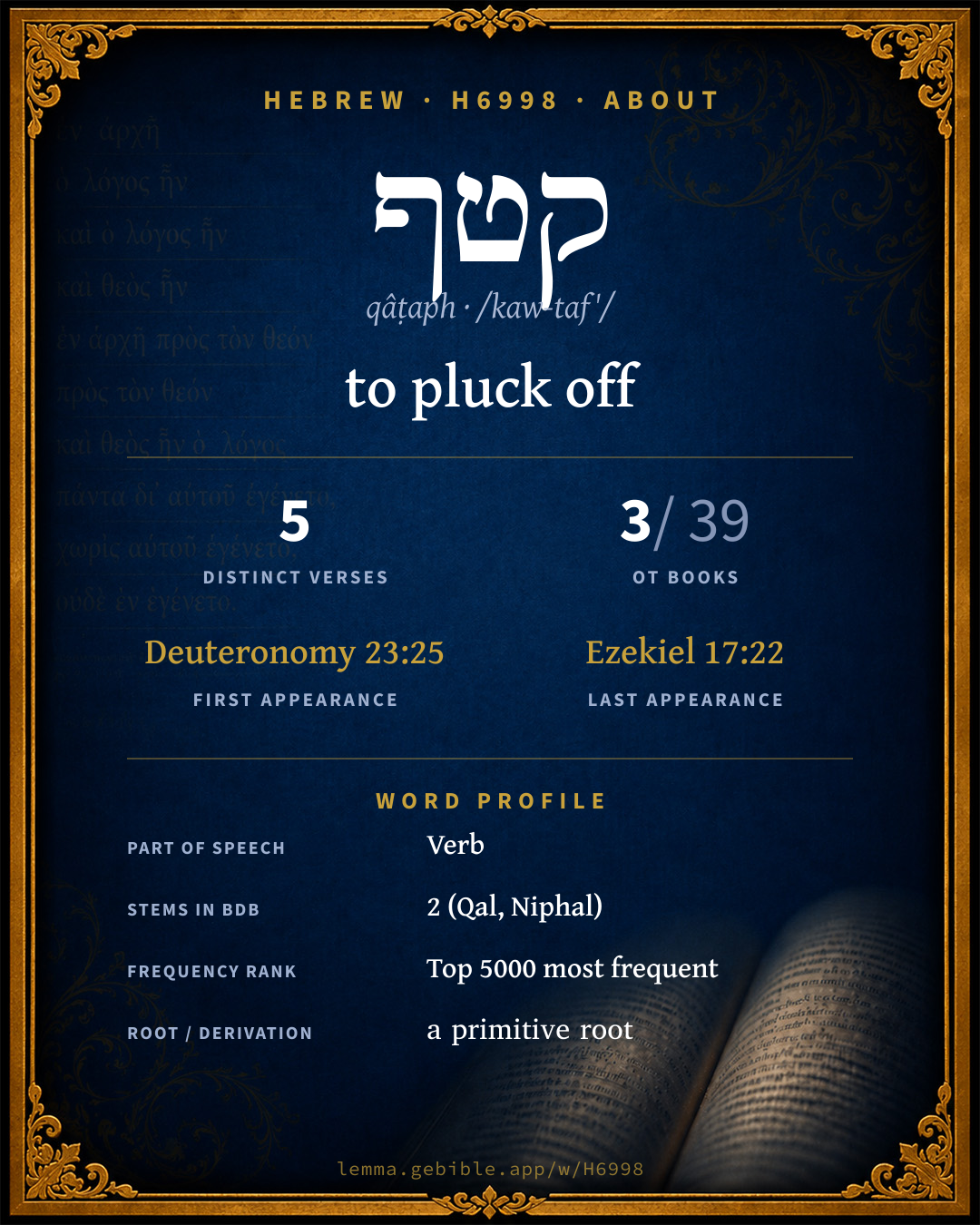
קָטַף
to pluck off
‘to pluck off’ is one of 3 main senses fuller range ↓
Full lexicon entry — Brown-Driver-Briggs (BDB)
From Brown-Driver-Briggs (BDB)
Where this word appears
See every Qal verb in the Hebrew Bible →
Grammar key — what these labels mean
Part of speech
- Verb
- An action or state-of-being word.
Stem
- Qal
- The basic, simple active stem — the plain form of the verb (“he wrote”).
- Niphal
- Usually the simple passive or reflexive of the Qal (“he was written”).
Form
- Sequential Perfect
- A perfect with prefixed waw continuing a preceding imperfect or command (waw-consecutive perfect).
- Participle Active
- A verbal adjective expressing ongoing or characteristic action (“writing / one who writes”).
- Imperfect
- An incomplete, ongoing, or future action (“he will / would write”).
- Perfect
- A completed action or state — Hebrew marks aspect (completeness) more than strict tense (“he wrote”).
State
- Absolute
- The independent form of a noun, not bound to a following word.
Person
- 2nd Person
- The one addressed (“you”).
- 3rd Person
- The one spoken about (“he / she / it / they”).
- 1st Person
- The speaker (“I / we”).
Gender
- Masculine
- Grammatically masculine.
- Common
- Either gender — not distinguished for this form.
Number
- Singular
- One.
- Plural
- More than one (in Hebrew, generally three or more).
Grammatical forms
- Verb, Qal, Sequential Perfect, 2nd Person, Masculine, Singular 1 time (20%)
- Verb, Qal, Participle Active, Masculine, Plural, Absolute 1 time (20%)
- Verb, Niphal, Imperfect, 3rd Person, Masculine, Singular 1 time (20%)
- Verb, Qal, Imperfect, 1st Person, Common, Singular 1 time (20%)
- Verb, Qal, Perfect, 3rd Person, Masculine, Singular 1 time (20%)
Parsed forms decoded from the imported morphology (morphhb / Westminster Leningrad Codex — WLC text public domain, morphhb tagging CC BY 4.0), counted across 5 parsed occurrences — not distinct verses.
Every verse where H6998 appears — 5 distinct verses across 3 books. Click any verse to open its interlinear word-by-word view. Verse text shown in the World English Bible for context — . Each verse’s Hebrew form is shown with its reference; the English is not keyword-highlighted, since the data carries no word-level English alignment. Use “Compare translations” on any verse to read it across multiple English versions. This concordance covers the Hebrew Bible; Septuagint (Greek Old Testament) occurrences are not indexed here.
Deuteronomy 1 verse
Job 2 verses
Ezekiel 2 verses
- Ezekiel 17:4 קָטָ֑ף Qal pf 3ms he cropped off the topmost of the young twigs of it, and carried it to a land of traffic; he set it in a city of merchants.
- Ezekiel 17:22 אֶקְטֹ֔ף Qal impf 1cs Thus says the Lord Yahweh: I will also take of the lofty top of the cedar, and will set it; I will crop off from the topmost of its young twigs a tender one, and I will plant it on a high and lofty mountain:
About this entry
At a glance — auto-summarized from this page’s data, not written by a person. Every figure links to its source below. This summary describes the numbers; it doesn’t interpret them.
The Hebrew verb קטף centers on the idea of “to pluck off.” It occurs a mere 5 verses across Scripture. Job dominates its distribution — 2 of 5 verses. First canonically at Deuteronomy 23:25, it enters the text early. Different stems carry different senses — BDB groups them under 2 stems, among them Qal and Niphal. For the data behind this summary, explore the sense tree and the renderings breakdown below.
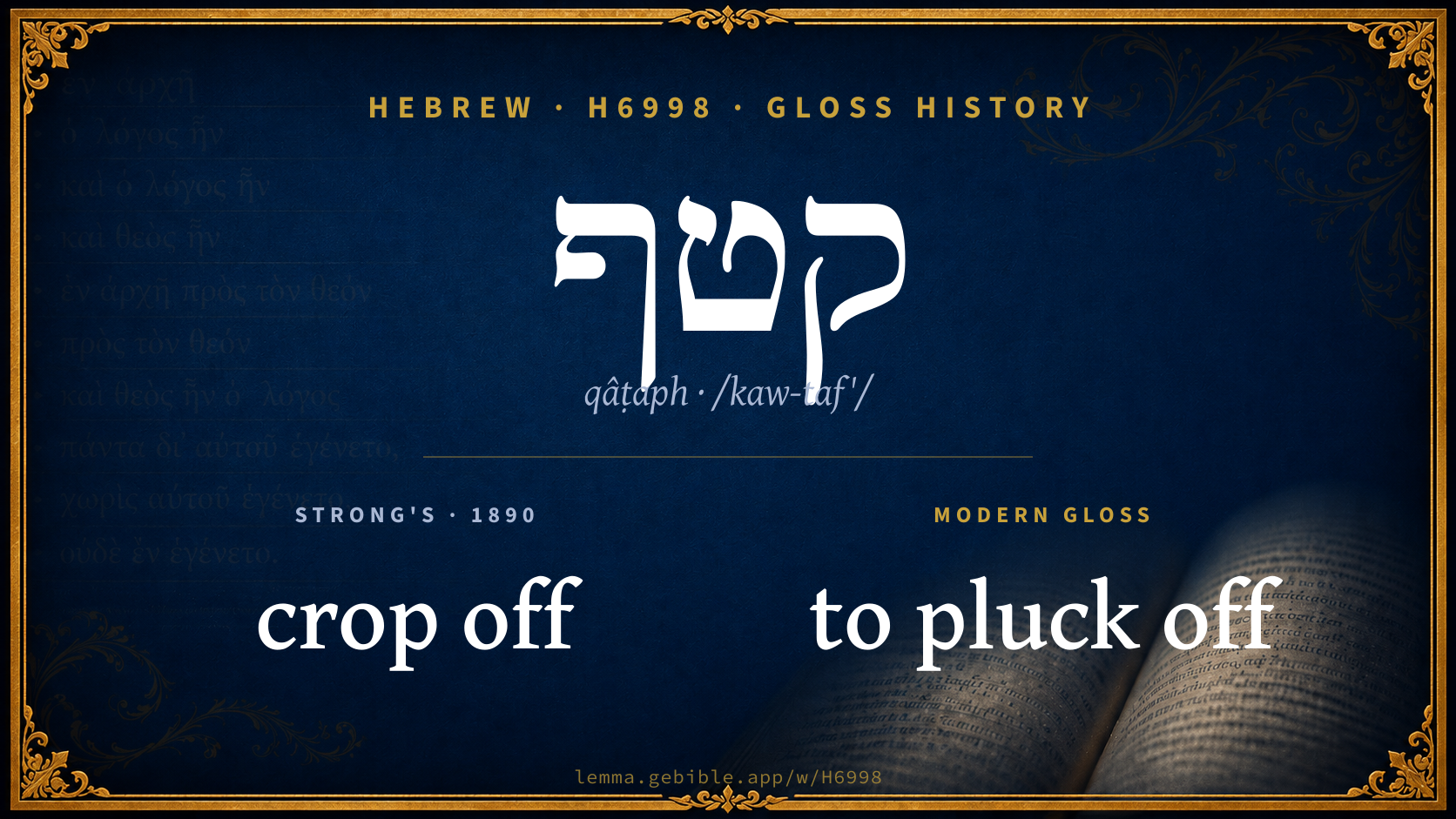
Gloss history
Strong's 1890 vs modern scholarship
About this word
Strong's H6998 catalogs a Hebrew word from the Hebrew Old Testament.
These counts are not copied from any lexicon or concordance. They are computed here, from the morphology-tagged Hebrew Old Testament. What Lemma adds →
- 5
- distinct verses
- The word appears in 5 distinct verses.
- 3 / 39
- OT books
- The word appears in 3 of 39 Old Testament books.
- #3,337
- by frequency
- Top 5000 most frequent Hebrew words (rank 3,337 of 8,640 Hebrew words by occurrence).
View all 5 occurrences in the concordance →
Most concentrated in
- Job 2 verses 40%
- Ezekiel 2 verses 40%
- Deuteronomy 1 verse 20%
By section of the Old Testament
By traditional corpus
Conventional, traditional groupings — biblical authorship is debated, so this is a traditional corpus grouping, not an authorship claim. Each share is this word’s portion of its verses in that division of the Hebrew canon. Each figure is a share of the word’s 5 distinct verses.
- Prophets (Nevi'im) 2 verses · 40%
- Writings (Ketuvim) 2 verses · 40%
- Torah (Pentateuch) 1 verse · 20%
How translations render this word
Counts come from each version’s own published word-to-Strong’s tagging or interlinear alignment — an approximate guide to how each version renders this word, not a word-level alignment the data otherwise carries. Because each total is that version’s own tagged count, the per-version totals vary from one another and need not match the appearance or distinct-verse counts above. These counts may also differ from a printed concordance because Lemma counts each distinctly tagged rendering and does not collapse phrase taggings into a single head-word total. This is a fixed set of word-tagged versions (KJV, ASV, BSB, ULT) and does not change with the reading translation you choose elsewhere. Each version’s license is shown beside its name below (and on Sources).
- King James Version: Cut down 1×, Cut up 1×, He cropped off 1×
- American Standard Version: Cut down 1×, He cropped off 1×, It 1×
- Berean Standard Bible: He plucked off 1×, I will pluck 1×, They plucked 1×
- unfoldingWord Literal Text: Broke off 1×, Cut down 1×, I will break it off 1×
King James Version Public Domain
Renders H6998 across 5 tagged occurrences — most commonly:
American Standard Version Public Domain
Renders H6998 across 5 tagged occurrences — most commonly:
Berean Standard Bible Public Domain
Renders H6998 across 4 tagged occurrences — most commonly:
Not rendered by a distinct English word in 1 further occurrence.
unfoldingWord Literal Text CC BY-SA 4.0
Renders H6998 across 6 tagged occurrences — most commonly:
Senses in the full BDB
Hebrew verbs can shift meaning by stem (binyan): Qal is the basic action, Niphal is often passive or reflexive, Piel often intensifies or makes it factitive, and Hiphil is typically causative. The senses below are grouped under the stem BDB assigns to each.
What do BDB’s symbols mean?
BDB uses these scholarly abbreviations:
| Symbol | Meaning |
|---|---|
| 𝔊 | the Septuagint (the ancient Greek translation, LXX) |
| 𝔙 | the Vulgate (the Latin translation) |
| 𝔖 | the Syriac version (the Peshitta) |
| 𝔗 | the Targum (the Aramaic translation) |
| ψ | the Psalms |
| √ | root (the underlying root or stem) |
| ‖ | parallel passage (a synonymous or contrasted parallel) |
| † | the dagger: every passage where the word occurs is cited |
The 2 senses and sub-senses the full Brown-Driver-Briggs lexicon distinguishes for this word, in lexicon order (not ranked by frequency), with BDB’s own verbatim wording and sub-sense lettering. Shown in Hebrew script with BDB’s own scholarly abbreviations. The condensed entry is in the Lexicon Entry tab. See also the Forms in the corpus table below.
Qal
- Pf. 3 ms. קָטָ֑ף Ez 17:4 he [i.e. eagle, in fig.] plucked off twigs; 2 ms. וְקָטַפְתָּ֫ Dt 23:26 (ears of grain, בְּיָדֶ֑ךָ); Impf. 1 s. אֶקְטֹף Ez 17:22 (subj. י׳; acc. + מִן from); Pt. mpl. הַקֹּטְפִים Jb 30:4 they who pluck out the mallow. e.g. Ezekiel 17:4
Niphal
- Impf. 3 ms. יִקָּטֵ֑ף Jb 8:12 it is not plucked off. e.g. Job 8:12
Senses from the full Brown-Driver-Briggs lexicon (Brown, Driver, Briggs; Oxford 1906 — public domain), digitized via Sefaria, supplemented by the OpenScriptures HebrewLexicon (CC BY 4.0). Full attribution on Sources.
Word origin
vb. pluck off (twigs, etc.), or out (NH = BH; Arabic قَطَفَ pluck grapes; 𝔗 קְטַף, Syriac ܩܛܰܦ; cf. Assyrian ḳatâpu, appar. pluck off);—
— Brown-Driver-Briggs (Oxford 1906, public domain), digitized via Sefaria, supplemented by the OpenScriptures HebrewLexicon (CC BY 4.0). See Sources.
Origin: a primitive root
Jastrow Dictionary
A second Hebrew/Aramaic lexicon for comparison, covering Aramaic and post-biblical (Talmudic, Targumic, Midrashic) usage that the biblical-Hebrew BDB does not. Matched by lemma rather than by Strong’s number, so a lemma may carry more than one Jastrow headword (shown separately below), and the entries cover usage well beyond the Bible.
קָטַף
- to cut, break off, pluck. Lam. R. to I, 12, v. עוֹלֵלָה.—Part. pass. קָטוּף; f. קְטוּפָה. Ber. 47ᵃ; Tosef. Meg. IV (III), 27, a. e. אמן ק׳, v. infra.—Pirké d’R. El. ch. XXIX עוללות קְטוּפִין premature (undeveloped) grapes.
- to be plucked, broken off. Tosef. l. c. העונה אמן … קטופה יִקָּטְפוּ שנותיו he who pronounces a broken Amen (v. אָמֵן II), his years shall be broken off; Ber. l. c. יִתְקַטְּפוּ; Y. ib. VIII, end, 12ᶜ תִּקָּטֵף נשמתו his soul shall be plucked off (he shall die before his time).
- 1. same. Esth. R. to I, 9, v. עוֹלֵלָה.—Esp. ק׳ בעוללות [to do plucking among the small single bunches,] to initiate persecution with attempts to destroy the young generation. Gen. R. s. 42 הראשון התחיל מְקַטֵּף בע׳ וכ׳ the first enemy began with breaking off the young bunches, the second with thinning the clusters (v. וִּנֵּב) &c.; Lev. R. s. 11; Ruth R. introd. (ושם האיש).—Nidd. 66ᵇ בנתר משום דמקטף she must not wash her head with natron, because it plucks (uproots) the weakly rooted hairs (which left on the head prevent the water from immediate contact with the body; v. חוּץ I); a. fr.—Trnsf. (of fire) to creep along the ground of a field, opp. קָדַח. Y. B. Kam. VI, 5ᶜ top במְקַטֶּפֶת (Bab. ib. 61ᵃ בנכפפת), v. קָדַח.
- 2. to tear in pieces a lump of dough to form cakes, for which purpose the kneader moistens his hands with water, oil &c.; hence: to form dough and smoothen its surface. Y. Pes. II, end, 29ᶜ אין לשין … אבל מְקַטְּפִין וכ׳ you must not knead unleavened bread (for the Passover night) with liquors (juice of fruit, oil &c.) but you may form it with liquors; Bab. Pes. 36ᵃ. Ib. את שלשין בו מקטפין בו only such liquid as may be used for kneading, should be used for forming. Ib. 42ᵃ אחד שמְקַטֶּפֶת וכ׳ one vessel in which she dips her hand when forming the cakes, and another &c.; a. e.—Part. pass. מְקוּטָּף; f. מְקוּטֶּפֶת &c. broken off, nipped Midr. Till. to Ps. LXXIII, 4 האשה … אחת מק׳ ואחת מעוכה ed. Bub. (ed. מעוסה, corr. acc.) when a woman spins a yarn, once a thread is broken (and must be knotted), and once it is rubbed off (crumbled, too thin). Gen. R. s. 99 יצא … ואזניו מק׳ Reuben came forth with his ears clipped (his pride humbled); (comment.: his ears hanging down like a nipped plant, i.e. saddened).
קְטַף I
- Targ. O. Lev. XXV, 11 (Y. Pa.; h. text בצר). Targ. Deut. XXIII, 26. Targ. I Sam. II, 31 (h. text גדע). Targ. Ez. V, 11 (h. text !גרע); a. fr.—Lam. R. to I, 22 קַטֵּיף … דקְטַפְתְּ וכ׳, v. עוֹלְלָא. Y. Gitt. III, end, 45ᵇ דאינון קָטְפִין בתר קדימתא וכ׳ (not קדמיתא) they cut the grapes after the first east wind after Succoth; a. fr.—Part. pass. קְטִיף. Koh. R. to XI, 9 כדון נחירך ק׳ וכ׳ now that thy nose is nipped (hanging down like a faded plant), thy ear heavy of hearing &c.
- 1. same. Targ. Y. Lev. XXV, 11; a. e.—Lam. R. l. c., v. supra.—2) same.
- to break off, interrupt. Ab. Zar. 72ᵇ דקא מְקַטֵּיף קַטּוּפֵי (Rashi דמפסוקי פסוקי, read דמפסיק) he breaks off (the connection of the flow, withdraws the pouring vessel before the jet reaches the vessel into which the wine is poured). Ib. קַטְּפוּ קטופי (not קטפי; Ar. ed. Koh. קטיפתו) interrupt you the flow!
- to be broken off, lopped, mutilated. Targ. Is. XLVI, 1, sq. (h. text קרס). Targ. Jer. XLVIII, 25 (h. text נגדע); a. fr.
קְטָף
- (preced.) [incision,] resin gained by tapping, balsam; עץ הק׳ (or sub. עץ) balsam-tree. Shebi. VII, 6 אין לק׳ וכ׳ the law of the Sabbatical year does not apply to the balsam tree; Tosef. ib. V, 12 יש לק׳ שביעית (ed. Zuck. לקט בש׳, corr. acc.) the law does apply; Y. Orl. I, 61ᵇ bot. Nidd. 8ᵇ קְטָפוֹ זה פריו its resin is its fruit. Ker. 6ᵃ הצרי … מעצי ק׳ tsŏri is the sap that drips from resinous trees. Gen. R. s. 91, v. בַּלְסָם; a. fr.
קְטַף II
- Targ. Gen. XXXVII, 25. Ib. XLIII, 11 (Y. קָטָף). Targ. Y. I Ex. XXX, 34 (Y. II ed. Vien. קְטַב, corr. acc.; h. text נטף); a. e.—Ab. Zar. 35ᵇ ק׳ דגוזא, v. גַּוָּוזָא I; ק׳ דפירי the sap which flows out of incisions in fruits; Nidd. 8ᵇ. Ib. ק׳ פירא resin is considered as fruit (v. preced.). Ber. 48ᵃ מקִּטְפֵיה, v. בּוּצִינָא; a. e.
קְטַף III
- (קְטַף) plucking, cutting grapes, vintage. Targ. Mic. VII, 1 (ed. Lag. a. oth. קְטוֹף). Targ. Lev. XXVI, 5. Targ. Jer. XLVIII, 32; a. e.
A Dictionary of the Targumim, the Talmud Babli and Yerushalmi, and the Midrashic Literature (Marcus Jastrow; London, Luzac, 1903) — Public Domain. Digitized via Sefaria. Digitized via Sefaria. Full attribution on Sources.
Forms in the corpus
The 5 distinct written forms H6998 takes in the Hebrew Bible, most frequent first — each parse links to that stem’s occurrences in the concordance. Hebrew forms include their vowel points and cantillation, so a single lemma takes many written forms.
| Form | Parsing | Example | Uses |
|---|---|---|---|
| אֶקְטֹ֔ף | Verb, Qal, Imperfect, 1st Person, Common, Singular | Ezekiel 17:22 | 1 |
| הַ/קֹּטְפִ֣ים | Verb, Qal, Participle Active, Masculine, Plural, Absolute | Job 30:4 | 1 |
| וְ/קָטַפְתָּ֥ | Verb, Qal, Sequential Perfect, 2nd Person, Masculine, Singular | Deuteronomy 23:25 | 1 |
| יִקָּטֵ֑ף | Verb, Niphal, Imperfect, 3rd Person, Masculine, Singular | Job 8:12 | 1 |
| קָטָ֑ף | Verb, Qal, Perfect, 3rd Person, Masculine, Singular | Ezekiel 17:4 | 1 |
Septuagint verse parallels
This word appears in 5 verses that also exist in the Greek Old Testament (Septuagint), out of the 5 Hebrew verses it occurs in. You can read those verses in Greek by switching the Old Testament edition to the Septuagint.
Read these verses in the Septuagint
This is a verse-level parallel only — the same verses exist in both the Hebrew and Greek Old Testaments. No word-level Hebrew↔Greek correspondence is claimed: the data carries no such alignment, so no Greek word is shown as this Hebrew word’s translation. Coverage is not total — the Septuagint omits the deuterocanon and renumbers the Psalms, so some Hebrew verses have no direct Greek parallel.