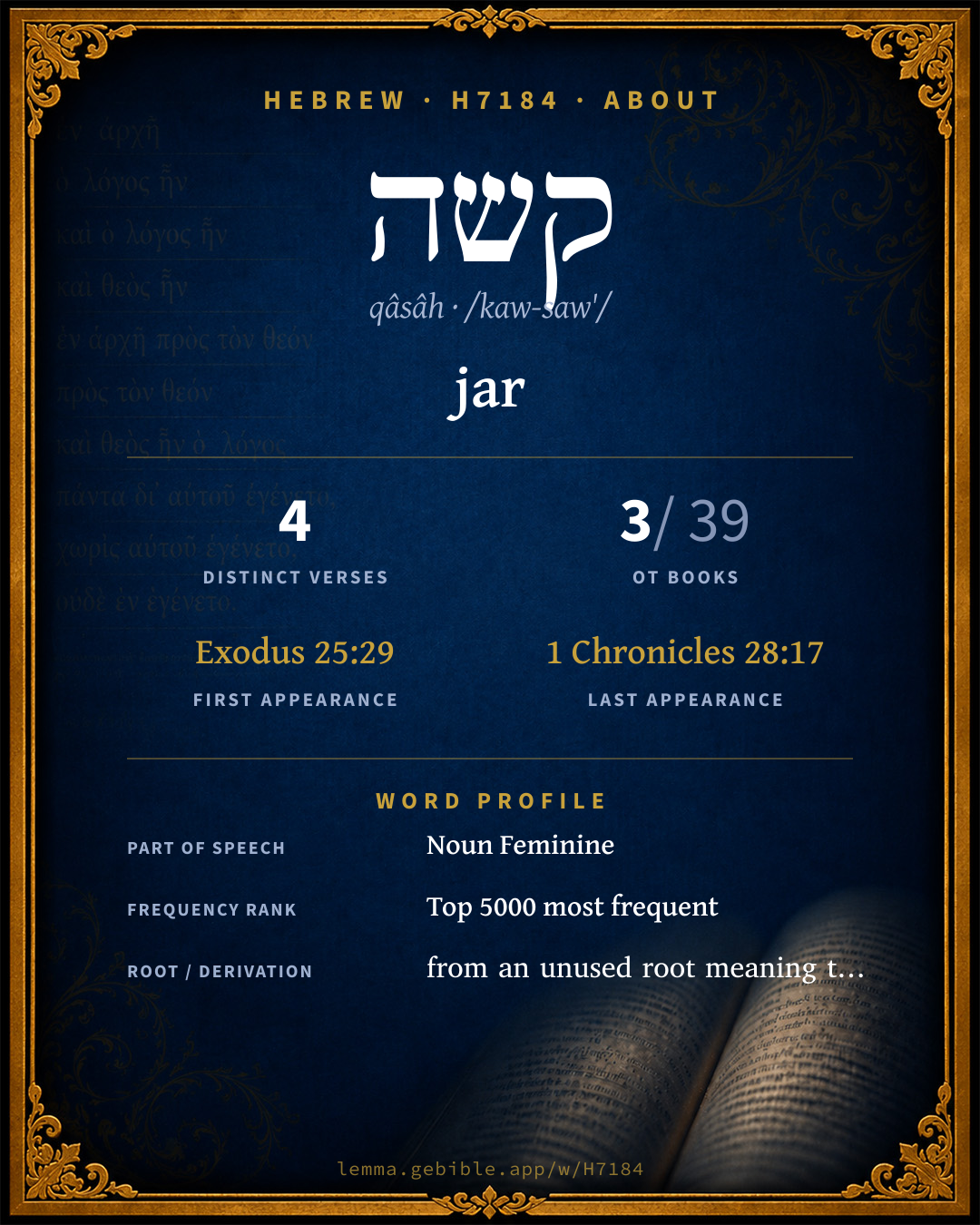
קַשְׂוָה
jar
Full lexicon entry — Brown-Driver-Briggs (BDB)
From Brown-Driver-Briggs (BDB)
Where this word appears
See every Absolute-state word in the Hebrew Bible →
Grammar key — what these labels mean
Part of speech
- Noun
- A naming word — a person, place, thing, or idea.
Noun type
- Common
- A common noun — a general class of person, place, or thing (“king,” “city,” “water”), not a specific name.
State
- Construct
- A noun bound to a following noun in a possessive / “of” relationship (the construct chain).
- Absolute
- The independent form of a noun, not bound to a following word.
Gender
- Feminine
- Grammatically feminine.
Number
- Plural
- More than one (in Hebrew, generally three or more).
Grammatical forms
- Noun, Common, Feminine, Plural, Construct 2 times (50%)
- Noun, Common, Feminine, Plural, Absolute 2 times (50%)
Parsed forms decoded from the imported morphology (morphhb / Westminster Leningrad Codex — WLC text public domain, morphhb tagging CC BY 4.0), counted across 4 parsed occurrences — not distinct verses.
Every verse where H7184 appears — 4 distinct verses across 3 books. Click any verse to open its interlinear word-by-word view. Verse text shown in the World English Bible for context — . Each verse’s Hebrew form is shown with its reference; the English is not keyword-highlighted, since the data carries no word-level English alignment. Use “Compare translations” on any verse to read it across multiple English versions. This concordance covers the Hebrew Bible; Septuagint (Greek Old Testament) occurrences are not indexed here.
Exodus 2 verses
- Exodus 25:29 וּ/קְשׂוֹתָי/ו֙ conj + n c fp cs + sfx pers 3ms You shall make its dishes, its spoons, its ladles, and its bowls to pour out offerings with. Of pure gold shall you make them.
- Exodus 37:16 הַ/קְּשָׂוֺ֔ת ptcl def.art + n c fp He made the vessels which were on the table, its dishes, its spoons, its bowls, and its pitchers with which to pour out, of pure gold.
Numbers 1 verse
1 Chronicles 1 verse
About this entry
At a glance — auto-summarized from this page’s data, not written by a person. Every figure links to its source below. This summary describes the numbers; it doesn’t interpret them.
קשה — transliterated qâsâh — is a Hebrew noun carrying the sense “jar.” The Hebrew Bible uses it only 4 verses. Its uses cluster heavily in Exodus (50% of all occurrences). Its earliest occurrence is Exodus 25:29. See the sense tree, 4-verse concordance, and the renderings breakdown below.
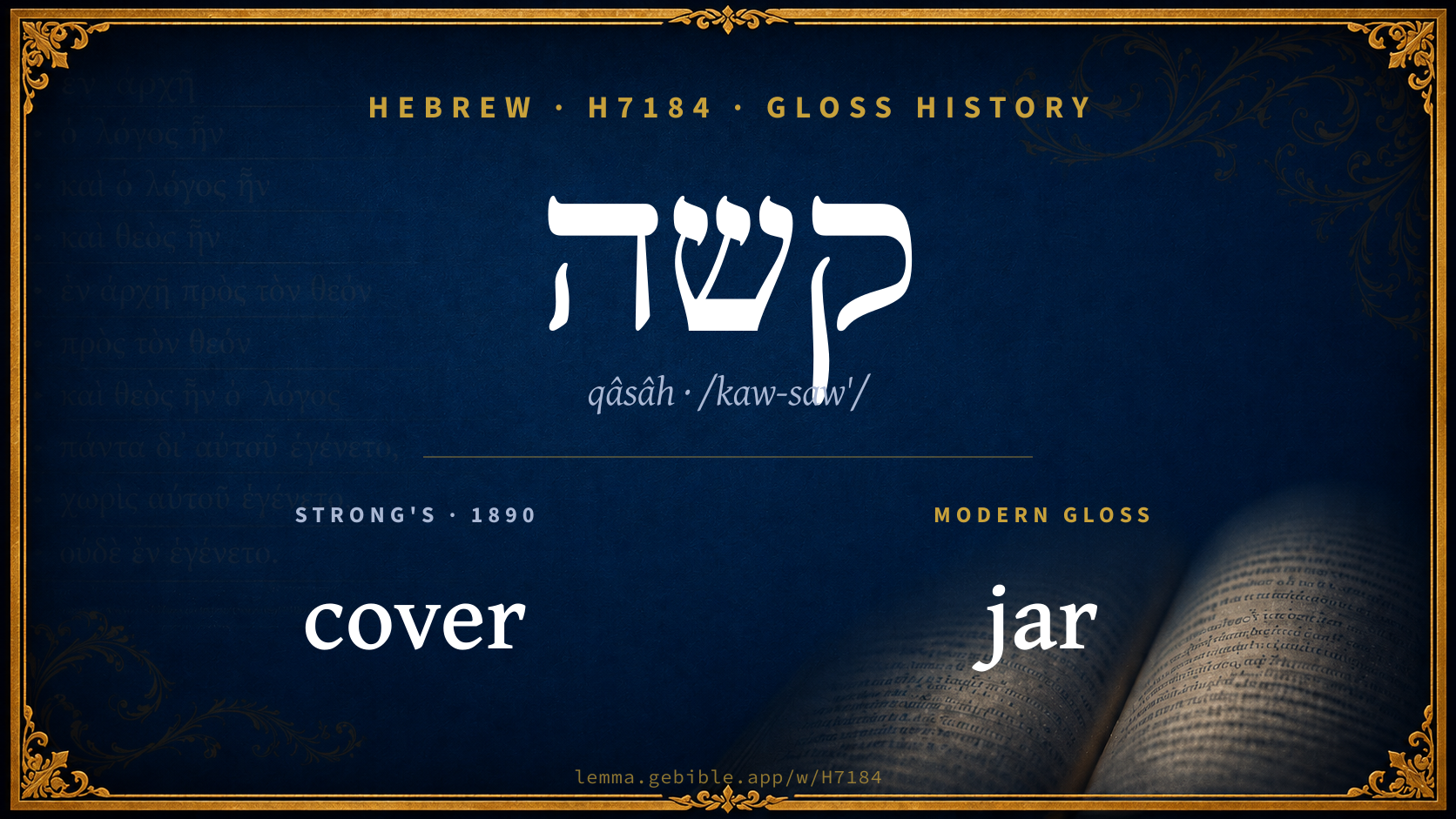
Gloss history
Strong's 1890 vs modern scholarship
About this word
Strong's H7184 catalogs a Hebrew word from the Hebrew Old Testament.
These counts are not copied from any lexicon or concordance. They are computed here, from the morphology-tagged Hebrew Old Testament. What Lemma adds →
- 4
- distinct verses
- The word appears in 4 distinct verses.
- 3 / 39
- OT books
- The word appears in 3 of 39 Old Testament books.
- #3,696
- by frequency
- Top 5000 most frequent Hebrew words (rank 3,696 of 8,640 Hebrew words by occurrence).
View all 4 occurrences in the concordance →
Most concentrated in
- Exodus 2 verses 50%
- Numbers 1 verse 25%
- 1 Chronicles 1 verse 25%
By section of the Old Testament
By traditional corpus
Conventional, traditional groupings — biblical authorship is debated, so this is a traditional corpus grouping, not an authorship claim. Each share is this word’s portion of its verses in that division of the Hebrew canon. Each figure is a share of the word’s 4 distinct verses.
- Torah (Pentateuch) 3 verses · 75%
- Writings (Ketuvim) 1 verse · 25%
How translations render this word
Counts come from each version’s own published word-to-Strong’s tagging or interlinear alignment — an approximate guide to how each version renders this word, not a word-level alignment the data otherwise carries. Because each total is that version’s own tagged count, the per-version totals vary from one another and need not match the appearance or distinct-verse counts above. These counts may also differ from a printed concordance because Lemma counts each distinctly tagged rendering and does not collapse phrase taggings into a single head-word total. This is a fixed set of word-tagged versions (KJV, ASV, BSB, ULT) and does not change with the reading translation you choose elsewhere. Each version’s license is shown beside its name below (and on Sources).
- King James Version: Covers 2×
- American Standard Version: Bowls thereof 1×, Cups 1×, Spoons thereof 1×
- Berean Standard Bible: Pitchers 3×
- unfoldingWord Literal Text: Pitchers 3×
King James Version Public Domain
Renders H7184 across 4 tagged occurrences — most commonly:
Plus 2 renderings that appear only once — usually multi-word phrases or single function words the recovered tagging swept in, not distinct renderings.
American Standard Version Public Domain
Renders H7184 across 3 tagged occurrences — most commonly:
Berean Standard Bible Public Domain
Renders H7184 across 4 tagged occurrences — most commonly:
Plus 1 rendering that appears only once — usually multi-word phrases or single function words the recovered tagging swept in, not distinct renderings.
unfoldingWord Literal Text CC BY-SA 4.0
Renders H7184 across 4 tagged occurrences — most commonly:
Plus 1 rendering that appears only once — usually multi-word phrases or single function words the recovered tagging swept in, not distinct renderings.
Senses in BDB
The 1 sense BDB distinguishes for this word, in lexicon order (not ranked by frequency or importance). The full entry — with sub-senses — is in the Lexicon Entry tab.
- a kind of jug, jar
Word origin
[ קַשְׂוָה ] n.f. a kind of jug, jar, utensil of tabern. and (Ch) temple
— Brown-Driver-Briggs (Oxford 1906, public domain), digitized via Sefaria, supplemented by the OpenScriptures HebrewLexicon (CC BY 4.0). See Sources.
Origin: from an unused root meaning to be round
Jastrow Dictionary
A second Hebrew/Aramaic lexicon for comparison, covering Aramaic and post-biblical (Talmudic, Targumic, Midrashic) usage that the biblical-Hebrew BDB does not. Matched by lemma rather than by Strong’s number, so a lemma may carry more than one Jastrow headword (shown separately below), and the entries cover usage well beyond the Bible.
קָשָׁה
- , v. קשי
קְשֵׁה
- , v. קְשֵׁי
קָשֶׁה
- , קָשָׁה f. (b. h.; preced.) stiff, hard, difficult, severe; strong. Tosef. Sabb. IX (X), 2 שני זייפין מן הק׳ וכ׳ (some ed. הקַשׁ) two of the stiffest bristles of the swine; Sabb. 90ᵇ מקָשָׁה של חזיר אחת carrying one of the stiff bristles of the swine is punishable. Taan. 20ᵇ ק׳ כארז, v. קָנֶה. B. Bath. 88ᵇ ק׳ עונשן של וכ׳ the responsibility for fraud in measures is severer than that for incest. Ib. ק׳ גזל הדיוט וכ׳ robbing an individual is worse than robbing the altar. Gen. R. s. 26, end ק׳ היא המחלוקת וכ׳ strife is as bad as (the sins of) the generation of the flood. Gen. R. s. 71 ק׳ היא התפלה וכ׳ prayer is a powerful factor, for it reversed the divine decree. Taan. 8ᵃ שלמודו ק׳ עליו וכ׳ to whom his study is as hard as iron. Ib. 8ᵇ (in Chald. dict.) ק׳ יומא וכ׳, v. קָשֵׁי. Ex. R. s. 6 היה ק׳ בעיניהם וכ׳ it seemed too hard a task for them to give up idolatry; a. v. fr.—Erub. 83ᵇ בק׳ with difficulty, v. נַחַת.—[Num. R. s. 16 end קשה ערפם, v. קְשִׁי.]—Pl. קָשִׁים, קָשִׁין; קָשׁוֹת. Yeb. 47ᵇ, a. e. ק׳ גרים וכ׳, v. סַפַּחַת. Sot. 2ᵃ ק׳ לזווגן (Snh. 22ᵃ קשה), v. זָוַג. Pes. 118ᵃ ק׳ … כקריעת וכ׳ the providential support of man is as difficult (wonderful) as the splitting of the Red Sea. Ib. ק׳ … כפלים וכ׳ man’s support is twice as hard (painful) as travailing. Ber. 57ᵇ (etymolog. play on קישואים) מפני שהם ק׳ לגוף וכ׳ because they are as hard on the body as swords. Koh. R. to XII, 7 נבואות ק׳ hard (evil) prophecies; a. v. fr.
קשי
- (b. h.) to be stiff, hard, difficult. Y. Ber. I, 2ᶜ top קָשְׁתָה על דעתך this is difficult according to (not reconcilable with) thy opinion; ib. למה א"ל קשתה (not קשתיה) why did he say to him, it is difficult?—V. קָשֶׁה.
- (קִישְּׁתָה, with לילד or without) to have hard labor in travailing. Ḥull. IV, 1 בהמה המְקַשָּׁה לילד וכ׳ if an animal is in labor, and &c., v. עוּבָּר. Nidd. IV, 4 קִשְּׁתָה שלשה וכ׳ if she was in pain for three days within eleven days; Tosef. ib. V, 8 קִישֵּׁת, קִשֵּׁת. Ib. 10; a. fr.—[Gen. R. s. 61 שהיו מקשין וכ׳, read: מקישין, v. נָקַשׁ.]
- 1. to stiffen, harden. Nidd. 13ᵇ המַקְשֶׁה עצמו וכ׳ he who causes erection wilfully. Ex. R. s. 11 הרשע הזה ה׳ את לבו וכ׳ this wicked (Pharaoh) hardened his heart against the first three signs; a. e.
- 2. to become hard. Y. Pes. VI, 35ᵇ top שסופו להַקְשׁוֹת which gets hard in the course of time. Shebi. II, 10 אם הִקְשׁוּ וכ׳ (Y. ed. a. Bart. הוּקְשׁוּ Hof.) if they became hard (dry) and unfit for man to eat before New Year. (Y. ib. 34ᵃ bot. הקשו a. הוקשו).
- 3. to be severe. Gen. R. s. 19, opp. ריתה, v. רָתָה.
- 1. to become hard, v. supra.
- 2. to be found hard, distasteful. Tanḥ. Sh’laḥ 5; Num. R. s. 16 ה׳ הדבר והרע וכ׳ the thing was distasteful to and displeased his father.
- 1. to suffer severely (in travailing). Gen. R. s. 84 נִתְקַשֵּׁת אמו וכ׳ his mother was in hard labor at his birth.
- 2. to become hard, stiff. Tosef. Nidd. VI, 4 משׁיִתְקַשּׁוּ, v. קִשְׁקֵשׁ I, a. II. Gen. R. s. 98, a. שׁנִתְקַשֵּׁיתָה, v. קַשְׁיוּת.
- 3. to find one’s self in difficulty, to be perplexed, unable to understand or remember. Num. R. s. 15 beg. נ׳ משה במעשה וכ׳ Moses found the work of the candlestick more difficult to understand than &c.; כיון שנ׳ אמר וכ׳ when he still could not remember it, the Lord said &c. Ib.10; Tanḥ. B’haʿăl. 6 נִתְקַשֵּׁיתִי לעשותה I could not understand how to do it. Ib. נ׳ על משה it was too difficult for Moses; a. fr.
- 4. to be reluctant, strive against. Tanḥ. Sh’moth 18 כמה נ׳ יונה שלא וכ׳ how hard did Jonah strive not to go on his mission. Deut. R. s. 9 מִתְקַשֶּׁה כנגדו (the sun) refused to obey; a. e.
- 5. to make one’s self obnoxious. Gen. R. s. 61; Yalk. Chr. 1073 (play on יקשן, Gen. XXV, 2) שהיו מִתְקַשִּׁין בעולם they were obnoxious to the world (were hard to deal with); (Midr. Till. to Ps. XCII ed. Bub. שהיו בני אדם קשין). e.g. Genesis 25:2
A Dictionary of the Targumim, the Talmud Babli and Yerushalmi, and the Midrashic Literature (Marcus Jastrow; London, Luzac, 1903) — Public Domain. Digitized via Sefaria. Digitized via Sefaria. Full attribution on Sources.
Forms in the corpus
The 4 distinct written forms H7184 takes in the Hebrew Bible, most frequent first — each parse links to that state’s occurrences in the concordance. Hebrew forms include their vowel points and cantillation, so a single lemma takes many written forms.
| Form | Parsing | Example | Uses |
|---|---|---|---|
| הַ/קְּשָׂוֺ֔ת | Noun, Common, Feminine, Plural, Absolute | Exodus 37:16 | 1 |
| וְ/הַ/קְּשָׂוֺ֖ת | Noun, Common, Feminine, Plural, Absolute | 1 Chronicles 28:17 | 1 |
| וּ/קְשׂוֹתָי/ו֙ | Noun, Common, Feminine, Plural, Construct | Exodus 25:29 | 1 |
| קְשׂ֣וֹת | Noun, Common, Feminine, Plural, Construct | Numbers 4:7 | 1 |
Septuagint verse parallels
This word appears in 4 verses that also exist in the Greek Old Testament (Septuagint), out of the 4 Hebrew verses it occurs in. You can read those verses in Greek by switching the Old Testament edition to the Septuagint.
Read these verses in the Septuagint
This is a verse-level parallel only — the same verses exist in both the Hebrew and Greek Old Testaments. No word-level Hebrew↔Greek correspondence is claimed: the data carries no such alignment, so no Greek word is shown as this Hebrew word’s translation. Coverage is not total — the Septuagint omits the deuterocanon and renumbers the Psalms, so some Hebrew verses have no direct Greek parallel.