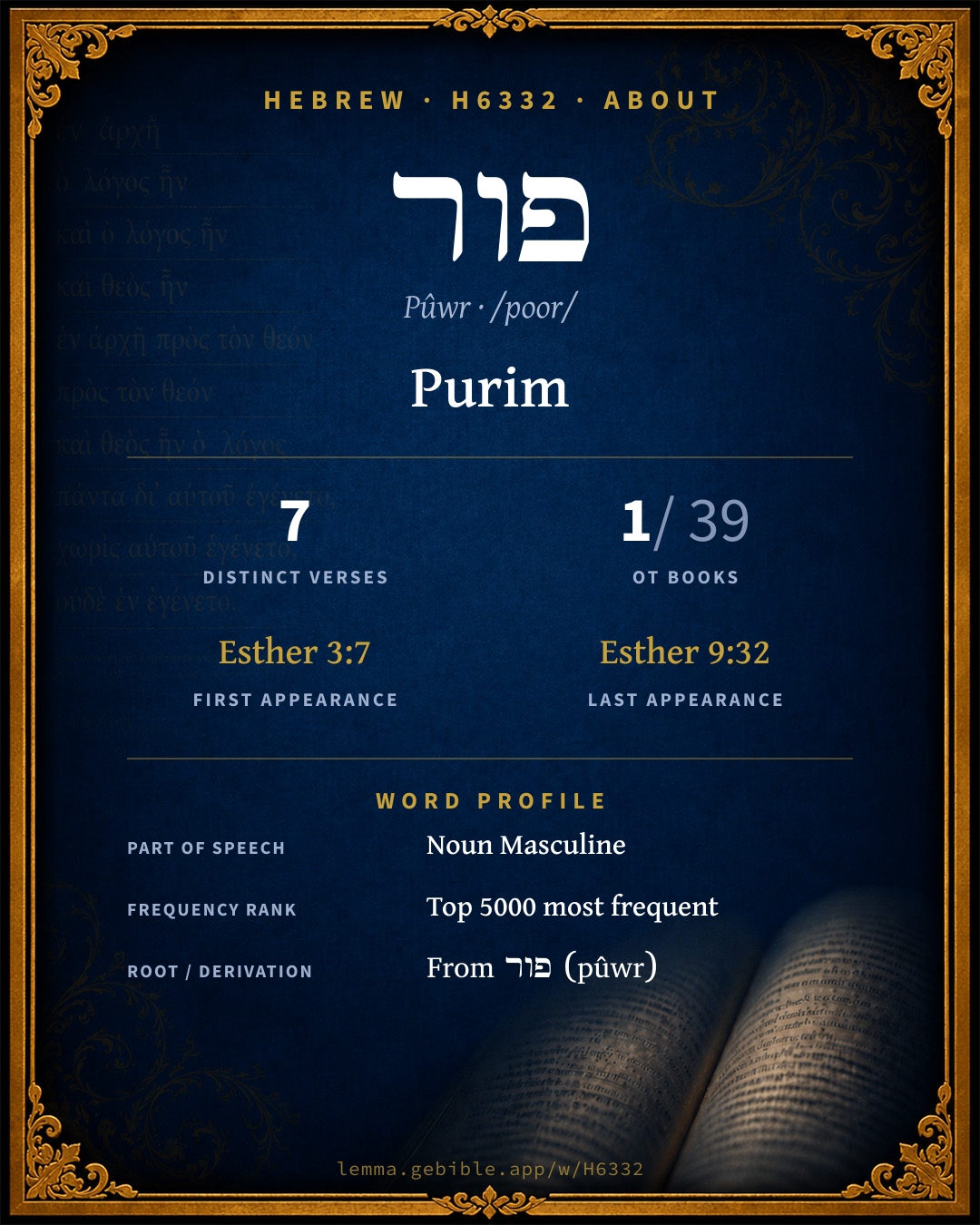
פּוּר
Purim
BDB lists 2 entries for ‘Purim’ fuller range ↓
Full lexicon entry — Brown-Driver-Briggs (BDB)
From Brown-Driver-Briggs (BDB)
Where this word appears
Grammar key — what these labels mean
Part of speech
- Noun
- A naming word — a person, place, thing, or idea.
Noun type
- Proper
- A name of a specific person, place, or people (e.g. Abraham, Zion, Israel).
- Common
- A common noun — a general class of person, place, or thing (“king,” “city,” “water”), not a specific name.
State
- Absolute
- The independent form of a noun, not bound to a following word.
Gender
- Masculine
- Grammatically masculine.
Number
- Singular
- One.
Grammatical forms
- Noun, Proper 5 times (63%)
- Noun, Common, Masculine, Singular, Absolute 3 times (38%)
Parsed forms decoded from the imported morphology (morphhb / Westminster Leningrad Codex — WLC text public domain, morphhb tagging CC BY 4.0), counted across 8 parsed occurrences — not distinct verses.
Every verse where H6332 appears — 7 distinct verses across 1 book. Click any verse to open its interlinear word-by-word view. Verse text shown in the World English Bible for context — . Each verse’s Hebrew form is shown with its reference; the English is not keyword-highlighted, since the data carries no word-level English alignment. Use “Compare translations” on any verse to read it across multiple English versions. This concordance covers the Hebrew Bible; Septuagint (Greek Old Testament) occurrences are not indexed here.
Esther 7 verses
- Esther 3:7 פּוּר֩ n c ms In the first month, which is the month Nisan, in the twelfth year of king Ahasuerus, they cast Pur, that is, the lot, before Haman from day to day, and from month to month, [to] the twelfth [month], which is the month Adar.
- Esther 9:24 פּוּר֙ n c ms because Haman the son of Hammedatha, the Agagite, the enemy of all the Jews, had plotted against the Jews to destroy them, and had cast Pur, that is the lot, to consume them, and to destroy them;
- Esther 9:26 פוּרִים֙ הַ/פּ֔וּר n Proper ptcl def.art + n c ms Therefore they called these days Purim, after the name of Pur. Therefore because of all the words of this letter, and of that which they had seen concerning this matter, and that which had come to them,
- Esther 9:28 הַ/פּוּרִ֣ים ptcl def.art + n Proper and that these days should be remembered and kept throughout every generation, every family, every province, and every city; and that these days of Purim should not fail from among the Jews, nor the memory of them perish from their seed.
- Esther 9:29 הַ/פּוּרִ֛ים ptcl def.art + n Proper Then Esther the queen, the daughter of Abihail, and Mordecai the Jew, wrote with all authority to confirm this second letter of Purim.
- Esther 9:31 הַ/פֻּרִ֨ים ptcl def.art + n Proper to confirm these days of Purim in their appointed times, according as Mordecai the Jew and Esther the queen had enjoined them, and as they had ordained for themselves and for their seed, in the matter of the fastings and their cry.
- Esther 9:32 הַ/פֻּרִ֖ים ptcl def.art + n Proper The commandment of Esther confirmed these matters of Purim; and it was written in the book.
About this entry
At a glance — auto-summarized from this page’s data, not written by a person. Every figure links to its source below. This summary describes the numbers; it doesn’t interpret them.
“Purim” is the headline sense of the Hebrew name פור (Pûwr). It clusters heavily in Esther, which alone accounts for 100% of its uses. With 7 verses in 1 book, it is an uncommon word in the Hebrew Bible. First canonically at Esther 3:7, it enters the text early. See 7-verse concordance and the renderings breakdown below.
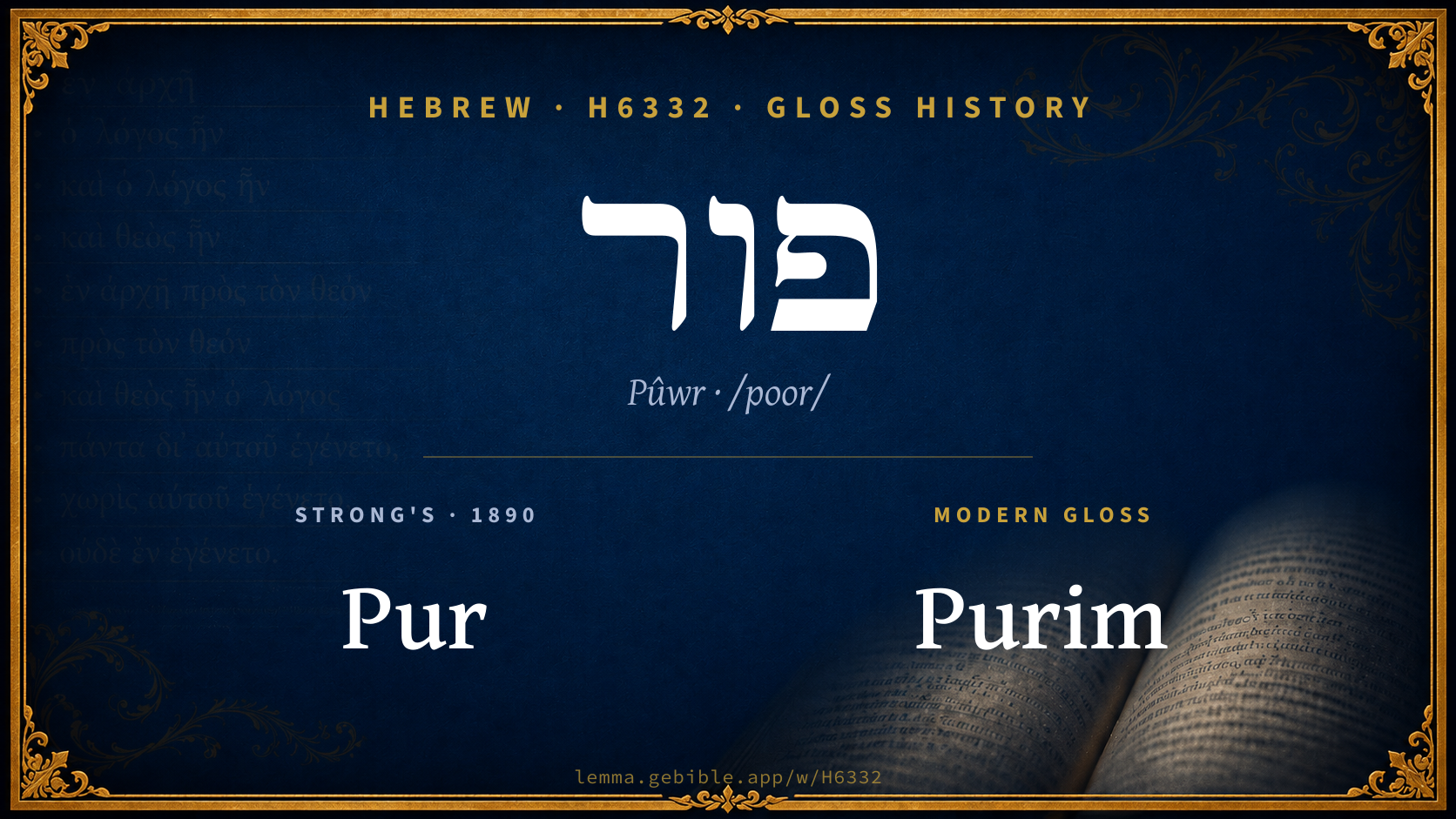
Gloss history
Strong's 1890 vs modern scholarship
About this word
Strong's H6332 catalogs a Hebrew word from the Hebrew Old Testament.
These counts are not copied from any lexicon or concordance. They are computed here, from the morphology-tagged Hebrew Old Testament. What Lemma adds →
- 7
- distinct verses
- The word appears in 7 distinct verses.
- 1 / 39
- OT books
- The word appears in 1 of 39 Old Testament books.
- #2,625
- by frequency
- Top 5000 most frequent Hebrew words (rank 2,625 of 8,640 Hebrew words by occurrence).
View all 7 occurrences in the concordance →
Most concentrated in
- Esther 7 verses 100%
By section of the Old Testament
By traditional corpus
Conventional, traditional groupings — biblical authorship is debated, so this is a traditional corpus grouping, not an authorship claim. Each share is this word’s portion of its verses in that division of the Hebrew canon. Each figure is a share of the word’s 7 distinct verses.
- Writings (Ketuvim) 7 verses · 100%
How translations render this word
Counts come from each version’s own published word-to-Strong’s tagging or interlinear alignment — an approximate guide to how each version renders this word, not a word-level alignment the data otherwise carries. Because each total is that version’s own tagged count, the per-version totals vary from one another and need not match the appearance or distinct-verse counts above. These counts may also differ from a printed concordance because Lemma counts each distinctly tagged rendering and does not collapse phrase taggings into a single head-word total. This is a fixed set of word-tagged versions (KJV, ASV, BSB, ULT) and does not change with the reading translation you choose elsewhere. Each version’s license is shown beside its name below (and on Sources).
- King James Version: Purim 5×, Pur 3×
- American Standard Version: Purim 5×, Pur 2×
- Berean Standard Bible: Pur 3×, Purim 3×
- unfoldingWord Literal Text: Purim 5×, Pur 3×
King James Version Public Domain
Renders H6332 across 8 tagged occurrences — most commonly:
American Standard Version Public Domain
Renders H6332 across 8 tagged occurrences — most commonly:
Plus 1 rendering that appears only once — usually multi-word phrases or single function words the recovered tagging swept in, not distinct renderings.
Berean Standard Bible Public Domain
Renders H6332 across 8 tagged occurrences — most commonly:
Plus 2 renderings that appear only once — usually multi-word phrases or single function words the recovered tagging swept in, not distinct renderings.
unfoldingWord Literal Text CC BY-SA 4.0
Renders H6332 across 9 tagged occurrences — most commonly:
Plus 1 rendering that appears only once — usually multi-word phrases or single function words the recovered tagging swept in, not distinct renderings.
Senses in BDB
The 2 senses BDB distinguishes for this word, in lexicon order (not ranked by frequency or importance). The full entry — with sub-senses — is in the Lexicon Entry tab.
- Pur or Purim = "lot" or " piece"
- lot
Word origin
n.m. lot (NH = BH; perhaps Assyrian loan-word from puru, buru, stone JenZA x. 339 f. and in Wild Est p. 173 f.);—expl. by הַגּוֹרָל Est 3:7; 9:24; שֵׁם הַפּוּר v 26 explains name of feast פּוּרִים v 26; יְמֵי הַפֻּרִים days of Purim v 28, 31; אִגֶּרֶת הַפּ׳ v 29, דִּבְרֵי הַפּ׳ v 32.—Vid. on Purim especially NowArch. ii. 194 ff. and reff.
— Brown-Driver-Briggs (Oxford 1906, public domain), digitized via Sefaria, supplemented by the OpenScriptures HebrewLexicon (CC BY 4.0). See Sources.
Derived from פור (pûwr) (H6331) — to break.
Jastrow Dictionary
A second Hebrew/Aramaic lexicon for comparison, covering Aramaic and post-biblical (Talmudic, Targumic, Midrashic) usage that the biblical-Hebrew BDB does not. Matched by lemma rather than by Strong’s number, so a lemma may carry more than one Jastrow headword (shown separately below), and the entries cover usage well beyond the Bible.
פּוּר
- , פִּיסָא; v. Halévy, Revue des Et. Juives XIV, p. 289 sq.) [piece, division,] lot. Sabb. 149ᵇ (ref. to חולש, Is. XIV, 12) שהיה מטיל פ׳ וכ׳ he used to cast lots on the nobles of his kingdom to find out &c. Esth. R. to III, 7 בתחלה הפיל פ׳ בימים first he cast the lot on days (of the week); הפיל פ׳ ביום אחד בשבת he cast the lot as to the first day of the week; a. e.—Ber. 16ᵇ יהי רצון שתַּשְׁכֵּן בפוּרֵינוּ וכ׳ (some ed. שתִּשְׁכּוֹן) may it be thy will to cause to dwell in our lot (that in our lot may dwell) love and brotherhood &c.; (Ms. M. בפוריינו, v. Rabb. D. S. a. l.); Y. ib. IV, 7ᵈ bot. שתשכן בפוּרְיֵינוּ (from פּוּרְיָא).—Pl. פּוּרִים, פּוּרִין. Yalk. Num. 785 they did not come spontaneously, אלא פ׳ שהטילו עליהן but lots were cast for them; a. e.—Esp. Purim, the festival commemorating the delivery of the Jews of the Persian empire from the massacre with which they were threatened through the machinations of Haman. Ab. Zar. 17ᵇ, v. מְעָה. Meg. 7ᵇ סעודת פ׳ the festive meal of Purim. B. Mets. 106ᵇ, a. e. מגבת פ׳, v. מִגְבָּה; a. fr. e.g. Isaiah 14:12
A Dictionary of the Targumim, the Talmud Babli and Yerushalmi, and the Midrashic Literature (Marcus Jastrow; London, Luzac, 1903) — Public Domain. Digitized via Sefaria. Digitized via Sefaria. Full attribution on Sources.
Forms in the corpus
The 8 distinct written forms H6332 takes in the Hebrew Bible, most frequent first — each parse links to that state’s occurrences in the concordance. Hebrew forms include their vowel points and cantillation, so a single lemma takes many written forms.
| Form | Parsing | Example | Uses |
|---|---|---|---|
| הַ/פּ֔וּר | Noun, Common, Masculine, Singular, Absolute | Esther 9:26 | 1 |
| הַ/פֻּרִ֖ים | Noun, Proper | Esther 9:32 | 1 |
| הַ/פֻּרִ֨ים | Noun, Proper | Esther 9:31 | 1 |
| הַ/פּוּרִ֛ים | Noun, Proper | Esther 9:29 | 1 |
| הַ/פּוּרִ֣ים | Noun, Proper | Esther 9:28 | 1 |
| פּוּר֙ | Noun, Common, Masculine, Singular, Absolute | Esther 9:24 | 1 |
| פּוּר֩ | Noun, Common, Masculine, Singular, Absolute | Esther 3:7 | 1 |
| פוּרִים֙ | Noun, Proper | Esther 9:26 | 1 |
Same root — word family
Other BDB entries built from the same root as H6332, grouped by Strong’s listed origin. These share a root / origin per the lexicon — not necessarily a shared meaning. Each links to that word’s own entry.
Derives from
Shares the same root
Compare all same-root words → They share a root, not necessarily a meaning.
Bible dictionary
Public-domain dictionary articles matched to this entry by name (Purim). A biblical name can be shared by more than one person or place, so an article may treat several.
Smith's Bible Dictionary · William Smith, 1863
(lots), the annual festival instituted to commemorate the preservation of the Jews in Persia from the massacre with which they were threatened through the machinations of Haman. (Esther 9:1) ... It was probably called Purim by the Jews in irony. Their great enemy Haman appears to have been very superstitious, and much given to casting lots. (Esther 3:7) They gave the name. Purim, or "Lots," to the commemorative festival because he had thrown lots to ascertain what day would be suspicious for him to carry into effect the bloody decree which the king had issued at his instance. (Esther 9:24) The festival lasted two days, and was regularly observed on the 14th and 15th of Adar. According to modern custom, as soon as the stars begin to appear, when the 14th of the month has commenced, candles are lighted up in token of rejoicing, and the people assemble in the synagogue. After a short prayer and thanksgiving, the reading of the book of Esther commences. The book is written in a peculiar manner, on a roll called "the Roll" (Megillah). When the reader comes to the name of Haman, the congregation cry out, "May his name be blotted out," or, "Let the name of the ungodly perish." When the Megillah is read through, the whole congregation exclaim, "Cursed be Haman; blessed be Mordecai; cursed be Zoresh (the wife of Haman); blessed be Esther; cursed be all idolaters; blessed be all Israelites, and blessed be Harbonah who hanged Haman." In the morning service in the synagogue, on the 14th, after the prayers, the passage is read from the law, (Exodus 17:8-16) which relates the destruction of the Amalekites, the people of Agag, (1 Samuel 15:8) the supposed ancestor of Haman. (Esther 3:1) The Megillah is then read again in the same manner. The 14th of Adar, as the very day of the deliverance of the Jews, is more solemnly kept than the 13th; but when the service in the synagogue is over, all give themselves up to merry making.
Classic public-domain reference works; full attribution on Sources.
Septuagint verse parallels
This word appears in 7 verses that also exist in the Greek Old Testament (Septuagint), out of the 7 Hebrew verses it occurs in. You can read those verses in Greek by switching the Old Testament edition to the Septuagint.
Read these verses in the Septuagint
This is a verse-level parallel only — the same verses exist in both the Hebrew and Greek Old Testaments. No word-level Hebrew↔Greek correspondence is claimed: the data carries no such alignment, so no Greek word is shown as this Hebrew word’s translation. Coverage is not total — the Septuagint omits the deuterocanon and renumbers the Psalms, so some Hebrew verses have no direct Greek parallel.