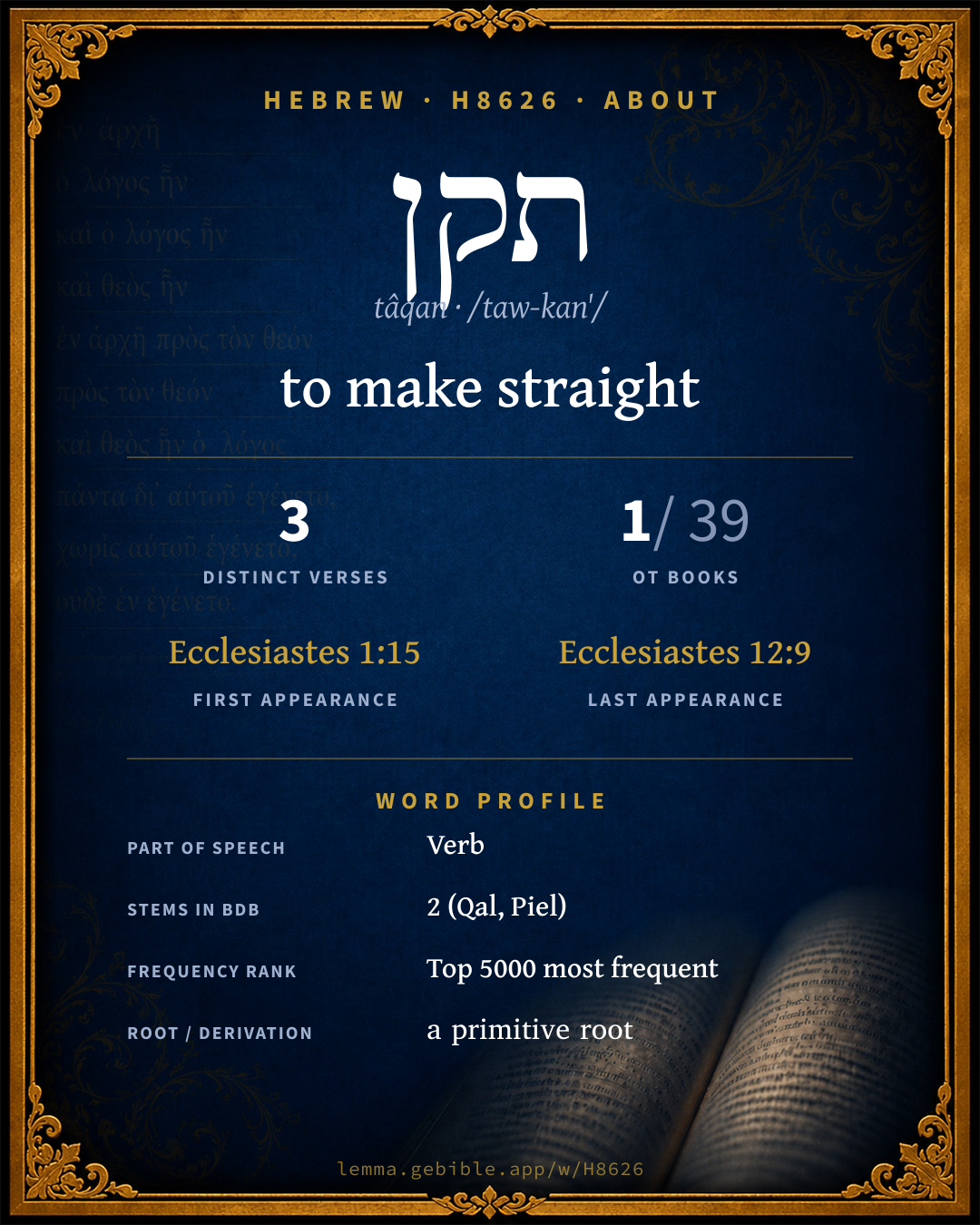
תָּקַן
to make straight
‘to make straight’ is one of 3 main senses fuller range ↓
Full lexicon entry — Brown-Driver-Briggs (BDB)
From Brown-Driver-Briggs (BDB)
Where this word appears
See every Piel verb in the Hebrew Bible →
Grammar key — what these labels mean
Part of speech
- Verb
- An action or state-of-being word.
Stem
- Piel
- An intensive or resultative active stem.
- Qal
- The basic, simple active stem — the plain form of the verb (“he wrote”).
Form
- Infinitive Construct
- A bound verbal noun, frequently with prepositions (“to write / in writing”).
- Perfect
- A completed action or state — Hebrew marks aspect (completeness) more than strict tense (“he wrote”).
Person
- 3rd Person
- The one spoken about (“he / she / it / they”).
Gender
- Masculine
- Grammatically masculine.
Number
- Singular
- One.
Grammatical forms
- Verb, Piel, Infinitive Construct 1 time (33%)
- Verb, Qal, Infinitive Construct 1 time (33%)
- Verb, Piel, Perfect, 3rd Person, Masculine, Singular 1 time (33%)
Parsed forms decoded from the imported morphology (morphhb / Westminster Leningrad Codex — WLC text public domain, morphhb tagging CC BY 4.0), counted across 3 parsed occurrences — not distinct verses.
Every verse where H8626 appears — 3 distinct verses across 1 book. Click any verse to open its interlinear word-by-word view. Verse text shown in the World English Bible for context — . Each verse’s Hebrew form is shown with its reference; the English is not keyword-highlighted, since the data carries no word-level English alignment. Use “Compare translations” on any verse to read it across multiple English versions. This concordance covers the Hebrew Bible; Septuagint (Greek Old Testament) occurrences are not indexed here.
Ecclesiastes 3 verses
- Ecclesiastes 1:15 לִ/תְקֹ֑ן prep + Qal inf.cs That which is crooked can't be made straight; and that which is lacking can't be counted.
- Ecclesiastes 7:13 לְ/תַקֵּ֔ן prep + Piel inf.cs Consider the work of God, for who can make that straight, which he has made crooked?
- Ecclesiastes 12:9 תִּקֵּ֖ן Piel pf 3ms Further, because the Preacher was wise, he still taught the people knowledge. Yes, he pondered, sought out, and set in order many proverbs.
About this entry
At a glance — auto-summarized from this page’s data, not written by a person. Every figure links to its source below. This summary describes the numbers; it doesn’t interpret them.
תקן — transliterated tâqan — is a Hebrew verb carrying the sense “to make straight.” A scarce word — 3 verses in all of the Hebrew Bible. More than three-quarters of its appearances fall in Ecclesiastes. Its earliest occurrence is Ecclesiastes 1:15. Different stems carry different senses — BDB groups them under 2 stems, among them Qal and Piel. Each statement above links to its evidence; the full detail follows below.
Gloss history
Strong's 1890 vs modern scholarship
About this word
Strong's H8626 catalogs a Hebrew word from the Hebrew Old Testament.
These counts are not copied from any lexicon or concordance. They are computed here, from the morphology-tagged Hebrew Old Testament. What Lemma adds →
- 3
- distinct verses
- The word appears in 3 distinct verses.
- 1 / 39
- OT books
- The word appears in 1 of 39 Old Testament books.
- #4,179
- by frequency
- Top 5000 most frequent Hebrew words (rank 4,179 of 8,640 Hebrew words by occurrence).
View all 3 occurrences in the concordance →
Most concentrated in
- Ecclesiastes 3 verses 100%
By section of the Old Testament
By traditional corpus
Conventional, traditional groupings — biblical authorship is debated, so this is a traditional corpus grouping, not an authorship claim. Each share is this word’s portion of its verses in that division of the Hebrew canon. Each figure is a share of the word’s 3 distinct verses.
- Writings (Ketuvim) 3 verses · 100%
How translations render this word
Counts come from each version’s own published word-to-Strong’s tagging or interlinear alignment — an approximate guide to how each version renders this word, not a word-level alignment the data otherwise carries. Because each total is that version’s own tagged count, the per-version totals vary from one another and need not match the appearance or distinct-verse counts above. These counts may also differ from a printed concordance because Lemma counts each distinctly tagged rendering and does not collapse phrase taggings into a single head-word total. This is a fixed set of word-tagged versions (KJV, ASV, BSB, ULT) and does not change with the reading translation you choose elsewhere. Each version’s license is shown beside its name below (and on Sources).
- King James Version: Be made straight 1×, Make that straight 1×, Set in order 1×
- American Standard Version: Be made straight 1×, Make that straight 1×, Set in order 1×
- Berean Standard Bible: Arranged 1×, Be straightened 1×, Straighten 1×
- unfoldingWord Literal Text: Straighten 2×
King James Version Public Domain
Renders H8626 across 3 tagged occurrences — most commonly:
American Standard Version Public Domain
Renders H8626 across 3 tagged occurrences — most commonly:
Berean Standard Bible Public Domain
Renders H8626 across 3 tagged occurrences — most commonly:
unfoldingWord Literal Text CC BY-SA 4.0
Renders H8626 across 4 tagged occurrences — most commonly:
Plus 2 renderings that appear only once — usually multi-word phrases or single function words the recovered tagging swept in, not distinct renderings.
Senses in the full BDB
Hebrew verbs can shift meaning by stem (binyan): Qal is the basic action, Niphal is often passive or reflexive, Piel often intensifies or makes it factitive, and Hiphil is typically causative. The senses below are grouped under the stem BDB assigns to each.
What do BDB’s symbols mean?
BDB uses these scholarly abbreviations:
| Symbol | Meaning |
|---|---|
| 𝔊 | the Septuagint (the ancient Greek translation, LXX) |
| 𝔙 | the Vulgate (the Latin translation) |
| 𝔖 | the Syriac version (the Peshitta) |
| 𝔗 | the Targum (the Aramaic translation) |
| ψ | the Psalms |
| √ | root (the underlying root or stem) |
| ‖ | parallel passage (a synonymous or contrasted parallel) |
| † | the dagger: every passage where the word occurs is cited |
The 2 senses and sub-senses the full Brown-Driver-Briggs lexicon distinguishes for this word, in lexicon order (not ranked by frequency), with BDB’s own verbatim wording and sub-sense lettering. Shown in Hebrew script with BDB’s own scholarly abbreviations. The condensed entry is in the Lexicon Entry tab. See also the Forms in the corpus table below.
Qal
- Inf. cstr. לִתְקֹן Ec 1:15 (opp. מְעֻוָּת bent). e.g. Ecclesiastes 1:15
Piel
- Inf. cstr. לְתַקֵּן 7:13 make straight (opp. עִוָּה); Pf. 3 ms. תִּקֵּן 12:9 put straight, arrange in order (proverbs). e.g. Ecclesiastes 7:13
Senses from the full Brown-Driver-Briggs lexicon (Brown, Driver, Briggs; Oxford 1906 — public domain), digitized via Sefaria, supplemented by the OpenScriptures HebrewLexicon (CC BY 4.0). Full attribution on Sources.
Word origin
vb. become straight (NH תִּקֵּן arrange, put right; Ecclus 47:9 תיקן set in order; Assyrian taḳânu, be well ordered, especially Pi. as NH; Aramaic ܬܩܶܢ be established, firm, Pa. ܬܰܩܶܢ, תַּקֵּין fix, arrange, prepare, etc.; Palm. Pa. erect);—
— Brown-Driver-Briggs (Oxford 1906, public domain), digitized via Sefaria, supplemented by the OpenScriptures HebrewLexicon (CC BY 4.0). See Sources.
Origin: a primitive root
Jastrow Dictionary
A second Hebrew/Aramaic lexicon for comparison, covering Aramaic and post-biblical (Talmudic, Targumic, Midrashic) usage that the biblical-Hebrew BDB does not. Matched by lemma rather than by Strong’s number, so a lemma may carry more than one Jastrow headword (shown separately below), and the entries cover usage well beyond the Bible.
תָּקַן
- v. קָנַן a. to make straight, firm, right.
- same,
- 1. to straighten, mend, repair, set in order, prepare. Sifré Deut. 308 אחד … לתַקְּנוֹ one that had a crooked staff, and gave it to a mechanic to straighten it; מְתַקְּנוֹ באור he tries to straighten it by heat; Yalk. ib. 942. Shek. I, 1 מְתַקְּנִין את הדרכים וכ׳ they put in repair the roads and the open places (stations) &c. Pesik. R. s. 28 מְתַקְּנִים את המועדות they arrange (fix the dates of) the festivals; R. Hash. I, 4. Bets. 34ᵃ אין מתקנין את השפוד וכ׳ you must not prepare (chip) a spit or sharpen it (on the Holy Day). Ib. מתקנין את הקונדס וכ׳ you may dress artichokes &c. Gitt. IV, 5 תִּקַּנְתֶּם את רבו וכ׳ you have made it right for his master but not for himself; a. fr.—Trnsf. to make things legally fit for use by giving the priestly dues. Bets. 34ᵇ עבר ותִקְּנוֹ מְתוּקָּן if he transgressed (the law forbidding the separation of priestly gifts on the Holy Day) and prepared it for use, it is prepared (the act is valid). Y. Dem. II, 23ᶜ bot. כל אחד ואחד מְתַקֵּן דמאי every one of them gives the priestly dues of his purchase as d’mai (v. דְּמַאי). Tosef. Dem. IV, 5 ודאי שתִּיקְּנָהּ דמאי if one gives the dues of what is sure to be untithed, as if it were d’mai; a. fr.
- 2. to establish, institute, introduce a legal measure, ordain. Sabb. 33ᵇ תִּקְּנוּ שווקים וכ׳, v. שׁוּק III. Ib. bot. (ref. to Gen. XXXIII, 18) מטבע תי׳ להם he introduced coinage for them. Meg. 4ᵃ, a. e. משה ת׳ להם … שיהו וכ׳ Moses introduced the custom … of discussing and studying the subject of the day &c. Sabb. 14ᵇ שמעון … ת׳ כתובה וכ׳ Simon ben Sheṭaḥ introduced the marriage contract (jointure) for the wife. Succ. V, 2, v. תִּיקּוּן; a. v. fr.—Part. pass. מְתוּקָּן; f. מְתוּקֶּנֶת; pl. מְתוּקָּנִים, מְתוּקָּנִין; מְתוּקָּנוֹת a) properly prepared, proper, good, right. Bets. 34ᵇ, v. supra. Erub. 32ᵃ, a. e. חזקה … דבר שאינו מת׳ the presumption is in favor of the Ḥaber (חָבֵר) that he will not let go out of his hands a thing not ritually prepared (tithed &c.). Tosef. Dem. IV, 8 הטבל והמת׳ שנתערבו if untithed and tithed things have been mixed up. Ib. VIII, 13 מעשרותיו מת׳ ופירותיו מקולקלין the tithes he separated are right, but his fruits are wrong (considered untithed). Ib. VI, 14 מת׳ scrupulous guardsmen. Snh. 39ᵇ כמת׳ שבהם וכ׳, v. קִלְקֵל; a. fr.—b) prepared, predestined, designated. Pesik. R. s. 27-28 לצרה הזו הייתי מת׳ am I predestined for such trouble? Ib. עד … היית מת׳ לדבר (not הייתי) before yet the world was created, thou wast designated for this thing (the prophetic mission). Tanḥ. Ki Thissa 13 שהוא מת׳ מבראשית וכ׳ that he (Bezalel) was from the time of creation designated to make the Tabernacle; a. fr. e.g. Genesis 33:18
- 1. to prepare, fit. Ab. II, 12 הַתְקֵן עצמך ללמוד וכ׳ fit thyself to study the Law, for it does not come to thee by inheritance. Ib. IV, 16, v. פְּרוֹזְדוֹר; a. e.
- 2. to ordain, establish a custom, innovate. Succ. 51ᵇ הִתְקִינוּ שיהו וכ׳ they ordained that the women should sit uptairs, and the men below. Shebi. X, 3, v. פְּרוֹזְבּוֹל. Y. R. Hash. IV, 59ᵇ bot. מַתְקִין על דבר תורה introduced a measure extending a Biblical law; מתקין על דבריהן extending a Rabbinical ordinance. Ber. IX, 5 התקינו שיהו וכ׳ they ordained that they should say, ‘from everlasting and unto everlasting’; a. fr.
- to be straightened, mended, improved. Koh. R. to I, 15 יכול להִתָּקֵן (or להִתַּקֵּן Hithpa.), v. עָוַת. Ber. 40ᵃ בדבר … בו נִתְקְנוּ (or נִתַּקְּנוּ Nithpa.) they were mended (restored) by the same thing by which they were impaired (sinned); Snh. 70ᵇ; a. e.
תְּקֵן
- , to be firm, stand (corresp. to b. h. כּוּן, כָּנן). Targ. Ps. XC, 17 יִתְקְנַן ed. Ven. (Ms. יְתַקְנַן; ed. Wil. יִתּקְּנוּן Ithpa.). Targ. Prov. XXII, 18 נִיתְקְנִין (ed. Wil. נִתּקְּנוּן Ithpa.).
- 1. to establish. Targ. Ps. IX, 8. Ib. LXXIV, 16 Ms. (ed. Af.). Targ. Is. LXII, 7. Targ. II Sam. VII, 12; a. fr.—Part. pass. מְתַקַּן. Targ. Jud. XVI, 26 (not קֵן …). Targ. Ps. LXXXIX, 38 (ed. Lag. מִיתַּקַּן Ithpa.); a. e.
- 2. to prepare, arrange, set in order; to improve, do a thing properly. Targ. Is. XL, 13 (h. text תכן). Targ. O. Ex. XVI, 5. Targ. Prov. VI, 8. Targ. Ps. XI, 2; a. e.—[Targ. O. Deut. XXII, 5, read with ed. Berl. יִתָּקַן.]—Part. pass. as ab. Targ. Ez. XVI, 13 (not קֵן …). Ib. XVIII, 12; a. fr.—Keth. 112ᵃ bot. מְתַקֵּן מתקליה repaired its offences (dangerous places on the road to Palestine); Yalk. Ps. 855. Tam. 27ᵇ תַּקֵּין נפשך put thyself in order (regulate thy bowels). Sabb. 33ᵇ איזיל אֲתַקֵּין מילתא I will go and remedy something (do something to benefit the community). Ib. איכא מילתא דבעי לתַקּוּנֵי is there anything that requires to be remedied? Zeb. 15ᵃ אפשר לתַקּוּנָהּ it can be remedied. Ib. 76ᵇ תַּקּוּנֵי גברא שאני when a person is to be made fit (restored from a disqualification), we make an exception; Men. 105ᵇ. Keth. 85ᵃ, a. fr. לתקוני שדרתיך, v. עֲוַת; a. fr.—Esp. to make fit for use by separating the priestly gifts. Gen. R. s. 60 תַּקְּנַת אילין וכ׳ hast thou tithed those figs? Ib. תַּקַּנְתּוּהוּ have you tithed it (the barley)?; a. fr.—Part. pass. as ab. Ib. אפשר … דלא מְתַקְּנַן is it possible that R. Z. should have eaten of them when they were not tithed?; a. fr.
- 3. to introduce, ordain, innovate, reform. Ber. 33ᵇ אי לאו … ותַקְּנִינְהוּ בתפלה וכ׳ were it not that Moses had said them (the words, ‘O God, great, mighty and terrible’), and the men of the Great Assembly had come and introduced them in the prayers, we could not dare to say them. Ib. תמני סרי תַּקּוּן וכ׳ eighteen benedictions they have ordained, nineteen they have not. Ib. 40ᵇ ברכה דלא תַקִּינוּ רבנן a benediction which the Rabbis have not introduced. B. Bath. 90ᵇ רב פפא … ת׳ כיילא וכ׳ Rab Papa … introduced a measure of three Ḳ’fizas. Ib. אנא … תַּקִּינִי I have introduced a new measure; a. v. fr.
- 1. to establish. Targ. Prov. III, 19. Targ. Is. XXX, 33; a. e.
- 2. to prepare, arrange, set in order &c. (v. Pa.).). Targ. Num. X, 33. Targ. Gen. XLIII, 16. Targ. Ex. XXX, 7; a. fr.
- 3. to introduce, ordain, innovate, reform. R. Hash. 34ᵃ איתקין ר׳ אבהו וכ׳ (read: אַתְ׳; Ms. M. הִתְקִין Hebr.) R. A. introduced the custom in Cæsaræa of sounding one T’ḳiʿah, three notes of Sh’barim, and one T’ḳiʿah. Ib. מאי א׳ what has he improved (what has he achieved with his ordinance)? Gitt. 86ᵃ א׳ רב יהודה וכ׳ Rab Judah introduced the formula for the sale of slaves: ‘this slave &c.’ Y. Ḥag. I, 76ᶜ ר׳ יודה … למַתְקְנָא לון וכ׳ (or למְתַקְּנָא, Pa.) R. Judah the Nasi sent out R. Ḥ…, that they should pass the towns … to institute teachers of Bible and of Mishnah for them; Midr. Till. to Ps. CXXVII; Lam. R. introd., beg. דיפקון ויַתְקְנוּן קרייתא וכ׳ (or ויתַקְּנוּן) that they should go and improve (the education of) the towns in Palestine; a. fr.
- ; Ithpe. אִיתְּקֵין, אִיתְ׳
- 1. to be established, confirmed; to be prepared, arranged. Targ. I Kings II, 46. Targ. Prov. XII, 19. Ib. XIX, 29 (ed. Wil. מְתַ׳, part. pass. Pa.); a. fr.
- 2. to be prepared, dressed; to dress, adorn one’s self. Targ. Hos. II, 15. Targ. II Esth. V, 1; a. fr.
- 3. to be instituted, ordained. B. Kam. 82ᵃ עזרא תיקן … מִיתַּקְּנָא Ezra introduced this? was it not introduced before that (by Moses)?; a. e.
תִּקָּן
- , v. תִּיקּוּן
תַּקֵּן
- , v. תַּקִּין
A Dictionary of the Targumim, the Talmud Babli and Yerushalmi, and the Midrashic Literature (Marcus Jastrow; London, Luzac, 1903) — Public Domain. Digitized via Sefaria. Digitized via Sefaria. Full attribution on Sources.
Forms in the corpus
The 3 distinct written forms H8626 takes in the Hebrew Bible, most frequent first — each parse links to that stem’s occurrences in the concordance. Hebrew forms include their vowel points and cantillation, so a single lemma takes many written forms.
| Form | Parsing | Example | Uses |
|---|---|---|---|
| לְ/תַקֵּ֔ן | Verb, Piel, Infinitive Construct | Ecclesiastes 7:13 | 1 |
| לִ/תְקֹ֑ן | Verb, Qal, Infinitive Construct | Ecclesiastes 1:15 | 1 |
| תִּקֵּ֖ן | Verb, Piel, Perfect, 3rd Person, Masculine, Singular | Ecclesiastes 12:9 | 1 |
Same root — word family
Other BDB entries built from the same root as H8626, grouped by Strong’s listed origin. These share a root / origin per the lexicon — not necessarily a shared meaning. Each links to that word’s own entry.
Derived from this word
Compare all same-root words → They share a root, not necessarily a meaning.
Septuagint verse parallels
This word appears in 3 verses that also exist in the Greek Old Testament (Septuagint), out of the 3 Hebrew verses it occurs in. You can read those verses in Greek by switching the Old Testament edition to the Septuagint.
Read these verses in the Septuagint
This is a verse-level parallel only — the same verses exist in both the Hebrew and Greek Old Testaments. No word-level Hebrew↔Greek correspondence is claimed: the data carries no such alignment, so no Greek word is shown as this Hebrew word’s translation. Coverage is not total — the Septuagint omits the deuterocanon and renumbers the Psalms, so some Hebrew verses have no direct Greek parallel.