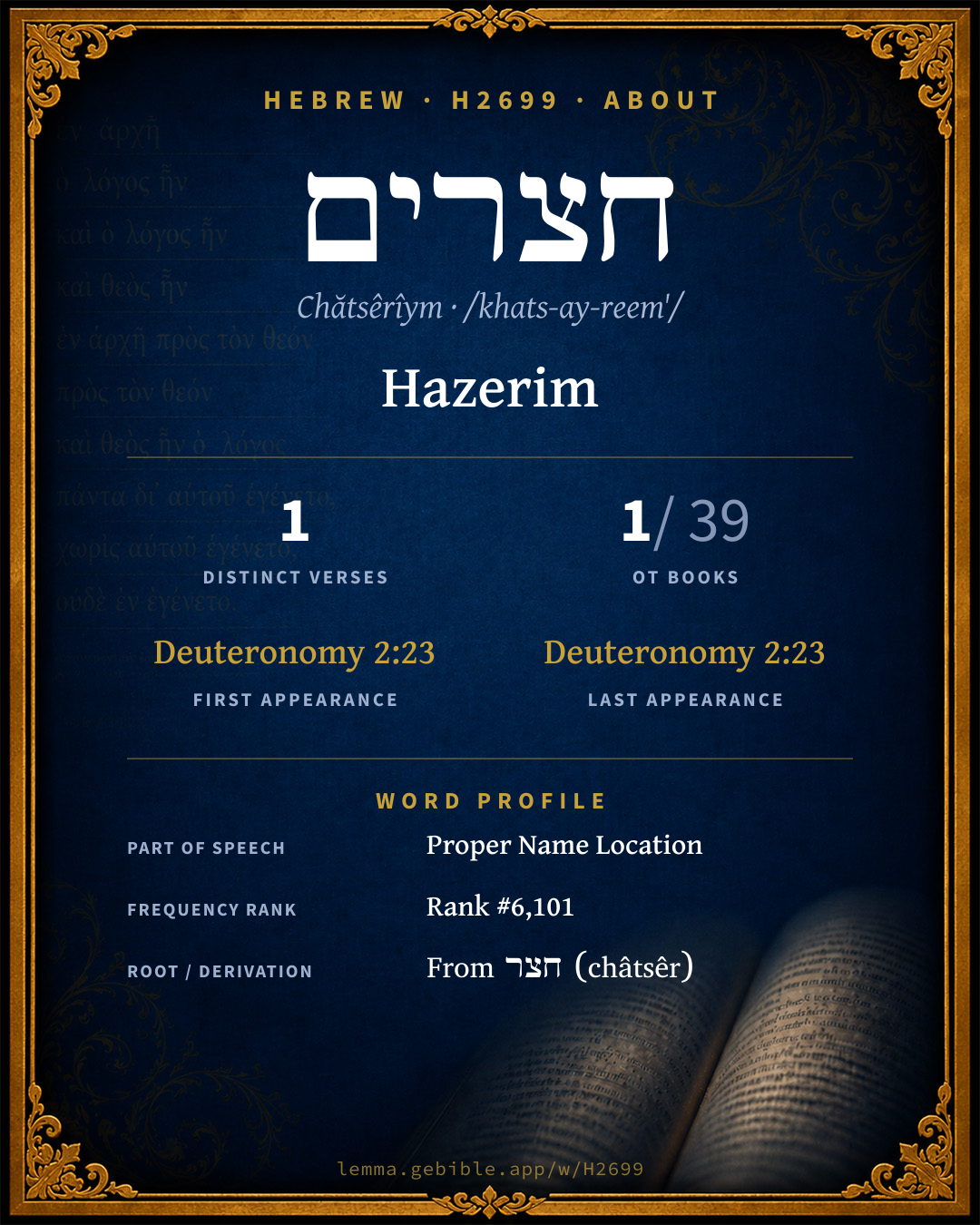
חֲצֵרִים
Hazerim
BDB lists 2 entries for ‘Hazerim’ fuller range ↓
Full lexicon entry — Brown-Driver-Briggs (BDB)
From Brown-Driver-Briggs (BDB)
Where this word appears
Grammar key — what these labels mean
Noun type
- Common
- A common noun — a general class of person, place, or thing (“king,” “city,” “water”), not a specific name.
State
- Absolute
- The independent form of a noun, not bound to a following word.
Gender
- Masculine
- Grammatically masculine.
Number
- Plural
- More than one (in Hebrew, generally three or more).
Every verse where H2699 appears — 1 distinct verse across 1 book. Click any verse to open its interlinear word-by-word view. Verse text shown in the World English Bible for context — . Each verse’s Hebrew form is shown with its reference; the English is not keyword-highlighted, since the data carries no word-level English alignment. Use “Compare translations” on any verse to read it across multiple English versions. This concordance covers the Hebrew Bible; Septuagint (Greek Old Testament) occurrences are not indexed here.
Deuteronomy 1 verse
About this entry
At a glance — auto-summarized from this page’s data, not written by a person. Every figure links to its source below. This summary describes the numbers; it doesn’t interpret them.
The Hebrew name חצרים centers on the idea of “Hazerim.” The Hebrew Bible uses it only 1 verse. The word gravitates to Deuteronomy (100%). Scripture uses it exactly once, at Deuteronomy 2:23. For the data behind this summary, explore 1-verse concordance and the renderings breakdown below.
Gloss history
Strong's 1890 vs modern scholarship
About this word
Strong's H2699 catalogs a Hebrew word from the Hebrew Old Testament.
These counts are not copied from any lexicon or concordance. They are computed here, from the morphology-tagged Hebrew Old Testament. What Lemma adds →
- 1
- distinct verses
- The word appears in 1 distinct verse.
- 1 / 39
- OT books
- The word appears in 1 of 39 Old Testament books.
- #6,101
- by frequency
- Rank #6,101 (rank 6,101 of 8,640 Hebrew words by occurrence).
View all 1 occurrence in the concordance →
Most concentrated in
- Deuteronomy 1 verse 100%
By section of the Old Testament
By traditional corpus
Conventional, traditional groupings — biblical authorship is debated, so this is a traditional corpus grouping, not an authorship claim. Each share is this word’s portion of its verses in that division of the Hebrew canon. Each figure is a share of the word’s 1 distinct verse.
- Torah (Pentateuch) 1 verse · 100%
How translations render this word
Counts come from each version’s own published word-to-Strong’s tagging or interlinear alignment — an approximate guide to how each version renders this word, not a word-level alignment the data otherwise carries. Because each total is that version’s own tagged count, the per-version totals vary from one another and need not match the appearance or distinct-verse counts above. These counts may also differ from a printed concordance because Lemma counts each distinctly tagged rendering and does not collapse phrase taggings into a single head-word total. This is a fixed set of word-tagged versions (KJV, ASV, BSB, ULT) and does not change with the reading translation you choose elsewhere. Each version’s license is shown beside its name below (and on Sources).
BDB lists this Strong’s number as 2 distinct words (homographs). Each count above pools all of them and is not split by sense — see the Senses section below. A low-frequency rendering may belong to a different one of those words, not the primary meaning.
- King James Version†: Hazerim 1×
- American Standard Version†: Villages 1×
- unfoldingWord Literal Text†: Villages 1×
King James Version Public Domain
Renders H2699 across 1† tagged occurrence — most commonly:
American Standard Version Public Domain
Renders H2699 across 1† tagged occurrence — most commonly:
unfoldingWord Literal Text CC BY-SA 4.0
Renders H2699 across 1† tagged occurrence — most commonly:
9 senses and sub-senses in the full BDB
What do BDB’s symbols mean?
BDB uses these scholarly abbreviations:
| Symbol | Meaning |
|---|---|
| 𝔊 | the Septuagint (the ancient Greek translation, LXX) |
| 𝔙 | the Vulgate (the Latin translation) |
| 𝔖 | the Syriac version (the Peshitta) |
| 𝔗 | the Targum (the Aramaic translation) |
| ψ | the Psalms |
| √ | root (the underlying root or stem) |
| ‖ | parallel passage (a synonymous or contrasted parallel) |
| † | the dagger: every passage where the word occurs is cited |
The 9 senses and sub-senses the full Brown-Driver-Briggs lexicon distinguishes for this word, in lexicon order (not ranked by frequency), with BDB’s own verbatim wording and sub-sense lettering. Shown in Hebrew script with BDB’s own scholarly abbreviations. The condensed entry is in the Lexicon Entry tab.
חצרים I
- 1. enclosures (in Egypt), perhaps court-yards, or cattle-yards, distinct from houses and from fields Ex 8:9 (J). e.g. Exodus 8:9
- 2. court of private house 2 S 17:18 (containing well), cf. Ne 8:16; of a palace, חָצֵר הָאַחֶרֶת 1 K 7:8 the other court, immediately surrounding palace, so called in distinct. from (הֶ)ח׳ הַגְּדוֹלָה v 9, 12 the great court, including ח׳ הא׳ and הֶח׳ הַפְּנִימִית of temple (v. 3 b) in one great enclosure (v. StaSalomos Bauten, ZAW 1883, 152f.); 2 K 20:4 (MSS. Qr Vrss The al.; Kt Ke al. הָעִיר), Je 36:20 Est 1:5; 2:11; 4:11; 5:1, 2; 6:4(×2), 5; ח׳ מַטָּרָה court of guard, place of (honourable) confinement Je 32:2 (in king’s house), v 8, 12; 33:1; 37:21(×2); 38:6, 13, 28; 39:14, 15. Especially e.g. 2 Samuel 17:18
- 3.
- a. court of tabernacle חֲצַר הַמִּשְׁכָּן Ex 27:9, cf. v 9, 12, 13 + 24 times Ex (all P; שַׁעַר הֶח׳ gate of the court Ex 35:17; 38:15, 18, 31; 39:40; 40:8, 33); Lv 6:9, 19; Nu 3:26(×2) (פֶּתַח הֶח׳), v 37; 4:26(×2) (פֶּתַח שַׁעַר הֶח׳), v 32; courts of house of י׳ 1 Ch 23:28. e.g. Exodus 27:9
- b. court(s) of Sol.’s temple, inner c. הֶח׳ הַפְּנִימית 1 K 6:36; 7:12 (but on txt. v Stal.c.) Ez 8:16; 10:3 cf. v 4; = upper c. הֶח׳ הָעֶלְיוֹן Je 36:10 (v. Gf), and ח׳ הַכֹּהֲנִים 2 Ch 4:9 (where also הָעֲזָרָה הַגְּדוֹלָה, as often Ezek., also דְּלָתוֹת לָעֲזָרָה); outer court הֶח׳ הַחִיצֹנָה Ez 10:5 = הֶח׳ הַחֲדָשָׁה 2 Ch 20:5; v. further 1 K 8:64 = 2 Ch 7:7, 2 Ch 24:21; 29:16; Je 19:14; 26:2; Ez 8:7; two courts 2 K 21:5 = 2 Ch 33:5, 2 K 23:12; courts Ez 9:7; 1 Ch 28:12; 2 Ch 23:5; Ne 8:1, 6; 13:7; often poet., courts of י׳ Is 1:12; 62:9 (ח׳ קדשׁי) Zc 3:7 ψ 65:5; 84:3, 11; 96:8; 100:4; 116:19; 135:2. e.g. 1 Kings 6:36
- c. courts of Ezek.’s temple Ez 40:14 + 38 times Ez 40–46 (of these read הַשַּׁעַר for החצר 40:19, 32 with 𝔊 Hi Co; and החיצון for החצר 41:15 with 𝔊 Ew Co; cf. 42:6 הַחִיצֹנוֹת for הַחֲצֵרוֹת); s. תִּיכוֹן on p. 1064. e.g. Ezekiel 40:14
חצרים II
- a. settlements of Ishmaelites Gn 25:16 (P; ‖טִירוֹת circles of tents); of עַוִּים Dt 2:23; of Kedar Is 42:11 (‖ עָרִים); בָּתֵּי הַחֲצֵרִים אֲשֶׁר אֵין־לָהֶם חֹמָה סָבִיב Lv 25:31 (H), houses of the villages which have no wall about them; מַאֲרַב חֲצֵרִים ψ 10:8 lurking-place(s) of villages (i.e. where oppressor, as a wild beast, watches his opportunity to attack the defenceless). Usually e.g. Genesis 25:16
- b. as dependencies of cities Jos 15:46, with בְּנֹתֶיהָ (v. supr. בַּת 4 p. 123) Jos 15:45, 47(×2) (all JE?); וְכָל־הַח׳ אֲשֶׁר סְבִיבוֹת הֶעָרִים 19:8 (P), also 21:12 (P) = 1 Ch 6:41, Ne 12:29; also Jos 13:23, 28; 15:32 + 23 times Jos (all P), Ne 11:25, 30 (‖ בָּנוֹת v 25, 27 etc.), 12:28. e.g. Joshua 15:46
- c. villages, not contrasted with cities (cf. Is 42:11 supr.) 1 Ch 9:16, 22, 25 (all of Levites). e.g. Isaiah 42:11
- d. ח׳ appar. incl. all settlements outside of Jerusalem הַח׳ בִּשְׂדֹתָם Ne 11:25.—ח׳ in n.pr.loc. v. infr. (and see Bla on Jos 15:20–32). e.g. Nehemiah 11:25
Senses from the full Brown-Driver-Briggs lexicon (Brown, Driver, Briggs; Oxford 1906 — public domain), digitized via Sefaria, supplemented by the OpenScriptures HebrewLexicon (CC BY 4.0). Full attribution on Sources.
Word origin
I. n.m. Ez 40:23 and (oftener) f. 1 K 6:36 enclosure, court—abs. ח׳ 1 K 7:8 +, חָצֵרָה Je 36:20; cstr. חֲצַר Ex 27:9 +; sf. חֲצֵרוֹ 2 S 17:18; חֲצֵרוֹת Ex 8:9 + 4 times; cstr. חַצְרֵי Ne 13:7, חַצְרוֹת 2 K 21:5 + 10 times; sf. חֲצֵרָ֑י Is 1:12; Zc 3:7; חֲצֵרֶיךָ ψ 65:5; 84:11; חֲצֵרוֹתָ֑י 1 Ch 28:6; חֲצֵרֹחָיו ψ 100:4, לְחַצְרוֹתָ֑יו ψ 96:8, וּבְחַצְרֹתֵיהֶם Ne 8:16;—
II. n.m. Ne 11:25 settled abode, settlement, village (Lagl.c.)—always pl., abs. חֲצֵרִים Jos 19:8 + 5 times; cstr. חַצְרֵי 1 Ch 9:16; Ne 12:28; sf. חֲצֵרֶיהָ Jos 21:12 + 4 times; חַצְרֵיהֶם 1 Ch 4:33 + 6 times; חַצְרֵיהֶן Jos 13:23 + 24 times; Jos;—
— Brown-Driver-Briggs (Oxford 1906, public domain), digitized via Sefaria, supplemented by the OpenScriptures HebrewLexicon (CC BY 4.0). See Sources.
Derived from חצר (châtsêr) (H2691) — court.
Same root — word family
Other BDB entries built from the same root as H2699, grouped by Strong’s listed origin. These share a root / origin per the lexicon — not necessarily a shared meaning. Each links to that word’s own entry.
Derives from
Shares the same root
Proper names from this root
People and places named from this root — a name, not an additional meaning of the word.
- חצור Châtsôwr H2674 Hazor
- חצר אדר Chătsar ʼAddâr H2692 Hazar-addar
- חצר גדה Chătsar Gaddâh H2693 Hazar-gaddah
- חצר התיכון Chătsar hat-Tîykôwn H2694 Hazar-hatticon
- חצרון Chetsrôwn H2696 Hezron
- חצרות Chătsêrôwth H2698 Hazeroth
- חצרמות Chătsarmâveth H2700 Hazarmaveth
- חצר סוסה Chătsar Çûwçâh H2701 Hazar-susah
- חצר סוסים Chătsar Çûwçîym H2702 Hazar-susim
- חצר עינון Chătsar ʻÊynôwn H2703 Hazar-enan
- חצר עינן Chătsar ʻÊynân H2704 Hazar-enan
- חצר שועל Chătsar Shûwʻâl H2705 Hazar-shual
Compare all same-root words → Showing 4 of 15 — not the complete family. 12 of the same-root words are proper names (people or places). They share a root, not necessarily a meaning.
Bible dictionary
Public-domain dictionary articles matched to this entry by name (Hazerim). A biblical name can be shared by more than one person or place, so an article may treat several.
Easton's Bible Dictionary · M. G. Easton, 1897
Villages, probably the name of the temporary villages in which the nomad Avites resided (Deut. 2:23).
Smith's Bible Dictionary · William Smith, 1863
(villages). The Avim, or more accurately the Avvim, are said to have lived "in the villages (Authorized Version 'Hazerim') as far as Gaza," (2:23) before their expulsion by the Caphtorim.
Classic public-domain reference works; full attribution on Sources.
Septuagint verse parallels
This word appears in 1 verse that also exists in the Greek Old Testament (Septuagint), out of the 1 Hebrew verse it occurs in. You can read those verses in Greek by switching the Old Testament edition to the Septuagint.
Read these verses in the Septuagint
This is a verse-level parallel only — the same verses exist in both the Hebrew and Greek Old Testaments. No word-level Hebrew↔Greek correspondence is claimed: the data carries no such alignment, so no Greek word is shown as this Hebrew word’s translation. Coverage is not total — the Septuagint omits the deuterocanon and renumbers the Psalms, so some Hebrew verses have no direct Greek parallel.