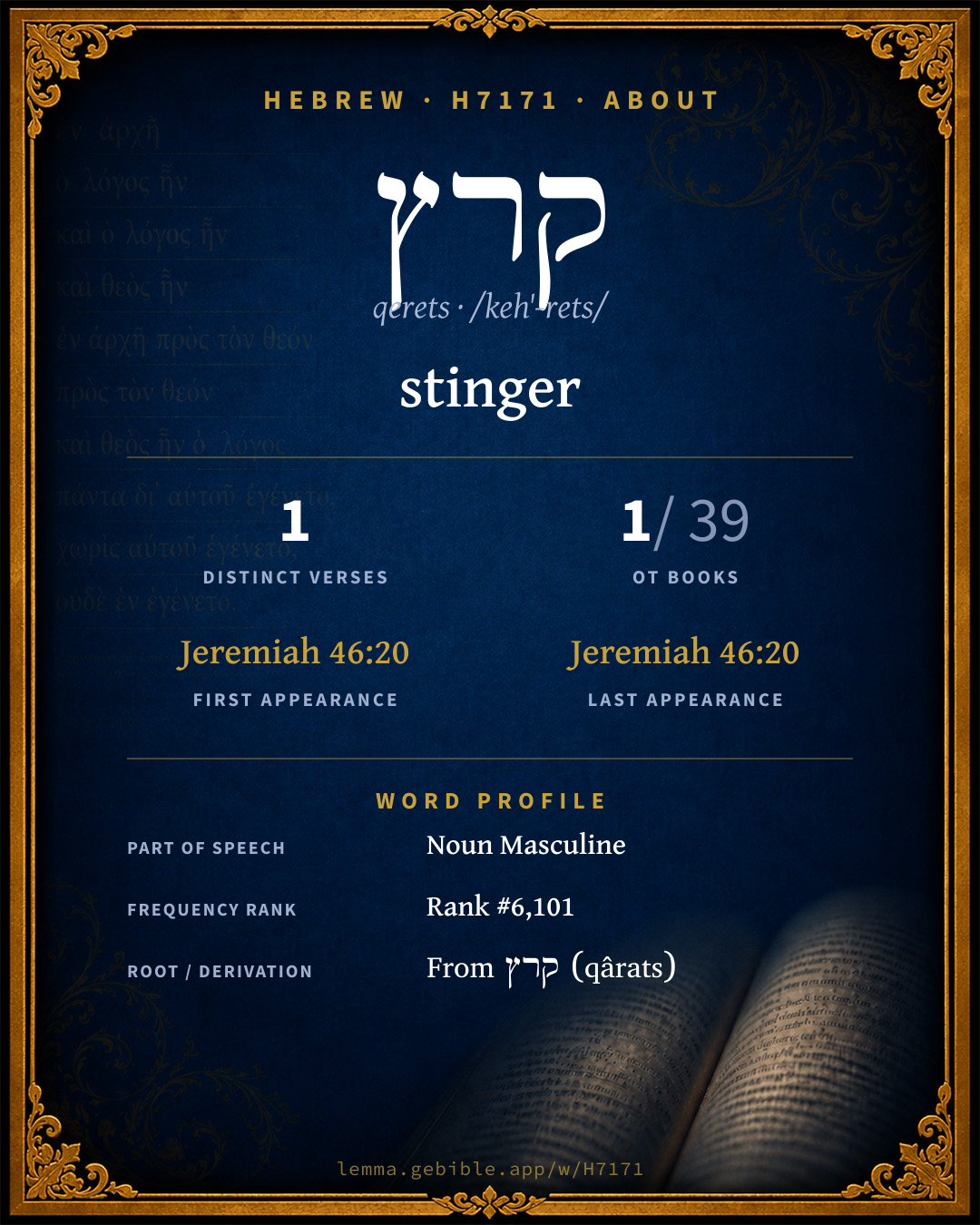
קֶ֫רֶץ
stinger
also: nipping, nipper fuller range ↓
Full lexicon entry — Brown-Driver-Briggs (BDB)
From Brown-Driver-Briggs (BDB)
Where this word appears
Grammar key — what these labels mean
Part of speech
- Noun
- A naming word — a person, place, thing, or idea.
Noun type
- Common
- A common noun — a general class of person, place, or thing (“king,” “city,” “water”), not a specific name.
State
- Absolute
- The independent form of a noun, not bound to a following word.
Gender
- Masculine
- Grammatically masculine.
Number
- Singular
- One.
Every verse where H7171 appears — 1 distinct verse across 1 book. Click any verse to open its interlinear word-by-word view. Verse text shown in the World English Bible for context — . Each verse’s Hebrew form is shown with its reference; the English is not keyword-highlighted, since the data carries no word-level English alignment. Use “Compare translations” on any verse to read it across multiple English versions. This concordance covers the Hebrew Bible; Septuagint (Greek Old Testament) occurrences are not indexed here.
Jeremiah 1 verse
About this entry
At a glance — auto-summarized from this page’s data, not written by a person. Every figure links to its source below. This summary describes the numbers; it doesn’t interpret them.
קרץ — transliterated qerets — is a Hebrew noun carrying the sense “stinger.” A scarce word — 1 verse in all of the Hebrew Bible. Its uses cluster heavily in Jeremiah (100% of all occurrences). Scripture uses it exactly once, at Jeremiah 46:20. BDB distinguishes 2 senses; alongside “stinger” it spans “nipping” and “nipper”. Each statement above links to its evidence; the full detail follows below.
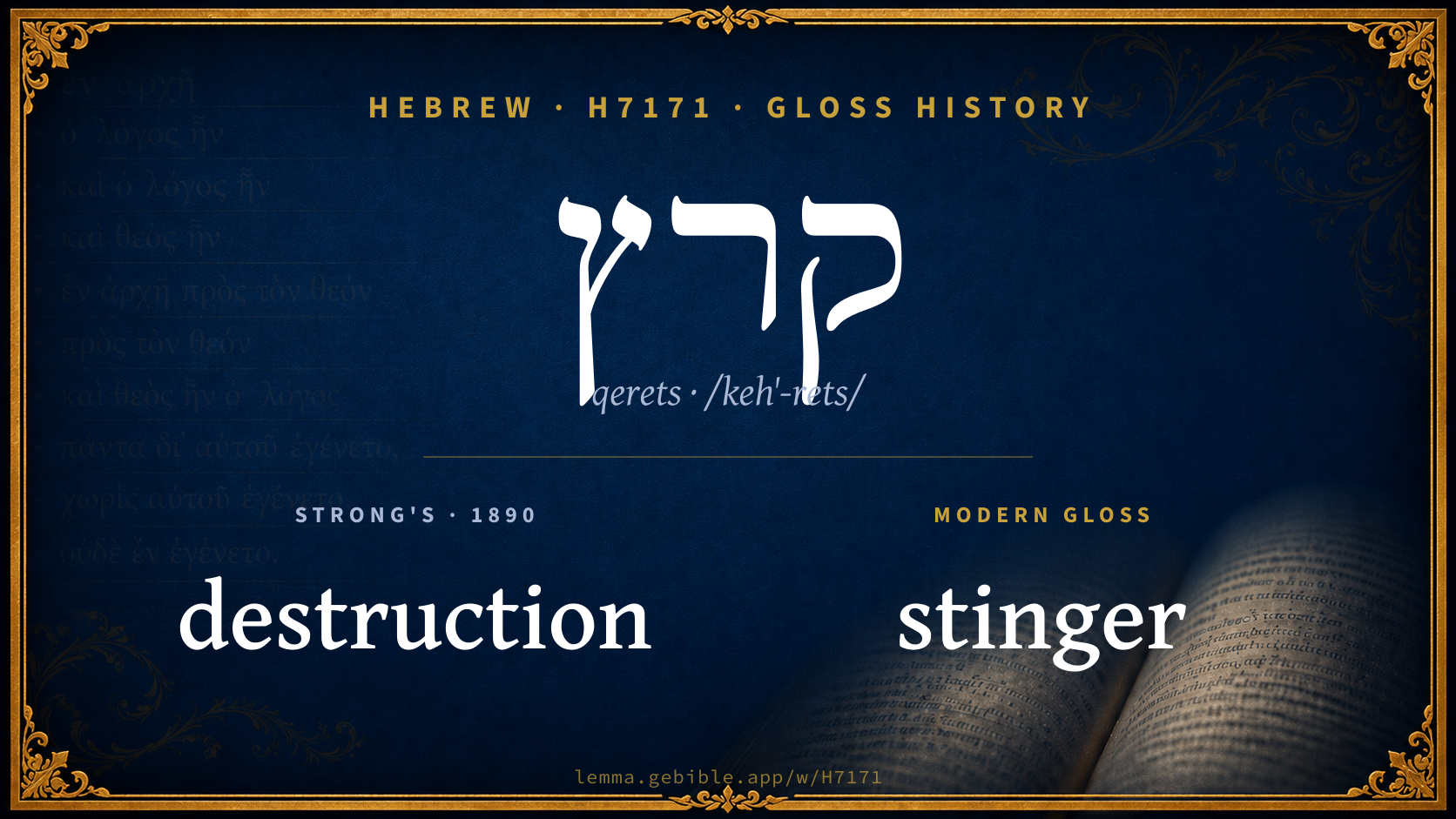
Gloss history
Strong's 1890 vs modern scholarship
About this word
Strong's H7171 catalogs a Hebrew word from the Hebrew Old Testament.
These counts are not copied from any lexicon or concordance. They are computed here, from the morphology-tagged Hebrew Old Testament. What Lemma adds →
- 1
- distinct verses
- The word appears in 1 distinct verse.
- 1 / 39
- OT books
- The word appears in 1 of 39 Old Testament books.
- #6,101
- by frequency
- Rank #6,101 (rank 6,101 of 8,640 Hebrew words by occurrence).
View all 1 occurrence in the concordance →
Most concentrated in
- Jeremiah 1 verse 100%
By section of the Old Testament
By traditional corpus
Conventional, traditional groupings — biblical authorship is debated, so this is a traditional corpus grouping, not an authorship claim. Each share is this word’s portion of its verses in that division of the Hebrew canon. Each figure is a share of the word’s 1 distinct verse.
- Prophets (Nevi'im) 1 verse · 100%
How translations render this word
Counts come from each version’s own published word-to-Strong’s tagging or interlinear alignment — an approximate guide to how each version renders this word, not a word-level alignment the data otherwise carries. Because each total is that version’s own tagged count, the per-version totals vary from one another and need not match the appearance or distinct-verse counts above. These counts may also differ from a printed concordance because Lemma counts each distinctly tagged rendering and does not collapse phrase taggings into a single head-word total. This is a fixed set of word-tagged versions (KJV, ASV, BSB, ULT) and does not change with the reading translation you choose elsewhere. Each version’s license is shown beside its name below (and on Sources).
- King James Version: Destruction 1×
- American Standard Version: Destruction 1×
- Berean Standard Bible: Gadfly 1×
King James Version Public Domain
Renders H7171 across 1 tagged occurrence — most commonly:
American Standard Version Public Domain
Renders H7171 across 1 tagged occurrence — most commonly:
Berean Standard Bible Public Domain
Renders H7171 across 1 tagged occurrence — most commonly:
Senses in BDB
The 2 senses BDB distinguishes for this word, in lexicon order (not ranked by frequency or importance). The full entry — with sub-senses — is in the Lexicon Entry tab.
- nipping, nipper, stinger
- nipping or stinging insect, gadfly
Word origin
n.m. dub. word, appar. nipping, concr. nipper usually interpr. (since Hi) of a nipping or stinging insect (cf. Aramaic קָרוֹצָא, Arabic قَارِصٌ biting insect); e.g. gadfly (cf. ThesAdd. 111), fig. of Nebuchadr. ק׳ מִצָּפוֹן בָּא Je 46:20 a gadfly cometh from the north; 𝔙 (Aq Symm) stimulator, i.e. קֹרֵץ; Thes al., more gen., excidium.
— Brown-Driver-Briggs (Oxford 1906, public domain), digitized via Sefaria, supplemented by the OpenScriptures HebrewLexicon (CC BY 4.0). See Sources.
Derived from קרץ (qârats) (H7169) — to pinch.
Jastrow Dictionary
A second Hebrew/Aramaic lexicon for comparison, covering Aramaic and post-biblical (Talmudic, Targumic, Midrashic) usage that the biblical-Hebrew BDB does not. Matched by lemma rather than by Strong’s number, so a lemma may carry more than one Jastrow headword (shown separately below), and the entries cover usage well beyond the Bible.
קָרַץ
- (b. h.)
- 1. to make an incision; to cut. Yoma III, 4 קְרָצוֹ ומרק וכ׳ he made the ritually required cut, and some one else finished &c., v. מָרַק. Ib. 32ᵇ מאי קרצו … לישנא וכ׳ what is meant by ḳ’ratso?… It has the meaning of slaying (by ref. to Jer. XLVI, 20); Y. ib. III, 40ᶜ top, v. נָכוֹסָא. Tosef. Ukts. II, 8 כיון שקרצו as soon as he has made an incision into it (although he did not cut it apart, v. Ukts. II, 5).—Esp. to cut dough on the baker’s board. Kel. XV, 2 אם … קוֹרֵץ עליו if he prepares it to cut dough on it; Tosef. Kel. B. Mets. V, 4; a. fr.—[Y. Pes. IV, 31ᵇ top מודיי שקורצין, read: שקוצרין.] e.g. Jeremiah 46:20
- 2. to bite, pinch. Nidd. VI, 12 כדי לִקְרוֹץ בצפורן a hair large enough to seize with the nails.
- 3. [to form a groove,] to press the lips close together; to gesticulate with closed lips. Mikv. VIII, 5 קָרְצָה שפתותיה if (in taking a ritual immersion) she pressed her lips together.—Yoma 19ᵇ הקורא … ולא יִקְרוֹץ בשפתותיו reading the Sh’mʿa one must not blink with one’s eyes, nor gesticulate with one’s lips &c. (make motions to his neighbor).
- same. Ib. הקורא … ומְקָרֵץ וכ׳ of him who reads the Shmʿa and blinks with his eyes and gesticulates with his lips and points with his fingers, the Scriptures say, ‘not me didst thou call &c.’ (Is. XLIII, 22); Yalk. Is. 318) וקוֹרֵץ. e.g. Isaiah 43:22
- to be nipped off. Peah VII, 4 אם נִקְרֶצֶת עם וכ׳ if it (the isolated bunch on the knee of a vine) can be nipped off as a cluster, it belongs to the owner (Ms. M. נקצרת, v. Rabb. D. S. a. l. note); Sifra K’dosh., Par. 1, ch. III (Var. נקצרת); Yalk. Lev. 605 נקצרת; Y. Peah VII, 20ᵃ bot. אני אומר את הנִקְרָצוֹת עם האשכולות (not עם) I mean those which have been nipped off in clusters; a. e.
קְרַץ I
- , to bite, pinch, sting. Erub. 65ᵃ אי קְרַצְתָּן כינה וכ׳ I could not study, if a vermin were to bite me.
קְרַץ II
- (denom. of קְרִיץ, קְרִיצְתָּא) to get up early, to do a thing early. Y. Ter. XI, end, 48ᵇ ע"י כן הוה שהר … הוה ק׳ through that (burning lamp) he was wakeful, and through that he arose early; Y. Sabb. II, 4ᵈ top. Y. Ab. Zar. V, 44ᵈ נִקְרוֹץ וכ׳, v. סְדַר. Ib. וק׳ ונפק ליה he got up early and went off. Lev. R. s. 25 אי קַרְצַת לא חשכת if thou hadst worked early (while young), thou wouldst not have to work late (in old age). Ib. קַרְצִית וחשכית (not קריצת) I did work early, and do work late. Lev. R. s. 32 ק׳ נוגש וכ׳ Ar. (ed. קדם), v. נָגַשׂ. Lam. R. to III, 7 לא הוה בר נש קָרֵיץ לתאיניא וכ׳ (not לתאינה) and none came in the morning to gather the figs earlier than they; Y. Maas. Sh. V, 56ᵃ top. Y. Kidd. III, 64ᵃ ק׳ זבונה וכ׳ the trader got up early &c., v. קְרַן; a. fr.
קֶרֶץ
- (קָרַץ) division, partition. Kel. VIII, 6 השאור … והק׳ וכ׳ the leaven and the reptile in it (in the vessel with two compartments), and the squeezed-in partition between them; [Hai Gaon: a piece of dough, v. מִקְרֶצֶת].—Pl. קְרָצִים, קְרָצִין. Tosef. B. Mets. IX, 19 פשתן עד שיעשנו ק׳ ed. Zuck. (oth. ed. קורצין) he that rents (on shares) a field on which to raise flax, must attend to it until he has made it into divisions (piles ready for division into shares).
קְרַץ III
- (קְרַץ I) biting, cutting, destruction; only in אכל ק׳ (mostly pl. קַרְצִין, קוּרְ׳) (v. אֲכַל I) to inform against. [Targ. Is. LVIII, 1 אכלי ק׳ Ar., read with ed. Koh. only אכלי, quoted to prove the meaning of אכל = קרא, v. כְּלֵי II.] Targ. Prov. XI, 13 קֻרְצָא ed. Wil. (Ms. קורצין). Ib. XX, 19. Targ. Lev. XIII, 16 (O. ed. Berl. קִירְצִין); a. fr.—Lam. R. to IV, 2 קַרְצְהוֹן, v. אֲכַל I; Gitt. 56ᵃ קורצא; a. fr.—Ab. d’R. N. ch. XVI (in Hebr. dict.) אוכילו קורצא אצל וכ׳ (?).
A Dictionary of the Targumim, the Talmud Babli and Yerushalmi, and the Midrashic Literature (Marcus Jastrow; London, Luzac, 1903) — Public Domain. Digitized via Sefaria. Digitized via Sefaria. Full attribution on Sources.
Same root — word family
Other BDB entries built from the same root as H7171, grouped by Strong’s listed origin. These share a root / origin per the lexicon — not necessarily a shared meaning. Each links to that word’s own entry.
Derives from
Derived from this word
Compare all same-root words → They share a root, not necessarily a meaning.